Long and short reads – a reading update for 2025

I consider myself ahead of the game on reading this year, having finished my 29th book of the year just the other day. It was Peter C. Newman’s “Caesars of the Wilderness”, the second volume of his three volume history of the Hudson’s Bay Company of Canada. As I’ve commented before, to read about the Hudson’s Bay Company is to read about Canada – although this volume ends with the effective end of the HBC’s tenure of the wilderness of North America, in the 1870’s. A third volume covers the modern history of Canada. One reads about brave men and women, one reads about heroes and drunkards, about martinets and missionaries, about visionary leaders and intransigent fools. Sometimes one finds that some of these different people are the same men. And I say “men” deliberately – only the womenfolk are consistent, not double-minded nor hypocritical. I can’t call the womenfolk and the native Americans “unsung” heroes, for Peter Newman deals with them as the important characters they are, but there are certainly still songs to sing, stories to tell, about their lives. The real hero of the book is the North American wilderness itself. One discovers interesting things along the way – part of the current border between the United States and Canada follows the original path trappers made through the wilderness between Lake Superior and the “Lake of the Woods”. There’s a part of the United States bordering Lake of the Woods, which is completely surrounded by Canada. The history and geopolitics of the Pacific coast of North America, the lands west of the Rockies – both north and south of the current border, might easily have been very different. There was and is nothing inevitable about the United States. It took me 124 days to read this book.

Another book that took me a long time to read this year was Stanislaw Lem’s “Fiasco”, which was recommended to me by the Economist. Stanislaw Lem was a Polish science-fiction writer. At one level his work is somewhat niche; but at another level, it is highly regarded and sought after. The George Clooney film “Solaris” is based on one of his stories. “Fiasco” is the story of what happens when humankind first encounters evidence of an intelligent alien species on a planet orbiting another star. It is a human story, with believable characters – the captain of a ship caught in a hard place and having to make terrible decisions; a Jesuit priest trying to mould ancient certainties to new realities; a man caught up and rescued at the moment of his death, finding himself unexpectedly playing a vital part. The story itself is perhaps an allegory of the old Cold War doctrine of “mutually assured destruction”. Only on the last page does the author reveal the utter alienness, the total strangeness, of the alien species – but by then of course, it is too late. It is a fiasco.

My third long read was also Eastern European fiction: Bulgarian writer Georgi Gospodinov has written a book called “Time Shelter”. It starts off all about “memory clinics” and safe places for persons suffering from senile dementia, but soon, the wider populace start to seek shelter in the past from the uncertainties and terrors of the modern era. Whole towns and countries embrace the past – particular decades or eras of lost greatness. Political parties form and reform, countries dissolve. Beautifully written, it began as a book that had much to say about managing memory loss and dementia, but ended as something much more disturbing. The stand-out phrase from the book is where a man arrived at a railway station in a central European town, “dressed as if he were a refugee from another time”.

The fourth would be Lord Moran’s biography of Churchill, “The Struggle for survival 1945-1960”. A very entertaining and informative insight into the post-1945 life of Churchill, from his summary ejection by the electorate in 1945, to his decline and fall into illness at the start of the 1960’s. Much may be learned about the 1950’s, about post-war England, about the politicians of the time. Oddly, not so much about Suez, the most important event of all those years. As that was the end of the Empire in effect, it is perhaps no surprise that neither Lord Moran nor Churchill would have been pleased to dwell on the matter. In the end, not so uplifting, but Churchill, as one of – perhaps the – central figure of 20th century history, is always worth studying.

Works I managed to get through rather more quickly, included Alison Weir’s “Lancaster and York”, readable historical account of the earlier part of the Wars of the Roses. On the fiction front I read Ursula Le Guin’s “Rocannon’s World” which was one of those books you finish, put down and gaze into the middle distance to think for a while –like a startling short story. Ursula Le Guin manages to create so much, as a story-teller, from so little. Two journeys, treks, or voyages of discovery at different times – one by a well-born young lady, the other, later, by the man Rocannon. A bildungsroman (building up story), as the Germans say, with a simple twist in the plot caused by the unforeseen effects of time dilation. I also read David Peace’s “The Damned United”. I’m not normally a football or a sport man. I’m certainly no fan of over-promoted cocky and arrogant men like Brian Clough, however able they might seem. You’d think a novel about such as he would not interest me. But I am from Derby: Brian Clough put Derby on the map when I was a boy, and I know people that were in the same class at school as his sons – he only lived a few miles from where I did. So, odd though it was, it was a worthwhile and exciting read.

Also I read Paul McAuley’s “Austral”, Gareth Powell’s “Embers of War” and John Christopher’s ancient “The world in winter”. I re-read a lot of Ian Fleming’s Bond stories. I read Nicholas Gould’s excellent little book on placenames, and Horatio Clare’s second work on seafarers “Icebreaker”. And that’s not all. But that’s all for now!

Reading in 2024

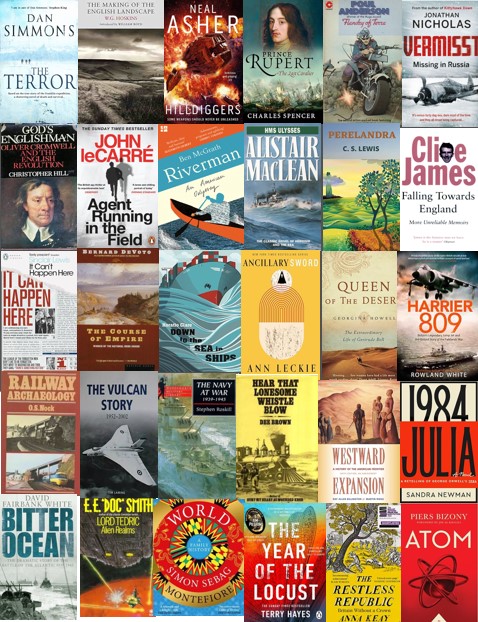
I have managed fifty books this year. That’s a result. Interestingly, the fiftieth book, Simon Sebag-Montefiore’s epic history of the world, took me more than a year – I started this work in December 2023. It was an excellent read, stretching my vocabulary in many respects. All the major swear words were present in plain text along with graphic sex and stomach-churning violence, but the “N word” was beyond him or his editors, which is an interesting comment on modern liberal social mores.

I started the year reading Dan Simmons’ gripping historical fantasy drama “The Terror” about the loss of the Franklin expedition in Arctic Canada. By complete contrast I very much enjoyed W.G Hoskins’s classic “The making of the English landscape”. I do tend to fall back on historical non-fiction, and a recommendation from earlier reading was Charles Spencer’s “The last Cavalier”, a biography of Charles I’s son Prince Rupert. This, in turn, led to something of a season of reading about 17th century England. I followed Prince Rupert in February with Christopher Hill’s biography of Cromwell – “God’s Englishman” and later, in December, by Anna Keay’s delightful “The Restless Republic”, which covered aspects of England in the republican years as seen through the lives of various protagonists. Fairfax the politician; John Bradshaw the lawyer; Marchamont Nedham the journalist; Lady Derby the royalist; Anna Trapnel the prophetess, amongst others. A brilliant and humane piece of work from which I learned much. Cromwell not quite the villain, nor the hero, he has been painted. Successive military coups, army juntas running the country…so much of our past is just not taught in school. At the time, George Monck, the general who engineered the return of King Charles II, wrote: “the army should serve the civilian government, not the reverse.” Amen!!

All of that reading on the 17th century, flowed from reading Peter Newman’s book on the Hudson’s Bay company, which in turn came from recommendations in Bernard de Voto, which in turn was recommended to me by Robert Kaplan. Recommendations are everything. Let your reading go where it will!

I read A. L Poole’s “From Domesday Book to Magna Carta”. Over months I worked my way through Geogina Howell’s biography of Gertrude Bell, the “Queen of the Desert”. My continued interest in American history saw me reading the final instalment of Bernard DeVoto’s masterly trilogy on the westward expansion in America: “The course of Empire”. Also, in that vein, Ray Allen Billington on “The Westward expansion in America”. Railways and America were combined in Dee Brown’s unsettling book on the displeasing and deeply venal American railroad barons, “Hear that lonesome whistle blow”. Also on railways I enjoyed the delightful and prolix O.S Nock on “Railway archaeology”. Very few people can write like that these days. I had a canter through the war at sea with David Fairbank-White’s “Bitter Ocean” and Roskill’s “The Navy at war: 1939-1945”. In that context I also re-read Alistair Maclean’s “HMS Ulysses”, and then I lent a copy of it to a close friend. A book perhaps to save for a time when your mental health is at it’s best. Not for the faint-hearted.  

I did some re-reading – it is always good to go over old ground. Old ground like Keith Laumer’s short stories, which I first read as a schoolboy in the mid 1970’s. One of them is “Special placement test” about the guy who can’t get a job in a massively overpopulated future America, and is faced with submitting himself for a lobotomy. How does he escape? It would make a great film. Or Frank Herbert’s “Hellstrom’s Hive” for which I would love to write a sequel. Also, in light of the new Dune films, I re-read “Dune” and “Dune Messiah”.

I started reading some of Neal Asher’s space operas, getting through three or four of them, but laid off them as they were quite hard on my mental health, being full of quite astonishing levels of violence and nastiness. I read – and this was a good deal more positive – Ursula K. Le Guin’s “The winds Twelve Quarters” and “The Compass Rose”, more encouraging and uplifting space opera set in her “Hainish” universe. Equally uplifting was Anne Leckie’s “Ancillary Sword” although the latter’s refusal to use male pronouns confused me somewhat. I suppose the point is, it doesn’t matter if you’re male or female. Except it does… Other sci-fi included work by Ken Macleod and Alistair Reynolds, and vintage pulp fiction by Poul Anderson (“Flandry of Terra” – “Bond, James Bond” out amongst the stars, written about the same time as Fleming was writing the 007 tales) and E.E Smith (“Lord Tedric: Alien Realms” – pure pulp read in less than a day). I re-read C.S Lewis’ epic “Perelandra”, something I try to do every few years. This retelling of the legend of the Fall, the story of the unfallen planet Venus threatened by evil – but delivered by the actions of one brave person – never fails to grip me. I found time for an “omnibus” trip to Darrowby, with James Herriot – leading my wife into a season of reading him as well. “Agent running in the field” and “A Legacy of spies” were my fix of John le Carre’s work for this year. Must have read most of his stuff by now? Also, Jonathan Nicholas’ “Vermisst” about a German WWII aviator lost in the Soviet Union. Also, two technical books on the Vulcan bomber, and a book by Raymond White on the use of Harriers in the Falklands War.

An outstanding read was Sandra Newman’s “Julia”, being the story of Winston Smith’s eponymous lover in Orwell’s 1984. Very graphic and quite violent in places, she manages to fill in some interesting social detail that would have quite eluded a man like George Orwell. Also, towards the end, she conveys some of the hope that is entirely absent in 1984. I gave the book to my daughter and sent a copy to one of my sisters, so impressed was I. In the context of dystopia I also read Sinclair Lewis’ “It can’t happen here”, a story of America under a dictatorship, written decades before Orwell wrote 1984, and eerily prophetic…I will say no more.

I enjoyed Ben McGrath’s very humane “Riverman”, an account of travels by canoe through the great rivers and backwaters of the continental United States – not really about rivers, but about people. Also about people but not really about ships or the sea, was Horatio Clare’s “Down to the sea in ships”. A man whose writing I love, but who I find can get a bit pompous, is Clive James. I read another of his now quite hard to find memoirs, “Falling towards England”. I can cope with someone with such a high opinion of himself as Clive James, only in small doses. I also read a couple of books on cosmology I’d been recommended to: Brian Clegg’s “The Quantum Age” and Piers Bizony’s “Atom”.

There’s more! The untimely death of Michael Mosley saw me reading my wife’s copy of his “Just one thing” – leading to a few small but positive changes to my lifestyle, which of course is all he would have wanted. Terry Haye, a respected screenwriter, wrote “I am Pilgrim”. His second book “The year of the locust” was not quite as good, and had an odd sci-fi component in the middle, but was eminently readable. I read Christopher Tolkien’s expansion of his late father’s mythos with “The fall of Gondolin”. I confess that the three or so different versions of this story now available do lead me to getting a little confused. Gondolin was a legendary city in Tolkien’s Middle Earth. The beautiful White City of Gondor, as seen in The Lord of the Rings, is held up as a pale reflection of Gondolin’s beauty. As with all of Tolkien, and indeed this is true to a degree of all great writing, the epic tale of the city’s fall is both just story, and yet also a profound lesson for all our lives.

Reading in 2023

This year we’ve been a little busier, perhaps. “The judges’s scores are in”, as they say on Strictly; I have read fewer books in 2023 than I did in 2022. At the start of this year I was reading two books. One was Nick Hayes’ excellent and inspiring “The Book of Trespass”, an ostensibly scurrilous and subversive work about the countryside and how much if it is not accessible because of the draconian property laws in England. The fact that it is in print at all, and was widely and positively reviewed by various national newspapers representing the Establishment (whatever you conceive that to be) indicates that it is perhaps not quite as subversive as some readers might like to think. The other was “Life in the Far West” by G. F Ruxton. I am a student of the westward expansion of Europeans into the north American continent, and this book is a 19th century travelogue of an Englishman who travelled extensively in the lands that became the western United States.

My wife bought me a copy of W. Heaton Cooper’s “Lakeland Portraits”, completing my set of W. Heaton Cooper’s books. I love his paintings. His writing is delightful, spare and concise, as it must be from someone brought up in more spacious times than ours. There was a time when learning to write good English still mattered in schools. I’m no conservative when I say that that time is long past. To be fair this is not the best of his books – for that I’d look at “The Tarns of Lakeland”.

As noted elsewhere on this blog – reviewed here – I found Alexander Maitland’s “The Life of Wilfred Thesiger” very readable in February. At this point my wife and I moved to the edge of the Peak District. Visiting the local library saw me reading Mark Patterson’s “Roman Derbyshire”, Catherine James “Derbyshire – where writers walked” and Stephen Bailey’s excellent “The old roads of Derbyshire”. Local knowledge – every time. I followed these with Lewis Dartnell’s “Origins” about the origin of humankind, and Ryzard Kapucinsky’s work about travels in Africa, “The Shadow of the sun”. Very entertaining. Of Addis Ababa, he writes, “Bullets were the most valuable commodity in that market place, even more valuable than dollars.” He writes about the fundamental differences in the understanding of time, between Africans and westerners. Years ago working in Nigeria, someone once told me “there is no word in any Nigerian language that conveys the urgency of the Spanish word “Manana“... I also read Kapucinsky’s “The Emperor”, a very informative and warts-and-all account of the reign and fall of the otherwise pretty much untouchable Haile Selassie. Everyone has feet of clay, particularly despots and military dictators.

I had a bumper year indulging my interest in the history of the westward expansion of the United States. I started with two works on the Lewis and Clark Expedition. Bernard de Voto’s eponymous history of that trip, and “These tremendous mountains” by David Freeman Hawke. I went on to read “Wondrous times on the frontier” by Dee Brown, which covered aspects of social history overlooked elsewhere – saloons and bars, what people wore, what they had for supper etc. Later on in the year I read the second book of Bernard de Voto’s three-part series on the westward expansion, “Across the wide Missouri”. This deals solely with the fur trade, with beaver trappers – the “mountain men” of legend. Also I found time for biographies of Kit Carson – “Kit Carson: A Pattern for Heroes” by Thelma Guild and Harvey Lewis Carter, and “Daniel Boone: The Long Hunter” by Lawrence Elliot. Finally, Alan Taylor’s “American Colonies”, another book that is part of a well-received trilogy of historical textbooks.

Janusz Bardach’s “Man is wolf to man”, recommended by Jacek Hugo-Bader, was quite a difficult read. Well written – just rather hard on the mental health to read of such terrible goings on. Another book difficult for similar reasons was my first Neal Asher sci-fi novel, “The voyage of the Sable Keech”. Asher is a prolific science-fiction writer and this work has immortals, viruses, some very dangerous animals, and is full of violence. Nearly as violent as Richard Morgan’s “Altered Carbon” trilogy about Takeshi Kovacs, and that’s saying something! I found Neal Asher’s crab-like aliens, the Prador, with their taste for eating living humans, particularly unpleasant. 

I read an obscure work called “Earthbound Astronauts” by Beirne Lay Jr. This was a singing of the praises of all the engineers, scientists and so forth that helped to build the Saturn V rocket that put man on the moon in 1969. Max Hastings’ account of Operation “Overlord – the story of the Normandy landings” came in August. I review elsewhere Peter C. Newman’s book “The company of Adventurers”, being the early history of the Hudson’s Bay Company (still extant in Canada today as a minor department store chain) from even before its inception, through, if not to the present, then certainly well into the late 19th century.

Then there was a clump of railway reading – the every delightful prose of O.S Nock (see above on the writers of old having such delicacy and skill in written English) firstly “British Locomotives of the 20th C, volume 3” and secondly, a really good historical read, “Steam Locomotive”. This book highlights the fact that we’ve had trains in the UK for nearly two hundred years. Christian Woolmar, a worthy successor to O.S Nock in my view, wrote “Broken rails” about how and why the privatisation of British Rail under the Major government was such a disaster. His work on the London underground, “The subterranean railway”, was also instructive. In all that reading one became aware that the heyday of the railway in Britain was not “before Beeching”, but before the Great War – the railways were at the best in Edwardian England and have been in decline ever since. Other rail-related reading included several of Brian Radford’s works including “Midland through the Peak”.

Stephen Alford’s “The Watchers” about spying in Elizabethan England, went down well, as did Monty Don’s autobiography “Down to earth”. John Lydon’s “Anger is an energy” is reviewed here.

Fiction? I also found time for some re-reads; Heinlein’s “Glory Road” – always a pleasure, Richard Morgan’s violent “Broken Angels”, my very favourite book, Tolkien’s “The Silmarillion”, and Iain M. Banks’ “Surface Detail”. New reading included Le Carre’s “Silverview”, Erin Morgenstern’s “The Starless Sea” and Adrian Tchaikovsky’s “Children of ruin” – all mentioned here. I read my friend Mrs Ruth D’Alessandro’s second very engaging historical police procedural “Calling Detective Crockford”, being a fictionalised account of her mother’s work as the the first female detective in Berkshire. Amor Towles’ top work on the aristocrat in the hotel in Moscow – “A gentleman in Moscow” – is reviewed here.

Also amongst that lot, a short and informative popular science book on graphene, “The graphene revolution” by Brian Clegg. A textbook “Do safety differently” on human and organisational performance (a new way forward in safety) by gurus Sidney Dekker and Todd Conklin. I finished the year with Peter Fleming’s rather weak and largely cribbed account of the never-was Operation Sealion, the German invasion of England in 1940. His other writing is excellent: this is is poor and though interesting and informative in places, it is not his best work.

Fifty-one in 22 – reading this year

At the start of 2022 I was reading a dense tome called “Railroaded – transcontinentals and the making of modern America” which was all about the development of the railroads, the growth of monopoly capitalism, and the effect this has had on American culture. I had to skip whole chapters; it was fascinating – but alas, rather intermittently and unreliably so. I was at the same time re-acquainting myself with the pulp science-fiction of Philip Jose Farmer (his “World of Tiers” series), and Sven Hassel’s “Monte Cassino“, a story of the second world war in Italy as seen from the German perspective.

In January I read Simon Sebag Montefiore’s historical novel “Red Sky at noon” about – cough – war in the Ukraine. Reviewed here. His novel opened “The red earth was already baking and the sun was just rising when they mounted their horses and rode across the grasslands towards a horizon that was on fire“. What an opening! I read Tim Marshall’s “The Power of Geography“, a weaker book, perhaps than his earlier outstanding “Prisoners of Geography”.

In February I finished another historical tome, Ray Allen Billington’s “Westward Expansion – a history of the American frontier”, which I’d recommend to anyone interested in this topic, an abiding fascination of mine. This book covers the whole, from the early Spanish incursions to the closing of the frontier at the end of the nineteenth century. Also in February I found time to read William Gibson’s “Agency” – one of his stories involving computer-generated “stubs” of a somehow alternate past rather like the recently filmed “The Peripheral” which I read years ago and am watching now.

In March I found myself enjoying John Julius Norwich’s history of “France” (how many of us in England know anything other than the very basic facts about that country?) and also military historian John Keegan’s “History of warfare“. I was then a little ambivalent about the highly recommended “Humankind – a hopeful history” by the Dutch philosopher Rutger Bregman. Very readable and informative but not a book whose conclusions I could whole-heartedly agree with – a bit like the work of Yuval Noah Harari in this respect. It’s not all about nodding sagely in agreement, nor all putting the book down in frowning consternation.

A short interlude in May saw me reading a book called “How steam locomotives really work“. I’ve still got that one – not given it away. It’s a gem in that it conveys an understanding of a very complex and difficult technical subject without resorting to advanced mathematics. In May I read the first novel of a friend of ours, Mrs Ruth D’Alessandro’s “Calling WPC Crockford“, an engaging memoir of rural policing in the 1950’s. We eagerly await both a sequel and watchable early Sunday evening TV adaptions thereof. Keith Robert’s “Pavane” – reviewed here – I had never heard of, despite its publication as an “SF Masterwork”. I thought I know my SF – but perhaps not? A pavane is a kind of Latin dance. This Pavane is a remarkable alternative history, a work of writing craftsmanship, a finely shaped bow or arc of story from beginning to end.

In June I read another sci-fi classic, Doris Lessing’s “Shikasta“. Shikasta is our earth, as seen from the viewpoint of those who try to settle it from afar. Like much great work by her and other female science-fiction writers such as Ursula le Guin, there are much deeper ideas at play here: this is not guns and heroes space-opera. A key idea explored in Shikasta is the importance of collectivism and community. At the far extremity of her argument in this direction, we see the idea that individualism itself could actually be a form of mental illness. You may be sure I don’t agree with that.

I was Between East and West – that is, touring in Eastern Europe – with Anne Applebaum, and then, I travelled from Portugal to India with Roger Crowley for an eye-opening account of “how Portugal forged the first global empire”. Remarkable to read what happened when men from Portugal – a primitive and feudal middle-ages culture – arrived at length in the Indian Ocean. They entered a sea of traders, free markets, and if by no means a democracy, then certainly, a functioning multi-cultural melting pot. The Portuguese, possessed as they were of vastly superior military technology but a much weaker moral and cultural understanding, swept the lot away and as good as destroyed everything they touched. There is a lesson there for us all.

Christopher Hibbert has published a life of Admiral Lord “Nelson – a personal history“. Nelson was a flawed man and not quite the untouchable English hero we see on the plinth in Trafalgar Square. I read the journal of Osborne Russell, a nineteenth century trapper: “nine years in the Rocky mountains“. I waded through Frank Snepp’s “Decent Interval“, about the Vietnam War. Upsetting. It put me in mind of a character created by the writer Richard Morgan who said “Anyone who still loves his country just hasn’t read enough history books yet”. Never a truer word wrote in fiction…

As summer turned to Autumn I had another good read on an upsetting and blood-soaked topic, “Partition” by Barney Spunner-White. This came about following a re-read of Kipling’s “Kim” and then a canter through Kipling’s short autobiography “Something of myself“. From upsetting and blood-soaked, to the engaging writing of Andrew Marr’s “The making of modern Britain”. Then, back to Norman times for “The White Ship” by Charles Spencer, being a history of pre-Plantagenet England, based loosely around the foundering of the aforementioned ship at Barfleur in 1120. Only two people survived. The king’s son and heir to the throne, William the Conqueror’s grandson, was drowned. This tragedy precipitated decades of bitter and bloody civil war.

Becky Chambers’ gentle and uplifting “social” science fiction “A closed and common orbit” tells the story of a woman – herself rescued from destruction as a child – who befriends and helps another woman. With Becky Chambers work it’s all in the emotional back-story: two plots move towards one another, only combining in the final pages. M John Harrison provided “You should come with me now“, being a collection of rather odd but compelling short stories about ghosts. Deeply strange, and rather reminiscent of the work of China Mieville. In the autumn, I re-engaged with the local library after many years away, and I borrowed and read “Thin Air” by Richard Morgan. You’ve read one Richard Morgan sci-fi/detective novel, you’ve read ’em all… Unremitting, gory violence. A bad tempered and ill-mannered former enforcer hero. Market forces gone mad. Explicit sex. All the usual Morgan tropes. Somehow unputdownable. More? Yes: Adam Robert’s “Bete” – another bad-tempered and irascible hero in a world where animals can talk – and do. Also, Sylvain Nouvel’s “Sleeping Giants“, a novel in the form of a series of interviews with a never-named representative of a shadowy and all-powerful government agency.

Moving back to non-fiction to finish, Jorge Cham wrote “We have no idea“, being a jocular, cartoony, sub-Bill Bryson account of how little science the human race actually knows. Refreshing reading, as I finished the year with Steven Weinberg’s (again highly recommended) “The first three minutes” about the birth of the universe. I thought it would be good; though he had a few good phrases, overall I was disappointed. I suppose cosmology IS complicated – see my comments above about advanced mathematics. I read Christian Woolmar’s “Cathedrals of Steam” about London’s great railway termini, which was a great account though it dwell on how things might have been better organised. I found Theodore Dalrymple’s anecdotes from the under-class (“Life at the bottom“) the more depressing for it being over twenty years old and knowing that little if anything has improved in that time.

Fifty-one books. Around a fifth of them, were re-reading. Only two-thirds I read in paper copy – the rest were on a Kindle. This year, a little over half of my reading was pure fiction. I re-read some old favourites: “The Lord of the Rings“, Heinlein’s “The cat who walks through walls“, and Stephen Baxter’s “Moonseed” and “Ark” to mention a handful. I finish the year deep in Nick Hayes’ “The Book of Trespass” which is troubling but exciting reading.

Mortal engines

A review of “Mortal engines” by Philip Reeve

This is a short review of the film of Philip Reeve’s boys’ story, “Mortal Engines” which I watched on a flight, back before the lock-down, some three years ago.

I have gone full circle in terms of fiction. Eleven years ago I read my son’s copy of “Mortal Engines” whilst on a long-haul flight. I am just now sitting through the film version of the same story, also whilst on-board a long-haul flight. And to be perfectly honest the film is as weak and as thin as the original boys’ story. The original story was for children and I – as well I might as an adult – found it too thin. This film, however, is in effect not for children but for all (PG cert) and I found the same lack of conviction that I found in the original book, though perhaps for quite different reasons. The book and the series to which it belongs were successful in their time, doubly so really, in that Hollywood bought the options to make it into a film.

As a film, I found it cliched. It was a triumph of special effects over plot, as so many sci-fi films are these days. I confess I’m not a fan of Hugo Weaving’s work and he plays the baddie in this film. I did like his role as Agent Smith in The Matrix, but not his Elrond in The Lord of the Rings. As a fan of the LOTR I’m familiar with Elrond as a character and I didn’t like at all the way he played Elrond: not at all like the character in the book. Here in Mortal Engines, he plays the Bearded Sultry Older Man. There is a beautiful daughter, a geeky hero and a second male lead with a strong Irish accent. It was quite literally tiresome to watch.

It would be interesting to see who wrote the screenplay for the adaption of Philip Reeves’ original novel. I had to give up watching, about a half hour from the end. It was so predictable and conventional I literally could not be bothered to watch it. Yet, along the way, amidst all the usual adventure thriller science-fiction memes and tropes, were some very interesting nuggets. This told me something about the screenwriters, hence my earlier comments. I’ve spent some time studying the Bible, and an aspect of doing so is what is called “redaction criticism”. Today we think of “redaction” as removing text from a document for whatever reason. But “redaction criticism” is trying to understand the use by biblical authors, of earlier written material. Take an example from the “Lord of the Rings”: recall the character Aragorn. Do we know if Tolkien, in his youth, read “The last of the Mohicans”? For Tolkien’s character Aragorn so closely resembles Fennimore Cooper’s character “Hawkeye” that it seems likely that Tolkien would have, and may have been influenced thereby. There is no way of knowing, of course. This then, is redaction criticism. And my senses are alert to it here: what influences were there on the screenwriters for this picture? It matters to me.

The first was the Shrike. Where does this immortal android zombie come from? Does he appear in the original books? I cannot now recall. I ask this because “the Shrike” is a strange and shadowy character in Dan Simmons’s Endymion in his very readable Hyperion novels. A dread figure, often invoked, rarely seen, much feared. Could Simmons’s work have influenced the screenwriters here? The Shrike in this Mortal Engines film excites some sympathy; there is, deep within it, some deeply buried kernel of humanity, some taste-bomb of humaneness that emerges to save the life of the young hero.

The second was the use of the term “shield wall” – towards which the travelling city of London is making its way. The term “Shield wall” originates in Frank Herbert’s “Dune”. An interesting juxtaposition, particularly when we see that this “Shield Wall” is actually located in the heart of central Asia, in what is now the Tien Shan of China.

Then, we have the environmentalist trope. I got the distinct sense that these marauding, raiding rolling cities, using up resources, harming the environment, represent the west, whereas the fixed buildings hidden behind the shield wall, are the east – the home of the “anti-tractionists”. They are portrayed as somehow better, and somehow inherently eastern. It is all a bit naïve and simplistic, and it can be, for it can easily be passed off as being for children, or being “just” science-fiction. But actually it’s quite cleverly crafted cultural spin and I don’t care for it as such.

The year of the lockdown – in books

I’ve read more books in 2020 than I have read for many years. You might think that NOT commuting means I have less time for reading, but the data clearly do not bear that out. I have finished 57 books during the year. Three of them I started during 2019. As of Boxing Day I am still reading five or six books and will not finish any of them in the year.

Of the 57, 16 were re-reads. 43 books I read in physical copy, the remainder on a Kindle.

Emily St John Mandel’s account of a young actress caught up in an apocalyptic plague – “Station Eleven” – was my first of the year, followed quickly by Adrian Tchaikovsky’s “Dogs of War”, which was about a world in which bio-engineered war-animals rebel against their corporate masters. The “collected intelligence” of a swarm of artificial bees was of particular interest in that story. Later in the year I read another high-concept novel about war, Adam Robert’s “New Model Army”, which is unusual and shocking in having descriptions of front-line warfare ravaging modern urban Britain – fighter aircraft strafing Guildford town centre, kind of thing. Some very thought-provoking ideas about direct on-line democracy there, too. Continuing the sci-fi line, I read Stephen Baxter’s “The Massacre of mankind”, being a sequel to H.G Well’s “War of the worlds”. My daughter recommended Margaret Attwood’s very readable apocalypse “Oryx and Crake”, which I perhaps oughtn’t have read during the fevered atmosphere of the first lockdown. I finally got around to reading Chinese author’s Cixin Liu’s “The three body problem”, which I didn’t find as exciting or as innovative as his earlier short stories. Of course I’m aware of the controversy relating to his views on who controls parts of central Asia, which we’ve become aware of since filming of this book was proposed. I was challenged – having had it on the shelf for years – by Ursula Le Guin’s “The left hand of darkness”. I read three Frank Herbert novels. “The dragon in the sea”, “Hellstroms Hive”, and “Dune”. A master story-teller, he. Apart from re-reading a few Heinleins (and Vernor Vinge’s startling “A fire upon the deep”), the final great sci-fi novel of the year was Robert Forward’s startling “Dragons Egg”, featuring a race of people living on a neutron star, and what happens when they encounter humankind.
Big hitters for me this year in the non-fiction space were Austin Kleon (“Steal like an artist” and “Show your work”). Kleon has written a series of short, entertaining books that encourage creativity. I’ve read American journalist Robert Kaplan. I started with his “To the ends of the earth” and “Eastwards to Tartary” and his very instructive book about the middle east, “The Arabists”. Staying in the middle east, I finally sourced a copy of Michael Elkins’ “Forged in fury”, about the creation of the State of Israel. Not a work I’d recommend to anti-zionists. I re-read Tristam Hunt on the English Civil War, I read Beevor on the Ardennes offensive. I read the engaging Andrew Marr on the history of Britain, and finished John Keay’s long and complex account of the history of China. I got through Yuval Noah Harari’s “21 questions for the 21st century” though it took me nearly a full year, and I read an inspiring account of Captain Cook’s life by my namesake Richard Hough. Anthony Beevor tells us, in his account of the Battle of the Bulge, about a certain Sergeant Salinger, who managed to write short stories whilst in the winter trenches in the Ardennes – this was before his big break with “The Catcher in the Rye”.
I re-read Tom Bingham on the Rule of Law, re-read HMS Ulysses, and read a life of Rasputin by Alex de Jonge. Remaining on the Russian side, I read P.S Nazaroff’s “Hunted through central Asia”, and Mikhail Bulgakov’s “The life of a dog”, an anti-soviet allegory whose writing – though not it’s publication – pre-dates “Animal Farm” by 20 years. The Soviets forbade it’s publication; this short and little known work did not appear until the 1960’s.
I’m still reading the official TED guide to public speaking as the year ends. I’m reading Gustav Herling’s GULAG memoir “A world apart”, Sashi Tharoor’s somewhat bitter and twisted “Inglorious empire”, and Muhammed Asaf’s “The road to Mecca”.
Reading should be a pleasure; it should be a distraction. It should entertain and it should inform. One might fall back on old favourites in times of stress. One might also, when feeling strong, test oneself with harder, more challenging material. I leave you with John Martin’s “A raid over Berlin”, an uplifting account of an RAF bomber command flyer’s time as a POW in WWII. Happy new year!

Reflections on a decade of reading

To early morning prayers on the first Saturday of this new month, this year, this new decade: outside, squirrels and magpies go about their winter business. As the day dawns, the exquisite light cheapens and becomes more banal, less delicate.

And now a look back at some of my reading over the last ten years. I have – at least according to my own records – read 491 books. Of those books, 349 I read for the first time: the rest, were books I have read before, sometimes once, sometimes more often. Tolkien’s “The Silmarillion” and C.S Lewis’ “Mere Christianity” top the re-read list, followed closely by Tolkien’s “The Children of Hurin” and R.A Heinlein’s “The cat who walks through walls” and “Friday”. Did I re-read any non-fiction? Why yes! I read twice these last ten years, Sebastian Junger’s “War” and Jon E. Lewis’s “The Making of the American West“. Also, Anthony Beevor’s account of the Spanish Civil War, and N.A.M Roger’s history of the Royal Navy, “The Safeguard of the Sea“.

I read two books called “On writing” – one – most excellent work – by Stephen King; the other, by George Orwell. I’ve read every one of Alan Furst’s dozen delicately written European spy novels set generally at the outbreak of World War II.

Alex Scarrow’s “Last light” was an apocalypse based around the end of electricity – how thin is the barrier that keeps the rule of law in place? How quickly could a person – or a society – somehow stumble through that barrier, and find themselves trampled to death by the Four Horsemen of the Apocalypse coming at a fast gallop in the other direction? In Scarrow’s book – about 48 hours. The Prime Minister fumbles a vital question in a press conference on a Monday morning. Wednesday afternoon, a policeman is shot dead at a motorway roadblock – and so the die-back begins. It was reminiscent of Nevil Shute’s propaganda piece “What happened to the Corbetts“, which was a fictional account written in the late 1930’s, of the bombing and destruction of the city of Southampton by an unknown enemy.

I had a re-read of Antony Beever’s masterful account of the Spanish Civil War – a book I enjoy reading, as he deals very lightly with the grey areas, the nuance and complexity of that conflict. I read a paper copy of the collected short stories of Arthur C. Clarke – always a pleasure to re-read the story of the Master, or the story of Grant and McNeil marooned on their freighter between Earth and Venus – with only enough air for one. I read and re-read Bill Bryson’s book “Mother tongue” about our great language. I was particularly impressed with “The man who went into the west“, being a biography of that sublime and yet oddly disquieting English poet, R.S Thomas. A clergyman who hid from his parishioners, a most peculiar and perhaps unlovable man, and yet, what poetry:

 The priest would come
and pull on the hoarse bell nobody
heard, and enter that place
of darkness, sour with the mould
of the years. And the spider would run
from the chalice, and the wine lie
there for a time, cold and unwanted
by all but he, while the candles
guttered as the wind picked
at the roof.

I read a number of China Mieville novels, and was most impressed by “Embassytown“, a story where the human ambassadors to a race of beings who speak with two mouths, have to be telepathic identical twins trained from birth. A very strange story – but fundamentally, all about language and communication. I read a couple of the memoirs of the late Clive James – what a writer, what a great guy. There are and have been few role models in my life, but God knows I’d regard him as one. Inspiring to me because he came from nothing. In “Unreliable memoirs” he writes of small boys throwing stones at an old lady, and compares it with Kristallnacht, noting that “the difference between mischief and murder is no greater than the law allows“.

I went through a Dennis Wheatley phase, once his material became available on Kindle, and relived some of the stories I first read in my early twenties. Evan Connell’s “Son of the morning star” was a biography of General Custer – and hence, of the development of the American west. That is a particular historical interest of mine. F.A Hayek wrote “The Road to serfdom” – a destruction of the errors of socialism – and perhaps the most influential book I’ve read this last ten years. Though oddly, it did not stand up (or has not yet done so) to re-reading.

I went through a Bond period and re-read much of Fleming’s original 007 stories. Great, spare writing. I also read a good few of Iain Banks space-opera novels, and also his de facto autobiography called “Raw Spirit” which I found encouraging. I read some of Keith Laumer’s science fiction stories, and Lord Moran’s excellent “The anatomy of courage” which every single one of us ought read. I read the journal of the Lewis and Clark expedition- that was long and tedious in places, but rivetting and exciting in others. Neal Stephenson’s work was a blessing to me – particularly “Cryptonomicon” and “The System of the World“. Nevil Shute’s “In the wet” I’d also highly recommend. I’ve mentioned elsewhere the radical and strange voting system he proposes in that story.

Who else is there to mention? Kipling, perhaps. I went through a Kipling phase after one of my daughters spent time at Simla, and later, lived for a year or so near New Delhi. “Plain tales from the hills” demonstrates that astute observer of the human condition in his best form. “Kim” I would put on the list of books everyone ought to read. Two interesting things about Kipling’s “Kim”: 1) it is available extensively in translation throughout India – but it is not available in Urdu and hence not available at all in Pakistan – where much of the story is set. I leave the reader to draw his or her own conclusions about that. 2) It is not so much the startng point of the Scout movement – that would be B.P’s “Scouting for Boys” – as the grandfather or underlying source material for Scouting. You want to understand what Scouting is about? Read “Kim”.

We may add the former astronaut Stephen Baxter. Whilst no crackerjack conspiracy theorist, he suggests that NASA exists not to faciliate human space flight but to prevent it – we could have gone to Mars in the 1980’s. I recommend “Flood” and “Ark” and especially “Moonseed” with a character whose immortal line is – after Arthur’s Seat becomes once again an active volcano – “Edinburgh is Olympus Mons now”. Also the learned Doctor Theodore Dalrymple. Never less than a pleasure – such works as “The politics and culture of decline” and “The Wilder shores of Marx”.

Tom Bingham wrote “The rule of law”, a helpful book on a vital concept. It is a book I bought and read after an oddly encouraging visit to Parliament which my wife and I won in a raffle. Up for re-reading in these interesting times, is that one. The leather-faced explorer the late Wilfred Thesiger was one of a series of Arabist explorers of the last 150 years. He was effectively guilty of opening the flood gates and allowing the desecration by oil companies of the Rubal Khali or Empty Quarter of Arabia. But he writes wonderfully of the (now doubtless long-vanished) desert Bedu. Read his autobiography “My life and travels“. Read “Arabian Sands“.

Much that perhaps ought to be included has been omitted. But I just read a book called “Steal like an artist” by Austin Kleon, and he notes that the future, in the present world where we are swamped by easily available data and information, belongs to those who know what to leave out. It was perhaps ever thus…and on that note, I bid you good day.

Nick Hough <nick@houghlife.com>Fri, 3 Jan, 18:46