A review of “New Pompeii” by Daniel Godfrey

Recently I was discussing my writing and reading with a friend of mine, someone I consider wiser and more Godly than I. A man of few words, his sage remark summing up our conversation was, “read more fiction”. That night I ordered three books. The first was “North Woods” by Daniel Mason (short stories about New England, recommended by the Economist). The second was “Children of the dead end” by Patrick MacGill, which I was recommended to by visiting the town of Kinlochleven in the Highlands. This was an autobiographical novel of an Irish navvy and his journeyings in childhood from Donegal to being a “man of the road” in Edwardian Scotland. The third, was “New Pompeii“, a science-fiction thriller by Daniel Godfrey, again, recommended by the Economist. For those with a snobbish bent towards literary fiction, this is perhaps the least considerable of the three. But I read it first and I will review it first.

New Pompeii started slowly, but it built up in pace very well, and it ended very strongly. I have found in recent years that a lot of fiction, particularly science-fiction, tends to end weakly, as if the author ran out of steam towards the end. I was anticipating yet another weak ending here, and I was disappointed! The protagonist is called Nick Houghton. This, for obvious reasons, pleased me. This is the closest I’ve ever got to being in a book myself – although in Steven King’s “The Stand” there is a minor baddie called Carl HOUGH, and a major goodie called NICK Andros…

That said, this Nick Houghton I found unsympathetic; a little too prissy and sensitive for my tastes. He’s an academic with little consequent grounding in reality, a sufferer from migraines, a man very much in thrall to an overpowering father, also an academic. Nah – that ain’t me, that’s not my kind of guy. One might say of this character, “He’s definitely on the spectrum” – though of course, aren’t we all? Yet, I think it’s important in good fiction to have characters with flaws; better still if they are modern flaws, like suffering from migraines, like neuro-divergence, OCD or excessive risk aversion.

Notwithstanding this character who I found I would not like, and some early plot twists that caused my suspension of disbelief to shiver slightly like a Jenga tower towards the end of a game, the story developed well. If there was one grave flaw it was the baddies – the antagonists – were pantomime baddies, badly drawn men, somewhat unconvincing. Whelan. the former soldier, was the stock hard man, but neither convincingly evil nor convincingly redeemable. He was never frightening. McMahon his boss, was no more than just a cipher; a boor and indeed a bore, pasted into the role of CEO.

I found this book unputdownable – I read it through continuously in one go and I paid full price for it. I think that gives me the right to be critical. Serious questions arose in my mind about the siting of the city of New Pompeii – which cleverly, the author does not reveal. In practical terms, where could such a city be placed such that it would not be swiftly obvious to the Roman inhabitants that it was not Pompeii? It would have to be within a couple of degrees of latitude of southern Italy – otherwise after a few years the climate would soon betray its location. It could not be at an equivalent latitude in the southern hemisphere – that would become obvious on the very first night, from the different stars and constellations. There would have to be a “no-fly” zone round the city with a radius upwards of 30-40km – or the city situated where there was no possibility of overflight by commercial aircraft. Can’t have our Roman citizens wondering what contrails are.

The surprise is not that Whelan and NovusPart have underestimated their Roman captives, but that those captives remained quiescent for so long. The author’s characters did pick up on some things – the change in colour of carrots, and the change in the size of chickens – over 2000 years – but not others. I read once that Venus, the Morning Star, was visible in broad daylight until modern air pollution rendered it otherwise. It seems unlikely to me that no-one in New Pompeii would not have spotted artificial satellites rushing across the sky. Underlying this point about underestimating the people of the past is an important principle. What I call the “myth of continuous improvement” is at work. Today we often tend to assume that things have got better, that we are morally, intellectually and even physically superior to our forebears. The author brings home nicely the point that this is not necessarily so.

Overall though, this was a page-turner that showed and did not tell. It was a story concerned with people rather than with the enginery and natural philosophy associated with time travel, or with geomorphological and natural change over 2000 years. It is the people that are important, as indeed the protagonists themselves noted.
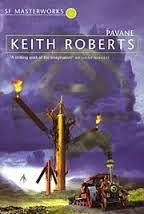
A review of Pavane, by Keith Roberts

A review of Pavane, by Keith Roberts

This is one of the “SF Masterworks” series which has re-issued, over the decades, some absolutely classic titles. Some of them are well-known to me; others, like this one, I had never heard of. You can see the list yourself here. I’ve read 21 of the 73 titles in the softcover list. It is necessarily some editor’s subjective choice, and there is a tendency for Philip K. Dick to appear rather too often in my view.

But this is about Pavane. A pavane, we read, is a kind of Latin dance. This is important. Roberts has written a work with six “measures”; six long chapters, each of them meaningful, each of them drawing us onto an inevitable conclusion. We start in the late 1960’s, and we finish sometime near the end of the 20th century, describing the growth of, the antecedents of, a very English revolution. A humble engine-driver at the beginning, further on has become a rich business man. His niece becomes the mother of a firebrand aristocrat, the Lady of Corfe, whose actions bring the established order down in flames and ruin. Throughout, there is an older hidden England, a faerie England, at work. It is at work for good. It is a concealed spiritual England such as C.S Lewis hints at “That Hideous Strength” – although he speaks rather, of “Logres”, a spiritual Britain.

Pavane is an alternative history. And it is remarkable as such, for it is a work of writing craftsmanship, a finely shaped bow or arc of story from beginning to end. In this alternative history, Good Queen Bess is assassinated in 1588; the Spanish Armada is successful in its conquest of England, and the entire Reformation is brought to a bloody halt, unlikely as it may seem (more on that in a minute.) The Catholic church militant then reigns from Rome, supreme and unchallenged, for centuries down to modern times.

The story starts in the late 1960’s in Dorset. Part of the attraction of the novel for me was the writer’s clear love of and knowledge of Dorset, an area I know and love myself. Most of the action is set between Dorchester and the Isle of Purbeck.

We see how control of innovation can prevent progress: in this alternate 1960’s, steam traction engines haul goods along rough unmade roads, often threatened by bandits in the woods, and subject to the constraints of impending darkness and winter weather. The use of concrete is tightly controlled and even banned – because concrete can be used to create fortifications, and hence foster rebellion against Rome, which is ruthlessly put down by the Church Militant.

There is no electricity; there is no radio or TV. Petrol and diesel engines have been invented, but the church has circumscribed the use of these new-fangled devices by Papal Decree. But in this world, unthinkable rebellion is brewing slowly, in the woods, in the fields, in the quiet villages. It is a world where the strength of England is found in the countryside.

Writing as a believing Christian here, I sense that Keith Roberts perhaps has little time for church or religion – but he never becomes openly anti-Christian, as in the worldview seen in such work as the “His dark materials” trilogy of Philip Pullman. He writes with a light pen of the faeries, the “old people”, of the old religions and the older Gods – Wotan, Thor, Freyr. In this he prefigures – or at least reminds me of – the much later work of Neil Gaiman in his excellent “American Gods”.

Pavane was very readable, very engaging, and full of delightful and evocative language. If I had a criticism of it, it would be of the opening premise – that the assassination of Queen Elizabeth I, and even victory for the Spanish Armada, would have been enough to destroy the Reformation and the protestant energy and faith of north-western Europe.

I’d argue not. I’d argue for a historical inertia; doubtless there are “cusp” points in human history when much can change subsequently because of a single event. But I’d argue that there are far fewer of them than science-fiction authors might like. I’d suggest the assassination of JFK might have been one; I’d certainly argue that the death from disease of Prince Arthur, allowing his younger brother Henry to become Henry VIII, was another.

But I think, rather, that there is a kind of historical inertia. I don’t think it’s quite so easy to change history through the turn of a card or the flap of a butterfly’s wing. I’d suggest that there is considerable cultural and historical momentum, which is preserved and not lightly shifted. Consider: throughout history there have been many times when reactionary forces might have won on the battlefield, but didn’t – would it have made much long-term difference even if they had?

Realistically would England be that different now if Charles I had won in the English Civil War? Would America today be really that different if the thirteen colonies had failed to prevail in their Revolution? And even if the South had won on the battlefield in the American Civil War, as a slave economy competing in a free market it could never have prevailed against the North in the long term. When the conservative, the reactionary and the traditional meets the progressive, the proactive, and the forward-looking, in the long run, there can be no doubt about what the outcome will be. The status quo is never acceptable.