Unknown's avatar

About Nick Hough

Don't get rich quick - get smart forever: I believe in knowledge. I'm interested in politics, economics, religion, science, and engineering. I'm a Christian, a family man, and a Scouter. I also tweet @enough32.

A review of The Massacre of Mankind, by Stephen Baxter

A review of The Massacre of Mankind, by Stephen Baxter

Stephen Baxter, one of the most prominent sci-fi writers around today, has written a sequel to H. G Wells’ “The War of the Worlds“. I confess I never read Wells’ original, but like most people of my generation I’m familiar with the story. Jeff Wayne’s concept album has played it’s part in that familiarity of course; “Forever Autumn” remains one of my favourite songs. A couple of years ago my wife and I went to see the stage show live in London – a real experience. It’s a story that touches every human heart.

I’m no real fan of H.G Wells, whilst acknowledging him as the outstanding futurist of his generation and one of the grandfathers, as it were, of the science fiction genre as we understand it today. I did read one of his short stories – written in Edwardian England more than a decade before the Great War and the invention of the tank – in which he describes great metal wheeled “landships”. It’s pleasing to read Baxter gives them more than a passing nod in this sequel.

The story, written in the same laconic narrative style as H.G Wells, recounts a second invastion of Earth by the Martians, in 1920. It’s readable and a page-turner, but I will reveal no more about it other than recommending it highly.

But here is where I enthuse about Stephen Baxter’s work, for alternative history is his real forte. He manages to challenge the idea that what happened in our past was immutable and things could only have been that way. The Martians invaded in 1907: they were foiled in their attempt by deadly pathogens. But as a direct consequence England and the British Empire never joined what his characters refer to as the “Schlieffen War” in 1914. In his history, there was no Great War, there was no Russian Revolution. The Bolsheviks were all defeated and tossed into prison.

The theme of “what might have been?” has entertained thinkers for all of history. What if Alexander the Great had lived? What if he had not recovered from a dreadful war injury he received when he was younger still? What if Henry VII’s oldest son had not died as a youth, leaving the throne open for his brother who became Henry VIII? What if the Nazis had successfully invaded?

Stephen Baxter in a number of his works, covers the the space-age era in this kind of detail. In “Voyage” he argues that humankind might have gone on from the Moon to visit Mars in the 1980’s – we could have; we just didn’t, for whatever reason. In “Titan” he sees an expedition to circum-Saturn space using Apollo-era technology, whilst Earth collapses into war, recrimination and apocalypse. In his short story “Sheena 5“, genetically-modified intelligent squid are sent to the asteroids to explore on behalf of humankind, because sending people is too expensive. They were betrayed: they were supposed to be unable to breed, but they could, and they did. Aggressive, intelligent, and capable of hard thinking, they return to Earth decades later as a space-faring species, to find humankind again mired in war, recrimination and apocalypse.

In “War birds” we see an alternative twentieth century far worse than our own, far worse than the worst nightmares of those who look down their nose at Donald Trump. The title refers to NASA’s space shuttles, which are seen and used almost entirely as fighter/bombers. We see Nixon rehabilitated; Tehran destroyed by an American atom bomb. A nuclear rocket blows up, rather like Challenger did in 1986, smearing radioactive material across the Florida sky. Reagan’s response is to start a nuclear war and destroy the Soviet Union. It gets worse…Stephen Baxter is willing to imagine the unimaginable in a quite relaxed and very English understated way. In his novel “Moonseed” (which does end on a positive note, though not before the Earth has been destroyed with billions dead) someone notes (after Arthur’s Seat becomes an active volcano) that “Edinburgh is Olympus Mons now”.

Reflections on a decade of reading

To early morning prayers on the first Saturday of this new month, this year, this new decade: outside, squirrels and magpies go about their winter business. As the day dawns, the exquisite light cheapens and becomes more banal, less delicate.

And now a look back at some of my reading over the last ten years. I have – at least according to my own records – read 491 books. Of those books, 349 I read for the first time: the rest, were books I have read before, sometimes once, sometimes more often. Tolkien’s “The Silmarillion” and C.S Lewis’ “Mere Christianity” top the re-read list, followed closely by Tolkien’s “The Children of Hurin” and R.A Heinlein’s “The cat who walks through walls” and “Friday”. Did I re-read any non-fiction? Why yes! I read twice these last ten years, Sebastian Junger’s “War” and Jon E. Lewis’s “The Making of the American West“. Also, Anthony Beevor’s account of the Spanish Civil War, and N.A.M Roger’s history of the Royal Navy, “The Safeguard of the Sea“.

I read two books called “On writing” – one – most excellent work – by Stephen King; the other, by George Orwell. I’ve read every one of Alan Furst’s dozen delicately written European spy novels set generally at the outbreak of World War II.

Alex Scarrow’s “Last light” was an apocalypse based around the end of electricity – how thin is the barrier that keeps the rule of law in place? How quickly could a person – or a society – somehow stumble through that barrier, and find themselves trampled to death by the Four Horsemen of the Apocalypse coming at a fast gallop in the other direction? In Scarrow’s book – about 48 hours. The Prime Minister fumbles a vital question in a press conference on a Monday morning. Wednesday afternoon, a policeman is shot dead at a motorway roadblock – and so the die-back begins. It was reminiscent of Nevil Shute’s propaganda piece “What happened to the Corbetts“, which was a fictional account written in the late 1930’s, of the bombing and destruction of the city of Southampton by an unknown enemy.

I had a re-read of Antony Beever’s masterful account of the Spanish Civil War – a book I enjoy reading, as he deals very lightly with the grey areas, the nuance and complexity of that conflict. I read a paper copy of the collected short stories of Arthur C. Clarke – always a pleasure to re-read the story of the Master, or the story of Grant and McNeil marooned on their freighter between Earth and Venus – with only enough air for one. I read and re-read Bill Bryson’s book “Mother tongue” about our great language. I was particularly impressed with “The man who went into the west“, being a biography of that sublime and yet oddly disquieting English poet, R.S Thomas. A clergyman who hid from his parishioners, a most peculiar and perhaps unlovable man, and yet, what poetry:

 The priest would come
and pull on the hoarse bell nobody
heard, and enter that place
of darkness, sour with the mould
of the years. And the spider would run
from the chalice, and the wine lie
there for a time, cold and unwanted
by all but he, while the candles
guttered as the wind picked
at the roof.

I read a number of China Mieville novels, and was most impressed by “Embassytown“, a story where the human ambassadors to a race of beings who speak with two mouths, have to be telepathic identical twins trained from birth. A very strange story – but fundamentally, all about language and communication. I read a couple of the memoirs of the late Clive James – what a writer, what a great guy. There are and have been few role models in my life, but God knows I’d regard him as one. Inspiring to me because he came from nothing. In “Unreliable memoirs” he writes of small boys throwing stones at an old lady, and compares it with Kristallnacht, noting that “the difference between mischief and murder is no greater than the law allows“.

I went through a Dennis Wheatley phase, once his material became available on Kindle, and relived some of the stories I first read in my early twenties. Evan Connell’s “Son of the morning star” was a biography of General Custer – and hence, of the development of the American west. That is a particular historical interest of mine. F.A Hayek wrote “The Road to serfdom” – a destruction of the errors of socialism – and perhaps the most influential book I’ve read this last ten years. Though oddly, it did not stand up (or has not yet done so) to re-reading.

I went through a Bond period and re-read much of Fleming’s original 007 stories. Great, spare writing. I also read a good few of Iain Banks space-opera novels, and also his de facto autobiography called “Raw Spirit” which I found encouraging. I read some of Keith Laumer’s science fiction stories, and Lord Moran’s excellent “The anatomy of courage” which every single one of us ought read. I read the journal of the Lewis and Clark expedition- that was long and tedious in places, but rivetting and exciting in others. Neal Stephenson’s work was a blessing to me – particularly “Cryptonomicon” and “The System of the World“. Nevil Shute’s “In the wet” I’d also highly recommend. I’ve mentioned elsewhere the radical and strange voting system he proposes in that story.

Who else is there to mention? Kipling, perhaps. I went through a Kipling phase after one of my daughters spent time at Simla, and later, lived for a year or so near New Delhi. “Plain tales from the hills” demonstrates that astute observer of the human condition in his best form. “Kim” I would put on the list of books everyone ought to read. Two interesting things about Kipling’s “Kim”: 1) it is available extensively in translation throughout India – but it is not available in Urdu and hence not available at all in Pakistan – where much of the story is set. I leave the reader to draw his or her own conclusions about that. 2) It is not so much the startng point of the Scout movement – that would be B.P’s “Scouting for Boys” – as the grandfather or underlying source material for Scouting. You want to understand what Scouting is about? Read “Kim”.

We may add the former astronaut Stephen Baxter. Whilst no crackerjack conspiracy theorist, he suggests that NASA exists not to faciliate human space flight but to prevent it – we could have gone to Mars in the 1980’s. I recommend “Flood” and “Ark” and especially “Moonseed” with a character whose immortal line is – after Arthur’s Seat becomes once again an active volcano – “Edinburgh is Olympus Mons now”. Also the learned Doctor Theodore Dalrymple. Never less than a pleasure – such works as “The politics and culture of decline” and “The Wilder shores of Marx”.

Tom Bingham wrote “The rule of law”, a helpful book on a vital concept. It is a book I bought and read after an oddly encouraging visit to Parliament which my wife and I won in a raffle. Up for re-reading in these interesting times, is that one. The leather-faced explorer the late Wilfred Thesiger was one of a series of Arabist explorers of the last 150 years. He was effectively guilty of opening the flood gates and allowing the desecration by oil companies of the Rubal Khali or Empty Quarter of Arabia. But he writes wonderfully of the (now doubtless long-vanished) desert Bedu. Read his autobiography “My life and travels“. Read “Arabian Sands“.

Much that perhaps ought to be included has been omitted. But I just read a book called “Steal like an artist” by Austin Kleon, and he notes that the future, in the present world where we are swamped by easily available data and information, belongs to those who know what to leave out. It was perhaps ever thus…and on that note, I bid you good day.

Nick Hough <nick@houghlife.com>Fri, 3 Jan, 18:46

Specks of unfallenness

“There was now no place on earth left where there was a memory of a time without evil” (Tolkien).

What if that was not quite true?

What if there’s unfallenness
In little flecks and specks?
Little bits of Eden.
Resonance of bliss.

What if there was space and time,
Where the fall just hadn’t happened?
Where illness needn’t blight our lives,
And all might live like Adam?

So ill was David, he had to be trundled to the aircraft in a wheelchair, and helped from the air bridge to his seat by his wife Ruth, with the assistance of solicitous cabin crew. It was just possible that the wasting disease, the creeping illness that struck him down at random, could be treated with a rare new procedure only available on the other side of the world.  In the times since his illness had struck, Ruth’s world had focussed and shrank down to almost nothing.  There was only caring for her husband, looking after his welfare, keeping him clean in body and mind and spirit – keeping his spirits up.  Neither of them were young anymore; their children had long since departed into the wider world and had themselves become parents.  Ruth was worn down with care, and grey-faced with exhaustion. She did not look forward to the 12 hour flight to London, even in business class. As for David, she was not even clear that he was compos mentis at all; the  drugs he needed to stay the pain had been augmented by additional drugs to allow him to fly.  This was a last ditch attempt to find a cure, to find relief.

She was so constituted as to have no concept of doing anything other than her duty.  She barely even thought about it: in sickness and in health. No resentment at her lot troubled her.  She was unworried by bitterness or any sense of the unfairness of life.  In this she was lucky; her yoke was easy.  All she had to deal with was ever-present tiredness, with which she had to do battle daily, even hourly.  The last few years had been a quick but nonetheless arduous journey, a terrible path from the full health of the late afternoon of life, to the place there were now: a gathering evening storm, from which perhaps, there was no shelter. Thirty-odd short months, and now twelve eternally long hours, and then onwards: to meet with consultants, urbane sun-tanned clinicians half the age of her husband, polite, distant, ever so slightly but unintentionally patronising.

And all after an insect bite. Her David had been bitten by some insect, while they were on holiday in Namibia. He had swatted it away, thought nothing of it. Later, the itchy bite, the scratching, the cream.  Months later, like a betrayal, like a sudden unlooked-for defeat, the intense pain: to hospital, to discover that there was the dread infection of a mysterious wasting disease.

David: I need to hang in there and be good.  This really hurts now and even with these amazing tablets, I’m not really coping. I can’t be showing how weak I am; not because I’m tough – because I’m not.  I want to stay strong for my wife. I don’t want to let her down or discourage her, my dear darling wife of all these thirty-odd years. What a star she is; silver and gold to me, she has been. It’s not just the pain; it’s the dizziness, the nausea.  I hate nausea. To feel sick is to feel like death. I don’t want to wish I was dead: that’s God’s timing, not mine.  But there have been times when it’s been all too easy to wish just that. I wished I was dead. It’s like a panic rising up in me; like bile in my throat. I have to make constant efforts to push down the urge to panic, resist the urge to let my mind get out of control.

He thought again of that damned insect: he remembered it so well, the bite on his neck, the raised hand, the swatting away. Some kind of goddamn horse-fly. He grimaced at the thought. And afterwards, pain and itching.  But it was only an insect bite.  Soon enough forgotten.  Months later, back at home, he’d woken up with a fever one night with terrible sweats. Mopping his brow, drinking plenty of fluids. By morning he’d had a headache like an angle-grinder shrieking and whining away in front of him, the sparks going on his forehead and in his eyes. He’d gone to the doctor; the doctor had just taken a look at him and prescribed more painkillers and rest. He’d gone home again and followed the doctor’s instructions.  Two days later he collapsed.  The next thing he knew, it was a week later in hospital, him coming out of a coma with the worried face of his Ruth looking down at him.

The aircraft taxied out, turned onto the runway, and started it’s lumbering roll toward London. At least the noise and vibration weren’t too bad.  Course set, cruising altitude reached, and the long haul along the length of Africa began.

II

“Did you hear about that aircraft that nearly crashed, and everyone on board was somehow healed of all kinds of diseases?”

“When was this?”

“Couple of weeks ago. There was a short piece on the news, but it disappeared soon enough. I remember seeing it in the news at the time and it piqued my interest, because the flight was off course and had flying much lower than usual across some desolate stretch of African jungle.  Can’t say I understood or believed all the accounts of what happened in terms of healing.  But I came across it again the other day, and believe me…”

“Oh yes?”

“A patient was referred to me from South Africa. A gentleman had contracted some kind of an infection from an insect bite, and he had developed some very odd, very rare, and very terminal disease or syndrome of diseases arising from that infection.  I have all the notes; dreadful; a most unpleasant and horrible business, believe me.  It made Bilharzia look a cold in the nose, believe me. This guy and his missus were on that flight. I saw them a few days ago, and there can be no doubt in my mind that he was completely clear of any infection. He was going to die hard, and now, it’s like he’s thirty years younger. It’s just completely impossible, if I hadn’t seen the guy, checked him out as a doctor, and done the tests, I wouldn’t believe it.  I still don’t believe it, but the evidence is walking round the streets of this great city of ours.”

A number of factors conspired to a significant change of course for this particular flight. One, was a storm of unprecedented violence and tenacity right in the intended path of the aircraft. This, of itself, was manageable and, whilst unusual, did happen from time to time.  Controllers and crew had a range of alternatives from which to choose – different slight variations in vector, all intended to keep their passengers from getting bumped out of their seats.  The other, was ongoing civil war in a central African country right under some of the proposed new flight paths.  Whilst this did not pose a threat to the aircraft as such, it was company policy not to overfly this country if it could be avoided at all.  The “Swiss Cheese” Model of safety theory tells us that accidents happen when holes (as in slices of a Swiss Cheese) in a number of different layers or slices of prevention, all line up, allowing an accident to slip through.  Normally, the holes in these layers are all in different places, and because they never line up, accidents don’t happen. The barriers are in place.  But if by some malign mischance they do line up, then the defences are down, and accidents can happen.

The huge lumbering liner banked to port and began to lose height, all according to plan.  What was not according to plan was more – and very severe – clear air turbulence which took everyone by surprise. The aircraft dropped like a stone; loose equipment was flung about and people walking around the cabin or who were not strapped in were sent flying into the air. At least one passenger was killed instantly, his neck broken from being slammed into the ceiling of the cabin.  In economy, a trolley was lifted into the air weightless and landed on several passengers, causing some dreadful injuries. There was for some time, rank terror in the cabin, shrieks of panic and dismay, before order, such as it was, could be restored, first aid given, and an attempt at tidying up could be made.  The captain, grim-faced, heard the reports from his cabin crew in silence. Arrangements were made to descend and land, at a coastal city in a country not normally served by this airline. For some time, the captain found his aircraft to be flying through airspace not normally used by civil aircraft, with darkest green jungle and mountain far beneath.

Ruth thought, this turbulence has been going on for too long.  Bouncy bouncy and I could do with another drink. She glanced up at the lit up “seatbelt” sign. As she did so, she sensed and felt the aircraft start to bank deeply to the left.  To do so whilst circling to land in a big city, was usual, but to do so out in the wilds of Africa, was unusual. What was happening?  And her heart and her stomach all of a sudden were in her mouth; the aircraft was falling; she was weightless. She felt herself rise hard against her seatbelt. Her book and reading glasses flew into the air. She automatically looked across at David in the next seat; his eyes came open from a drowse and caught hers. Even in this time, even in this pain, they were unreadable. Or so he thought.  She knew what they were saying. Unreadable meant something: David’s face, his eyes, she’d always been able to read: he was never a poker player or any kind of an actor, at least not until this disease had struck and the shutters had had to come down.  Another jolt: a violent tug upwards and then a jink downwards.  All around, shrieks and moans as the passengers felt the aircraft judder and sway around them.  The sound of small objects: cups and glasses, books, pens, tablets, being thrown around the cabin.  A dust of loose objects rattling around inside a cylindrical steel can, faraway over the jungle.

After this in-flight catastrophe, the aircraft made it’s way down to an airfield serving a city in a country that was wild and undeveloped even by the standards of west Africa.  Yet, land they must, and address the casualties amongst the passengers, attend to first aid and check that nothing was damaged on the aircraft. There was one rather odd experience common to all the passengers, as the aircraft descended.  It was as after the aircraft had come down through the clouds. Deep in the clouds, all of a sudden, there was a few brief seconds when it seemed as if the aircraft was lit up by golden sunshine. Perhaps, some of the more practical passengers reported, long afterwards, there had been some form of voltage surge to cause all the cabin lights to briefly brighten up.  Problem was, the records and the evidence in the computer systems of the aircraft, found no evidence of any such surge. But every passenger reported that they had felt suddenly as if the cabin had been lit up by sunshine. There was no report of lightning or of any explosion or anything of that sort.

David: The Bounce woke me up from a light slumber. I was reasonably tightly strapped in, so I didn’t move very far.  Books and various other things went lying into the air, including my all wife’s things.  After the Bounce I was no longer asleep or even drowsy; I was wide awake. After the chaos and panic was addressed, the aircraft began to descend; the Captain had announced what had happened and what was going to happen, how we were going to make an unscheduled landing at the city of Noula.  Even though I was already awake at the time of the sudden flash of sunshine, it felt as if I was woken up by it.  I suddenly came awake or was somehow revived.  I never saw it as such even though I was awake.

Ruth: My life is divided into before that flash of light, and after.  I’ll never see things the same way again. I was so tired.  Came that flash, that sudden burst of light, and it was as if someone had mopped my brow with Ambrosia. I can’t put it any other way. I felt renewed and refreshed; it felt like I’d been asleep for a hundred years, and awoke on a late summer’s morn. All my weariness was gone: my mind was cast back over thirty years to my youth, to those golden moments, those shining hours of youth.

Much delayed, after a certain amount of trouble in Noula, the airliner took off again and made its way to London, whence it arrived nearly eight hours late. 
Woodsmoke

He remembered autumn in the garden.
Autumn’s smell of woodsmoke.
The small boy feels valued,
of worth, in helping his father:
A much flawed man, but his father nonetheless.
His father did much in those brief days,
Showed the boy how to be.
And now whenever he smells woodsmoke
Or thinks of brown-leaved autumn
He remembers those times,
And sometimes cries in secret.

For I also am flawed.
And each time, my Father above,
Who is not flawed but perfect, without fault,
Pours pure gold into my own flaws
And polishes me up.

The heart of the fire

What is it in the heart of the fire
That calls us to stand and watch?
Why do the flames draw us nigh
To stare in the dark at the flickering light?
In the red of the glowing embers,
Something inside us is moved
Fire! From primeval past, some remembrance
Of flame and warmth, life and truth.
What truth is there, in the heart of the fire?

At lands end, the booming sea and strand
The cliff edge and the crumbled coast.
What yearning draws us there?
Why do we listen as we stand
Gazing out at ocean’s edge?
Why does the sea-sound sooth
The troubled heart?
What beauty is there, in the sound of the sea?

At the start of time we came
Out of the forest into the light,
Onto the sun-baked plain.
Out from the safety and the gloom
To where we could be seen
Where one mistake was doom.
And today the woodland scene
Remains a place of shelter.
What shelter is there, in the shade of the trees?

Who should not be charmed
By the face of the smallest child?
A baby grins in innocence, free
of art or guile, and the world smiles.
When babies laugh, the angels dance.
No-one looks askance
When a little baby gurgles.
Who would ever tire of such?
What joy is there, in the face of a baby?

The deepest peace is found
In silence. Order is rounded
And rightness renewed, in quiet.
As dreams order our troubled thoughts
So silence prepares us for the onslaught,
For the next task, for the din of daily life.
At the centre, at the hub, nothing moves,
and all is still and quiet.
What voice will we hear, in the time of quiet?

Arctic

I watched an Icelandic film, called “Arctic”. There were two characters, and possibly twenty words spoken in the film. It was a remarkable movie about how humans deal with adversity and challenge. Not only the physical adversity and challenge associated with being lost in the Arctic and having to survive, but also the deeper issues of emotional adversity and life challenges.

How ARE we prepared? Our hero has a coat, hat and gloves – equipment for survival in harsh conditions. This is what the safety professionals call PPE – personal protective equipment. PPE guards and protects your physical health. Is our emotional and mental health likewise well guarded?

Our hero has things to hand – matches, a knife, a torch perhaps – as do I when I go camping. But how easily are those things to hand? Can you lay hands on your torch or your knife or your matches when you need them? In the dark, for example? That’s the difference between a good and bad experience of camping – but in the situation our hero finds himself, it could mean the difference between life or death.

Our hero has mental and emotional strength. He is not above weakness, and we see it in the film, but it is this inner strength that carries him through in the end, not his winter clothing or his tools, or even his physical stamina or his knowledge, though that all helps.

This was as moving a short film as ever I’ve watched, though I did watch it during a long-haul flight when I was very tired. It is a film about prevailing in adversity; it is a film about digging deep into ourselves, about persistence, about never, ever, ever giving up. As a piece of film-making, I found it refreshingly understated – much of the pain and much of the pushing through the pain, was implicit and off-camera.

It is of necessity a human story. One reads in the introduction to Nicholas Monserrat’s classic war novel “The Cruel Sea” – another deeply human story – that the sea itself is a character in the tale. Not here: the Arctic is merely the setting for this human story. The other day I read one of those opinion pieces in a left-wing newspaper where the author argues that the human race is a two legged plague” on our planet, and that the human race is inherently A Bad Thing. Expressing myself without use of coarse language, it is a view I profoundly disagree with. It is the most ungodly view imaginable.

This film shows the opposite, that individual people, men and women, do matter, they are of worth, they are all potentially capable of true greatness. One man carries a gravely injured woman hundreds of miles to save her life, at grave risk to his own life. To do so he has to dig deep into himself, into a part of himself he perhaps did not even know existed. He has to confront his own selfishness, and conquer it. I was especially moved by two scenes; one, where he defends himself and the injured woman from a hungry polar bear, and then breaks down in tears of stress and exhaustion once the bear has been scared off. The other, is when he thinks the woman has died, or is about to die, and he composes himself to abandon her – but she was not dead, and he was mortified with himself that he ever thought to abandon her.

People matter: individuals matter. We are immensely capable, very important and inherently able to do great, noble things. Evil does exist, of course, and we must confront it in ourselves – we find it most of all, I think, in selfishness, in the belief in the primacy of MY NEEDS. At one level, it is quite biologically natural to put OUR NEEDS ahead of everyone else’s needs, MY needs ahead of yours. But in a healthy childhood the individual is shown how to subvert selfishness and self-centredness, and put others first. It keeps popping up of course, all our lives through. In some folk, more strongly than others. And we have to keep it under control.

Here in “Arctic” our hero has to keep control of the urge to give up…in all cases, we can control that urge. We can persist, and achieve remarkable, incredible greatness. But do we? We can.

Lecht

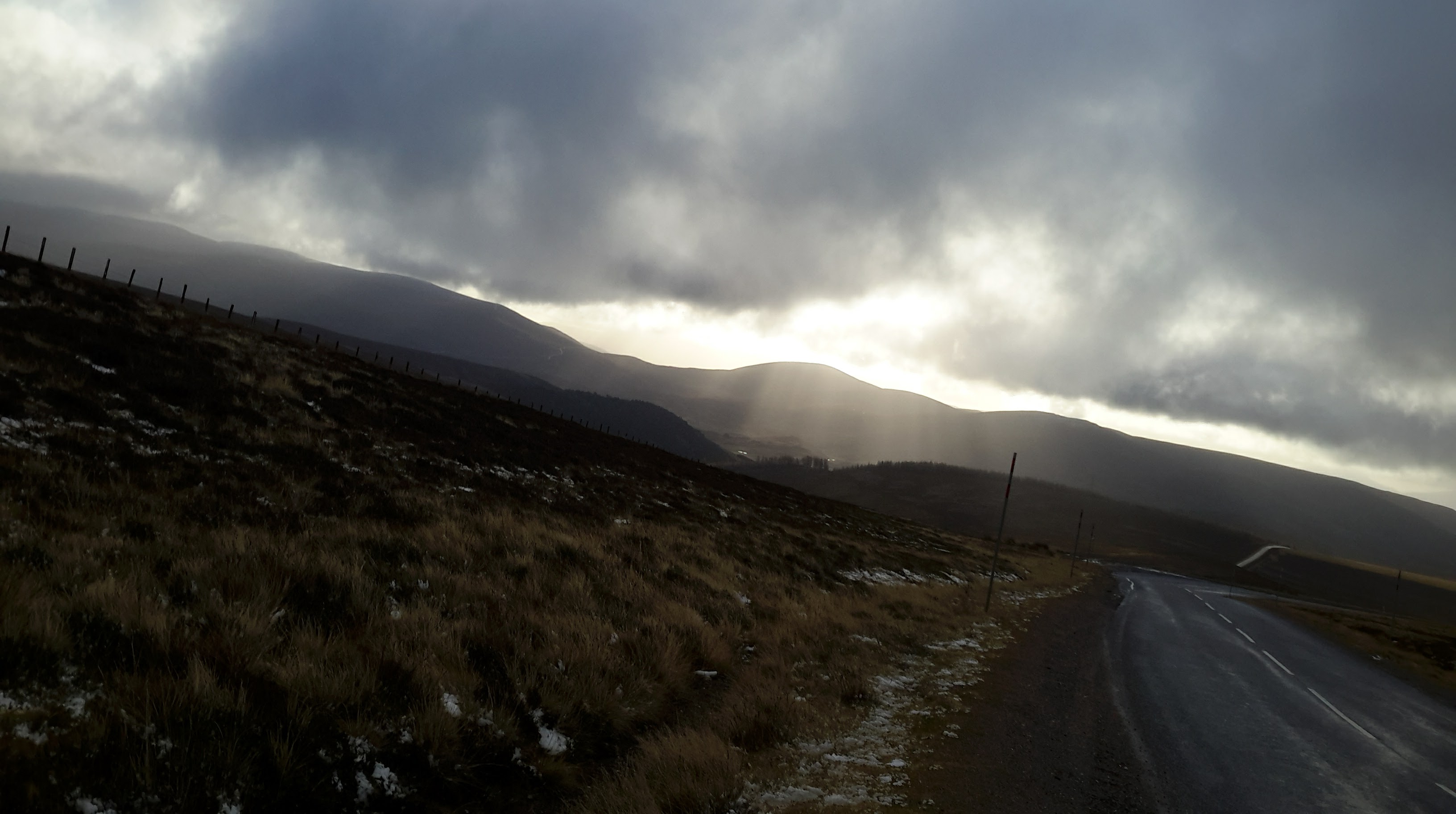
The road over this blasted heath
Across this windswept hill
at the edge of the east,
Has been a place of peace
A kind of pilgrimage for me.


Once in crisp autumnal airs,
Once in bitter cold,
Car tracks through
A dust of freshly settled snow
White across the tarmac.


Today: a rain-filled murky dusk.
Water sluicing over the road
Wind buffeting the roof of the car
The wiper’s wup-wup only adds
To the deepest sense of peace.

Here one talks with the Most High
Like he was sat in the passenger seat
Listening to what I say,
Nodding sagely, making mental note,
To fix this situation, bless that person.
I am, He says, the God who hears.

More Scottish travels

After a work-related evening in The Dutch Mill in Aberdeen, the following morning I set off up Deeside towards Braemar. My first stop was Gordon’s Tea Rooms in Braemar, an excellent little gaff where I had a latte and some rather tasty fruit shortbread. I did like the lamps each hung on a miniature sheave.

From there, over the blasted wilderness of Glen Shee. A typical Scottish ski-station at the top of a pass – deserted other than under winter conditions. On the Aberdeenshire side, deep, thick mist. Oddly enough, a change in the weather meant that the Perthshire side of the pass was much clearer – an odd effect of the mountains. Thence, through to Pitlochry. Amidst rain and tourists, I sought lunch. Pitlochry has not changed for the better; the retail trade is in deep recession, and the main road through the mountains has long since bypassed this town – and it shows. I went to see the Fall colours at Garry Bridge, but it was no weather to be outdoors in town clothes. I pushed on towards the central Highlands, toward the dreary 55mph treadmill of the Pass of Drumochter.

Long before I got there, I happened upon the Atholl Arms Hotel on the north side of Blair Atholl. I like an historic coaching inn every now and then, and I turned into the car park with no further ado. Grey stone, an imposing frontage and large display windows that seemed almost Mackintosh-esque to me. Coats of arms prominent, yet not covering itself in tartan, nor in the cross of St. Andrew. So far so good. In a cosy little reception area to the right of the front door, a blonde lady in blue suggested a single room for £50, or a double for £75. I opted for the single. It was off to one side, clearly an erstwhile room for students or staff. The room looked dreadful: it was ill-lit; there was woodchip on the ceiling; 80’s pine furniture, and a single bed jammed against the wall. I liked it. It also had a perfectly excellent shower, a fluffy white bath towel, and the makings for tea included a little teapot. I was set up! I went out for a run up Glen Tilt.

It’s the touches of old that endeared it to me…the wooden sash windows, the 1970’s light fittings, the domestic patterned glass in the windows was probably older than I am. For £50, it was atmospheric and excellent. But I could not hope for a great breakfast. I went down with low expectations, and I was disappointed. I had as good a full breakfast as anywhere in the UK, served by friendly and engaged staff in an enormous baronial hall fully two floors high – the recipient of light from the aforementioned large display windows. The ceiling was Robin Hood green, the walls, a deep maroon. Crossed swords and pikes were hung on the walls, interspersed with stags heads.

The following day at noon, after trundling through rainswept countryside along single-track roads, I stopped in Kingussie and took coffee in the “Sugar Bowl” cafe. I was luckier with the second-hand bookshops and picked up Geoffrey Household’s “The Sending”, Iain Banks “Raw Spirit” and Christopher Sommerville’s “The January Man: a year of walking in Britain”. I happened to glance at my phone, looking for information about a heritage railway I knew was somewhere near here, and I saw that there was a Diesel Gala Day – today. I put on my coat and hat and left for Aviemore on the instant.

The High Peak Trail – by bike from Edale to Whatstandwell in 2004

A propos of this rather excellent Go-Pro timelapse footage of a cycle ride down the High Peak trail, https://youtu.be/mbttC49o5Hg, here is a slightly slower but just as interesting account of a similar journey taken in 2004 before Go-Pros were invented…

Arriving at Edale Station at 10a.m, I set off uphill, and was soon walking… Nevertheless 10.25a.m saw me at Hollins Cross on the Mam Tor ridge. You could not walk from Edale Station to Hollins Cross in twenty five minutes. Thence riding and walking up to Mam Tor, and carrying my bike down the stairs to the road. Thence down Winnats (peaking at 37mph just before the Speedwell cavern), through Castleton and up into Cave Dale, where I had once again to carry my bike, so rough was the ground. I was up and out of Cave Dale and onto the moor, whence I lunched, at 11.35a.m. Then onwards over bridleways, quite slow going, bringing me down through some quite delightful woodlands to Peak Forest on the A623. I came east a few miles along the main road – unpleasant work, mostly uphill with heavy freight traffic sweeping past me, and very little safe room to walk the bike – and then struck south to the west of Tideswell, along minor roads firstly, and the Limestone Way secondly, bringing me to Millers Dale after a decent interval, again mostly by bridleways.

From Millers Dale, up along “long lane”, another bridleway, strongly upstairs, to the A6 at the western end of the Taddington bypass. Through Taddington and further south again, minor roads leading me to the “Bull in t’ Thorn” on the Ashbourne-Buxton road for a much needed pint at a little after 1.30p.m. Thence a hundred yards or so to Hurdlow. The first section of the ride was over – 20 miles in a little under four hours. Very good riding but quite slow. At least five miles on foot, maybe as much as a mile having carried my bike.

I hared off down the High Peak Trail, whizzing through Parsley Hay about 2.05p.m. This were my target points – Parsley Hay by 2p.m, High Peak junction by 3p.m (I gravely underestimated the time and distance – nearly 18 miles – from Parsley Hay to High Peak junction.) So concerned was I with keeping my speed up, that I missed the junction and continued burning down the Tissington Trail, only realising my mistake at Hartington signal box! I was able to cut a couple of miles across country on a bridleway, getting myself easily back onto the C&HPR.

Thereafter, a very long leg with only one or two brief rests, along the railway track, which due to the pace I was having to sustain, was only slightly enjoyable. With increasing saddle sore and tiredness, wrist pain and thirst, I came to Wirksworth a little after 3pm. I had made 32mph down Hopton Bank, but so slow was my progress (8mph) down the much steeper Middleton Bank, that I abandoned the High peak Trail and went down the much faster main road into Cromford, arriving at Cromford Wharf at about 3.25pm.

I had planned to arrive at High Peak Junction – still a good mile away – at 3p.m. I was running very late and had been thinking about that for well over an hour. It wasn’t that I couldn’t make it home, it was that I wanted to be home in time to get showered up and ready to take Cubs at 6.15p.m. Had I rode all the way home to Derby, I should have arrived, very tired and very stiff, and most likely well after 5p.m. I needed a break with the trains. So I was very pleased when, almost as I turned into the car park at Cromford Wharf, the clickety-clack of an approaching northbound train could be heard across Cromford fields.

I now knew that all I had to do was ride along the towpath through to Whatstandwell station in the time it takes the train to run up to Matlock, rest a while and set off back again. I  figured I had a little under half an hour. I pushed very hard along the tow path, hindered in the first mile by pedestrians, and I had to draw on inner reserves to keep the pace up as I drew near to Whatstandwell. I was constantly expecting to hear the sound of the train running through the woods, signalling that I would have to ride all the way to Derby. But, I need not have worried. I was ensconced on the station at Whatstandwell after a fifteen minute dash, and the train did not arrive for another ten minutes. An excellent day out in the White Peak.

Arundel

We started out with brunch in an Italian cafe. For her, some very sweet waffles. For me, a sausage bap but the sausages were from a boar. Tasty. Then, a short tour round in the summer sunshine. To my eye Arundel resembles Uckfield with its steep main street and pleasant buildings. It’s nearly all cafes and restaurants, though we did find an actual grocer trading on one side-street. And there were antique shops, which is always a good thing when we’re out together.

Thence to Arundel Castle, which I found eye-opening and not entirely refreshing. Whilst it is in superficial appearance a Norman castle, the majority of it is Victorian. It is, rather like Bamburgh Castle in Northumberland, something of a reconstruction, a Victorian ideal of what a Norman castle should be like. That may be a little unfair, but only a little. Both had been “real” castles back in the day. Both, interestingly enough, were reduced during the Civil War. Bamburgh by artillery, Arundel, by siege and thirst. The Parliamentarian besiegers cut off the water supply – game over, as they say. Surprising to find the Royalists held out for so long – for 18 days.

Arundel is a centre of Roman Catholicism. The large and very French looking cathedral church in the town is not Anglican but the seat of the Roman diocese of Arundel. The owner of the castle is the Duke of Arundel, also known as the Duke of Norfolk. I already knew that Norfolk was a Catholic peer, and also the most senior nobleman in England. What I learned today was that the Duke of Norfolk is also the hereditary Earl Marshal of England. It is he to whom would fall the burden of organising the Queen’s funeral and the coronation of her successor. It is fascinating to me that right at the heart of the ceremonial State, right next to the Crown, to a protestant monarch, you find this high Catholic nobleman.

Going round this home of a Catholic peer, this tremendous castle, made me feel very Protestant. I recall a time some years ago when I was sat one lunchtime praying in Westminster Cathedral, and the priest started talking about the uniqueness of the virgin Mary, and I found I had to get up and walk out – I just could not be doing with listening to such stuff. I didn’t realise how deeply Protestant I was until thrown into that Catholic environment. It’s not sectarian hatred – there’s no orange and green with me. It’s just doctrinal differences. I’m aware that in writing this I may set myself up for “POT/KETTLE/BLACK” responses…

The other clear learning from the visit – though I knew it in my heart – is that had I lived in the English Civil War, I would have taken the Roundhead or Parliamentary side – at least in the war itself. But I am no fan of the coup, overthrow of parliament and military dictatorship that followed the Civil War, nor any respecter of Cromwell’s memory. He has so much to answer for in England and Scotland, to say nothing of the lasting damage he did in Ireland. Some years back in less stable parts of the world than ours, there was a spate of politically motivated toppling of statues. I’d nominate the statue of Cromwell in London: not for toppling of course, but perhaps for egging, or some of that horrible string that squirts from a can – or perhaps a student to put a traffic cone on his head.

History has much to teach us; we miss much by forgetting the fact that we are deeply shaped and moulded as a people over centuries. You want to understand the EU? Study the second world war. Where did the Troubles come from? Learn about Cromwell and even further back into Irish history. It’s worth going back and remembering that the Catholic/Protestant divide in the 17th century was as much about who was in charge, about state power, as it was about religion. The superpowers of the day were underpinned by these ideologies, even as in our youth, they were underpinned by Communism and Capitalism. Then, as now, we ask: who is in charge? A leader, a hereditary King, or an elected Parliament? Who should be in charge? And should they who are in charge account for themselves to the common people? Do we follow the status quo and leave things as they were, or do we embrace change? These were and of course are, vital questions. That most of the answers to these questions seem obvious, and come easily to the mind, does not mean that it will always be so. We should take nothing for granted.

A review of “Collapse”, by Jared Diamond

A review of “Collapse”, by Jared Diamond

“The past”, writes Jared Diamond, “offers us a rich database from which we can learn, in order that we may keep on succeeding”. This is powerful truth and it is one of the reasons why I keep a journal. R.A Heinlein writes of people uninterested in their historical background that “a generation without a past is a generation without a future“. George Orwell tells us, more bluntly, that “he who controls the past, controls the future“. All of this points to the fact that we can and should learn from the past, as individuals and collectively, as a society or a culture. Jared Diamond’s book bring us lessons on how societies and cultures collapsed, or survived, and draws some broad conclusions for our time.

Starting with a perhaps counter-intuitive look at the potential problems faced by modern Montana, he goes on to look at a number of cultures the collapses of which we may all be aware of, and examines in some detail why those societies failed. The Anazazi Indians of the American southwest; the Maya. The island settlements in the Pacific – Easter Island. The Norse settlements in Greenland and on the North American continent.

He then moves on from consideration of those collapsed ancient societies, to consider some modern cultures which may or may not be facing collapse: Why are some in great shape, why are some in crisis? Papua New Guinea. Modern Australia. Haiti and the Dominican Republic – two widely differing cultures on the same island. If there is any conclusion to be drawn here, it is that there is no sound-bite solution, no quick or straightforward answer, but instead, case-by-case complexity and nuance.

The Anazazi in Chaco Canyon grew crops in multiple locations and then distributed it, ostensibly (but probably not) equally. In describing this he artlessly demolishes command economics or the economics of state-sponsored redistribution of wealth. The risk of redistribution is that “it required a complex political and social system to integrate activities between different sites”, and “lots of people ended up starving to death when that complex system collapsed”. This is an inherent problem with command economics: when a planned economy goes wrong, thousands or even millions of people end up starving to death – as in Bengal in 1770 in the days of the East India Company, as under Stalin in the Ukraine in the 1930’s, and as in Ethiopia in the 1980’s. When a market economy goes wrong, there may be widespread malnutrition, but there won’t be mass starvation. It’d be interesting to see how many people actually starved during the Great Depression – but you may be sure it won’t be many.

Moving onto some success stories, he spends some time discussing an area he does know something about, the Highlands of Papua New Guinea. Here we have a culture that has embraced innovation, a culture that has found it necessary to abandon conservatism or resistance to change. Conservatism though, he argues, comes from being on the edge, facing a survival situation. We dare not change things, if changing things pushes us over the edge to destruction. And yet, the adaptable highland tribal people of PNG have done just that – embraced change, done things differently, and not only survived but have prospered. In contrast he notes that the Norse settlements in Greenland ultimately failed (though climate change was also a causal factor) because of conservatism – what worked in Norway, should work in Greenland: but it didn’t. The differences were subtle and complex, and were difficult to understand or comprehend given the knowledge and technology of the time.

Is “progress” sustainable at all? He notes that Inuit hunter-gatherers lasted 500 years in Greenland. But aboriginal hunter-gatherers in Australia lasted 40,000 years. What’s the difference? Is “progress” itself a bad thing? Me personally, I don’t think it is. I don’t think a culture that doesn’t change or grow is healthy at all. That’s as true for hunter-gatherers as it was for the more advanced Roman state which remained at broadly the same technical level for a thousand years. Underlying all of this discussion is the importance of engaged, enthusiastic and committed citizens, insightful and courageous leaders, and a willingness to look at the bigger picture and think about the long term.

Diamond draws some thought-provoking conclusions, some of which are truism, to a degree; others, less obvious and more challenging to me. He suggests that we need to challenge our deeply held core beliefs – some of them are compatible with the survival of society; some of them, have to be given up in order to survive. As true for individuals as for cultures.

More challenging though, “in all politically complex human societies in which people encounter other individuals with whom they have no ties of family or clan relationship, government regulation has arisen precisely because it was found to be necessary for the enforcement of moral principles”. This is about what he calls the “tragedy of the commons” – people in general do not behave in a way that prospers the common good, but in a way that prospers them as individuals. But there is always a “commons”; we need the common good. Therefore – though it break my heart to write it – I have to acknowledge that it IS the job of the State to make men moral.

In the end, Diamond is hopeful. He argues that (in our market economy) it is the PUBLIC – the customers – and not the State, and not businesses or corporations, who have the ultimate power to change the behaviour of businesses and ensure we move forward in a sustainable way.

A review of “Lexicon”, by Max Barry

A review of “Lexicon”, by Max Barry

I saw this title on a shelf in a second-hand bookshop in Aberdeen, and I was drawn to it on the instant. “Words are weapons” went the blurb. Never a truer word even if written by Marketing. “Sticks and stones can break my bones…words can kill“, it went on. Words can create; they can build people up and raise hope. Words can destroy; they can ruin people and remove all hope. This is true metaphorically; it is a fundamental fact and a powerful truth in the spiritual and emotional world. In this book “Lexicon” it is also literally and actually true.

I testify to the power of words. A teacher once said of me, “That Hough’s an oaf. A clever oaf, but an oaf nevertheless”. That was said between teachers in the staff room; some years later, when I was an adult, another teacher told me the story. It were fair to say I wish he hadn’t bothered. Those words, spoken about me nearly forty years ago, could define me to this day – almost like a curse. They could be my epitaph.

I have since met the Lord Jesus Christ, and He has spoken a better word over me. “You are already clean because of the word I have spoken to you” – John 15:3. Jesus is, as the writer to the Hebrews notes, the minister of sprinkled blood that “speaks a better word than the blood of Abel” (Hebrews 12:24). We know of spells, curses and blessings, and of strange unbreakable injunctions – the “geas”. In Dennis Wheatley’s stories we read that eleven words of eleven syllables, spoken with due preparation, will bring forth a dread demon. In C. S Lewis’s “The Magician’s Nephew” we read of the Deplorable Word, a word uttered by the witch Jadis on the planet Charn. A word so terrible, that merely speaking it, destroys all life. In Frank Herbert’s “Dune” we read of sound being used as a terrible weapon – the “weirding way”.

And the list of spells, words of power, curses and dark magic goes on through all literature. There are manifold examples of words used in power, dreadful negative power, destructive power. Max Barry has written such a tale here. The story is of pursuit of a “bareword”, a word so potentially destructive, that every time in history one has appeared, it has wrought catastrophic, end-of-days levels of destruction and chaos. In his story, a shadowy department in Washington DC is peopled by agents who are able to persuade people to their will by words alone. Sometimes through everyday persuasion, other times, though what are in effect, spells: the use of strange and sonorous words of power in lost and unknown languages, to compel people to obey.

The idea that words have power is fascinating and compelling. The pen IS mightier than the sword. The tongue, as St James writes, can set the whole course of our life on fire. The idea that words can create and destroy goes back to creation. The world itself, even light itself, was spoken into being by God. God said Fiat Lux let there be light. And this point is crucial: …and there was light.

Today, more than ever, we need to use words to bring light, to do good, to build up and encourage others. Today words are used to great destructive effect; social media acts as an echo chamber for empty words, and as a magnifier of whipped up hatred and divisiveness. It is vital that our words – for as we have seen, words can be uniquely powerful – are for good and not for ill. They should build up and not tear down. They should encourage and not discourage. If I speak in the tongues of men or of angels, but do not have love, I am only a resounding gong or a clanging cymbal. It’s actually worse than that: we can actually cause immense damage through careless words, negative words, thoughtless words. We should write and speak in love. Let our words be powerful, let them be few, and let them be for good.

A review of “The Pigeon Tunnels”, by John le Carre

A review of “The Pigeon Tunnels”, by John le Carre

I was at the same time inspired and daunted by “The Pigeon Tunnels”. It’s a kind of autobiographical work, consisting of a series of short essays, just a few thousand words each. The essays detail some of the people he has met, and the places he has been, as a world-famous writer, researching novels in trouble spots; hob-nobbing with the great and the good; burying old ghosts. Inspired – because a thousand-word essay, almost anyone can write. Daunted, because le Carre’s craft, and his connections and background, both seem miles from my own.

For someone like me who comes from dust, out of a comprehensive school/polytechnic background, he makes little of his own patrician roots. For this I am thankful. But it is clear that many of his heroes are in fact he, or possibly, more likely, his father. That said, le Carre does note (of the writer’s trade) that at some point, you have to get out and meet people – stories come from people, and the people are out in the world.

In an account (“In deep cover”) of burying an old Cold Warrior, some old spy, he speaks well of the Cold War infiltration of subversive groups. But he writes that he is ostensibly repelled by such infiltration today, arguing that it is not justified. I think this is disingenous. But then, later, in “Son of the author’s father”, le Carre writes about “the writer as conman“. He describes the similarity between himself (a successful writer) and his father (a successful conman) relating the two arts – that of conman and writer.

The writer and the conman:

  • Spin stories out of the air, from nothing
  • Sketch characters that do not exist
  • Paint golden opportunity where none exist
  • Blind you with bogus detail
  • Clarify knotty points
  • Withhold great secrets
  • Whisper those same secrets in your ear

This chapter on his father Ronnie is as moving and as revelatory a chapter as ever I have read, and was most enlightening. How far from my own experience. I have been a very different kind of father, and my own father, though perhaps not much more flawed than I, a very different kind of man again.

I always used to say of his writing, you could read a dozen early John Le Carre novels, and you would learn little or nothing about the writer’s own personal politics. You need read only a dozen or so pages of a Tom Clancy “Patrick Ryan” novel to know his. But that’s not true of his later, post-Cold War material – stuff like “Our kind of Traitor”, where his politics – and his anger – almost boils off the page.

Writing about documenting and reporting on the horror of the Eastern Congo, he says that “cameras don’t work for me. When I write a note, my memory stores the thought. When I take a picture, the camera steals my job”. This is important. The writer paints pictures with words: the camera exists; it cannot be un-invented. But just as pen and paper render memory less necessary, even as GPS erodes our innate sense of direction, and even as wristwatches mean we no longer need a sense of time or duration, so the rise of the universal camera is making the written story rarer and harder to create.

Mental health

Much is talked and written today about mental health; it’s all over the TV as high (and not so high) profile names tell us about their mental health problems. It’s on the agenda in corporate board rooms; it’s big in social media. Hardly a day goes by when I’m encouraged to “share” something on social media telling others how much I understand and empathise with their mental and emotional turmoil. It’s yet another ribbon or wristband to wear, virtue-signalling, telling you how much I care.

I have been through a long period of admittedly slight, but nevertheless significant, mental ill-health. But I never so much as took a day off work. It is possible to continue leading a normal life whilst ill. Every day, people continue to go to work suffering from heavy colds, or in chronic and severe pains, or with serious disabilities, and they get by. There are others who do not bother; they don’t even try. I have worked with able-bodied, fit and healthy people a good deal younger than I, who were in the habit of taking 15-20 days a year off “sick”. I confess I have no patience with such people.

I did consider seeing the doctor, and in fact I would have done so much earlier. What prevented me from doing so was the fact that in modern England it takes three weeks to get an appointment to see a GP, unless you face a life-threatening emergency. For some, mental ill-health is of course a life-threatening emergency, but for me, it was merely life-changing. Eventually I did see the GP for anxiety. More of that later.

I don’t really know where it all started. At one point during 2016 my wife turned to me and said “it’s been a couple of years now” meaning the length of time I had seemed “down in the dumps” and not myself. I guess that sometime in 2015, things started to take a dive. What was the cause? Who knows? As engineers, as safety professionals, we are taught to look for causation: What happened? Why did it happen? What went wrong? And most importantly, how do we stop it from happening again?

Sometimes, in the complexity of the real world, these questions are unanswerable. It is fair to say that changes at work may have causal factors. A man might catch pneumonia and become gravely ill: the immediate cause, of course, is infection by bacteria or virus. But working too hard, or giving a long speech outside on a rainy November day, could easily act as the starting point or “causal factor” as the safety professionals say. Of such work-related causal factors we will write no more, as these matters have still to run their full course.

Certainly though, looking back, I wonder how I kept my job. I know, of course, full well. I kept it by the grace of God. Both through my prayers and through the skills he has given me. The worst time was from November 2016 through to June 2018. Changes in the workplace in the early summer of last year heralded a time of recovery. At the present time I consider myself convalescent, and would guard carefully against the risk of relapse.

These years have been studded with bereavement. In November 2015, after years of decline, my wife’s mother passed away. We were not close – but this was my wife’s mother, not just anyone, and obviously my wife was deeply affected. In March 2016, one of my Scouters died of cancer after years of heroic struggle – just a young man of only 27. The following winter, my wife’s beloved Aunt Josie went into hospital in early January, and we buried her in early April 2017. Last summer, my son’s girlfriend took her own life in the days before his graduation. That summer, on the day of the funeral, I learnt of the suicide on her 18th birthday of the only daughter of one of my former Scouters.

These years have been a time of growth and spreading of wings for our kids, as they all have “flown the coop” and found their way in the wide world. At least their welfare has not been a grave concern to us; all three of them proving to be healthy, upright citizens well able and willing to earn a living.

In this very difficult time, I have found strength in three very different activities. One of them, has been running. I’d started running earlier, back in 2012, and running continues to be a source of strength and comfort to me. In the very worst times at work, I sought for activity that did not involve deep thinking, activity which some might refer to as “right-brain”. Like running, neither were innovation: I’ve always been a writer, and I’ve played guitar off and on (perhaps mostly off) since childhood. I found great refreshment and renewal in playing guitar, and my journal-keeping or writing has taken what I would very much consider a high priority in my life. I have beside me as I write, paper diaries back to the end of 2016 with upwards of 160,000 words written: I could have written a novel in a six-month if I chose to do that rather than to journal. But, that journalism, if not saving my life (that would be inappropriate hyperbole and crass exaggeration, both of which I find deplorable), has certainly contributed to recovery of my mental health, and in any case – writing is never wasted.

In those dark years I sought the face of God – most often in one or two places in London – and I have been found by Him. I sought the face of God through prayer and fasting , and enjoyed a period of tremendous personal renewal and spiritual growth, at perhaps the lowest point on my journey.

I have become a District Commissioner for Scouts and at the same time, have largely lost interest in Scouting. What took up 20-25 hours a week of my time before October 2016, I will not permit to take half that time now. I continue as DC out of a sense of duty, an awareness that there is no-one to replace me, and an unwillingness to be known as a quitter.

What were the symptoms?

  • A sense of feeling “What’s the point?
  • A lack of interest, ambition and motivation – as the other ranks say in the Navy – “NAAFI – no ambition and fuck-all interest”
  • A lack of concern for my long-term welfare in my work and home life;
  • Easily irritated and angered – irrascible at times;
  • At times tired to the point of tears – not metaphorically, but literally;
  • An inability to concentrate or focus;
  • An inability to see things through to completion;
  • Anxiety attacks at all times of day but especially in the small hours
  • Insomnia – lying awake transfixed by fear and worry, at random times
  • Panic attacks and dread at what should be undaunting and straightforward tasks or decisions e.g. what shall we have for supper, what shall I buy my wife for her birthday?
  • Weight loss: this symptom alone has been to my advantage. The reasons for it are complex and not just related to mental health. In 2015 I was 17st 11lb; today (May 2019) I am 16st.

A history of violence in England – a review of a book by James Sharpe

A review of “A fiery and furious people – a history of violence in England”, by James Sharpe

Take that! Blam! And that!! Oww!!

I saw this title a good few years ago and I thought, that’s one for me, that’ll be interesting. Are we English violent? Are we more violent than other races? Is it our Anglo-Saxon or Norse heritage? The Duke of Wellington famously said of his own troops that they were the “scum of the earth”, and it is possible that propensity to violence does make for good soldiers. One feels that crossing the street to avoid soldiers need not be completely unnecessary. The purpose of soldiers, after all, is to visit physical violence on others, hopefully, but not always, other soldiers.

James Sharpe traces the social, cultural and legal history of violence from the Middle Ages to the present. It’s mostly readable, although there were a few sections I had to skip, particularly the section about serial killers. Not because I’m particularly squeamish, but because the work in those places was in danger of being about crime and legislation, rather than violence per se. That said, you can’t today discuss violence without discussing crime and punishment, and that, of itself, is an important finding of the book. What passes for violence has changed through the ages. The degree and type of violence that the common people, the law, and indeed the State, will accept or put up with, and where the line is to be drawn, has changed much over time.

Sharpe has chapters on various themes, as well as moving in a logical way from the past to the present. He covers violence in the middle ages, where he draws in the influence of the Norman French feudal aristocracy and the effect of the concept of “Chivalry”. He covers dueling, and domestic violence, rape and sexual violence, and also serial killers. Of families, he notes: “It was only as feudalism succumbed to capitalism, and a traditional, community-based kinship dominated society started to give way to one in which individuals began to come to the fore, that the family as we understand it today, emerged”

He does note that most (although not all) violence is visited by men, and mostly, to be fair, on other men. It is men who are violent. Aggression plays a part. I’m reminded of Sebastian Junger’s excellent book “War”, about the young men fighting in Afghanistan. Here, we read of the importance, particularly for young men, not of war as such, but of combat. Most men understand this instinctively, even if today, that combat is no longer always physical.

Alas, he does not mention the story quoted I think by Churchill, that the Venetian Ambasssador was so intimidated by the physical presence of Henry VIII that whenever he was in that king’s presence, he never stopped worrying that the king would actually lay hands on him and do him violence.

Several more important conclusions are drawn. We should be careful of the danger of reading too much into crime statistics (or any statistics). Reporting of violent crime is not the same as violent crime. An example of this is the suggestion (reasonable certainty, really) that some police forces today – as in the past – do not have the funding to prosecute as many violent criminals as they otherwise ought – which will affect crime figures. Prosecuting people is expensive. Another: our world and the people in it are very much more complicated than it would appear from social media or from the pages of the Daily Mail. The nature of violence is changing; I don’t think it is getting less, although our tolerance of casual violence is lower than it was – just as it should be.

We come into a world now where social violence – trolling, online bullying etc – may need much more tightly regulating: because who needs a judge and jury when you’ve got Facebook?