Unknown's avatar

About Nick Hough

Don't get rich quick - get smart forever: I believe in knowledge. I'm interested in politics, economics, religion, science, and engineering. I'm a Christian, a family man, and a Scouter. I also tweet @enough32.

Bright Brandelhow

Outside, in the July evening, the round grey pebbles of the lake shore were still warm from the hot summer sunshine. The sky across the water was turning to pink, but he was comfortable outdoors in only shorts and T-shirt. Gathering handfuls of sticks, he prepared a little fire on the shingle a few yards from where he’d pitched the tent. He no purpose but leisure, and no food to cook. He had the ancient desire to look into the heart of the fire.

Image result for brandelhow

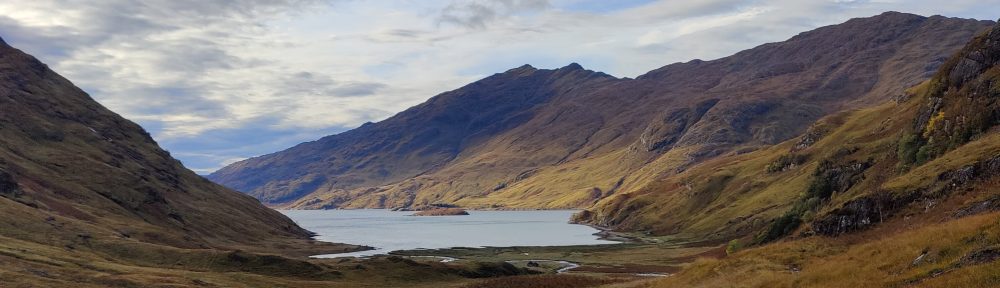
He’d been brought to the Newlands Valley, to this western shore of Derwent Water, as a boy. In that single week he had lost his heart. He loved it all: the tree-clad islands, the rounded fells, the delicate peace-drenched light at evening and early morn. As the dry sticks caught fire and began to burn, he recalled the smell of woodsmoke. This little place, this nook of old England, this quiet corner of the Lake District, was to him, a kind of spiritual centre, a place of pilgrimage.

Behind the little tent on the tree-fringed meadow by the lake, the land rose up in waves to the high tops, even at this hour, crested in sunshine. In the stillness, the sound of sheep high on the fell could be heard.

Dark Brandelhow

Two nights ago, he and the others had escaped from Force Crag Mine. They’d made their way across the grain of the country, through trackless valleys and overgrown fields, through the dark and the storm, travelling at night, hiding up in the daytime.  They’d got here late on the second night, drenched, cold and shivering, and had holed up in the ruins of an old outdoor centre.  They’d no means to light a fire, and nothing to cook even if they could. The ever-present risk of being caught, weighed heavy upon them like their cold, wet clothes.

Their pickup was to be by boat, on the lake that had been called Derwent Water. There was a jetty in these overgrown woods, near a place they’d heard was called Brandlehow.  An old jetty from better times, when there had still been such a thing as tourism. But now, these once busy woods, these unkempt fields, all the land about, were drear from decades of neglect.

Only the trees moved, roaring and bending, creaking in the wind. The rain dripped from the leaves of Autumn, and where there was no shelter, it came down endlessly, an unstoppable grey noise.

Hope ebbed away as the grey daylight grew stronger. Sheets of rain obscuring the mountainside became visible. Dark clouds were down on the high tops. Wind was whipping the water into a frenzy. Even on this lake, there were substantial white-horsed waves thrashing the stones of the shore. The wind was like a solid noise in the tree tops; the rain, relentless, dispiriting. Despair and defeat was an actual taste in the mouth. It seemed to be over. They would be stuck here, and stuck here, they would be caught.

As the daylight thickened, the weather, if it were possible, grew worse. Nothing animal or man was out and about or moving in this weather. Small furry creatures were hidden away in their burrows and holes, hiding from the storm. Such people as were left in this remote part of the country would likewise be in their homes. It was all wet leaves, mud, sodden clothes, wet hair, wet and cold feet. Hunger gnawed at them, weak as they already were from working in the mine. They were paralyzed with defeat and exhaustion, hunkered down in the woods, sheltering in long collapsed ruins, buildings that had been derelict for decades.

The crunching sound of footsteps…what was that? His heart hammered. A man appeared from around the corner of the ruined building, wearing a rain-soaked outdoor jacket made in the previous century, and a leather hat. Rainwater dripped from the rim. He had a straggly beard, and missing front teeth. He looked silently at the fugitives for a few moments, saying nothing, and yawned hugely. The three of them struggled tiredly to their feet. The stranger did not speak. He just indicated with a jerk of his head, in a voiceless movement, that they should follow him, and almost as quickly as he appeared, he was gone.  One after the other, the three fugitives limped back out into the rain and wind, their feet squelching, wet socks, wet shoes, blisters. Their footwear was light prison issue work shoes, not really appropriate for walking in wild country in heavy weather.

Following the stranger down through the dripping woods, they came to what looked like a derelict landing stage.  A rather odd-looking boat was alongside.  The boat was somehow, difficult to see. It was certainly grey. It sat very low in the wave-strewn water. Or was it grey? Was it bigger than it appeared to be? The three of them climbed onto the landing stage, each casting dubious and fearful glance at the violence and malevolent passion of the waters beneath, and thence, following the man in the hat, down onto the strange grey boat. Close-up, it looked like a launch of some kind. As soon as the men were aboard, the boat jerked violently astern, and, rocking violently, turned away from the shore. 

Fidelis ad ultimum

1.

After lunch, Mrs Smith prepared to go out. She was going to have to leave her dog behind. Her dog was a little terrier, very intelligent, but not great at being left alone for a long time. The dog was prone to what some people called “separation anxiety”. She talked to the dog as she prepared herself, telling him what was happening, informing him why she could not take him along. It wouldn’t be strictly true to say that the dog frowned, but you could see that he knew that something was going to happen that he would not like. In his doggy mind, he formed the impression that he would be taken to the vet – the worst possible thing he could think of.

Mrs Smith was in fact going to a hospice to visit the husband of her dearest friend. The poor man was dying of cancer and was not long for this world. Mrs Smith would be going to meet her friend at her house, and together, they would drive to the hospice.

As Mrs Smith put her coat on it finally dawned on little Fido that he was going to be left behind, and he started to whine.

“Stop that!!, said Mrs Smith. “I don’t want to hear it. You’ll have to put up with being on your own for a few hours.”

Stooping down, she said “C’mere”, and the little dog ran, tail wagging, to be petted and fussed over. The terrier calmed down somewhat, and Mrs Smith got back to her feet – slowly, for she was no longer a young woman. She did it slowly mainly to avoid dizziness and seeing stars.

The dog stood in the hall, quite still, as Mrs Smith left the house. The front door closed with the distinctive click peculiar to that particular door. Not for the first time, Mrs Smith reflected that no two doors shutting ever sounded alike – each door was different. That caused a moment of reminiscence as she remembered the sound of the shutting of the front door of her home when she was a little girl. Mrs Smith had a walk of perhaps a mile to her friend’s house. It was a bright fresh morning in October. Cold – but not too cold. As she walked along the street she saw the postman and waved to him, as she always did. This postman was the most cheerful and helpful man imaginable, and bore a close resemblance to a popular TV personality.

Mrs Smith and her friend were very close, and had known each other for a long time. They drove to the hospice to visit with her friend’s husband, who was terminally ill. He had been ill for some years. It is of course never easy to deal with a loved one dying in this way. Mrs Smith’s friend sometimes wondered if she was responding in an inappropriate way to the impending death of her husband of forty years. It wasn’t that she didn’t love him deeply, or that they had not had a wonderful life or deeply satisfying marriage – although with all the ups and downs you might expect of any marriage. She sometimes felt that the younger generation tended to wear their hearts on their sleeves in such matters. She was of an older, perhaps more emotionally continent generation. Her own mother had been born during the Second World War and had recounted to her harrowing stories of living through that conflict as a little girl in a family with no breadwinner.

Mrs Smith and her friend managed to have a short conversation with the dear dying man who had been so important to them both for so much of their lives. Towards the end of the conversation, he fell asleep. It was clear to them both that he was in a good deal of pain so this was perhaps a good thing. Though no perceptible signal passed between the two friends, they got up to leave at exactly the same moment. No word was spoken; none was necessary.

When Mrs Smith got back home, she knew something was wrong almost the instant the key slid into the lock. One distinctive noise, normally followed seconds later by another – the exciting yapping of her terrier as he bounded towards her in greeting. Except the second sound never came. She went into the house and shut the door behind her. Nothing seemed out of place; there was no shredded newspaper on the hall floor. No coats had been pulled from the coat rack. There were no deep scratches in the newel post at the foot of the stairs. But the dog was not there. There was quite literally no trace of him. His basket was there, but it had been there when she left after lunch. She looked all around the downstairs of her house; she checked that the doors were all locked. Fido was quite clever enough – though neither strong enough nor big enough – to trip the handles of doors and thus make his escape from a room. She checked upstairs; she checked downstairs. She checked upstairs again, looking under the beds. There was no doubt about it – the dog was gone.

Could her one of her sons have arrived unannounced and taken him for a walk? This was unlikely. Both of them lived hundreds of miles away and both had families and worked full time. Both were unlikely to come to her house alone or without giving her some notice beforehand. Could the dog have got through a door she had missed and left unlocked? No. She had left every door locked. Could a thief have stolen him? No – realistically, why would they steal such a dog? But in any case, there was no sign of breaking and entering, no sign of any disturbance of any kind whatsoever. But the dog was gone. It seemed beyond belief. She wondered for a moment, whilst absent-mindedly putting the kettle on, if she was losing it. Could she herself be struggling with dementia or memory loss issues? It was possible; since the death of her own husband some years previously she had wondered if she should remain on her own in this big old house. A wave of self-doubt and uncertainty swept over her as she waited for the kettle to boil.

But the dog was gone. She should at the very least, report it to the police and to the RSPCA.

2.

In my dream I was on holiday, sat at a little table outdoors. The table was one of two or three on a terrace at the rear of a large villa. Behind the villa are gentle wooded hills. The terrace was made of light-coloured flagstones, and at the edge, there were two small carved stone lions, worn and old, barely recognisable as lions. They were made of a darker red sandstone, quite different from the flags of the terrace and the low wall supporting them. From between the lions a few steps descended to a path through some scrubby, grassy dunes to a beach. The curve of a bay was visible; in the distance, a headland. It was a glorious summery evening in a hot country. The sky was a vault of the clearest blue, with the promise of sunset.

A waiter, wearing a cream dinner jacket and a black bow tie, appeared from the house, carrying a tray. He looked to be of Mediterranean descent. On the tray, a jug of water, a bottle of red wine, glasses, and a bowl of bread. The waiter set the tray down with professional aplomb and delivered these items onto the table, saying nothing as he did so. I looked closely at the waiter, for he seemed somehow familiar. No flicker of recognition came as he opened and poured out the wine. He nodded with grave professional courtesy, and smiled, saying, “enjoy”. And then he disappeared, walking back up to the house as unobtrusively as he had appeared.

I settled into my chair, sipping a very good Malbec, and nibbling at the bread. A tremendous burden seemed to have lifted from my shoulders; a huge task of work was now complete. I could relax. I was almost too tired to think, and quite content to just sit and look at the dunes and the beach, and the occasional wheeling sea birds, and enjoy the sunshine.

Sometime later, as the sun neared the horizon, I spied movement on the beach. People were there, of course, sunbathing and walking and relaxing, and they were moving about, but this movement stood out against that pattern as unusual. Out of the corner of my eye, I saw an unusual pattern. A hidden part of my mind noticed something odd. A large brown dog was making it’s way purposefully along the beach. The dog seemed to know where it was going, quite content to trot along past various people, with no obvious sign of a master or an owner. The dog was not wandering aimlessly with nose to the ground, as dogs do.

It came up the steps and crossed the terrace towards me, and greeted me, licking my hand briefly and allowing me to stroke him. It was a big German Shepherd, and it seemed somehow familiar. This was odd, because I’ve never owned a dog or known such a dog. But then again, this is a dream.

The dog turned around a few times, and lay down to doze. Occasionally it twitched in its sleep and thumped its tail. Time passed; evening fell, the light faded and the sunset was glorious upon the sky. By and by, the red wine was finished, and it was night. I decided to get up and go indoors. The promise of a chill was in the air – not the chill itself, just the hint of what might come later. So I got up and stretched, creaking and stiff after so long sat down. I made my way up the villa, leaving the wine glass and bottle on the table. The dog, sensing me move, likewise got up, shook itself, followed me across the terrace and into the house.

Inside the house there were a few dim lights. There was no-one about, in what seemed to be a small hotel of some kind. I went up the stairs to the first floor, and the dog followed me up the stairs. Some way along a musty and ill-lit corridor, I pulled a key from my pocket, unlocked the door to one of the rooms, and went in. The dog was at my heels, so I held the door open, and the hound went ahead of me into the room. There was a bed, a chair and a washbasin, and a simple desk. An elegant antique wardrobe stood in one corner.

Deeply tired now, and with a pleasantly buzzing head from having drunk a full bottle of good red wine, I prepared myself for bed. I did so by the simple expedient of taking my clothes off and laying them over the chair. After washing my face and drinking water straight from the tap, I was into bed, which was just sheets, after the fashion of a hot country. The dog, after checking things and looking round the room and sniffing for a few moments, found himself a place and lay down, making that curious circling round that dogs sometimes do when laying down. Lying in bed, I was happy to be able to relax, grateful for the rest and peace. It seemed again as if some great task, some mighty or immense work, some tremendous effort, was behind me now. It was accomplished. Glad I was to have been sitting in the sunset and sipping good red wine. Soon enough, I slept.

3.

And I dreamed again, a dream within a dream. I was walking my dog in what seemed to be the North Downs, something like the quiet, secret chalk valleys around Woldingham. I knew it was a dream because I don’t have a dog. I’ve never had a dog. I admire well-behaved, aristocratic, classy dogs. I like clever dogs and I like working dogs – sheep dogs for example – but I never owned a dog myself. But here, in this dream, I have a dog. This does not seem odd. This is a dream. Anything can happen, but in another sense, everything that happens will make perfect sense. I’ve always valued dreams. In my youth I wrote them all down, trying to remember them from year to year. Some classics have stayed with me all my life; others I can remember only because I wrote them down. I can remember only that I once must have dreamed that dream, but cannot recall the dream itself. I have found that the great God above sometimes speaks to us mortals through dreams and visions.

The dog was deriving immense pleasure from being required to fetch sticks. This can be tiresome after a while, but today I too was satisfied with hurling the stick into the distance. The dog watched carefully to see which way the stick would go, and then bounded off joyfully, and with endless enthusiasm and energy, to fetch the stick back. With the stick grasped firmly in his jaws, the dog crouched down, eying me, playing a kind of teasing game, not releasing the stick until it wants to.

I spied a man crossing the hillside, dressed in a Barbour jacket and wellingtons. He had the look and dress of a landowner about him. My dog bounded up to him to say hello, and he squatted down to make a fuss of the hound. He glanced up at me and I was somehow not surprised to see that the man appeared to be the waiter that served my wine last night. Or was it on a hotel terrace in Italy many years ago? And yet also, he seemed to be someone I should know.

“You’ll forgive me”, I said, “but I’m sure I know you from somewhere, but I’ve forgotten your name.”

“No, that’s fine.” He replied. “I know a lot of people and I do have a very good head for faces. I’ve known you for years, and we have met once or twice, but you may not have recognised me when we met.” He said this with a little smile.

I was nonplussed. I knew him from somewhere, that’s for sure. “Are you the owner of this land or the farmer or the estate factor?” I asked.

He gave me an odd glance before replying. “Yees, I suppose I am something of that sort. It’d certainly be true to say that I’m familiar with the country round here, and isn’t it beautiful?”

He had an odd accent that I could not for the life of me pin down or place. I’ve always loved language and accents, even to the extent of trying to understand accents in different languages. A German speaking in an Essen accent; the French of a person from Algeria; Russian spoken by a Muscovite.

“On a day like this, for sure. On any day, in fact. You’d hardly believe that London Bridge and the Square Mile is only twenty miles from this place. What I like here is that you can barely even hear the M25. I used to live in the north of England and I could do lots more visiting places like the Lakes and the Yorkshire Dales. I sometimes miss those places terribly, lovely though it is here. I remember driving through the Lake District years ago and having that feeling of returning home. I had to pull over; I was in tears.”

“Mmmm. It’s a strange thing to miss a place you once loved, isn’t it?” he observed. “Like you’re a stranger in a strange land, a country not your own. I think we’re all in exile to an extent, and that somewhere else there is a true home for us all. I guess you’re retired now?”

“Well yes, as such. I haven’t been well lately, and to be honest it’s nice to be able to get out in the fresh air. I was an engineer for years, working all over the world, and after that I had a desk job, but I stopped that years ago. Nice to do something different”. I told him about church, about being the church warden and a lay preacher, and about working with the Rotary Club, and he listened politely, nodding at intervals.

“Yes,” he agreed. “I learned my trade as a joiner, working with my dad. I worked with him fifteen years until he died, and I took over his business. Bit of general building work. Nice to work with your hands. But the opportunity to do something different came up. As I said, I look after all kinds of things now, and this land is only a small part of what I do. I do get about it a bit, travel a lot, and it’s nice, as you say, to be out in the fields and fresh air, meeting people”.

We spoke more, of my wife and our children and their families, their hopes and dreams. We spoke of the church and of the young people; we spoke of the political situation. He was quite the most remarkably courteous fellow; he never interrupted or got hot under the collar about politics, as the English often are. That accent of his was niggling me; this pleasant and well-mannered fellow was no Englishman, however well he seemed to know the North Downs. I never got around to asking him where he was from. So delightful a listener was he that the time just flew by and it was me talking, talking all the time. And yet that seemed right. I was not bending his ear, nor was he just putting up with me out of politeness. Without seeming to be too interested in me, he had the knack of giving me his full and complete attention. I know – over the years I’ve seen enough of the signs of boredom, and tried not to express them myself. The cocktail eyes, the surreptitious glance at the clock on the wall, the edginess. I remember being in an interview with a very clever and very observant priest and making every effort not to look at my watch at all – but at the end this priest said, “I know you want to get on…I’ll let you go now”. He knew, he knew all along how shallow were my attempts to be courteous. But this gentleman’s courtesy was whole-hearted. It was if the whole of his attention, the entirety of his being, was given over to courtesy and politeness.

“You’ve been wondering about my accent…”

I opened my mouth to speak but no words came out.

“It’s Syrian. My name is Maran. Maran Atha. I was bought up in the Middle East; I came here after the Syrian Civil War. It’s been good talking with you, but I think your dog” – he said this with a sidelong glance at the dog – “wants to get on with stick throwing.”

The dog was bored with all this conversation and was whining. He wanted attention. I waved him towards me and he came to me, licking my hand as I fussed over him.

“I’m sure we’ll meet again, and quite soon”, said Mr Maran Atha, looking at me with that same little smile. And I woke up.

I was back in the hotel room and the brown dog was licking my hand. The dog was whining, trying to tell me something; insistent, it would not give up. I’d no clock or watch, but bladder pressure seemed to tell me that it was later in the night than earlier. The dog continued with its whining. Coming back from using the bathroom, I peered out the window but it faced northwest and I could see nothing of dawn.

I became aware that I was still dreaming. This was somewhat confusing because I’ve just woken up from a dream of speaking to a man on a chalky hillside in southern England. A very few times in my life I’ve been in a dream within a dream – woken up from a dream to find that I am still dreaming. Though on those occasions it was only afterwards when I woke up fully that I became aware of this. Remember the old film “Inception”? I thought I’d best get out of bed, and run with what was happening.

The dog waited patiently for me to fling on some clothes. The two of us left the room, went down the stairs, through the hall and out onto the terrace. The house was quiet and dark, with the strange smells of a house not your own, and the strange unfamiliar shapes of night time. There was no night porter or concierge; all was quiet, and the door out onto the terrace was not locked. Once outside, it was clear that it was very early morning, and sunrise was at hand. The dog and I walked around the side of the house to find the eastern sky ablaze with the promise of sunrise, above the tree-clad hills. The dog trotted off ahead, and I followed along an ancient track, up the hill behind the house, towards the sunrise. It seemed to know the way. The path led through the gloom under trees and shrubs, past an old and decayed shed, unused for decades. As we climbed, the view of the bay opened out behind me, and the pre-dawn light grew stronger as the minutes passed. The dog and I climbed on for a while, sometimes steeply uphill, sometimes level and in the valleys of little streams, always through trees. Somehow it was always still just before dawn. In due course, we reached a hilltop, and the trees came to an end. Here was a flatter place, a kind of terrace. A stone wall marked the edge of the woods.

All of a sudden, in that way that occurs only in dreams, there was an odd and disorienting kind of shift, one of those strange and unexplained changes of circumstance, rather like when you find yourself running in treacle or getting onto the train dressed in your pyjamas. I had become a downed airman in enemy territory, and here was a guide from the resistance, to lead me across a frontier from a war zone into a peaceful country. A man was waiting for us, by the stone wall. He resembled a friendly waiter I’d once met, but I couldn’t be sure. The dog had disappeared.

“Hallo, my friend.” he said, “I will be your guide, anbd we shall make this last stage of your journey together. You’ll need my help”.

“Why?” I asked.

“At the frontier there is a deep and fast-running river to cross. You cannot cross it alone or without a guide to help you.” With this he looked right at me and I knew him for the man in my dream last night, when I’d dreamt of being on the North Downs.

And with no further word, the man who was to be my guide turned away and set off, and I followed him towards the rising sun.

5.

In the early morning, the phone rang, and Mrs Smith was instantly awake. She was a light sleeper in these times, the more so since the disappearance of her dog the other day. Dawn was in the air; there was light behind the curtains. Even as she reached out for the telephone, she knew who it was and what would be said. The call was from her dear friend whose husband was dying. In a few words, Mrs Smith’s friend passed on the news that her husband had died only a few minutes before, not long after sunrise.

“It was a remarkable thing,” she said. “I spoke to him last night, and he said was so very tired. But right at the end he seemed very relaxed and peaceful, after everything he’d been through.”

Mrs Smith thanked her friend and she rang off. They would meet later.

She got up out of bed, and started to go downstairs. About half-way down the stairs, she had an odd moment of disorientation when she heard the click of her dogs paws on the wooden floor of the hall. It was disorienting because it was quite impossible – her dog was gone these few days. She’d reported the loss, and had had a telephone conversation with a nice lady from the police, who in the end, was no help at all, however nice she’d been to talk to. Mrs Smith wondered once again if she was losing her senses. Not a great feeling to have when coming down the stairs at 7 o’clock in the morning in your seventies.

But no, there he was, the cheeky and intelligent little terrier, looking up the stairs at her, waiting patiently for her to get to the bottom of the stairs, as if he’d never been gone.
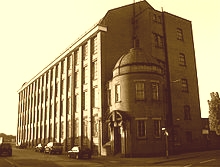
All the landscape was the mill

A crowd of ladies from a faraway land, each dressed in brightly coloured fabrics, would come chattering past the house each day. They would sweep along every morning and evening, their conversations bright, adult, and quite incomprehensible in some unknown language. The little boy asks, who are those ladies? His mother tells him that they all work in the mill at the bottom of the street.

The boy learned a lesson young: who you are and what you are can be seen from where you’re going – and when. The direction you’re walking, and the time of day, tells us something about who you are.

At the bottom of the street, a crossroads. Go left into a quiet lane past the allotments to the edge of town. Go right past a bowling green smooth like a billiard table, to a sweet shop. Straight on, to the park, to school, to Cubs. The crossroads of our lives – turn each way for different lives, different paths. People will know where you are going, when you walk through these streets. Here, brick and tarmac, there, woods and quiet shrubs and grasses. Straight on – for play, and for learning.

The sepia stains of history lie on these streets, or at least it seems so, to the boy and to the man he became. Here, a grandfather swam in an outdoor pool. There, a street where an unsmiling lady stood in a crowd of joy and cheers, struggling to see the good in VE Day. Over there, the flats, and the outlines of vanished streets. The streets are gone, but the memories remain, thick like dust, easy to discern if you’re the right sort. Listen carefully, even today, and you can hear the treble drone of bombers, or the wretched tears of poverty, the grinding life of the urban poor.

He came back to those streets in a kind of pilgrimage, thinking somehow to reconnect with the past, with the feeling of those early days. If he could represent his childhood. all the carefree years of boyhood, as an icon, that icon would be a little image of the mill at the bottom of the street. He walked past that mill every day for years uncounted, it seemed to him when he was young. Endless weeks, he went past that mill, morning, afternoon, evening. And he never went inside it, in all his life.

As a young man, he’d sat with this father watching old Laurel and Hardy movies. They were amusing; there were wry smiles. But even as he watched them, he found that they were just not as funny as they had been when he was a small boy. He’d mentioned this to his father, who’d shook his head with the greybeard wisdom of ages. “The boy who rolled around laughing on the floor at these movies, no longer exists”, he said. The boy became the man, the young man became the older man.

Could these streets ignite a kind of holy nostalgia? Could they form a harbour into which a pilgrim might sail, to sojourn briefly in the past – a visit only. Not to remain. The mill was still there; the streets were still there. The crossroads by the bowling green was unchanged. The municipal lines of alternating plane trees and lime trees in the park – still there, save for a few gaps caused by storms of old.

Walking in past the park, he’d noticed that no single youngster was out playing. It was 4.30pm on a spring weekday afternoon. The roundabouts were siezed and rusted, the swings abandoned, it seemed. Where was everybody? Where were they all? He knew, really. No Marie Celeste mystery here. Just the modern world, risk averse, focussed on itself, with smartphones, tablets and unwillingness to be out of doors.

The mill was the fixed point – all the landscape was the mill. But there was no river of bodies pouring down the street to find work there. That river had dried up long ago. Here had been a future for hands of skill. No longer. That much had changed even in his own youth. What remained now, was clearly foreseeable even back then – if you could read the writing on the wall. What had been a mill making clothes, was now a university department. It was a department covering such matters as textiles and art, so there remained a tenuous connection with what had been. On the river of time, you cannot paddle upstream. That river flows only in one direction.

He walked up the street, remembering the red and blue bricks in the pavement. He recalled cycling down the street on a baking hot day, trying to keep in the shade. The baleful sunlight of reality was upon him now, beating mercilessly on his head. No golden light of evening, nor delicate pink at dawn, but scorching tropical sunshine at noon. A sunshine, as Kipling wrote, that sometimes strikes men dead.

Yet, though saddened, he knew things had to change. There is no going back. There’s no returning to those places of golden childhood. Nostalgia is a hip-flask from which we can allow ourselves no more than a discreet sip, every now and then. If we look back, we must look in thankfulness, not in nostalgia.

Treading his way up what he thought was a dried up riverbed, he noticed that there was a new river of bodies making their way to the mill, young people, people learning. people looking to the future. And reassured somewhat, he left that harbour and sailed away back home.

Green Park

Here is a young man sketching the skeletal outlines of winter trees, using a blue pencil. Here is an older man, quietly reading a book. Here is an arrogant ass, sprawled on a park bench, with an expression like a King, as if he somehow owned the whole park. Groups of ladies run up and down. A helicopter buzzes somewhere up above – this is SW1.

A little yellow-breasted bird swoops down and lands two feet away from a Smartie, abandoned on the path. It hops smartly forward, picks it up in its beak, and flies off with it. A lucky find! Two men go past, of Mediterranean or possibly near Eastern origin, sharing the same bicycle.

A blonde lady of unknowable age, but svelte and curved in Lycra, is performing somewhat distracting (to me, anyway) stretching exercises on a nearby fallen tree, pressed in to service as a park bench.

Passing the Grand Sheraton on Picadilly, I spy a single open window amongst dozens, set against the sunlit white Portland Stone.

A review of “The Silk Roads”, by Peter Frankopan

A review of “The Silk Roads”, by Peter Frankopan

I got this book on the basis that it was about Central Asia. A legitimate assumption, perhaps, given it’s title. But no, it is not about “the Silk Roads” as such.

The expression “Silk Road” comes not from antiquity but from a 19th century German historian. Just thought I’d throw that into the pot, so to speak.

Peter Frankopan’s book is a new history of the world, starting in deep classical antiquity, and ending right now in the second decade of the 21st century.

Persia and other middle eastern “silk road” countries are mentioned early on. The importance of the nations and states through which what we now call the “Silk Road” becomes apparent, though Persia -Iran- seems to be considered paramount.

The book makes a detour, in order to gain a wider perspective, into a history of Western Europe and the adventures of Europeans in the New World.

In my view, the latter part of the book is tilted subtly against the west and against America. This is never shrill, but it is there nonetheless. In this, it only really reflects the zeitgeist. Me, I like the West, I like America, and I like what they stand for.

Overall, an excellent piece of work, in the “grand sweep of history” style which does appeal to me.

Victoria

I sat in the bar on the mezzanine level, looking down at the jostling throng. There were crowds of people, rivers of humanity, rushing streams and babbling brooks of concerns: work, life, holiday, family, health. The people flowed back and forth across the concourse, each intent on their own business.

And it seemed to me as I sat in the bar, nursing my beer, that amongst the swirling crowds, that sea of people, just a few of them stood out. Across space and time, I saw a handful of people crossing this station concourse.

A man – two men – in morning suits appeared as from the pages of history. It was 1957. Britain was only slowly recovering from the austerity of rationing. There was a greyness, a grim and drab feel to the station. These two young men were rushing, desperate to catch their train to Dorking. For it was a special day for them both. One was a Best Man; the other, the Groom. They had been in what seemed like an endless queue, and somehow, they had convinced the staff of the railway company to let them jump the queue and get on. Now, at least, they were almost on the platform and on their way.

I took a pull at my pint, and when I looked down again, the scene had changed. Soldiers streamed across the station. Orderly ranks, serried columns. Rifles, rucsacs, the harsh shouts of sergeants. These men were entraining for Dover, bound for Flanders field. The hopes and fears of a generation of young men are hidden on a thousand faces. Here is a young subaltern, pink of voice and cheek, bravely concealing his worry, doing his best, biting his lip. His men may have to depend on him being strong.

Back in the present, I see a young lady, a refugee from war, crossing the station carrying everything she owns in one immense suitcase. Three young children accompany her, silent, scared, intimidated by the noise and crowds. Their mother knows only a few words of the language; she holds little or no currency. But she and her kids are in a better place by far than where they were before. .

Here is a youth in his eary twenties, visiting the big city for the first time. perhaps. He’s crossed by tube from one of the great northern terminii, and must now make his way to a small town in Kent, for a job interview. Days before, a mighty storm leveled trees all aross the south of England. He will soon travel by bus through all that chaos of fallen branches and broken limbs, from a town whose very name has been rendered a lie by the storm.

The scene changes again and I see a man carrying a small grip crossing the station. The crowds have all disappeared and the grey light of early morning can be seen in the glass roof. He has come up from the underground to find it pouring with rain. He pauses for a moment to take in the scene. Rain cascades from the gutters. The tarmac gleams wet in the reflected street lights. He crosses the forecourt, taking in the calm of early morning. The rain, the sound of the rain, calming his nerves, as he makes his way to the airport train and the other side of the world.

A review of Sapiens, by Noah Yuval Harari

A very readable canter through the entire history of humankind, from pre-conscious apes out on the Savannah, through to the possibility of post-human cyborgs and immortality.

Harari has taken a humanist and atheist standpoint throughout, which I found challenging and upsetting in places. I was warned by the person who recommended the book to me (who knew I was a Christian) that I would find it challenging. And it is, and rightly so. But my faith in a transcendent, caring and personal Cod is not shaken by the work of this liberal academic. Some might say I’m too thick to understand.

He has expressed some outrageous and refreshing ideas; a key theme throughout the book has been to question the established wisdom on economics, politics, history, culture and language. I was particularly impressed with his chapter on the individual, the market and the state, noting that the free market cannot really survive without the state. He avoids the espousal of Socialism, but manages nonetheless to articulate the main flaws in the free market, capitalist system. He acknowledges that, notwithstanding those flaws, it is that same system that has brought us so far this last five hundred years.

He notes that European cultures prevailed over comparable or even superior Islamic and Asian cultures because of the concept of credit. What he does not say is that there was little choice. Kings came before Parliaments seeking money: they needed credit, generally to fight wars. This development, of itself, fueled the rise of Parliaments and of democracy.

His final remarks on the future seem ill-at- ease and somewhat hurried. He describes a number of ideas as if they were new- ideas like immortality and post-humanity, cyborgs, genetic modification of people, to name a few. Some of these ideas have been discussed by modern science fiction writers such as Paul McAuley, Richard Morgan, and Alister Reynolds, for decades. He goes on to confuse science fiction as a whole genre with that small sub-genre we call space opera, demonstrating a perhaps understandable ignorance of sci-fi at the very part of his work that would call for an understanding of it. But his final chapter does articulate some of the potentially dreadful and also potentially changing possibilities that lie ahead of us.

Overall, refreshingly positive in outlook, once you are past the early sections where you could be forgiven for thinking that the author does not like the human race. Me, I do like the human race. I think it is excellent. I am a member.

The interview

The interviewer glanced sharply at Igor. Whilst she did not actually move her eyebrows, he had the impression that she did not approve of him.  Negativity and discouragement seemed to come off her in waves.  He made a conscious decision to gather up his courage, taking it up about him as if it were an actual cloak; with an effort, which he hoped was concealed, he held her gaze steadily.  He’d been through battle, through fire and storm; he had no need to be afraid of such as she – and yet, he was. But where had she been at Yekatarinburg? Had she attained to battlefield promotion? Had she seen what he’d seen, done what he’d had to do? Yet, he knew in his heart the answer to all those questions.  The interviewer was an air force officer and very much senior to him. She was a combat veteran – we all were. She would have seen as much action as he, if not more than he.

She took a short intake of breath, as a precursor to speaking.  Ages passed in an instant.  All time seemed to him to stand still in that single moment between her little intake of breath and the words that he knew would follow.

“OK, Major. Thank you for time and for joining us today. The panel will consider your application and we will let you know in due course.”

And that was that.  He had hoped against all hope that he would know in the interview itself, though he should have known better. He would have to wait. He arranged his face in what he knew would appear as a grave and formal military mask, and thanked his interviewer.  He pushed back his chair, rose to his feet, and saluted the officers of the panel. And he left the room.

“What does the Group Captain think?” asked one of the other two members of the panel, once Igor had left the room.

“He’s easily the strongest and most able candidate we’ve seen so far. A definite.  I don’t want him thinking he’s God’s gift to Mother Russia though, so I had to take a stern line with him in the interview. If he has a weakness, it’s that he will tend to see things in black and white.”

“That could be his downfall” replied the Army officer to her left.

“Indeed.  In these times, the need is for balance and nuance, for political nouse, for treading carefully through the post-war wreckage and taking forward what is right, but letting go what is not right, whilst not condemning it overtly.”

“Letting the old, bad ways wither on the branch”, put in the Army officer.

“Tochna” replied the third officer, heretofore silent. Precisely. “Much is at stake.  Stray but a little to the left or to the right, and our new-found strength will snap in our hands.  We would not wish to return to the past.  Russia has moved a long way during and after the war.”

There’s a new young man at Tony’s

There’s a new young man behind the counter at Tony’s coffee shop.  Young, good looking and Italian – of course Italian.  As Italian as they come.  Thick black hair, olive skin, white teeth, lots of gesticulation.

I once knew an old man who spoke perfect Italian.  As a soldier in the war, he’d been set to be a translator, during the Italian campaign.  He told me once that he’d grabbed an Italian officer by the hands.  He’d took hold of both the guy’s hands, and held them still.  And the poor chap was speechless.  Literally.  You ever met an Italian man who could say anything without moving his hands? I reckon this new chap behind the counter at Tony’s will be like that.  I saw him talking – no, gesturing – to one of the waitresses.  He’s very energetic and outgoing.  Cram full of energy, like Tony used to be.

“Issa good job amma fromma Sardinia” Tony once said.

These days, Tony looks a little careworn.  Particularly so, since his mother died – you know what Italian men are like with their mothers.  Tony’s black hair is edged with grey.  Look closely at his eyes, and you see care.  You see concern.  Tony has a kind word for everybody.  An older man’s friendly kiss for every young mum.  A hug and a chuck under the chin for every baby. A handshake for every man. Tony knows everybody’s name.  And now he has a new man behind the counter.  A new generation is coming, taking up the mantle, ready to continue in his footsteps.


Every glass tells a story

A selection of glasses seen here after washing up. Each glass tells its own story. Each glass has a history.

The red wine glass at the rear was made by my brother-in-law.  It is one of a pair gifted to my wife, his sister. They are not quite identical. My brother-in-law does a little glass blowing, or at least, he used to. He is a skilled craftsman living at Winsley near Bradford-an-Avon. See http://www.metal-arts.co.uk.

The pint pot on the right at the rear was a gift to me from my first employer. I got such a glass by serving on a commercial survey ship over Christmas. Originally I had three of them, one for each Christmas I worked offshore.  Two of them are now lost. One of these, I broke at New Year any days after I was given it. This was a long time ago. This glass dates from the late 1980’s. It is Norwegian lead crystal, engraved with the name of the vessel. And thereby hangs another tale.

The two sherry glasses in the middle are all that remain of a set of six which my wife and I received as wedding presents these 27 years ago. There were wine glasses too, and also, whisky tumblers. Most of them are now gone. As a married lady I know once remarked, “we’ve been married quite long enough that much of the crystal originally given us as wedding presents is long gone.” You can tell the half-life of a marriage by looking in the glass cabinet.

The small crystal glass on the right was inherited from my mother-in-law. It is one of six, very small, and they see much service for drinking malt whisky.

The silver tankard in the foreground is from my wife’s Aunt Josephine, who died last Spring.

2017 in reading

It has been a challenging year in a number of different respects. Difficulties at work, family bereavement, complexities in my volunteer role as a senior Scouter.

I’ve read nearly fifty books in 2017, though some of this reading will have been comfort re-reading – a bit like comfort eating or comfort shopping, but healthier. We’ll look at some of the more edifying reading, as well as some of the comfort food, here.

Peter Frankopan – The Silk Roads

I started off the year reading this excellent overview of world history from the standpoint of trade.  Trade goes along roads.  This was a history of the world in roads, and had little enough to do, however excellent and readable, with the Silk Road or with Central Asia.

Stephen King On Writing

Perhaps the best and most inspiring read of the year, recommended to me by fellow members of the Woldingham Writers Group.  This was an encouraging and stimulating autiobiography, telling the story of how King wrote his first novel – “Carrie” – in his lunch breaks whilst working at a laundry. 

Stephen King – The Stand

Thought I’d re-read quality fiction after my interest in Stephen King was re-ignited by his autobiography on writing. The opening paragraph is unforgettable, classic Stephen King – “Arnette, a pissant four street burg in East Texas”.  Yet, he is never disrespectful of such a humble place or of the humble folk who hail from ordinary places.  King’s heroes in The Stand are not the Walkin’ Dude or the old lady Abigail, but common folk like Stu Redman, hailing from “pissant four street burgs”. 

Nicholas Monsarrat – The Master Mariner

Read masterly fiction – it should sharpen your eye and make keen your appetite for good writing. This is classic tale weaving.  Our hero Matthew, guilty of cowardice at a battle in the 15th century, is cursed by a witch to live on and on until he learns courage.  Clearly he had not managed it by the time of Trafalgar, centuries later.

David Eugene Smith and Louis Charles Karpinski – The Hindu-Arabic numerals

This is a nineteeth century work on the history of numbers, and is, for something hailing from that era, surprisingly accessible and informative.

Len Deighton – Declarations of War

Another fine writer whose work we would do well to emulate.  Deighton here brings us a series of short stories about war, some with amusing twists in the tail. We read one about the rise of right-wing politics amongst honourable and upright men – ostensibly in the UK – and only in the last lines  do we see the name of Herr Goebbels mentioned.  In another, men battle in the home counties against the German invasion, as the front rolls inexorably toward London.

Richard Morgan – Altered Carbon

Richard Morgan’s characters are bitter and twisted.  You don’t need to read more than a few dozen pages of his fiction to feel anger and frustration boiling off the page.  Here we have a dark detective story set in the San Francisco of 500 years hence.  An immortal man has killed himself – and it is important to find out why.

Chuck Palahniuk – Fight Club

Why did I read this? It was on my daughter’s shelf.  It was certainly compelling, but ultimately a futile read about a futile subject.  And in any case, the first rule of Fight Club is, don’t write about Fight Club.  I should point out that I never watched the film, nor ever will I watch it.

W.H Murray – The evidence of things not seen

For me, the long-awaited autobiography of celebrated Scottish climber and environmentalist Bill Murray.  His work “Mountaineering in Scotland” is one of the best pieces of mountain literature available.  In this longer work we see the whole of Murray’s life laid out before us, from childhood, through his war service as a tank commander in the Western Desert, imprisonment in Germany, and onto his work in Everest reconnaissance in the Himalayas after the war.

Bruce Sterling – Holy Fire

I like Bruce Sterling; this earliest of the “cyberpunk” authors here tells a rather odd story of an old woman who through late twenty-first medical technology, is restored to full health and youth.  The holy fire, I think, is that of youth.

Peter Fleming  – Bayonets to Lhasa

Peter Fleming was the older (and today, less well-known) brother of Ian Fleming. Both brothers were capable and gifted writers. Here, Peter Fleming writes an account of William Younghusband’s assault on Lhasa in 1904.  It is an essential piece of reading for anyone like me interested in Central Asia or in “The Great Game”.

A. N Wilson – Our times

Another sweeping historical perspective work, covering the new Elizabethan era – our times – from the mid 1950’s until the early noughties.  Much changed in the first four decades of the reign of Queen Elizabeth II.  But, it might be said that more has changed in the UK since A. N Wilson finished this book, than in all the forty years before.

Geoffrey Wellum – First Light

A delightful boys-to-men account of a youth who longs to fly, joins the RAF, and becomes a great pilot, taking part in the Battle of Britain.  Even as I write this, I am reminded of Robert Mason’s classic “Chickenhawk” which tells a very similar story about a helicopter pilot in Vietnam.  But Wellum’s account is stiff upper lip throughout.  Mustn’t grumble, old boy….

J D Vance – Hillbilly Elegy

J D Vance has been condemned as a “poster boy of the right” for his Republican views, but what he surely is, is an example of conquering adversity and winning through against the odds.  It is the story of how a boy from the backwoods of Kentucky,  a hill-billy – made good.  Three things contribute to his success: the faith, love and support of his grandmother; serving in the Marine Corps, and a certain amount of luck.  Other reasons are available: ability, charm etc.  A very inspiring read.

Isaac Asimov – It’s been a good life

I set out deliberately this year, to read autobiographies of great writers.  Find me someone who thinks Asimov was not a great writer, and I’ll find you a fool.  Isaac was blessed with a mind far sharper than most of us, and as a writer was energetic, prolific, and wide-ranging in interest.  John Campbell said of him, I think, “Isaac Asimov once had writer’s block….it was the worst ten minutes of his life”.

Rick Broadbent –  Endurance – life of Emil Zatopek

This was encouraging to me as an erstwhile and very amateur 10km runner.  I first heard of Zatopek when I was just a boy.  I recall reading about his amazing triple triumph at the Helsinki Olympics in 1952. That year, he took the gold medal in the 5000m, 10000m, and in the Marathon.  I found the book much more interesting in the first half, which dealt with Zatopek’s upbringing and his early success as an athlete.  The second half, dealing with his fame and his struggles with the Communist regime in Czechoslovakia, whilst important enough a subject, I confess I found less stimulating.


R.A Heinlein – The unpleasant professional of Jonathan Hoag

Representing the many sci-fi books I read this year, this is Heinlein’s only real horror story.  It would make an excellent movie if only someone would write the screenplay.  The story opens with a man trying to find out from a doctor what the substance is that is stuck in his nails. He goes on to hire a private detective – to find out what he does for a living. After that, things get macabre.

Hampton Sides – Blood and Thunder: An Epic of the American West

This was spot on: whilst at one level, a biography of Kit Carson, at another level, it is a biography or history of the American nation in the late nineteenth century, as the imperial expansion out to the Pacific was made reality by the grit, determination and plain nastiness of men like Carson and his mentor Fremont.  A very worthwhile read.

Tim Harford – Fifty Things that Made the Modern Economy

A first rate canter through some interesting technical and cultural developments that shaped the modern world.  The book is basically an extended version of some chats given on the BBC World Service.  I wasn’t sure which one of the fifty I would have chosen, if any, as the most important, but if I had to pick any one, it would be the JOint Stock company or the concept the Limited Liability Company or LLC.

Len Deighton – SS-GB

I remember when this came out; I tried to read it then as a youth and could not make headway against it, however well-written it is.  Len Deighton is a master of the written word and you’ll learn a lot by him: read him, emulate him.  Unsurprisingly much-copied, this is the grand-dad of all alternative history spy thrillers.  I was particularly gratified to find in his story that the side-streets around the back of Victoria Station, on Vauxhall Bridge Road, were considered one of the roughest inner city areas in Europe.  Go there now!

Tim Marshall – Prisoners of geography

I go this in a charity shop in St Ives. A most excellent account of history as seen through maps, cartography and the importance of where you live, where your country lies.  Straits, river mouths and estuaries, mountain ranges,  cliffs and forests – these are the difference between life and death, wealth and penury.  Even in the days of cruise missiles and cybersecurity, your location still matters.

In a country churchyard

We have experienced a quintessentially English village hall wedding, that of the daughter of a dear friend of ours. I am moved to create Chaucer-like descriptions of some of the main characters, the chief set piece scenes.
I took a day off to make the journey from my home to the place where the wedding was being held. My wife preceded me by car, to offer help to the bride’s mother. On a sunny morn I went on foot from London Bridge to St Pancras, stopping to look in the outdoor equipment outfitters in Covent Garden. I stopped in a café on Shaftesbury Avenue, before pushing on through the streets of this great city. Whenever I walk in this town I am accompanied by the shade of my wife’s dear Aunt, who died at the beginning of April this year.
She knew this town, and I oftimes walked these streets, especially the streets around Bloomsbury, on my way to have dinner with her. Those walks are memories to treasure, for I shall never again have dinner with her. But we press on, and remember well.
Recall from our C.S Lewis, how Screwtape rages when his young devil allows his “client” to do something he really likes doing. Be it a walk by the river and a cream tea; be it a deep scented bath with candles; be it a glass of lager and a Club sandwich. Or a walk through the streets of this great city.
Arrival
People close to the bride’s family gather in the days before the Great Day. For months prior to the event the bride’s mother has been preparing decorations, ordering drinks, planning settings. On a hot Friday I journeyed by train from Surrey, arriving by omnibus at a village in the flat, big-sky country of the Trent valley, at 6pm on a sweltering summer evening.

The bride’s mother, the bride-to-be herself, my wife and oldest daughter (one of the Bridesmaids) and a host of other ladies, including the groom’s mother, are preparing the Village Hall. I am minded of the Natalie Merchant song “My sister Rose” about a similar village hall wedding in the USA. In other rooms, ladies in black Lycra do synchronised stretching. Kids gather for a karate lesson.
Tables are endlessly adjusted – a foot left here, one a bit forward and slightly to the right there. Eventually the tables are arranged to the satisfaction of the bride, whose critical eye sweeps over the tables one last time. It is time now for table cloths and place-setting. All wash their hands. We do not now leave the hall until the table has been laid for all the guests. Vintage china, napkins, glasses. It has to be just so. The sun is low on the sky before we set off back to the bride’s mother’s house for a well-earned drink ourselves.

The morning of the wedding
Immense quantities of Prosecco, wine, beer and soft drinks are transferred to the hall, in fridges and cool boxes. Cake, cheese, rolls, sandwiches: food is delivered to the kitchen in the hall, which has been scrubbed to within an inch of its life. Eventually, after much going back and forth, all seems ready and it is time for the labourers to scrub up and put on their glad rags, and become magically transformed into guests.

The rain
As we put the orders of service into the church, it starts to rain. It has been a long time coming; we could see the storm approaching all morning. The rain drums on the roof of the ancient and lovely church, and for a moment we are happy to be trapped inside. But only for a few minutes. In ten minutes it is over; in an hour, little sign remains of the downpour.
The gathering and the wedding
Guests start to arrive about an hour before the service is due to start. They gather like birds of paradise in their bright clothes, near the ornate lych gate on the main road. The groom’s mother recalls that the groom’s party arrive in a body, striding down the road toward the church like a western posse. Eventually, all are gathered in the cool of the church. 1pm comes and goes. Some of us discuss, in low tones, how fashionably late the bride will dare to be. At the altar, the groom and his best man stand, looking nervous. This is possibly the one occasion in the life of a young Englishman not schooled to military service, when he must stand up straight and look smart for a long period of time.
The conversation of the waiting guests dies down, and an expectant hush fills the church. It is 1.15pm. “All stand” rings out, though some of the guests can hear the vicar saying “excellent, excellent” as he has forgotten to turn off his throat mike. All are on their feet, ready, and the bride with her father make their entrance
“…dressed in simple white, wearing flowers in her hair,
Music as she walks slowly to the altar” (Chris de Burgh)

Classic English hymns – Jerusalem, Thine be the Glory – are drowned out by a brass band in this small English country church. The readings are taken. Firstly, by an elderly lady friend of the bride, who reads slowly, beautifully, and with the greatest dignity, and secondly by the bride’s grandfather, a devoted Christian man whose soft Geordie accent and clear faith illuminate the words.
At the Signing of the Register, the band play a wonderful and moving piece written by a songwriter known to many of us. This is the brass band’s finest moment, and it is achingly beautiful. And then, out into the churchyard for the photos.
A bridesmaid approaches my wife discreetly, holding some keys. The confetti…it is still at the bride’s mother’s house…might we fetch it? Off we go on a short car journey, a Confetti mercy dash, and the day is saved. No-one is any the wiser.
The afternoon tea
To the village hall, on foot. A journey of a few hundred yards on a pleasant summer afternoon. Eventually, after standing around drinking Prosecco for a time, we’re all seated in our places. The warm wind billows the curtains in through the open French doors. More Prosecco. And then there is cake and sandwiches, served on vintage china. Tea is brought in, in large teapots.
We are sat at a table with two very similar looking brothers in their late fifties, uncles of the groom. One has a teenage son with a thin shadow of a moustache. The youth wants to be a professional footballer, but is refreshingly reticent about this ambition. The other person at the table is the wife of one of these two brothers, an attractive lady in a red 1950’s style dress. She and her man have been married 44 years, and they both look good on it. It becomes clear in conversation with this lady – she has a certain look about her – that she is involved in the Guide movement, and indeed, was once a District Commissioner for Guides.
The elderly couple
Here are an elderly couple – let’s call them Jill and David. They have been married 60 years; old and frail they seem, but they are not as frail as they look. Each week David visits his elderly brother in a care home near Stockport, travelling by train from their own home in retirement, which is near Brighton. To make regular return train journeys between Brighton and Stockport would be an achievement for anyone in twenty-first century Britain; for someone in their eighties to do so, is a demonstration of immense commitment and love. This lovely Christian couple were the bride’s landlords during some of her time at university. Indeed, they became friends with the bride and offered her the full hospitality of their own home. David was a consultant surgeon and speaks with a lovely cut-glass English accent – though he is ostensibly of more humble origins than his wife. To my eyes he bears a startling resemblance to the TV naturalist Sir David Attenborough.
He spoke of a wedding he attended in Edinburgh, at which there was a fight. Someone in this fight got their thumb bitten off. David recounted how the wound, infected as it was with baccal bacteria from the mouth of the assailant, smelt of halitosis – bad breath. We feel assured that David played a full part as a surgeon in returning the victim to full health.
He spoke of struggling to get to his own wedding. He and his best man were at Waterloo, trying to get to Haslemere by train. And there were immense queues. Somehow they made it on time – this was 1957. It was said of this couple that they found their own wedding reception (controlled and run as it was by their parents) so stultifying, boring and bound by the conventions of the day, that they made their escape, hid under some railway arches and then took train to the Isle of Wight for their honeymoon. Wonderful. Literally true to say, you couldn’t make it up.

The tools

From underneath the coffee table, he drew a heavy wooden box, opened it, and showed me some of the tools inside.

“These chisels belonged to my grandfather”, he said.  “I cleaned them up, put these new handles on, and then I sharpened them”.

The thickness of history was upon the box.  He showed me the contents with the reverence of a man who had a deep love for things.

“This belonged to my dad”, he said, showing me one tool. I could not guess what it might be used for.

“What’s it do?” I asked.

“It’s for creating straight edges and angles”, he said, holding the tool in his scarred craftsman’s hands with a satisfaction that was almost palpable. Here, I was in the presence of greatness.  It was for him to speak, and for me, to listen.

“These here”, he continued, unrolling an old leather bundle of a dozen or more wooden-handled metal tools, “are wood-carving tools.  It was a set like this I gave to Andy.  These are much nicer, though.”

“What would they cost today?” I prompted, knowing that he would have something  to say about it.  He thought for a moment.

“Sixty, eighty quid each? But you can’t get tools like this any more.  These are real quality.  They are from before the first world war.”

Moral ground zero

In significant moments
At times of great growth
Life on the anvil
Is really no joke

Change swirls around us
Upending our lives
Help us to cope, Lord
And do what is right

The kids are all gone now
They have faraway beds
Out in the wide world
Earning their bread

Our elders are passing
Who shaped us in love
We walk in their shoes now,
We are those we loved

We must move on now
Press on to the goal
Run that long race, Lord
And in time, become whole