Peak travel?

Travelling to London for work, I find that my train ticket with East Midlands Railway is “cancelled”. The female guard was quite polite about it; she caused me to fill in and sign some kind of penalty notice, and then encouraged me to appeal against it. It was only when I started to look into filling in this appeal form whilst sat in the train, that I started to encounter grave difficulties. And I got to thinking about infrastructure. Here I was, in the third decade of the 21st century, working on a modern laptop, with a modern smartphone, whilst sat on a twentieth century train trundling along at barely 100mph on twentieth century tracks.

South of Kettering, the catenary poles flash by, reminding us of the half-forgotten electrification of the Midland Mainline from London to Sheffield. That particular project has been cancelled. It has been started, and cancelled, and started again, and then cancelled again, according to some arcane and unknowable Department for Transport agenda. I’ve written about the D(a)fT elsewhere on here and noted that the Scots have a much more sensible attitude to railway electrification – that is, do as much as possible, as fast as possible. But that calculus doesn’t seem to apply to England.

The list of half-cocked railway infrastructure projects is not short. There’s the Borders Railway (part of the closed Waverley route from Edinburgh to Carlisle) which was rebuilt on the cheap with a single track; there’s the half-finished electrification of the Midland Mainline, and there is the absolute shambles of HS2, which has become a national embarrassment. Infrastructure does not seem to be a strength of the English. We seem to have forgotten how. And yet, it can be done, it has been done, it could be done. It certainly needs to be done. It is my understanding that Heathrow’s Terminal 5 was built by the contractors of the former British Airports Authority, on time, and on budget. (That it wasn’t actually opened on time is rather a different story, I think, and maybe more to do with British Airways.) So, it is possible.

But it’s not just railway infrastructure that is creaking. I’m trying to work on-line using EE’s mobile phone network. One might expect a usable (more than 5 MB/second) data signal pretty much everywhere in central England. You’ll not be getting that with EE on a Midland Main line train to London. Other providers may do better; this railway may pass through remote “black spots”. After about five or six attempts to do some basic work, I had to give up for lack of internet access. It was quite literally a waste of time. I understand very well the need for competition and a free market, but the way cellular mobile phone infrastructure is organised in the UK, does not provide best value to the customer. In some places and at some times there are overlapping competing services; at other times and in other places, there is no service at all. One buys a new mobile phone, and the sales team will tell you what colour it is, how shiny it is, how good the camera is – when all I want to know is, does it work in my front room? Does it work on the train in the heart of England?

In a few weeks I will take train with LNER, from Kings Cross to Newcastle. I will sit in a Japanese electric train which will take about 2 hrs and 45 minutes for the journey up the East Coast Mainline. Sounds great! What’s not to like? I’ll tell you what: the journey took three hours forty years ago in 1984, using the Intercity 125 – 1960’s technology diesel trains. There’s not much laudable in a modern western country about a train that takes 165 minutes to travel 245 miles, not when the French can journey from Paris to Lyon – a train trip of equivalent length – in 120-130 minutes. Although I suppose we should be thankful for small mercies: to drive from London to Newcastle will be five hours if you’re lucky. And on that note…

I used to know a fellow in East Surrey who as a boy in the 1960’s went on holiday with his family to Devon. Each year they would set out, driving along the A25, and so on through the A-roads to the A303 and on down into the West Country, taking a very long and full day in doing so. This was before the M4 was built, and long before the M25 was built.

There was a time, forty, perhaps fifty years gone by, when you might have driven from London to Derby along the M1, in not much over an hour and a half. You’d be speeding of course, but that’s neither here nor there. I have heard of someone driving from Edgware Road to Derby marketplace in 97 minutes. I myself (albeit very late at night and back in 1995) once drove from Heathrow to Derby in 105 minutes. Journey times like that would be impossible today even late at night, what with roadworks, heavy traffic, and the practical certainty of an automated speeding fine.

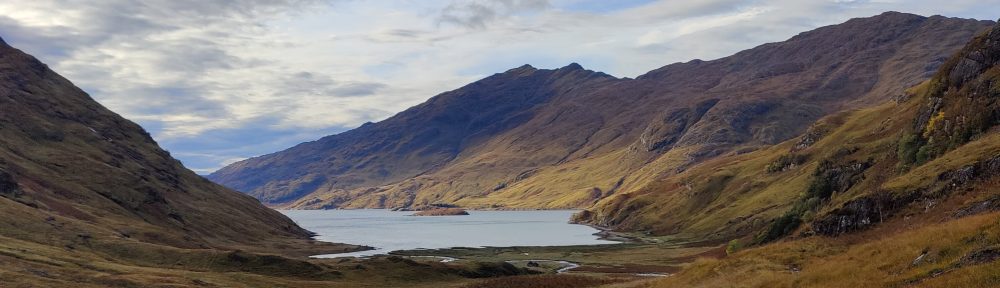
The road across Rannoch Moor, a road that thirty years ago you might safely drive at 90-100mph, is today literally – not metaphorically – a white-knuckle ride at 70mph. The reason is, the road is barely maintained any more and is deteriorating rapidly. In a few months time I will be driving from the Midlands to the Scottish Highlands: I expect the journey to take longer than a similar journey would have taken thirty years ago, primarily because of much heavier traffic and more roadworks. I will say nothing of “average speed cameras”.

I wonder that we in the UK have reached not “peak oil” or anything of that sort, but “peak infrastructure”. For all of my life, we have more or less assumed that there has been, and there will continue to be, improvement in transportation infrastructure. We took it for granted that roads are better, faster, and wider than they once were; that railways are more modern, with shiner, speedier trains than in the past. That has pretty much been the case for the whole of the twentieth century. Overland journeys in the UK, whether by road or by rail, became quicker, easier and more comfortable. But now, I think that has changed. In my view we can now look back at “peak travel”. I suggest that there was a moment sometime about 20-25 years ago, when transport in the UK stopped getting better, faster, and more efficient. Now it only gets worse.
The High Peak Trail – by bike from Edale to Whatstandwell in 2004

A propos of this rather excellent Go-Pro timelapse footage of a cycle ride down the High Peak trail, https://youtu.be/mbttC49o5Hg, here is a slightly slower but just as interesting account of a similar journey taken in 2004 before Go-Pros were invented…

Arriving at Edale Station at 10a.m, I set off uphill, and was soon walking… Nevertheless 10.25a.m saw me at Hollins Cross on the Mam Tor ridge. You could not walk from Edale Station to Hollins Cross in twenty five minutes. Thence riding and walking up to Mam Tor, and carrying my bike down the stairs to the road. Thence down Winnats (peaking at 37mph just before the Speedwell cavern), through Castleton and up into Cave Dale, where I had once again to carry my bike, so rough was the ground. I was up and out of Cave Dale and onto the moor, whence I lunched, at 11.35a.m. Then onwards over bridleways, quite slow going, bringing me down through some quite delightful woodlands to Peak Forest on the A623. I came east a few miles along the main road – unpleasant work, mostly uphill with heavy freight traffic sweeping past me, and very little safe room to walk the bike – and then struck south to the west of Tideswell, along minor roads firstly, and the Limestone Way secondly, bringing me to Millers Dale after a decent interval, again mostly by bridleways.

From Millers Dale, up along “long lane”, another bridleway, strongly upstairs, to the A6 at the western end of the Taddington bypass. Through Taddington and further south again, minor roads leading me to the “Bull in t’ Thorn” on the Ashbourne-Buxton road for a much needed pint at a little after 1.30p.m. Thence a hundred yards or so to Hurdlow. The first section of the ride was over – 20 miles in a little under four hours. Very good riding but quite slow. At least five miles on foot, maybe as much as a mile having carried my bike.

I hared off down the High Peak Trail, whizzing through Parsley Hay about 2.05p.m. This were my target points – Parsley Hay by 2p.m, High Peak junction by 3p.m (I gravely underestimated the time and distance – nearly 18 miles – from Parsley Hay to High Peak junction.) So concerned was I with keeping my speed up, that I missed the junction and continued burning down the Tissington Trail, only realising my mistake at Hartington signal box! I was able to cut a couple of miles across country on a bridleway, getting myself easily back onto the C&HPR.

Thereafter, a very long leg with only one or two brief rests, along the railway track, which due to the pace I was having to sustain, was only slightly enjoyable. With increasing saddle sore and tiredness, wrist pain and thirst, I came to Wirksworth a little after 3pm. I had made 32mph down Hopton Bank, but so slow was my progress (8mph) down the much steeper Middleton Bank, that I abandoned the High peak Trail and went down the much faster main road into Cromford, arriving at Cromford Wharf at about 3.25pm.

I had planned to arrive at High Peak Junction – still a good mile away – at 3p.m. I was running very late and had been thinking about that for well over an hour. It wasn’t that I couldn’t make it home, it was that I wanted to be home in time to get showered up and ready to take Cubs at 6.15p.m. Had I rode all the way home to Derby, I should have arrived, very tired and very stiff, and most likely well after 5p.m. I needed a break with the trains. So I was very pleased when, almost as I turned into the car park at Cromford Wharf, the clickety-clack of an approaching northbound train could be heard across Cromford fields.

I now knew that all I had to do was ride along the towpath through to Whatstandwell station in the time it takes the train to run up to Matlock, rest a while and set off back again. I  figured I had a little under half an hour. I pushed very hard along the tow path, hindered in the first mile by pedestrians, and I had to draw on inner reserves to keep the pace up as I drew near to Whatstandwell. I was constantly expecting to hear the sound of the train running through the woods, signalling that I would have to ride all the way to Derby. But, I need not have worried. I was ensconced on the station at Whatstandwell after a fifteen minute dash, and the train did not arrive for another ten minutes. An excellent day out in the White Peak.

China by train

From Guangxhou to Guilin by bullet train

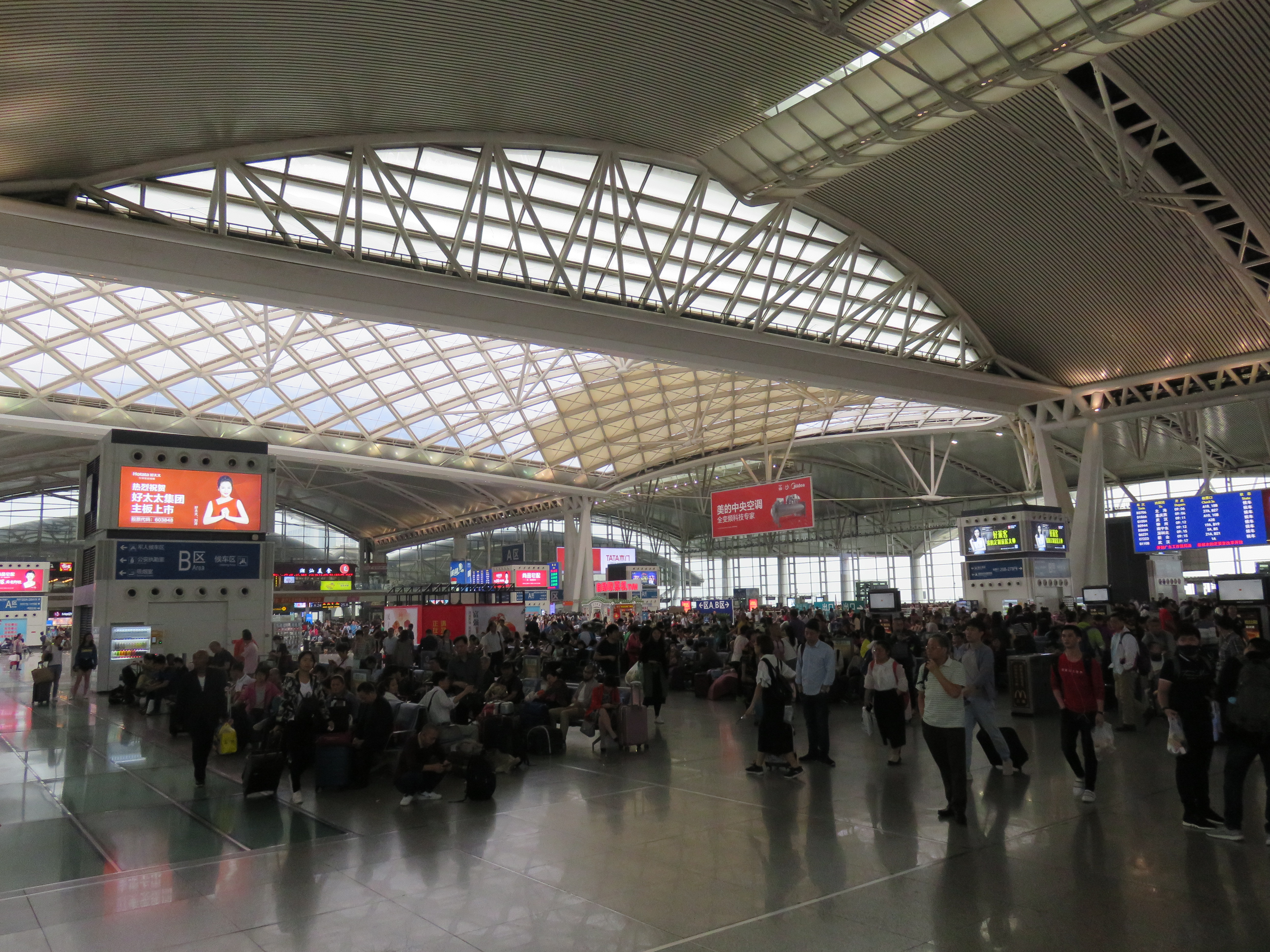
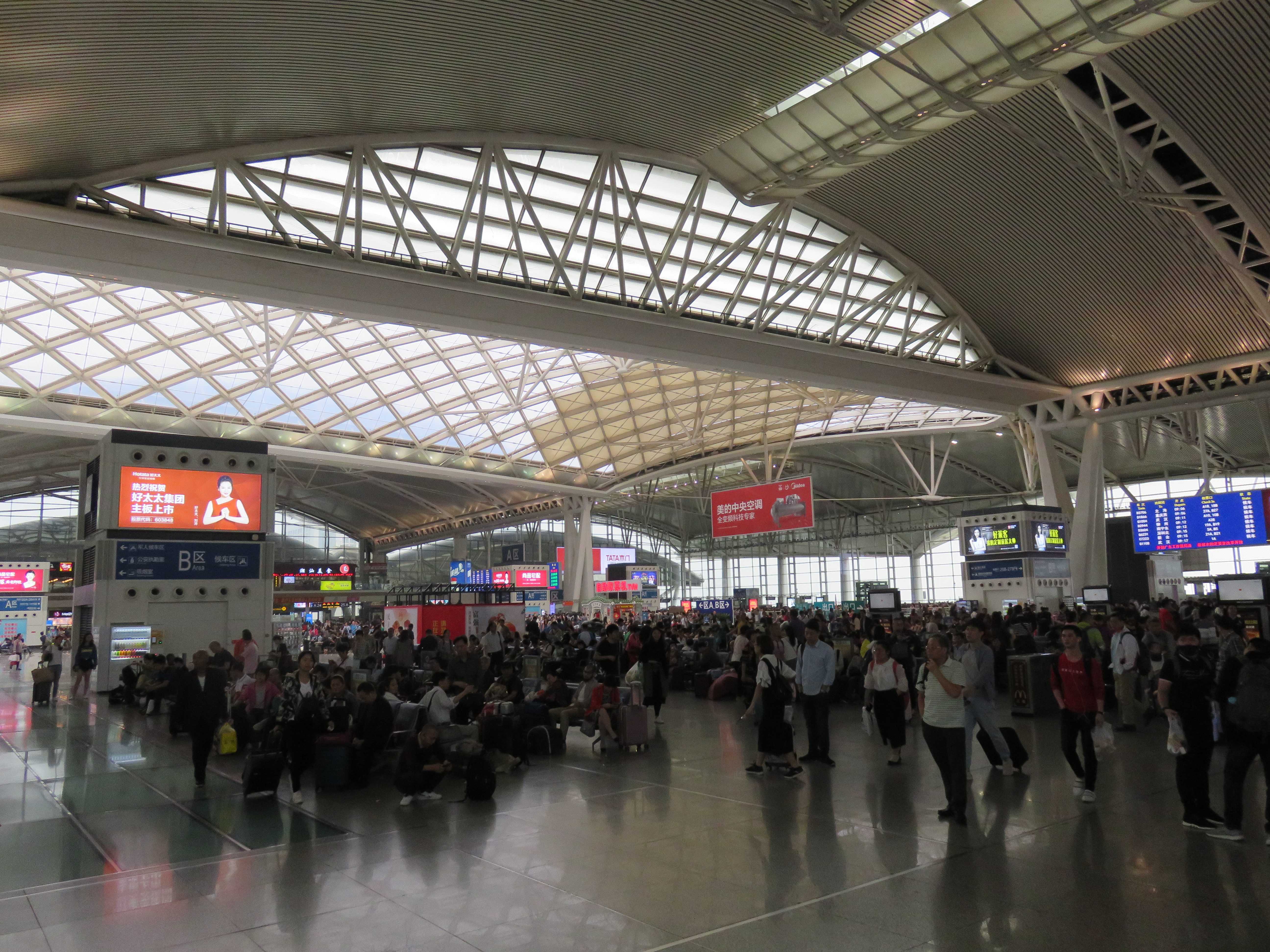
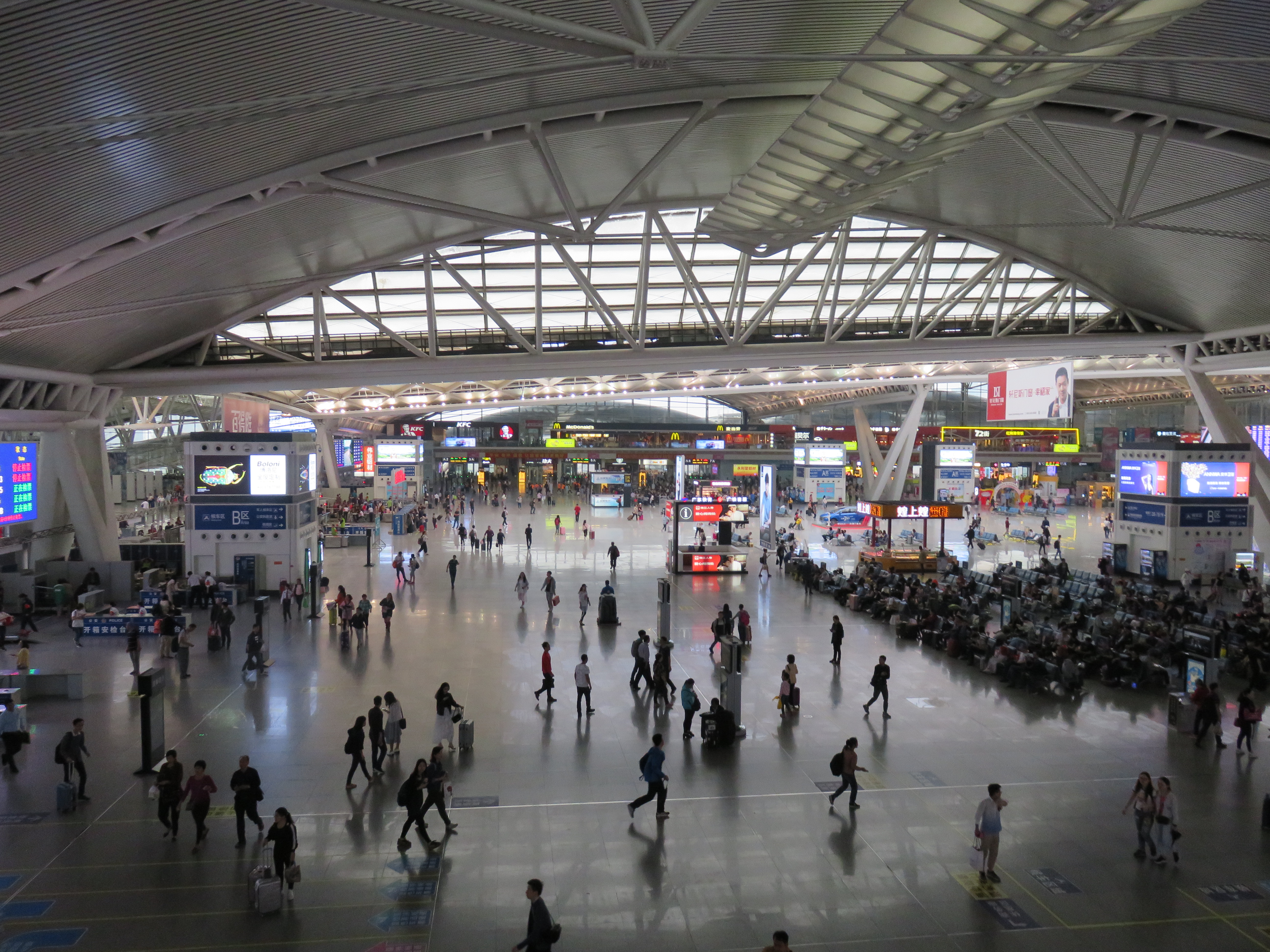
Arriving at Guangxhou South Railway Station, I am quite literally stupified by the size of the place.  It is a Terminal 5 amongst railway stations.  It is hardly distinguishable inside from a large international airport.  It is over three floors – like an airport, departures and arrivals are on separate floors.

IMG_1302
IMG_1304

This is a through station, not a terminal. Coming in by taxi, I counted at least 12 separate tracks coming out from under the canopy, all grey concrete on stilts.  The  floor is granodiorite tiles; the passengers are everywhere.  There are shops, booths, queues, scanners. It does not smell of decay and weak air-conditioning, as do so many large municipal buildings in hot climates.

IMG_1302

It is to my eye, no St Pancras: it is not built to last, and I suspect that, rather like Terminal 5, it may look distinctly jaded by 2050.

All must go through luggage scanners merely to get into the building. This is common enough at municipal buildings in China and increasingly so in the West. That said, the people doing the scanning and body pat-down work showed little interest – the scanning process is not strict.  Once inside, you then find what train you are on, and go through the ticket check to go “trainside” as it were.  Chinese high speed train tickets are not usable by any bearer, as train tickets are in the UK and elsewhere in the world – they are specific to you, as well as to a given seat in a given carriage.  Indeed. ours had our passport numbers on them in addition to our names.  But once through the ticket check, no-one was interested in our ID.  Once “trainside” and upstairs, it just felt like the airside of an big international airport. And the other similarity is, access to the platform is tightly controlled – no trainspotters welcome here.  We weren’t allowed onto the platform until only a few minutes before departure,  The train had already swept in.

The station is only a few years old. It speaks of tremendous economic growth, this outpouring of concrete: Bill Bryson once wrote something to the effect that half of all buildings in the United States had been built since 1980, and fully 90% of all American buildings, since 1945.  A similar thing is happening in China.  Natalie Merchant sings, in her song “Motherland”

Where in hell can you go
Far from the things that you know
Far from the sprawl of concrete
That keeps crawling its way
About 1,000 miles a day?

It is applicable here in China, at this time of expansion, as viaducts arc across whole cities, as 150mph bullet trains flash through tunnels so expensive as to defy understanding.  How do they do it? The growth of high speed rail in China today is rather like the development of the Interstate network in the USA of Eisenhower’s time.  And just as the Interstate highways changed America beyond recognition, high speed rail is changing China.  The old China is still visible, but it is disappearing. Go there and see it while it still exists. The old ladies brushing the street with straw brooms.  The scooter riders with no helmet but an umbrella. The little stalls selling foodstuffs. The little motorcycles converted into vans, burdened under seemingly impossible loads.

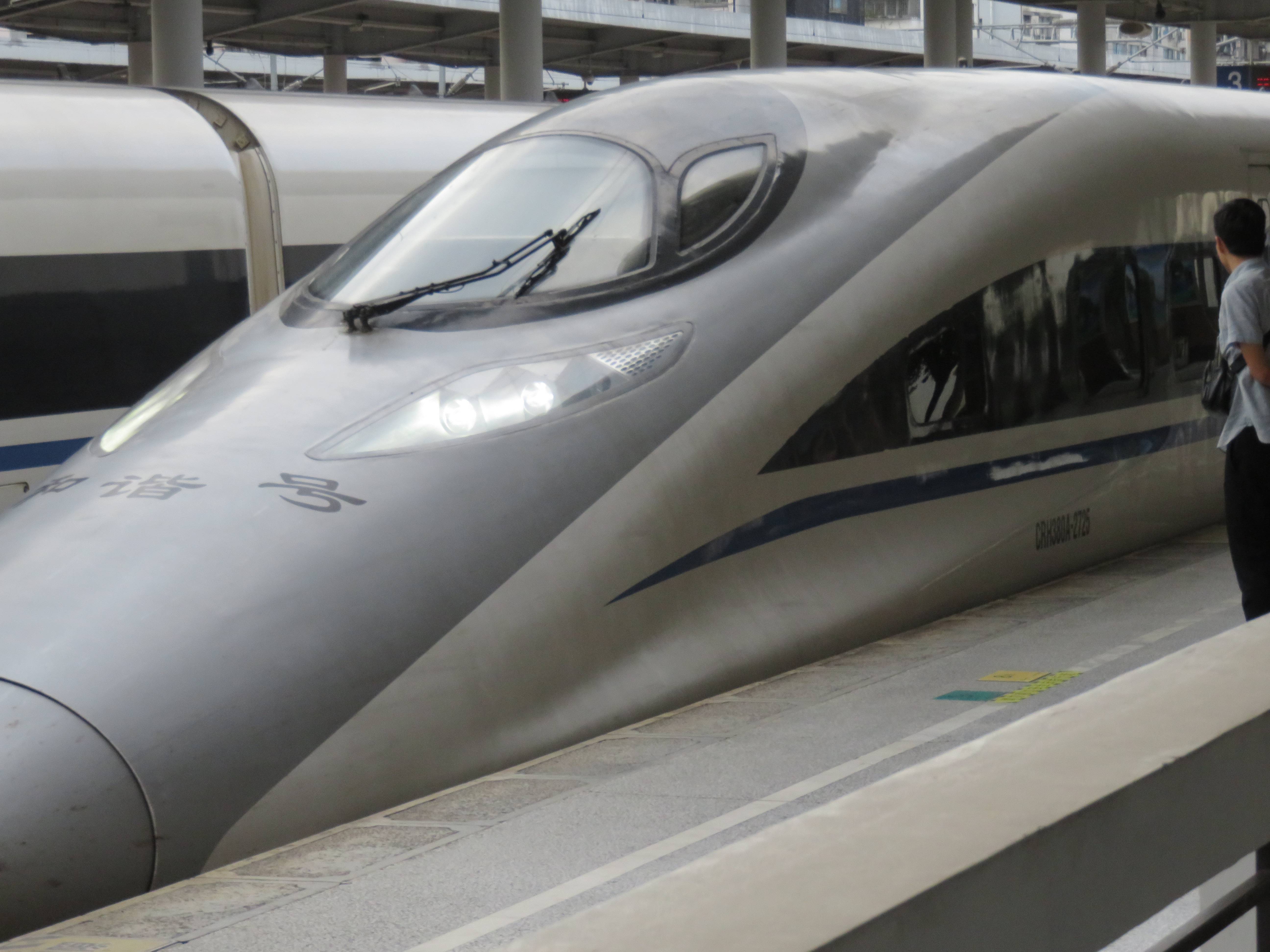
Off we go and there are almost continuous announcements in Mandarin.  Once through the suburbs, the train perceptibly speeds up and shoots along at 150 mph.  The acceleration is noticeable, and audible, an indistinct and distant hum rather like the sound of the original Starship Enterprise at Warp Factor 10.

We plunge through misty green forests and mountains, brown rivers, farms and rice paddies. There are endless tunnels. Some long, some short. Billions of dollars have gone into building this railway – and it is only one of many.

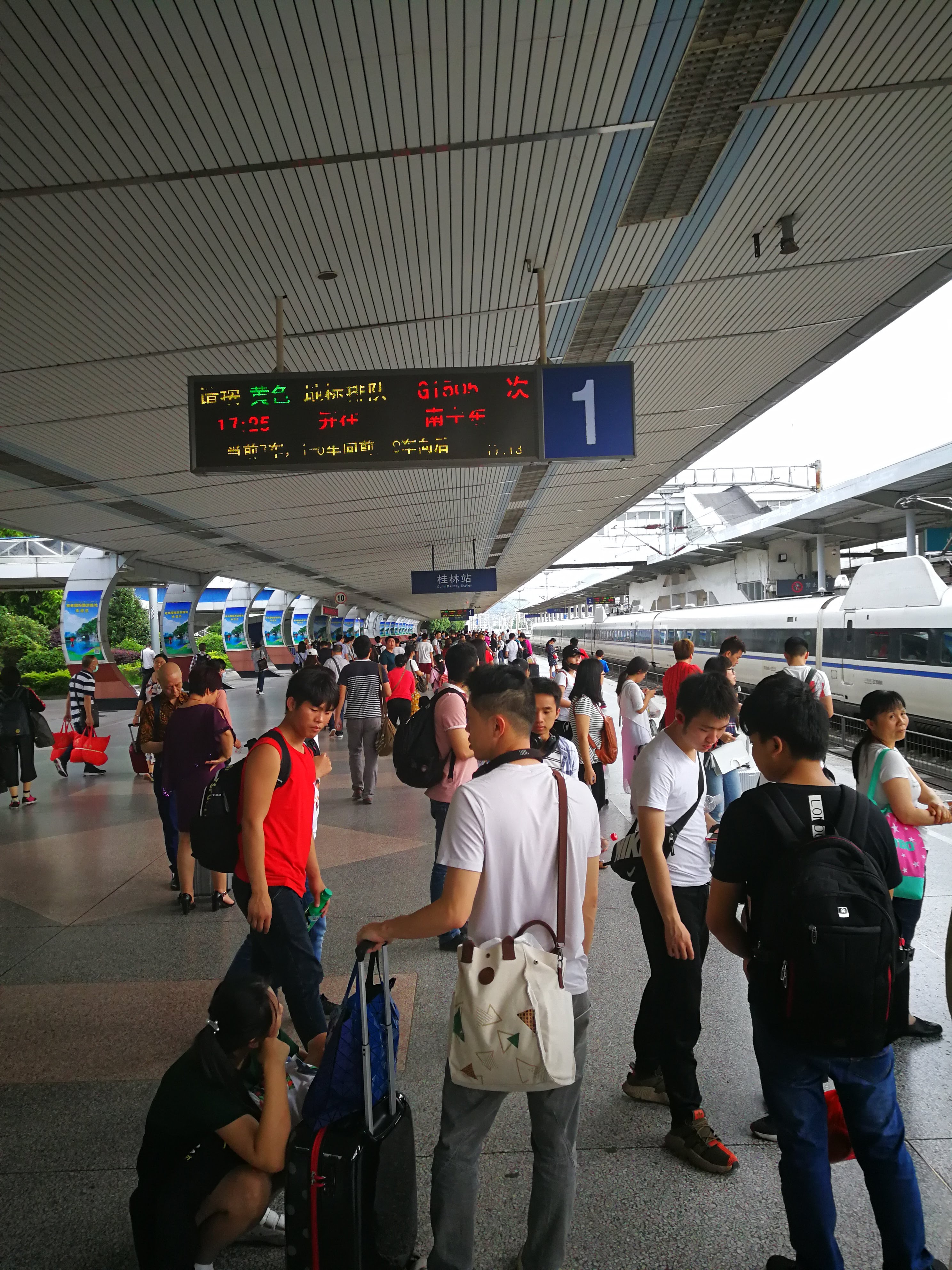
We arrived at Guilin Bey (North) Railway Station at 12,30pm on a hot and humid afternoon.  We  got off the bullet train, along with myriad Chinese, and followed them down the stairs into the underpass. Chattering, walking, kids laughing, suitcases on wheels rumbling along. The Chinese experience is to be surrounded by people.

IMG_1578

To Liuzhou and on to Zhiangziajie

Onwards: another city, another railway station.  This one is different; older, more prosaic.  The first two, at Guangxhou and at Guilin North, were grandiose to the point of being ridiculous.  This one is more intimate, more obviously a railway station rather than a palace, and very much older, dating from the 1970’s or even older.

In the huge waiting room (a departure lounge really) we’re enjoying massage chairs at Y4 (about 40p) for 10 minutes.  I say “enjoying”.  My wife and daughter think they are great, and had two goes each.  I found the massage a bit heavy handed.

cof

By bullet train from Guilin to a city called Liuzhou, from whence we will take sleeper train to another city called Zhiangziajie. So many cities I have never heard of.  Here is a train with a front like an aircraft, like a TGV, based in fact on a Japanese Shinkansen train, and the “dwell time” at this station (the time spent stationary in the platform) has been over five minutes.  That said, the train did arrive early.  As a commuter in the Home Counties, I’m accustomed to “dwell times” of less than a minute – in and out, quick quick quick…

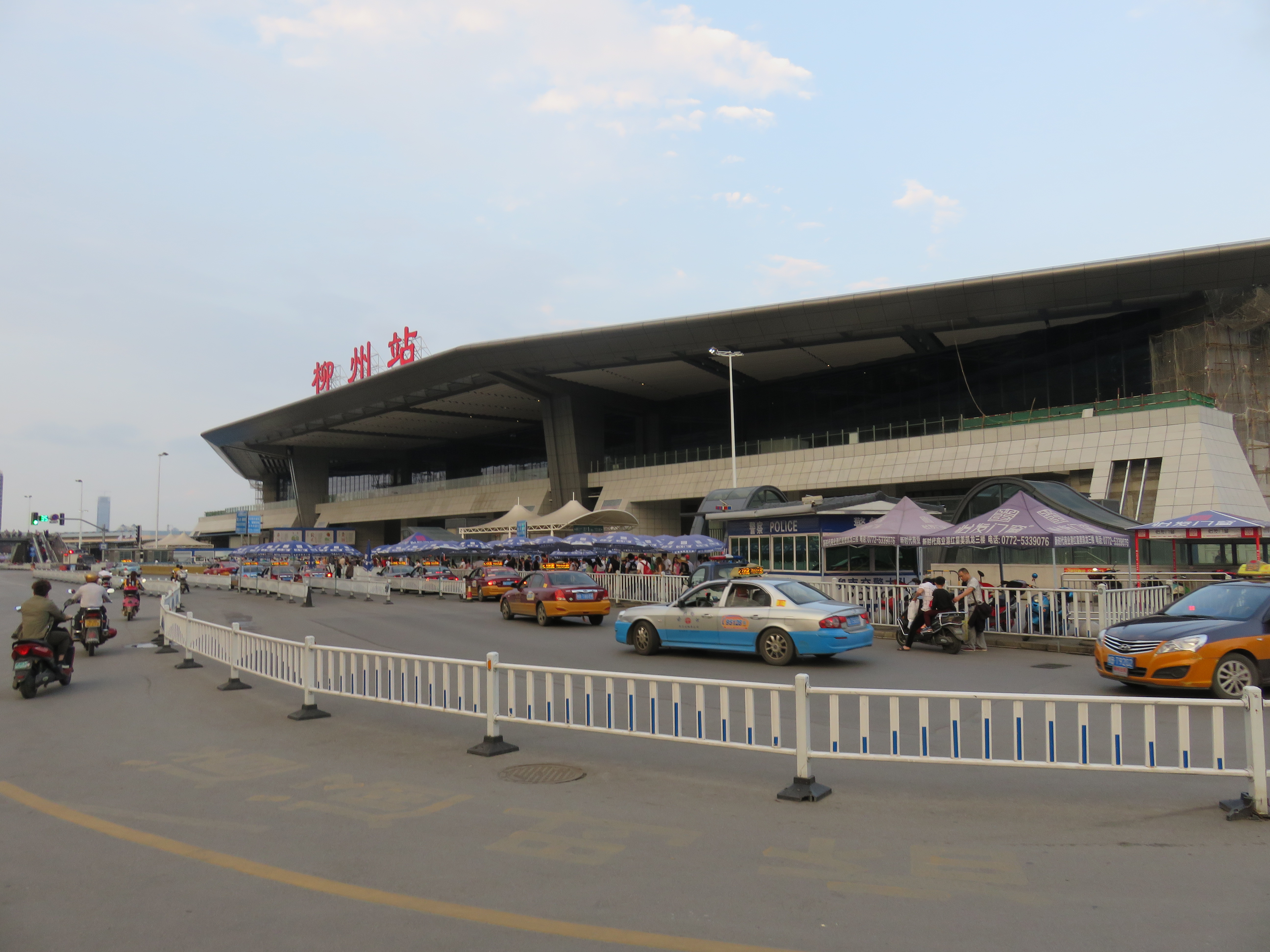
Liuzhou is a city of over three million people. I’d never heard of it, and it is just one of hundreds of cities of this size in China.  Here is the railway station:

IMG_1640

We walked a little away from the station, having to run some light interference from taxi drivers, in order to be far enough away from the station to find somewhere to hail a “Didi” (the Chinese equivalent of Uber) where it might safely and legally stop.  We took the taxi to a second railway station, called Liujiang, located in in an area of the city called Labao – a good 40 minutes by taxi.  The driver was an affable fellow; himself a Chinese teacher, and he took our photo when he dropped us off.  The second station, whence we arrived at dusk, was something of a disappointment.  More in the “Inter-Railing” style of railway station – just a single track, a single waiting room.  Outside, some shops and little cafes where we found something to eat.  Though not without some stress and difficulty in establishing what we might eat: no pictures, and of course no English menu.

The waiting room was stressful, to a degree: by now we were tired and the train was late.  “Do not lie down” the signs said. People laid down.  Our  tiresome wait was enlivened by the sign above the door for the “Security” people, where the proof-reading had failed.  The “r” and the “i” had blurred into an “n”. This slightly rude sign cheered us up as eventually the train roared in, and everyone got on.