A review of “Lexicon”, by Max Barry

A review of “Lexicon”, by Max Barry

I saw this title on a shelf in a second-hand bookshop in Aberdeen, and I was drawn to it on the instant. “Words are weapons” went the blurb. Never a truer word even if written by Marketing. “Sticks and stones can break my bones…words can kill“, it went on. Words can create; they can build people up and raise hope. Words can destroy; they can ruin people and remove all hope. This is true metaphorically; it is a fundamental fact and a powerful truth in the spiritual and emotional world. In this book “Lexicon” it is also literally and actually true.

I testify to the power of words. A teacher once said of me, “That Hough’s an oaf. A clever oaf, but an oaf nevertheless”. That was said between teachers in the staff room; some years later, when I was an adult, another teacher told me the story. It were fair to say I wish he hadn’t bothered. Those words, spoken about me nearly forty years ago, could define me to this day – almost like a curse. They could be my epitaph.

I have since met the Lord Jesus Christ, and He has spoken a better word over me. “You are already clean because of the word I have spoken to you” – John 15:3. Jesus is, as the writer to the Hebrews notes, the minister of sprinkled blood that “speaks a better word than the blood of Abel” (Hebrews 12:24). We know of spells, curses and blessings, and of strange unbreakable injunctions – the “geas”. In Dennis Wheatley’s stories we read that eleven words of eleven syllables, spoken with due preparation, will bring forth a dread demon. In C. S Lewis’s “The Magician’s Nephew” we read of the Deplorable Word, a word uttered by the witch Jadis on the planet Charn. A word so terrible, that merely speaking it, destroys all life. In Frank Herbert’s “Dune” we read of sound being used as a terrible weapon – the “weirding way”.

And the list of spells, words of power, curses and dark magic goes on through all literature. There are manifold examples of words used in power, dreadful negative power, destructive power. Max Barry has written such a tale here. The story is of pursuit of a “bareword”, a word so potentially destructive, that every time in history one has appeared, it has wrought catastrophic, end-of-days levels of destruction and chaos. In his story, a shadowy department in Washington DC is peopled by agents who are able to persuade people to their will by words alone. Sometimes through everyday persuasion, other times, though what are in effect, spells: the use of strange and sonorous words of power in lost and unknown languages, to compel people to obey.

The idea that words have power is fascinating and compelling. The pen IS mightier than the sword. The tongue, as St James writes, can set the whole course of our life on fire. The idea that words can create and destroy goes back to creation. The world itself, even light itself, was spoken into being by God. God said Fiat Lux let there be light. And this point is crucial: …and there was light.

Today, more than ever, we need to use words to bring light, to do good, to build up and encourage others. Today words are used to great destructive effect; social media acts as an echo chamber for empty words, and as a magnifier of whipped up hatred and divisiveness. It is vital that our words – for as we have seen, words can be uniquely powerful – are for good and not for ill. They should build up and not tear down. They should encourage and not discourage. If I speak in the tongues of men or of angels, but do not have love, I am only a resounding gong or a clanging cymbal. It’s actually worse than that: we can actually cause immense damage through careless words, negative words, thoughtless words. We should write and speak in love. Let our words be powerful, let them be few, and let them be for good.

A review of “The Pigeon Tunnels”, by John le Carre

A review of “The Pigeon Tunnels”, by John le Carre

I was at the same time inspired and daunted by “The Pigeon Tunnels”. It’s a kind of autobiographical work, consisting of a series of short essays, just a few thousand words each. The essays detail some of the people he has met, and the places he has been, as a world-famous writer, researching novels in trouble spots; hob-nobbing with the great and the good; burying old ghosts. Inspired – because a thousand-word essay, almost anyone can write. Daunted, because le Carre’s craft, and his connections and background, both seem miles from my own.

For someone like me who comes from dust, out of a comprehensive school/polytechnic background, he makes little of his own patrician roots. For this I am thankful. But it is clear that many of his heroes are in fact he, or possibly, more likely, his father. That said, le Carre does note (of the writer’s trade) that at some point, you have to get out and meet people – stories come from people, and the people are out in the world.

In an account (“In deep cover”) of burying an old Cold Warrior, some old spy, he speaks well of the Cold War infiltration of subversive groups. But he writes that he is ostensibly repelled by such infiltration today, arguing that it is not justified. I think this is disingenous. But then, later, in “Son of the author’s father”, le Carre writes about “the writer as conman“. He describes the similarity between himself (a successful writer) and his father (a successful conman) relating the two arts – that of conman and writer.

The writer and the conman:

  • Spin stories out of the air, from nothing
  • Sketch characters that do not exist
  • Paint golden opportunity where none exist
  • Blind you with bogus detail
  • Clarify knotty points
  • Withhold great secrets
  • Whisper those same secrets in your ear

This chapter on his father Ronnie is as moving and as revelatory a chapter as ever I have read, and was most enlightening. How far from my own experience. I have been a very different kind of father, and my own father, though perhaps not much more flawed than I, a very different kind of man again.

I always used to say of his writing, you could read a dozen early John Le Carre novels, and you would learn little or nothing about the writer’s own personal politics. You need read only a dozen or so pages of a Tom Clancy “Patrick Ryan” novel to know his. But that’s not true of his later, post-Cold War material – stuff like “Our kind of Traitor”, where his politics – and his anger – almost boils off the page.

Writing about documenting and reporting on the horror of the Eastern Congo, he says that “cameras don’t work for me. When I write a note, my memory stores the thought. When I take a picture, the camera steals my job”. This is important. The writer paints pictures with words: the camera exists; it cannot be un-invented. But just as pen and paper render memory less necessary, even as GPS erodes our innate sense of direction, and even as wristwatches mean we no longer need a sense of time or duration, so the rise of the universal camera is making the written story rarer and harder to create.

Mental health

Much is talked and written today about mental health; it’s all over the TV as high (and not so high) profile names tell us about their mental health problems. It’s on the agenda in corporate board rooms; it’s big in social media. Hardly a day goes by when I’m encouraged to “share” something on social media telling others how much I understand and empathise with their mental and emotional turmoil. It’s yet another ribbon or wristband to wear, virtue-signalling, telling you how much I care.

I have been through a long period of admittedly slight, but nevertheless significant, mental ill-health. But I never so much as took a day off work. It is possible to continue leading a normal life whilst ill. Every day, people continue to go to work suffering from heavy colds, or in chronic and severe pains, or with serious disabilities, and they get by. There are others who do not bother; they don’t even try. I have worked with able-bodied, fit and healthy people a good deal younger than I, who were in the habit of taking 15-20 days a year off “sick”. I confess I have no patience with such people.

I did consider seeing the doctor, and in fact I would have done so much earlier. What prevented me from doing so was the fact that in modern England it takes three weeks to get an appointment to see a GP, unless you face a life-threatening emergency. For some, mental ill-health is of course a life-threatening emergency, but for me, it was merely life-changing. Eventually I did see the GP for anxiety. More of that later.

I don’t really know where it all started. At one point during 2016 my wife turned to me and said “it’s been a couple of years now” meaning the length of time I had seemed “down in the dumps” and not myself. I guess that sometime in 2015, things started to take a dive. What was the cause? Who knows? As engineers, as safety professionals, we are taught to look for causation: What happened? Why did it happen? What went wrong? And most importantly, how do we stop it from happening again?

Sometimes, in the complexity of the real world, these questions are unanswerable. It is fair to say that changes at work may have causal factors. A man might catch pneumonia and become gravely ill: the immediate cause, of course, is infection by bacteria or virus. But working too hard, or giving a long speech outside on a rainy November day, could easily act as the starting point or “causal factor” as the safety professionals say. Of such work-related causal factors we will write no more, as these matters have still to run their full course.

Certainly though, looking back, I wonder how I kept my job. I know, of course, full well. I kept it by the grace of God. Both through my prayers and through the skills he has given me. The worst time was from November 2016 through to June 2018. Changes in the workplace in the early summer of last year heralded a time of recovery. At the present time I consider myself convalescent, and would guard carefully against the risk of relapse.

These years have been studded with bereavement. In November 2015, after years of decline, my wife’s mother passed away. We were not close – but this was my wife’s mother, not just anyone, and obviously my wife was deeply affected. In March 2016, one of my Scouters died of cancer after years of heroic struggle – just a young man of only 27. The following winter, my wife’s beloved Aunt Josie went into hospital in early January, and we buried her in early April 2017. Last summer, my son’s girlfriend took her own life in the days before his graduation. That summer, on the day of the funeral, I learnt of the suicide on her 18th birthday of the only daughter of one of my former Scouters.

These years have been a time of growth and spreading of wings for our kids, as they all have “flown the coop” and found their way in the wide world. At least their welfare has not been a grave concern to us; all three of them proving to be healthy, upright citizens well able and willing to earn a living.

In this very difficult time, I have found strength in three very different activities. One of them, has been running. I’d started running earlier, back in 2012, and running continues to be a source of strength and comfort to me. In the very worst times at work, I sought for activity that did not involve deep thinking, activity which some might refer to as “right-brain”. Like running, neither were innovation: I’ve always been a writer, and I’ve played guitar off and on (perhaps mostly off) since childhood. I found great refreshment and renewal in playing guitar, and my journal-keeping or writing has taken what I would very much consider a high priority in my life. I have beside me as I write, paper diaries back to the end of 2016 with upwards of 160,000 words written: I could have written a novel in a six-month if I chose to do that rather than to journal. But, that journalism, if not saving my life (that would be inappropriate hyperbole and crass exaggeration, both of which I find deplorable), has certainly contributed to recovery of my mental health, and in any case – writing is never wasted.

In those dark years I sought the face of God – most often in one or two places in London – and I have been found by Him. I sought the face of God through prayer and fasting , and enjoyed a period of tremendous personal renewal and spiritual growth, at perhaps the lowest point on my journey.

I have become a District Commissioner for Scouts and at the same time, have largely lost interest in Scouting. What took up 20-25 hours a week of my time before October 2016, I will not permit to take half that time now. I continue as DC out of a sense of duty, an awareness that there is no-one to replace me, and an unwillingness to be known as a quitter.

What were the symptoms?

  • A sense of feeling “What’s the point?
  • A lack of interest, ambition and motivation – as the other ranks say in the Navy – “NAAFI – no ambition and fuck-all interest”
  • A lack of concern for my long-term welfare in my work and home life;
  • Easily irritated and angered – irrascible at times;
  • At times tired to the point of tears – not metaphorically, but literally;
  • An inability to concentrate or focus;
  • An inability to see things through to completion;
  • Anxiety attacks at all times of day but especially in the small hours
  • Insomnia – lying awake transfixed by fear and worry, at random times
  • Panic attacks and dread at what should be undaunting and straightforward tasks or decisions e.g. what shall we have for supper, what shall I buy my wife for her birthday?
  • Weight loss: this symptom alone has been to my advantage. The reasons for it are complex and not just related to mental health. In 2015 I was 17st 11lb; today (May 2019) I am 16st.

A history of violence in England – a review of a book by James Sharpe

A review of “A fiery and furious people – a history of violence in England”, by James Sharpe

Take that! Blam! And that!! Oww!!

I saw this title a good few years ago and I thought, that’s one for me, that’ll be interesting. Are we English violent? Are we more violent than other races? Is it our Anglo-Saxon or Norse heritage? The Duke of Wellington famously said of his own troops that they were the “scum of the earth”, and it is possible that propensity to violence does make for good soldiers. One feels that crossing the street to avoid soldiers need not be completely unnecessary. The purpose of soldiers, after all, is to visit physical violence on others, hopefully, but not always, other soldiers.

James Sharpe traces the social, cultural and legal history of violence from the Middle Ages to the present. It’s mostly readable, although there were a few sections I had to skip, particularly the section about serial killers. Not because I’m particularly squeamish, but because the work in those places was in danger of being about crime and legislation, rather than violence per se. That said, you can’t today discuss violence without discussing crime and punishment, and that, of itself, is an important finding of the book. What passes for violence has changed through the ages. The degree and type of violence that the common people, the law, and indeed the State, will accept or put up with, and where the line is to be drawn, has changed much over time.

Sharpe has chapters on various themes, as well as moving in a logical way from the past to the present. He covers violence in the middle ages, where he draws in the influence of the Norman French feudal aristocracy and the effect of the concept of “Chivalry”. He covers dueling, and domestic violence, rape and sexual violence, and also serial killers. Of families, he notes: “It was only as feudalism succumbed to capitalism, and a traditional, community-based kinship dominated society started to give way to one in which individuals began to come to the fore, that the family as we understand it today, emerged”

He does note that most (although not all) violence is visited by men, and mostly, to be fair, on other men. It is men who are violent. Aggression plays a part. I’m reminded of Sebastian Junger’s excellent book “War”, about the young men fighting in Afghanistan. Here, we read of the importance, particularly for young men, not of war as such, but of combat. Most men understand this instinctively, even if today, that combat is no longer always physical.

Alas, he does not mention the story quoted I think by Churchill, that the Venetian Ambasssador was so intimidated by the physical presence of Henry VIII that whenever he was in that king’s presence, he never stopped worrying that the king would actually lay hands on him and do him violence.

Several more important conclusions are drawn. We should be careful of the danger of reading too much into crime statistics (or any statistics). Reporting of violent crime is not the same as violent crime. An example of this is the suggestion (reasonable certainty, really) that some police forces today – as in the past – do not have the funding to prosecute as many violent criminals as they otherwise ought – which will affect crime figures. Prosecuting people is expensive. Another: our world and the people in it are very much more complicated than it would appear from social media or from the pages of the Daily Mail. The nature of violence is changing; I don’t think it is getting less, although our tolerance of casual violence is lower than it was – just as it should be.

We come into a world now where social violence – trolling, online bullying etc – may need much more tightly regulating: because who needs a judge and jury when you’ve got Facebook?

From the Gulag to the Killing Fields – notes on Totalitarianism

A few musings on totalitarianism, brought on by a work-related visit to Vietnam. I have juxtaposed this with a recent re-reading of Orwell’s “1984”. I read a lot of books at once, mind, and I am also ploughing my way through a collection called “From the Gulag to the Killing Fields: Personal Accounts of Political Violence and Repression in Communist States”. It has been put together by an academic called Paul Hollander, himself a victim of the political violence of the Hungarian uprising of 1956. It’s certainly not bedtime reading. It makes uncomfortable reading for me, much less for anyone with remotely left-wing sensibilities. We tend to look at Russia and China as the worst offenders in terms of the sheer volume and quantity of communist political oppression and violence, and this book tends to support that view. But reading books these upsetting personal stories, other places take the record for sheer horror and human tragedy (Cambodia and Vietnam). For the ill-treatment of political prisoners, I’d look at Cuba, where there was a peculiar and toxic mixture of Latin machismo and the malevolent foolishness of Marxism.

It never fails to be a pleasant surprise to me that books like this collection are in print in the UK at all. It is not beyond the bounds of darkest fantasy that a time will come for the UK when having a copy of such a book could put someone at risk of being sent to prison.

It’s always good to pick up a few points from Orwell. His character “Bernstein” who ostensibly writes the “book within the book” plot device allowing Orwell to lecture us on totalitarianism, says that the rise of machines has, “by producing wealth which is sometimes impossible not to distribute”, led to an increase in average living standards. Our standard of living has indeed improved from the early 20th century (earlier really) until now, and should continue to improve all this century. This is not politics, nor economics, but technology – the rise of machines. Orwell notes that “an all-round increase in wealth threatens a hierarchical society” and “A hierarchical society is only possible on the basis of poverty and ignorance”. Amen. This truth lies at the very heart of “1984”, and at the heart of opposition to technology for it’s own sake. Opposition to “machines taking over men’s jobs” is at heart a desire for order and hierarchy, a vote for the established order, an endorsement of the status quo. And I believe the status quo is almost invariably worth upsetting. Technology and machines, of themselves, create wealth and hence threaten the status quo in hierarchical societies.

The frailty of human life

Three recent deaths, all juxtaposed, all very different, form a backdrop to the last few days and move me to put pen to paper. A murder, a suicide, a death from disease.

Knife murder: The murder of Jodie Chesney comes to mind first. A young person is snatched from us as a result of a deliberate act of deadly violence. It is doubly brought to my attention because she was an Explorer Scout: I am a District Commissioner for Scouts. We all wring our hands – what can we do? Some say, with strident tone, “This has to stop!” and of course, they are right. But these are empty words; those who say this have little if any power to prevent the rampant knife crime that racks our nation. I suspect that our government, realistically, lacks the political will to do anything really effective about knife crime. I was in Singapore recently and saw how it is quite safe to leave your wallet lying around. Singaporeans explained to me graphically what the state does to thieves in Singapore. I don’t expect there’s much knife crime in Singapore either. But just and appropriate treatment of knife criminals and indeed knife murderers will be too much for most of us in UK to stomach. Some rightly argue for a solution that is not penal in nature – addressing the root of the problem. But that is a long term solution delivering a safe Britain in the 2030s, and does not solve the problem we face now. Meantime, we look behind ourselves more often and stay more alert in public spaces – good if cynical advice at any time.

The suicide of Keith Flint of The Prodigy is the second death I would reflect upon. The Prodigy, if not actual rock’n’roll, follows the important rock’n’roll principle of scaring your mum and dad. I myself am drawn to The Prodigy precisely for that reason – their music is not nice. To some, it is offensive. I sometimes tire of “nice”. Say what you like about The Prodigy, you could not call them hypocritical. There are other musicians out there playing very listenable traditional blues rock’n’roll. Reputably and by commonly acknowledged anecdote, some of these players are rude and unpleasant men, however harmonious their music may be. Keith Flint and the music of The Prodigy may not have been harmonious to some of us. But for all that, he did have a reputation for being a friendly and helpful guy. And he took his own life, which points up the growing concern we have today for mental health: a vital issue that ought not be neglected.

The third death I would reflect upon, I only found out about by browsing a Christian magazine. The passing away on 6th February of the theologian Canon Michael Green, was a shame and a sad loss. You wouldn’t have heard about that on the BBC, I thought. He was and remains very influential as a thinker: I’ve read a number of his books; they are on my shelf still. I once heard him preach at St Alkmunds Derby, in the late 1990’s. He recounted in that sermon how he had met a guy in a car park at Euston station, and this guy asked him if he could break a fiver for change for parking. Michael Green had given the driver the few quid in change he needed – to which the driver’s response was a horrified refusal. Canon Michael replied – “Take it – that’s the way my Boss works…” which opened the way for a conversation about Christianity. As he himself noted, he was an academic who was also passionate about the Lord Jesus Christ.

I make no apology for mentioning all these three sad deaths in the same post. All were tragic: a murder, a suicide, a death from a dreaded illness. We do well to remember how frail we are, and as my wife’s late Aunt noted, we should live while we are alive.

There’s hope for Merrie England

In posh frocks and best suits, we took train in the rainy morning up to London Bridge. It was that kind of fine rain that gets you wet. The event we were invited to was not a wedding, but it proved to be more like a wedding than anything else. We were going to Southwark Cathedral for the Ordination and Consecration to Bishop of our friend and former rector, the Reverend Doctor Andrew Rumsey.

At the cathedral we took coffee with a lady we know who must use crutches to get about. She bears considerable pain and disability in her life with a very English stoicism and understatement, and she often looks rather tired and drawn. But today she had battled through on her crutches and was looking very well, pushing the boat out to join in this important celebration.

And then we were all seated. There was a short warm-up act, a deacon or dean or some such, who made everyone laugh while explaining how things would go during the service. In a more secular gathering, he would have been the person who had to start his short speech by saying “There are no planned fire drills today”.

Then there was a procession. There were dozens of richly robed prelates and lords spiritual. Bishops, deans, deacons, priests, acolytes and singers. A number of people carrying shiny sticks, or candles, or holding up Bibles. And amongst this procession, all our clergy friends. In all this colour, pomp and pagaentry, a connection to people we knew. A young priest I know touched my shoulder as he walked past. Hey Nick!!

The final person in the procession was the Archbishop of Canterbury, who took the service. Our former vicar was presented to Canterbury by two mentors, one on either side: the Bishops of Salisbury and Southwark. Questions were asked, “Do you believe him to be of Godly life and sound learning?“, using a form of words that must be centuries old.

Canterbury went on to cause a clerk – “the Provincial Registrar” – to read out the whole of the letter of authorisation for the ordination of a Bishop – the letter patent. Here was language linking the everyday of the here and now, to the sweeping arc of history; here were words from the seat of power, from the Queen herself, relating to someone I’ve sat and had a pint and peanuts with. Just remarkable. One might feel part of a nation, tribe or group as it exists across the land today, but less often, perhaps, might we feel that sense of belonging across time, stretching back through the generations. And listening to this letter being read out, we were all part of Merrie England. Someone else deserves the credit for saying this, but there is hope for Merrie England when people like Andrew Rumsey are appointed to posts like this.

The sermon was given by the Reverend Canon Chris Russell, the Archbishop’s Adviser for Evangelism and Witness, and parish priest in Reading. And what a sermon! Of the art and craft of sermons, my old vicar used to say, “always start with personal stories”. Chris Russell did just that and took us from the inessential (in his family’s case, a shower head that lit up) to what we really need. What do we really need? What do we really want? What MUST we have? God’s call on our lives: all of us are called by God personally, and by name. We are called by name because we all matter, each and every one of us. God has questions for us, which must be answered – again, because we all matter to God.

Later on, the college of Bishops laid hands on their new colleague Andrew at the actual moment of his ordination. There were dozens of them; not all could get near him. The further away Bishops laid hands on nearer Bishops who in turn laid hands on Andrew. To see this very physical act, this laying on of hands, right at the pinnacle of the Anglican establishment, was a remarkable sight. History, tradition and the teaching of Scripture brought right into the present. The laying on of hands is a common enough practice in house churches and in Charismatic churchmanship, but perhaps less common in the grass-roots Church of England.

There was a giving of appropriate and symbolic gifts. A Bible, a ring; a cross, a crozier – all the “stuff” a Bishop might traditionally use to exercise their office. A word on the crozier. My wife organised that. It was again, a moment of connection. We’d driven across all England, all the way to a former mining village near Durham to collect this fine piece of work, which was now in the hands of the Archbishop of Canterbury. A craftsman by the name of Tom Keers made the Cleek (that is, the curved part made of horn at the top) and another, named Roger Marwood, made the shaft of oak- from Acstede – “the Place of the Oaks.” Both will be proud to see their work in such hands.

And then it was over: the rector was become a Bishop. The gathered prelates and lords of the church started to process down the aisle with their newest colleague among them. As they did so, there was a spontaneous round of applause and cheering for Andrew Rumsey, which he acknowledged with a smile. It was another human moment in a big, portentous, important occasion when powerful forces for good were at work.

As the procession of lords spiritual, prelates, clerks, singers, acolytes and men carrying shiny sticks made its way out, I saw the Archbishop of Canterbury stop, greet and touch fists with a ten year old boy, who like me, had an aisle seat. Canterbury didn’t need to do that. In doing so, in stopping to greet that lad, he made his day. And mine too.

Extraordinary complexity

We live in times of extraordinary complexity. Perhaps it was ever thus: were there ever truly simple and straightforward times? Yet, our willingness and our ability to discern complexity is under attack as never before. It is under attack from social media; it is under attack from the rise in sentimentality we’ve seen over this last twenty years or so, and it is under attack because of the fashion for hyperbole and over-statement.

The deplorable rise of “spin” – the use of language to conceal, obscure or divert people from the facts – has much to answer for.  The use of carefully chosen, politically charged, and nuanced phrasing, has, paradoxically, eroded our capability to discern nuance.

We look back at events like the Great War, and perhaps see simple causes, straightforward effects, obvious and clear protagonists and antagonists.  We view such events through the simple lens of modern thinking.  Cliches such as “senseless slaughter” come to our lips; we take off our hats, and rightly, spend a moment in silence to remember the fallen. 

But it was never that simple: that war was no simple struggle between good and evil, nor even a titanic battle between two great empires, the British and the Austro-Hungarian.  Britain, even the British Empire, was part of an alliance, and not even the senior partner at that.   

And then, consider what else was happening at the same time as the Great War.  The struggle for female emancipation and women’s suffrage.  The Easter Rising and the struggle for independence in Ireland.  The Russian revolution.  The technical innovation happening as a result of the war; the changing relationship between the New World and the Old.  

All of it points to a time of complexity to which we don’t do justice by over-simplifying what happened. It is not less true today.  I’m minded to reflect on our shortening attention span.  My boss wants 3-5 bullet points, size 21 font, one slide in Microsoft PowerPoint – just the salient facts to present to the Board.  In the second war,  Churchill reputedly turned to his underlings and asked them to provide for him a “report on the current state of the Royal Navy – on one side of a sheet of paper”.  As writers we do have a duty to keep things simple, to use short words, sentences and paragraphs, and to cut out unnecessary waffle. There is a case for simplicity – but we have made the case for simplicity our idol. 

How are we going to comment meaningfully and profitably on the hideous complexity through which we are now living? Three bullet points won’t cover Brexit nor explain the reasons for and against it.  One side of a sheet of paper may not cover the reasons for our changing culture.  A few photographs will not explain the balance of power between the West, China and Russia.  The job of the commentator is made doubly difficult by the fact that everyday folk have lost interest in complexity.  Today we have Twitter and Instagram – but think of the walls of text in a Victorian newspaper.  Today we want to see things reduced to three bullet points, the sound bite, the black and white. We want to see the spectacle of wrong and right, of bread and circuses.  Who needs a judge and jury when you’ve got Facebook?

A review of “Walk East Til I die”, by Mike Pinnock

A review of “Walk East Til I die“, by Mike Pinnock

I like a good outdoorsman’s travelogue, and this falls into the same category as Nicholas Crane’s “Clear Waters Rising” or “Two degrees West”.  An Englishman of a certain age sets himself to do an all-but impossible adventure – what’s not to like? I’m an Englishman of a certain age myself – but Mike is older.  I should admit early on in the interests of transparency that Mike is a relative of mine.   

All that said, I liked the historical accounts in this work better.  There’s only so many pints of lager you vicariously enjoy.  Mike paints an interesting story of Eire today and in the past.  My wife and I visited Kerry on our honeymoon in 1990, and we were told that almost no-one lives within twenty miles of the west coast of Ireland, except for those whose living depends on tourism.  Mike’s account bears that out – there seems to be no-one there.  A far cry from queuing up to walk along Crib Goch in Snowdonia, as you’ll have to do on any fine weekend in summer.  

I learned much of Irlsh history.  You’ll not be learning this kind of thing in English schools, not this last 40-50 years. I’d heard of Michael Collins, of the Easter Rising, and of the Irish Free State, and few would not have heard of Eamon De Valera.  What Mike has done has coloured in the gaps a little, brought to life some of that fascinating past, some of the terrible suffering.  From the medieval saints, through the Norman overlordship, and onto Cromwell’s atrocities, then the Potato Famine and the emergence of Eire, Mike has provided some insights into Irish history without ever being partisan or taking an obvious side.  

Great future inventions

I was minded to write about some of the great inventions we may yet see, and to look at the rich imaginations of some of our great sci-fi writers.

1. The diamond flechette gun in Alistair Reynold’s “Chasm City”.  A small and easily concealed hand weapon, made out of diamond and exotic forms of Carbon – because there is no metal in it, of course, it can be carried with impunity through airport scanners and other such devices.  It is clockwork and as well as being made of diamond, fires bits of diamond as projectiles. It might be clockwork but I don’t think the users wind it up. It is, as characters describe, a thing of ‘intense, evil beauty’.  “Chasm City” is set in the 27th century.

2. The Turing Gate in Paul MacAuley’s “Cowboy Angels”.  In an alternative reality, Alan Turing is not hounded to death by the state for being gay, but emigrates to America where he goes onto invent a strange gate or means to move between dimensions and alternate realities.  The Americans of that reality (not ours) take it upon themselves to visit their particular brand of democracy on all other Americas in existence. All well and good until they visit the reality where President Nixon was elected.

3. The cortical stack, allowing Digital Human Storage, in Richard Morgan’s “Altered Carbon” and it’s two sequels.  This memory device is about the size of a cigarette butt.  The device is implanted in the spinal column soon after birth and records everything – sensations, memories, feelings. All can be backed up, everything can be uploaded into a computer as digital data.  Humanity is reduced to big data – both freed from death and enslaved by eternal life.

4. Douglas-Martin sun-power screens in R.A Heinlein’s “Let there be light”. Two inventors in the 1960’s perfect bioluminescent screens that can be used to convert electricity into light, or, if stuck in the sunshine, act as an effective solar panel, generating electricity.

5. The Bobble, in Vernor Vinge’s “Across realtime“.  A spherical and perfectly reflective indestructable minature cosmos, which can be created in any size from tiny up to tens of kilometres across.  They can last for moments – or for tens of millions of years.  Anything trapped inside endures NO duration at all, no matter how long they or it are stuck inside. They are effective one-way time machines.  Vinge has his characters use them as perfect (if someone inconveniently shaped) fridges, as remarkable air bags to protect aircraftmen in crashes, as restraints for madmen, as time machines, and as a means to contain political prisoners. Oddly he misses using micrometre sized bobbles as a building material.

6. The piece of paper as a computer in Neal Stephenson’s “The Diamond Age”. In the Diamond Age – late in this century – nanotech is all. An everyday piece of paper is many tens of thousands of molecules thick.  It’s a small matter to design the inside of it so that those many molecules can act as a kind of electro-mechanical microprocessor, churning through sums, doing calculations – doing computer stuff, in fact.

7. The genetically modified millipede used as sutures, in William Gibson’s “Count Zero“, set in the early 21st century but written in the 1980’s.  Our young hero is slashed across the back in a knife attack whilst on the run. The surgeon places a length of this millipede over the wound, ensures all the many legs are properly lined up on each side, and with a flourish, rips the spine from the brainless bio-artifact. It’s death spasm causes the legs to contract, neatly sewing a huge wound together in a split second.

8. Windows running on your clothes, and displaying in contact lenses, in Vernor Vinge’s “Rainbow’s End”.  Vinge can’t call it Windows of course, but calls it “Symphony”. Your clothes are embedded with threads acting as powerful microprocessors, and they are able to send information to contact lenses. Augmented reality – you want the low-down on this neighbourhood? Just google it and the info scrolls across the top right of your field of vision.  Communicate with your computer by sub-vocalising or just thinking what want to say,

9. The means to broadcast sound direct to your aural nerve – the “friend” device as seen in Stephen Baxter’s “Ark”.  Developed before 2020, the device renders earphones obsolete. A small instrument in your pocket, or your mobile phone, broadcasts sound in perfect hi-fi direct to your brain.  It’s a side issue in Baxter’s story which is about rising waters flooding the whole earth.

10.  The monomolecular spray-on hosiery in Iain M Banks’ “Against a dark background”. Others have said there are more ideas on one page of an Iain M. Banks novel than in whole books by other others. Here, he proposes a monomolecular covering for the female leg that looks great and feels great – spray on tights, in effect.

Buchaille Etive Mor

We took the sleeper from Euston, for a long weekend in the Highlands. As well as some hillwalking, there was a serious task at hand; the scattering of some ashes of a young woman who earlier this year, had taken her own life.

Our journey north was enlivened by about four fingers each of Glenlivet. We arrived at Glasgow Central after an adequate nights sleep, perhaps disturbed in my case by some rather odd whisky dreams. After a quick breakfast in the Gordon Street Cafe next to the station, we nipped off through the chill city streets to get our rental car. By 10 a.m we were parking up at Inveruglas on Loch Lomondside, in light rain.

Ben Vorlich

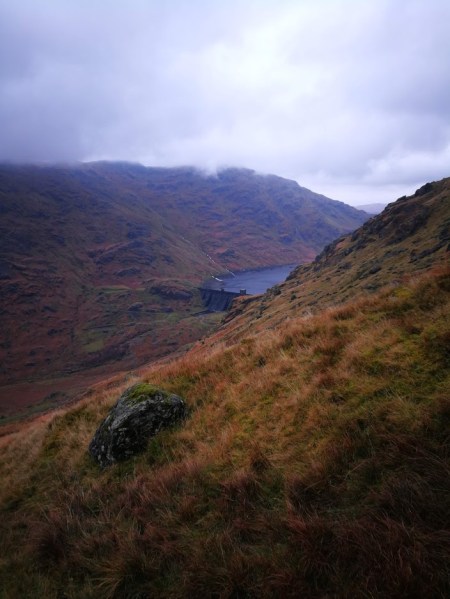
Past the rather impressive hydro-electric power station, you go under the West Highland Line, turn uphill keeping some rapids in a gorge on the left, and up a private road into the brown valley. Up ahead, there is a black industrial-looking dam.

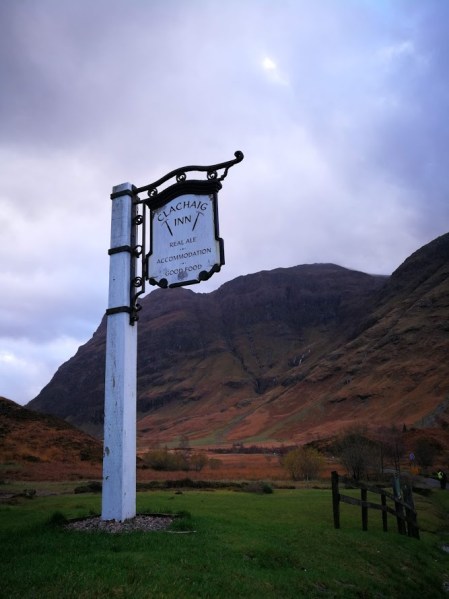
Power lines march off into the distance. Dodging some maternal cattle who were monopolising the road, we broke right straight up into the hills, a long slog. We stopped for a quick bite to eat in a draughty cleft in the rocks, and pushed on to the summit. As we did so, the weather broke with a vengeance. Another half an hour later in starting, and we’d have been forced to turn back from the summit. In a howling, lashing storm, we bagged the summit and retreated as fast as possible. Fortunately there’s a clear path, even in thick clag. We were off the hill before 2pm, meaning that we’d bagged a Munro in less than four hours. Rather pleased with ourselves, we got in the car and drove north to the Clachaig.

IMG_20181110_093531

In Glencoe, we pitched our tents, not without some wind-related challenges, and retreated through the storm to the warmth of the pub:

“The evening shadows on the dry stone walls
The night draws in and the ale house calls”

(Chris Rea, “Chisel Hill“)

Buchaille Etive Mor

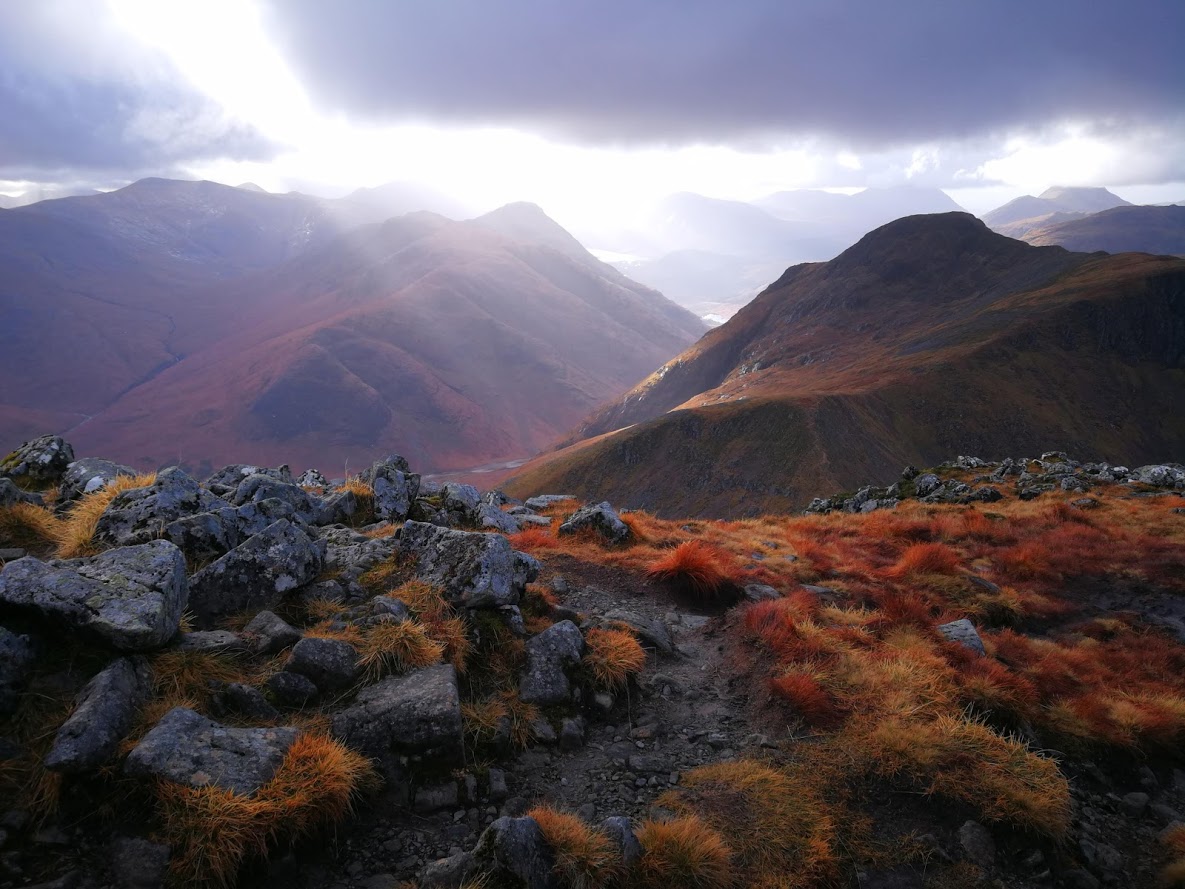
Around 10.30a.m, a party of eight of us set off up the Lairig Gartain. On the walk up the glen we had twice to ford streams that were running quite full and needed crossing with care. This was the largest group of people I’ve been on the hill with for twenty years. Six of the people present were university students less than half my age, and a handful of those young people were experienced hillwalkers. Everyone was quite fit, but the collective pace of such a group is slower than that of a smaller party. The route lay zig-zag up into Coire Altrium, negotiating through a band of cliffs and broken ground up onto the col between Stob Coire Altrium and Stob na Doire. We did not reach the ridge until after noon, and we paused there for refreshment. The day was wide open; whilst it was cold and windy, the weather seemed to be clearing.

The delicate light and remarkable visibility improved as the afternoon wore on.

IMG_20181110_131139

Along the ridge, things seemed further away than they really were. We met two parties as we continued north-west. The first was two guys, one of them with a rope over his shoulders. He reassured us in a strong Italian accent that the summit of Stob Dearg was by no means too far away. The second party was formed of more members of the university hiking club.

As we moved up towards the main summit of Stob Dearg, we were visited by a very tame raven.

IMG_20181110_140152

Strange, very strange, was this, to my eyes. I only found out later that this bird is a regular denizen of this summit. I should have known my local history better: A mountain with a route up it called Raven’s Gully might well have such birds lurking at the summit. The raven afforded some remarkable wildlife photography, with Ben Nevis prominent thirty miles away in the background.

At the summit of Stob Dearg – the shapely triangular mountain commonly referred to as “Buchaille Etive Mor”, the party paused for a moment of reflection. Earlier in the year, someone known and loved by members of the party had taken her own life whilst suffering from depression. Ashes were scattered. It was fitting that such an event should take place on the weekend of Remembrance Sunday.

IMG_20181110_143752

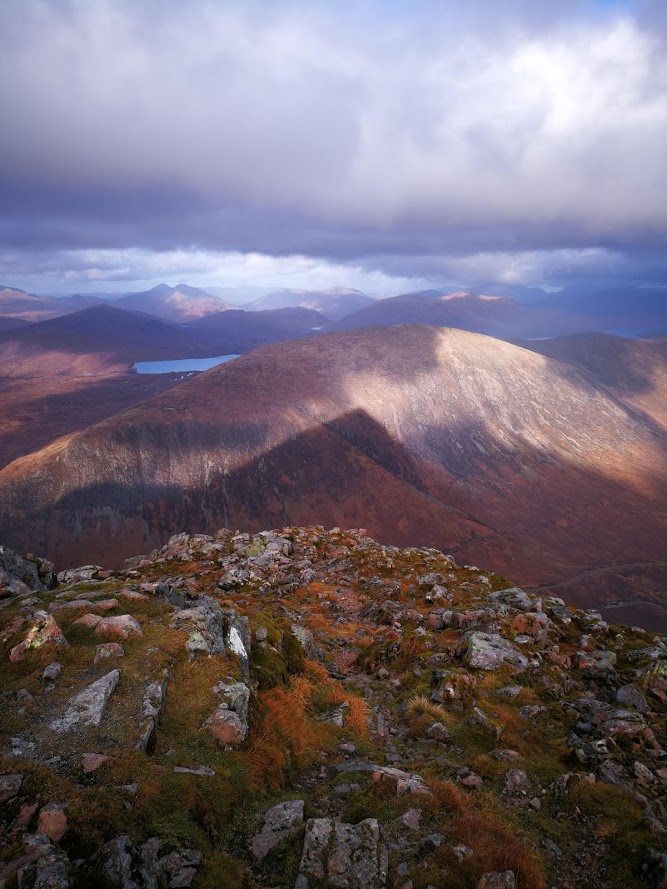
And then onwards and down. First, down to the col, and then, the steep descent into Coire na Tuliach. Until the party went down into the gully, the light remained absolutely remarkable. One might go on the hill for two years and not see conditions like it. Tired now, the party descended to Lagangarbh, and crossed the river. Only as we approached the road on the long tramp back to the car, did we reach for our torches. Our timing was perfect – in more ways than one, for the following day was rainy too. We were lucky enough to do our hike in all too brief weather window as Autumn slowly turned to Winter.

Stand up, hold my hand
I hope you understand
Here where time is still, I walk the hill

Stand here, close to me
Here for all eternity
I wait as others will, I walk the hill

(Stuart Adamson)

IMG_20181111_151448

By train to Euston

The train hisses through anonymous railway stations and anonymous towns. The stations fly past to quickly for me to catch their names. The towns? Houses and streets, industrial units, perhaps the odd ancient church standing out through the early morning mist.

Across the heartland the train goes, through the very essence of middle England. You don’t need to know what the names of the towns are, to know what they are like. The rails shine with use; the electrical wires and their supporting posts flash by. In the distance, green fields and hills under an early morning sky of pale blue. The molten sunshine of not long after dawn washes everything clean. It all looks idyllic. Frost-covered green fields, patches of ground mist.

Emily Barker at St. Peter’s, Tandridge

Earlier this year we attended the first pop concert in 800 years, at St. Peter’s church, Tandridge village. It was an unseasonably cold night in March, and late snow lay on the ground. Tonight, we returned, in mid-October, on what was another unseasonable night. This time, however, the weather was very warm. To be able to walk around on a mid-October night in shirt-sleeves is most unusual.

This event, like it’s predecessor, was a benefit gig aimed at raising money for the fabric of this wonderful and ancient church.  In this case, money is sought to install a much-needed loo: prosaic, but a vital human need.  And this evening was both human and prosaic, warm and uplifting, but friendly and community-oriented.  The Rector, Andrew Rumsey, introduced the evening with a warm-up act of a brace of autumnal songs that might have even been written for the occasion.

The actual support act for Emily Barker were two gents called Roy Hill and Ty Watling. These gents looked and sounded like characters from Mark Knopfler’s “Sultans of Swing”

…Check out guitar George
He knows all the chords…

Mind, Ty Watling did indeed know how to make his guitar cry and sing, and that he went on to do.  Roy Hill was of indeterminate age, and was in good voice, and made banter with the audience about how much better this was than their usual pub gig.  They started dark, with a song about pain beginning, and finished with a deeply moving number about failing mental health, yet, they were always somehow encouraging, humane, and uplifting.

Emily Barker came on and immediately impressed everyone with her beautiful clear voice and her guitar playing.  This evening has seen a series of guitarists bringing great joy and beauty into the world through their playing, song-writing and singing, like Chet Atkins:

…Money don’t matter as long as I scatter a little bit of happiness around
If people keep a grinnin’ I figure I’m a winnin’…

In between the numbers she told us stories of her early life, in a discernable Aussie twang.  It is always engaging when pop stars do that – you want to know that they do go to the shops, that they were once kids in the back of a car going on holiday, singing along to cassettes.  She performed an old Bruce Springsteen number – “Tunnel of love” – to illustrate this story.

Somehow, the fact that she is a supremely skilled professional guitarist and pianist, a powerful and gifted singer and a talented songwriter did not discourage or demotivate. After the concert I was speaking to a lady in the audience who has Downs Syndrome.  She wants to write songs – and she was saying, by no means demotivated, how high the bar has been set by Emily Barker.  The lesson is, everything is possible; anyone can do anything if they set themselves to it.  A lady you might pass in the street, wearing blue jeans and a cardigan, has a voice like Aretha Franklin, a solo voice so beautiful, so powerful, as to carry an entire church in stunned silence.

“To one, he gave five bags of gold, to another, two, to another, one bag, each according to his ability” – Matthew 25:15.  It’s what you do with what you’ve got that matters, not how much you’ve got.

There’s a pattern emerging here with these concerts: Not so much inspiring, as inspirational.  Do new things. Dare to create, dare to do something new with your bag of gold.

Waverley station

One of my favourite places to be “outdoors” is the concourse of a big city railway station.  To have coffee, or better yet, to be at beer, is an added bonus.

After an excellent breakfast at a little deli in Callander, I drove on southwards.  It was interesting to see clouds form over the central valley.  Coming into Edinburgh, there was heavy fog and drizzle, though it remained warm.

On the way down, I happened across an #Engineering #Marvel, and went out of way to go and see it.  Many years ago, touring with a friend of mine, on two occasions, we’d found ourselves at a loose end on a Sunday afternoon, and visited – quite by chance, as it were – engineering marvels.  One was a certain “nuclear installation” on the coast of Cumbria; the other, a radio telescope in Cheshire.  To pass within a few miles of the Falkirk Wheel, and not pay a visit, would be crass.  And I speak as someone who can allow the Flying Scotsman to steam unseen past the end of my garden at 5a.m on a working day, whilst I lie in bed.

I allowed myself the luxury of complete dependence on the Google sat nav to get me to my final destination, with only one or two cursory glances at it to ensure that it knew what it was doing.  There’s no call when using sat nav to switch off your common sense or your sense of direction.  At one point I drove past Fettes College.

But back to the great railway stations: I love big stations.  Victoria, St Pancras. Glasgow Central.  The destinations boards, the bustle and hustle, the romance.  Better still – possibly – in the days of steam, with whistles, steam heating, clatter and bang.  I remember steam heated trains from my youth.

And what of the journey, the pilgrimage, the embracing of change, the understanding that things must change? Steam has gone, but most everything changes.  Tomorrow will be different.  The journey never ends. We must take nourishment from all aspects of it: the good, the bad.  From the  rest and the rush.  From the pleasure and the pain.

On a journey, we may do things differently at the end, than at the beginning.  On a journey we must adapt and learn, most especially from our mistakes.

Mhor 84, at Lochearnhead

I arrived at Mallaig off McBrayne’s ferry Loch Nevis, about 5.30pm on a hot sunny evening. I bought such things as I might need were I to have to camp, and set off south at ten past six.  Lovely motoring through delicate evening light – or perhaps late afternoon sunshine.  It would have been nice to stop, but I couldn’t really spare the time. 

I was hampered in places by motorists “pootling”, particularly on the Mallaig to Fort William section, in Glen Coe, and on Rannoch Moor.  The practice of pootling is deplorable.  It is the practice of not driving as fast as the road will safely allow,  and not a mile an hour slower.  That this may be faster than the national speed limit is neither here nor there.  As an aside to the once delightful road across Rannoch Moor, I can see the authorities have found a very cost-effective way of restricting the speed of motorists on that stretch:  Failing to maintain the road.  A road that as recently as ten years ago was quite safe to take at 90 or even 100 mph is now so rutted and pot-holed as to be literally – not metaphorically – a white-knuckle ride at 75mph.

I got to Crianlarich at 8.15pm and I had every intent of staying in the Crianlarich Hotel, which I know had rooms available.  The restaurant was heaving with the Grey Pound, but the reception desk was abandoned.  I rang the bell. I waited. I left. Distinctly unimpressed, I pushed on down the Stirling road towards Lochearnhead.  I’d never driven this road, and it is over thirty years since I was taken along it in a minibus.  Lochearnhead itself has no licensed premises or hostelries of any form whatsoever. Slightly further on, and growing a little edgy as evening wore on, I saw and drove past “Mhor 84”. I stopped, three-pointed and came back.  It was 8.45p.m – the edge of the reasonable time for supper.  I could have ended up in some Travel Lodge in Stirling, or camping rough in the lowlands in some farmer’s field – this is not the wilderness of the Great Glen.

Mine host – a pleasant mannered and rounded Antipodean lady – said she had a room, for which the booked clients had not yet turned up.  On the basis that a bird in the hand is worth two in the bush, she promised the room to me, even as I stood before her.  Somewhat relieved, I went into dinner, and started a much-needed pint.  This meant that I wasn’t driving any further even if the Australian lady wasn’t good for her word.  But she was.

The room was small and white, with Venetian blinds which at this time of year at this latitude are not a lot of use. There were some great vintage signs on the walls – an RAC sign on one wall, and a training display of the Norwegian alphabet on another.  Some antlers had been salvaged from elsewhere.  I loved the fact that they had been wrenched by main force from a wall panel of that now lost building.  A little scrap of panel remained on the white wall.  A nice touch, was a flask of fresh milk to make tea in the morning.

In the morning I sat down for breakfast and it became clear to me that I had not paid £90 for B&B, only for the bed.  They wanted another £12 or so for my breakfast. I left on the instant, perhaps not with the greatest grace, and checked out.  Nice place, arguably over-priced.

Ten miles down the road in Callander I stopped in a little cafe – the Deli Ecosse – for a first rate Full Scottish with coffee, for a little over £6. Lovely atmosphere, great service.  That’s why I love the free market.