Reading in 2025

I managed to beat last year’s total of 50 books! I read 61 books last year. Of the 61, 17 were re-reads, and most of those, taken on my Kindle. My first book of last year was a re-read of C.S Lewis’s “Out of the silent planet”, that beautifully English account of the adventures of a middle-aged academic kidnapped and transported to Mars. The “silent planet” refers to Earth. A book I carried over from 2024 was Alison Weir’s “Lancaster and York – the wars of the roses”.

I was very impressed with Horatio Clare’s book “Icebreaker”, being a candid and revealing account of travels with the crew of a Finnish ice-breaker. I re-read – as I do every few years – Lord Moran’s “The anatomy of courage”, his thoughts on the nature of bravery and courage. They are based on his experiences as a doctor in the trenches during the Great War. At one level, it seemed to me his thoughts were not my thoughts. At another level, we are all moulded from similar clay. It is thought-provoking, essential reading. I went on to source a copy of his (controversial when it was released) “Churchill – the struggle for survival”, being an interesting account of his work as Churchill’s personal doctor in the 1950’s. It was as interesting as commentary on the politics and social mores of the time, as it was as a memoir about Churchill. That said, I was blessed to read of Churchill deliberately managing incipient depression – the “black dog” – by avoiding both people and situations that would trigger it.

A book that took me four months to read was Volume II of Peter Charles Newman’s A history of the Hudson’s Bay Company, entitled “Caesars of the wilderness”. As I’ve noted before, I am a student of the colonial history of North America, and these books were recommended to me after reading Bernard de Voto’s masterworks on the westward expansion in what became the United States. On this topic I also read David Freeman Hawke’s “Everyday life in early America” and Dave Reynolds’ “America – empire of liberty”.

I read  a good deal of fiction during 2025 – much more than usual. Two-thirds of my reading was fiction. I am keen to improve my own writing; my own head is full of ideas for fiction, though God only knows if anyone would ever read it. I opened my mind on this matter to a wiser and more sage man than I – a man of few words – and his reply was “read more fiction”. He it was who recommended Austin Kleon’s remarkable book “Steal like an artist”. I read space opera – Gareth L. Powell and Paul McAuley. I read two of McAuley’s thrillers that were almost sci-fi. “Cowboy Angels” is set in an alternative universe where Alan Turing was not hounded to death by the state for being gay, but emigrates to America and creates strange gates between dimensions to allow access to alternate Americas. All well and good until the “Cowboy Angels” – the equivalent of the CIA – come to the America where Nixon was president. Another of his was “Austral”, a readable tale using Antarctica in the late 21st century as a proxy for another planet. Odd to read of a city on the Antarctic Peninsula called Esperanza, a city of fifty-story skyscrapers and millions of people. Alas, I found the heroine in his book unconvincingly stupid and inflexible – I had trouble with suspension of disbelief. Interestingly it is only the second novel I have ever read set in Antarctica – the other being Payne Harrison’s geopolitical thriller “Thunder of Erebus”.

I had a long Bond season, reading five of Fleming’s 007 novels. No-one worth taking seriously would suggest that Fleming couldn’t write well, though the literary establishment, then as probably now, may look down their noses at him and his work. But I know good from bad – I don’t read literary fiction. I was duly impressed with Ursula K. Le Guin’s influential earlier works – “Rocannon’s World”, “Planet of Exile” and “City of Illusion”. They sound like hard sci-fi but written as they are by a woman of her sensitivity and genius, they are so much more complex than that. I was disturbed by Georgi Gospodinov’s “Time shelter”, ostensibly about “memory cafés” for those suffering from dementia – but again, a good deal more complex a story than that. On the eastern European side I continued by reading Stanislaw Lem’s “Fiasco”, a novel about first contact with aliens – and how it can all go so horribly wrong. Staying in Slavic territory I have “We” by Yevgeni Zamyatin, still on my shelf to be read. Maybe this year…

I treated myself to three new books mid-year. The first was “North Woods” by Daniel Mason (short stories about New England, recommended by the Economist). The second was “Children of the dead end” by Patrick MacGill, which I was recommended to by visiting the town of Kinlochleven in the Highlands. This was an autobiographical novel of an Irish navvy and his journeyings in childhood from Donegal to being a “man of the road” in Edwardian Scotland. The third, was “New Pompeii“, a science-fiction thriller by Daniel Godfrey, again, recommended by the Economist, and my review here: https://plateroom28.blog/2025/05/05/a-review-of-new-pompeii-by-daniel-godfrey/.

I read China Mieville’s account of the October revolution – riveting at first, but rather more tedious later, covering a few short months in Russian history in great technical detail – too much detail. I read – though I finished it in 2026 – Jonathan Healey’s refreshing and excellent “The Blazing world”, a history of Stuart England, pretty much the “long” 17th century. Healey’s position is fundamentally liberal and libertarian, and to me, noticeably protestant. What do we learn from his book and that century? We learn that all law and power ultimately springs from below, from the people, and not from above. The state itself, whether monarchs, presidents, barons, or captains of industry – is, or should be, subject to the law. At the time of the Restoration of Charles II, General Monck said, the Army should be subject to Parliament, not Parliament subject to the Army. A thousand times Amen!

On holiday I read Robert Leckie’s WWII memoir “Helmet for my pillow”, and his account of the battle of Okinawa. I read Seamus Meaney’s translation of Beowulf which was rich, dark and remarkably easy reading. A friend of mine leant me a copy of Ernest K. Gann’s “Fate is the hunter”, a memoir about early aviation. I read several books by O.S Nock including his trackside memoir “Out the line”. There were other railway books of course…I note here only H.C.B Rogers’ “Chapelon – genius of French steam”. All our famous British railway engineers – the likes of Bulleid, Gresley, Stanier etc – all sat at the feet of Andre Chapelon, who was indeed a genius.

Later in the year I managed some stranger fiction – what some call “magical realism”  – Robbie Arnott’s “The rain heron” was one such. Set at one level, in a real country enduring economic hardship and military rule, but at another level, a book of magic and fantastic goings on. Tim Lebbon’s “Echo City” was more traditional horror – or was it? Odd happenings in a strange, ancient city completely surrounded by desert. I found a copy of Richard Mattheson’s “The Shrinking man”. Mattheson also wrote the book that became the Will Smith film “I am Legend”. See here: https://plateroom28.blog/2022/04/22/no-adjective-for-terror-i-am-legend/. “The Shrinking Man” was interesting in that it covered without shrinking, the emotional life of his hero – his fear, his despair, his lust. My final book of the year was a gift from my kids, and it was Andy Weir’s “Project Hail Mary”. This is an unlikely but strangely realistic story of a last-ditch attempt to find out why the sun and all the local stars were dying, by sending a spacecraft to the one nearby star that wasn’t affected. I found it absolutely remarkable and very moving. I still think, not of his unconvincing everyman hero Ryland Grace, but of his down-to-earth alien engineer “Rocky”, the sole survivor of a similar mission from the alien home world. Underlying this and other stories about alien life, is the principle that life must exist everywhere in the universe. To suggest that life exists only on Earth would, to me, be as unrealistic as suggesting that the sun revolved around the Earth, or that the Earth was flat. I also think, the story needs telling, of what happened when the news got back to Earth that the threat to the sun could be fixed.

We’ll end on that positive note: things can be fixed; situations can be resolved; people can be healed. Though we live in strange, grim times and need all the good news we can get, the end of the world is not nigh. Not right nigh anyway…there is good news out there and some of it can be found between the pages of books – go read a book!
Politics as seen though the lens of science-fiction

Politics as seen though the lens of science-fiction

Two classic novels appear to me to define very well the opposing political positions we generally refer to as “left-wing” and “right-wing” – or at least, the left and right-wing libertarian or anarchist positions. I’ll deal first with the left-wing position, as represented by “The Dispossessed” by Ursula K. Le Guin. This is at one level an adventure story about a middle-aged male academic travelling from a place that resembles more than anywhere else, the Soviet Union, to a place that may be rather like the West. A physicist, who has developed a theory for a tremendous technological breakthrough, must travel from his technologically backward home country to a technologically  more advanced land, in order to secure further funding, get his theory validated and to obtain some form of engineering assessment as to the commercial possibilities for his theory. Can it be translated into a device allowing instantaneous – faster-than-light – communication?

He travels from a culture where there are no possessions – a place where the words of John Lennon’s song “Imagine” have for centuries been worked out in practice. So much so that the language used in that country no longer has any possessive pronouns. There are no possessions, no way of expressing even the concept of ownership. Think of the handkerchief scene in “Brief Encounter: A man could not say “use my handkerchief” but would have to say “use the handkerchief in this pocket”. It is a collective land; a communal country, an association of anarchists who believe in the primacy of the community and not the state itself. Her anarchist country, after centuries of this, is not a repressive dictatorship, but neither is it a liberal democracy. It’s not the Soviet Union; it is better than that. You can see similar ideas in her earlier work “The left hand of darkness” which is set centuries later – the principle that collectivism need not automatically lead to tyranny. I am unconvinced; perhaps better and wiser people than I can convince me otherwise. In “The dispossessed” you see the idea that community can work – it is an almost “Bennian” (as in the late Tony Benn) vision, that the community is better than the individual, and that the community and the state are more or less one. Le Guin’s world is one where – at least to my eyes – they have avoided totalitarianism, the “tyranny of the majority” and the so-called “tragedy of the commons” – where the individual does not in general act in the interests of the community.

Personally I think it is a utopian vision. I take F.A Hayek’s view that collectivism does in fact ultimately lead to tyranny – it is literally “The road to serfdom” (the title of Hayek’s book on this subject). To paraphrase Hayek I think that for collectivist politics and economics to survive in the long term, coercion and ultimately naked force would be required.

The other side of this essay on politics as seen through the lens of science-fiction is a novel that outlines the right-wing libertarian or anarchist position. We look now at Robert A. Heinlein’s “The moon is a harsh mistress”.  This short novel, set in 2075 but written in the 1950’s, tells the story of a revolution at a private sector penal colony on the moon. Convicted felons are transported, serve their sentence, and are then left to live or die on the moon – there is no return to Earth. The company running the prison makes no allowance for the former convicts, and in theory at least, does not care whether they live or die. They do in fact live and prosper in a network of caves under the surface, growing grain and other foodstuffs for the colony and for the prison. In fact, they grow so much grain that the company exports it at a huge profit back down to a hungry and wildly overpopulated Earth.

These ex-convicts survive in a society where there is no state, no welfare, and no rule of law, except what the company requires or provides. Yet it is an orderly and civilised place. Could that even be possible? Is Heinlein utopian in suggesting that such an anarchic arrangement could survive and prosper?

It all works well enough until the company levies a tax too much, a rule too far, and provokes a revolution. That is merely adventure and need not concern us here. The part that interests me is the story of the private sector judge.

A visitor from Earth is caught doing something considered worthy of death (in fact his crime is trying to hit on a girl, in a place where women’s rights are held absolutely sacrosanct); he is caught in the act by local people and is about to be lynched. Our heroes see this, intervene, and cause this man to be taken to “Judge X’s courtroom”. The mob agrees to put up the money to have the man tried in this entirely unofficial private sector courtroom, and agree to abide by the decision of the judge. The man is tried and acquitted. Why does the mob abide by the judge’s decision? We in the west struggle even with the concept of a private sector judge – why would you trust such a judge? But then again why not? Why would you trust a public sector judge? From the Bible down to the present day we have any number of examples of untrustworthy judges. For much of human history and even today in many places, the fact that a judge was or is a public sector employee has been and would be no guarantee of honesty nor even of impartiality.

American “anarcho-capitalist” theoretical economist Murray Rothbard asked this question: Who provides any given good or service? If it is the state, why? Is it the job of the state to provide goods and services?  This is a fundamentally American question, a question perhaps rooted in the American experience on the “frontier” in the 17th to 19th centuries, where for long periods in many places, there was no state – but some people prospered. Heinlein – a contemporary of Rothbard – puts this question in story form. To the modern 21st century mind, particularly in the UK and Western Europe, to even ask this question is offensive. I remember getting into very hot water socially after publicly quoting Barry Goldwater’s infamous phrase “It is not the job of the state to make men moral”.

The view of the French philosopher Rosseau was that the people are children that should not be allowed out on their own and need their hand holding – by the state. It is such a commonplace view as to be effectively the norm. It is not a view I share. I take John Locke’s view that the state is only a necessary evil.  

A review of “New Pompeii” by Daniel Godfrey

Recently I was discussing my writing and reading with a friend of mine, someone I consider wiser and more Godly than I. A man of few words, his sage remark summing up our conversation was, “read more fiction”. That night I ordered three books. The first was “North Woods” by Daniel Mason (short stories about New England, recommended by the Economist). The second was “Children of the dead end” by Patrick MacGill, which I was recommended to by visiting the town of Kinlochleven in the Highlands. This was an autobiographical novel of an Irish navvy and his journeyings in childhood from Donegal to being a “man of the road” in Edwardian Scotland. The third, was “New Pompeii“, a science-fiction thriller by Daniel Godfrey, again, recommended by the Economist. For those with a snobbish bent towards literary fiction, this is perhaps the least considerable of the three. But I read it first and I will review it first.

New Pompeii started slowly, but it built up in pace very well, and it ended very strongly. I have found in recent years that a lot of fiction, particularly science-fiction, tends to end weakly, as if the author ran out of steam towards the end. I was anticipating yet another weak ending here, and I was disappointed! The protagonist is called Nick Houghton. This, for obvious reasons, pleased me. This is the closest I’ve ever got to being in a book myself – although in Steven King’s “The Stand” there is a minor baddie called Carl HOUGH, and a major goodie called NICK Andros…

That said, this Nick Houghton I found unsympathetic; a little too prissy and sensitive for my tastes. He’s an academic with little consequent grounding in reality, a sufferer from migraines, a man very much in thrall to an overpowering father, also an academic. Nah – that ain’t me, that’s not my kind of guy. One might say of this character, “He’s definitely on the spectrum” – though of course, aren’t we all? Yet, I think it’s important in good fiction to have characters with flaws; better still if they are modern flaws, like suffering from migraines, like neuro-divergence, OCD or excessive risk aversion.

Notwithstanding this character who I found I would not like, and some early plot twists that caused my suspension of disbelief to shiver slightly like a Jenga tower towards the end of a game, the story developed well. If there was one grave flaw it was the baddies – the antagonists – were pantomime baddies, badly drawn men, somewhat unconvincing. Whelan. the former soldier, was the stock hard man, but neither convincingly evil nor convincingly redeemable. He was never frightening. McMahon his boss, was no more than just a cipher; a boor and indeed a bore, pasted into the role of CEO.

I found this book unputdownable – I read it through continuously in one go and I paid full price for it. I think that gives me the right to be critical. Serious questions arose in my mind about the siting of the city of New Pompeii – which cleverly, the author does not reveal. In practical terms, where could such a city be placed such that it would not be swiftly obvious to the Roman inhabitants that it was not Pompeii? It would have to be within a couple of degrees of latitude of southern Italy – otherwise after a few years the climate would soon betray its location. It could not be at an equivalent latitude in the southern hemisphere – that would become obvious on the very first night, from the different stars and constellations. There would have to be a “no-fly” zone round the city with a radius upwards of 30-40km – or the city situated where there was no possibility of overflight by commercial aircraft. Can’t have our Roman citizens wondering what contrails are.

The surprise is not that Whelan and NovusPart have underestimated their Roman captives, but that those captives remained quiescent for so long. The author’s characters did pick up on some things – the change in colour of carrots, and the change in the size of chickens – over 2000 years – but not others. I read once that Venus, the Morning Star, was visible in broad daylight until modern air pollution rendered it otherwise. It seems unlikely to me that no-one in New Pompeii would not have spotted artificial satellites rushing across the sky. Underlying this point about underestimating the people of the past is an important principle. What I call the “myth of continuous improvement” is at work. Today we often tend to assume that things have got better, that we are morally, intellectually and even physically superior to our forebears. The author brings home nicely the point that this is not necessarily so.

Overall though, this was a page-turner that showed and did not tell. It was a story concerned with people rather than with the enginery and natural philosophy associated with time travel, or with geomorphological and natural change over 2000 years. It is the people that are important, as indeed the protagonists themselves noted.

Reading in 2024

I have managed fifty books this year. That’s a result. Interestingly, the fiftieth book, Simon Sebag-Montefiore’s epic history of the world, took me more than a year – I started this work in December 2023. It was an excellent read, stretching my vocabulary in many respects. All the major swear words were present in plain text along with graphic sex and stomach-churning violence, but the “N word” was beyond him or his editors, which is an interesting comment on modern liberal social mores.

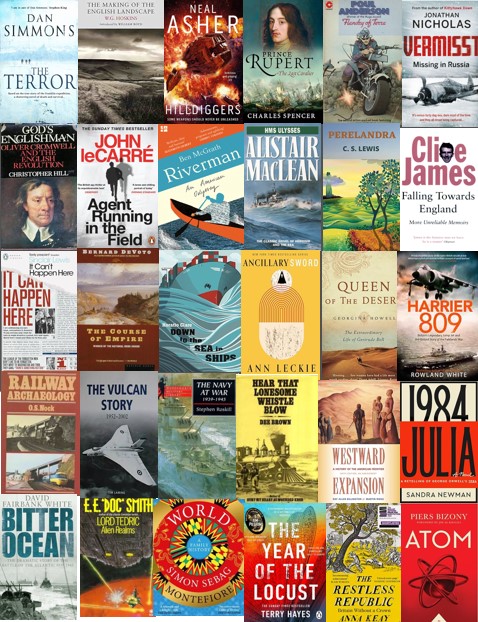
I started the year reading Dan Simmons’ gripping historical fantasy drama “The Terror” about the loss of the Franklin expedition in Arctic Canada. By complete contrast I very much enjoyed W.G Hoskins’s classic “The making of the English landscape”. I do tend to fall back on historical non-fiction, and a recommendation from earlier reading was Charles Spencer’s “The last Cavalier”, a biography of Charles I’s son Prince Rupert. This, in turn, led to something of a season of reading about 17th century England. I followed Prince Rupert in February with Christopher Hill’s biography of Cromwell – “God’s Englishman” and later, in December, by Anna Keay’s delightful “The Restless Republic”, which covered aspects of England in the republican years as seen through the lives of various protagonists. Fairfax the politician; John Bradshaw the lawyer; Marchamont Nedham the journalist; Lady Derby the royalist; Anna Trapnel the prophetess, amongst others. A brilliant and humane piece of work from which I learned much. Cromwell not quite the villain, nor the hero, he has been painted. Successive military coups, army juntas running the country…so much of our past is just not taught in school. At the time, George Monck, the general who engineered the return of King Charles II, wrote: “the army should serve the civilian government, not the reverse.” Amen!!

All of that reading on the 17th century, flowed from reading Peter Newman’s book on the Hudson’s Bay company, which in turn came from recommendations in Bernard de Voto, which in turn was recommended to me by Robert Kaplan. Recommendations are everything. Let your reading go where it will!

I read A. L Poole’s “From Domesday Book to Magna Carta”. Over months I worked my way through Geogina Howell’s biography of Gertrude Bell, the “Queen of the Desert”. My continued interest in American history saw me reading the final instalment of Bernard DeVoto’s masterly trilogy on the westward expansion in America: “The course of Empire”. Also, in that vein, Ray Allen Billington on “The Westward expansion in America”. Railways and America were combined in Dee Brown’s unsettling book on the displeasing and deeply venal American railroad barons, “Hear that lonesome whistle blow”. Also on railways I enjoyed the delightful and prolix O.S Nock on “Railway archaeology”. Very few people can write like that these days. I had a canter through the war at sea with David Fairbank-White’s “Bitter Ocean” and Roskill’s “The Navy at war: 1939-1945”. In that context I also re-read Alistair Maclean’s “HMS Ulysses”, and then I lent a copy of it to a close friend. A book perhaps to save for a time when your mental health is at it’s best. Not for the faint-hearted.  

I did some re-reading – it is always good to go over old ground. Old ground like Keith Laumer’s short stories, which I first read as a schoolboy in the mid 1970’s. One of them is “Special placement test” about the guy who can’t get a job in a massively overpopulated future America, and is faced with submitting himself for a lobotomy. How does he escape? It would make a great film. Or Frank Herbert’s “Hellstrom’s Hive” for which I would love to write a sequel. Also, in light of the new Dune films, I re-read “Dune” and “Dune Messiah”.

I started reading some of Neal Asher’s space operas, getting through three or four of them, but laid off them as they were quite hard on my mental health, being full of quite astonishing levels of violence and nastiness. I read – and this was a good deal more positive – Ursula K. Le Guin’s “The winds Twelve Quarters” and “The Compass Rose”, more encouraging and uplifting space opera set in her “Hainish” universe. Equally uplifting was Anne Leckie’s “Ancillary Sword” although the latter’s refusal to use male pronouns confused me somewhat. I suppose the point is, it doesn’t matter if you’re male or female. Except it does… Other sci-fi included work by Ken Macleod and Alistair Reynolds, and vintage pulp fiction by Poul Anderson (“Flandry of Terra” – “Bond, James Bond” out amongst the stars, written about the same time as Fleming was writing the 007 tales) and E.E Smith (“Lord Tedric: Alien Realms” – pure pulp read in less than a day). I re-read C.S Lewis’ epic “Perelandra”, something I try to do every few years. This retelling of the legend of the Fall, the story of the unfallen planet Venus threatened by evil – but delivered by the actions of one brave person – never fails to grip me. I found time for an “omnibus” trip to Darrowby, with James Herriot – leading my wife into a season of reading him as well. “Agent running in the field” and “A Legacy of spies” were my fix of John le Carre’s work for this year. Must have read most of his stuff by now? Also, Jonathan Nicholas’ “Vermisst” about a German WWII aviator lost in the Soviet Union. Also, two technical books on the Vulcan bomber, and a book by Raymond White on the use of Harriers in the Falklands War.

An outstanding read was Sandra Newman’s “Julia”, being the story of Winston Smith’s eponymous lover in Orwell’s 1984. Very graphic and quite violent in places, she manages to fill in some interesting social detail that would have quite eluded a man like George Orwell. Also, towards the end, she conveys some of the hope that is entirely absent in 1984. I gave the book to my daughter and sent a copy to one of my sisters, so impressed was I. In the context of dystopia I also read Sinclair Lewis’ “It can’t happen here”, a story of America under a dictatorship, written decades before Orwell wrote 1984, and eerily prophetic…I will say no more.

I enjoyed Ben McGrath’s very humane “Riverman”, an account of travels by canoe through the great rivers and backwaters of the continental United States – not really about rivers, but about people. Also about people but not really about ships or the sea, was Horatio Clare’s “Down to the sea in ships”. A man whose writing I love, but who I find can get a bit pompous, is Clive James. I read another of his now quite hard to find memoirs, “Falling towards England”. I can cope with someone with such a high opinion of himself as Clive James, only in small doses. I also read a couple of books on cosmology I’d been recommended to: Brian Clegg’s “The Quantum Age” and Piers Bizony’s “Atom”.

There’s more! The untimely death of Michael Mosley saw me reading my wife’s copy of his “Just one thing” – leading to a few small but positive changes to my lifestyle, which of course is all he would have wanted. Terry Haye, a respected screenwriter, wrote “I am Pilgrim”. His second book “The year of the locust” was not quite as good, and had an odd sci-fi component in the middle, but was eminently readable. I read Christopher Tolkien’s expansion of his late father’s mythos with “The fall of Gondolin”. I confess that the three or so different versions of this story now available do lead me to getting a little confused. Gondolin was a legendary city in Tolkien’s Middle Earth. The beautiful White City of Gondor, as seen in The Lord of the Rings, is held up as a pale reflection of Gondolin’s beauty. As with all of Tolkien, and indeed this is true to a degree of all great writing, the epic tale of the city’s fall is both just story, and yet also a profound lesson for all our lives.

Thoughts on some recently read fiction

Looking back across the last twenty books I have read, I find that most of them were non-fiction. I need to make the effort to read more fiction, but I find there is a greater risk with fiction, of a book proving to be unreadable – as we shall see shortly. Life is too short to read unreadable books.

I read John le Carre’s “Silverview“. I very much like Le Carre’s later work, and even his early Cold War stories are worth re-reading, though the politics and drama therein, if not the writing, have not aged well. A time will come when I have read all his books. “Silverview” has a few odd hostages to fortune. This one, I understand, was published posthumously and is effectively therefore, his last work. In “Silverview” the chief character is an English book-shop owner in his thirties, who does not recognise spoken Polish when he hears it, and who has ostensibly never heard of Noam Chomsky. I think it is impossible for a well-read and well-educated man of good family with a liberal arts background (as Le Carre’s characters always are) not to have heard of Noam Chomsky (say what you like about his politics and I won’t, here…) or to not be able to recognise spoken Polish. Notwithstanding all that, a very readable story.

I read “The Starless Sea” by Erin Morgenstern. I was drawn to the spine when I saw it in the shop. Then, reading the blurb, I was drawn in further still – and hooked. It was the phrase “labyrinth hidden far beneath the surface of the earth” that got me. Anything like that, I will read. I still occasionally re-read Jeff Long’s “The Descent” and “Deeper”, both deep horror thrillers about immense caves and strange lands far underground. Morgenstern has written something cross-genre. There’s aspects of fantasy – magic and weird immortal god-like characters. There’s also a thriller in there – the hero is running for his life throughout, chased by very modern and secular forces seeking to end his life. Very readable.

Then I read Adrian Tchaikovsky’s “Children of Ruin“. This is the second novel in a series about mankind’s future out amongst the stars. It stuck in my mind because some of the problems in the story relate to language and translation. Not merely translating between different written scripts or alphabets: how do entirely different species communicate? How do humans, with good eyesight and hearing, communicate with intelligent spiders who cannot hear at all at human frequencies, but whose language is based on vibrations in their webs? And how do those two species, working together, communicate with squid – intelligent cephalods who cannot hear and use no writing at all? These space-faring squid communicate entirely through colour – nuanced and delicate splashes and blotches of colour. This reminded me of China Mievelle’s story “Embassytown” which also deals with the deep concepts of translation that go beyond mere written text.

Then I read my first novel by Neal Asher, “The voyage of the Sable Keech”. Asher is a prolific science-fiction writer and I have been seeing his work on the shelves for years. For some reason I have never pulled one off the shelf to buy and read. This one was effectively drawn at random from his extensive catalogue. Again, authors and publishers would do well to note the importance of the blurb on the back. That’s what sold me…ancient hive mind…virus…new drone shell…Asher’s work has immortals, viruses, some very dangerous animals, and is full of violence. Nearly as violent as Richard Morgan’s “Altered Carbon” trilogy about Takeshi Kovacs, and that’s saying something! I found Neal Asher’s crab-like aliens, the Prador, particularly unpleasant. But nevertheless, a great read by someone who surely knows about the craft of story-telling. I’ll be reading more of his work, and trying to learn from his technique.

Finally, I tried and failed to read Ben Bova’s “Mercury“. Bova strikes me as being of the first generation of science-fiction authors (that of the early-mid 20th century), yet somehow crossing over into the second generation. One cannot be sure if he writes hard science-fiction (following the physics) or soft (what used to be called “space opera”). Writing in 2005 though, he is spot-on and prophetic about the effects of climate change. I found his characterisation not even good enough to be called two-dimensional. His heroes and anti-heroes were wooden and unconvincing. I love nuance – you’ll find none in a Ben Bova novel. I finally put it aside after growing cross at his “New Morality” priests. It’s fair enough to be an ardent atheist and to allow dislike of religion or even Christianity to creep into the text, but characters, even baddies, or even priests, need to be convincing. Pantomime baddies belong in the pantomine: my suspension of disbelief fell off. TL;DR.

A full review of all my reading of 2023, will be forthcoming shortly!

Mortal engines

A review of “Mortal engines” by Philip Reeve

This is a short review of the film of Philip Reeve’s boys’ story, “Mortal Engines” which I watched on a flight, back before the lock-down, some three years ago.

I have gone full circle in terms of fiction. Eleven years ago I read my son’s copy of “Mortal Engines” whilst on a long-haul flight. I am just now sitting through the film version of the same story, also whilst on-board a long-haul flight. And to be perfectly honest the film is as weak and as thin as the original boys’ story. The original story was for children and I – as well I might as an adult – found it too thin. This film, however, is in effect not for children but for all (PG cert) and I found the same lack of conviction that I found in the original book, though perhaps for quite different reasons. The book and the series to which it belongs were successful in their time, doubly so really, in that Hollywood bought the options to make it into a film.

As a film, I found it cliched. It was a triumph of special effects over plot, as so many sci-fi films are these days. I confess I’m not a fan of Hugo Weaving’s work and he plays the baddie in this film. I did like his role as Agent Smith in The Matrix, but not his Elrond in The Lord of the Rings. As a fan of the LOTR I’m familiar with Elrond as a character and I didn’t like at all the way he played Elrond: not at all like the character in the book. Here in Mortal Engines, he plays the Bearded Sultry Older Man. There is a beautiful daughter, a geeky hero and a second male lead with a strong Irish accent. It was quite literally tiresome to watch.

It would be interesting to see who wrote the screenplay for the adaption of Philip Reeves’ original novel. I had to give up watching, about a half hour from the end. It was so predictable and conventional I literally could not be bothered to watch it. Yet, along the way, amidst all the usual adventure thriller science-fiction memes and tropes, were some very interesting nuggets. This told me something about the screenwriters, hence my earlier comments. I’ve spent some time studying the Bible, and an aspect of doing so is what is called “redaction criticism”. Today we think of “redaction” as removing text from a document for whatever reason. But “redaction criticism” is trying to understand the use by biblical authors, of earlier written material. Take an example from the “Lord of the Rings”: recall the character Aragorn. Do we know if Tolkien, in his youth, read “The last of the Mohicans”? For Tolkien’s character Aragorn so closely resembles Fennimore Cooper’s character “Hawkeye” that it seems likely that Tolkien would have, and may have been influenced thereby. There is no way of knowing, of course. This then, is redaction criticism. And my senses are alert to it here: what influences were there on the screenwriters for this picture? It matters to me.

The first was the Shrike. Where does this immortal android zombie come from? Does he appear in the original books? I cannot now recall. I ask this because “the Shrike” is a strange and shadowy character in Dan Simmons’s Endymion in his very readable Hyperion novels. A dread figure, often invoked, rarely seen, much feared. Could Simmons’s work have influenced the screenwriters here? The Shrike in this Mortal Engines film excites some sympathy; there is, deep within it, some deeply buried kernel of humanity, some taste-bomb of humaneness that emerges to save the life of the young hero.

The second was the use of the term “shield wall” – towards which the travelling city of London is making its way. The term “Shield wall” originates in Frank Herbert’s “Dune”. An interesting juxtaposition, particularly when we see that this “Shield Wall” is actually located in the heart of central Asia, in what is now the Tien Shan of China.

Then, we have the environmentalist trope. I got the distinct sense that these marauding, raiding rolling cities, using up resources, harming the environment, represent the west, whereas the fixed buildings hidden behind the shield wall, are the east – the home of the “anti-tractionists”. They are portrayed as somehow better, and somehow inherently eastern. It is all a bit naïve and simplistic, and it can be, for it can easily be passed off as being for children, or being “just” science-fiction. But actually it’s quite cleverly crafted cultural spin and I don’t care for it as such.

A review of “The long way to a small angry planet”, by Becky Chambers

A review of “The long way to a small angry planet“, by Becky Chambers

A readable example of what some have referred to as “social” science fiction, that is, science fiction that (at least ostensibly) deals with the human or personal story rather than engines, guns, planets and stars – though all of the latter four items figure in this book. Other examples of this sub-genre would be Maria Dona Russell’s The Sparrow (reviewed here) and Dark Eden by Chris Beckett, reviewed here. We can include in this category, some sci-fi classics like Ursula Le Guin’s The Dispossessed and The Left Hand of Darkness.

I found this copy in a pile of second-hand books in a church in the Peak District, and it did make for entertaining and satisfying holiday reading. To me, that is enough. However, once into it, one swiftly became aware of the rather conventional Californian left-liberal politics and moral philosophy of the author. It’s all co-operation and warm fuzzy feelings, and that’s fine, as far as it goes – even if it all seems a little far-fetched to this hard-headed and cynical reviewer.

At one level, this is exactly what I have long called for – science fiction that is positive, warm and encouraging, eschewing the dreadful dystopian vision of many modern writers. At another level, it beggars my belief at least – there are no convincing baddies in this book, save possibly for a few prison guards. There’s never any sense that things could go badly wrong.

What’s the story? A young, well-born woman escaping from her past, takes a job as a clerk on a ship…a ship whose crew, all have their own secrets. The ship is then swept up into an escalating war, from which they narrowly escape. The plot, which is solid and believable, is pretty much used as an excuse for five or six essays or short stories on the secrets of the crew. We have a nod to Vernor Vinge’s “Fire on the deep” in that humankind are part of a pan-galactic community of sapient species, all connected by some form of galactic internet. We have a borrow from Ursula Le Guin in the use of her word “ansible” to mean a device enabling faster-than-light communication. The author must be familiar with the darker futures described in the works of such writers as Richard Morgan and Alistair Reynolds. She has worked hard to portray something better, and has brought us something – there’s no other word for it – more feminine.

Part of the back-story is that humankind has managed to completely ruin the earth, and yet somehow be technically able to escape to the stars and thus be rescued, as refugees escaping from a desolation, by compassionate star-faring aliens. There’s a strong theme of pacifism in here; the captain of the ship, an otherwise sensible and upright fellow, has pacifist leanings. The “Exodans” – the humans who have escaped from the dying earth, have learned lessons in that escape, ostensibly, about peace and war, about the importance of co-operation versus competition. These are, perhaps, important lessons. It is an interesting position to take, but it is a feminine position. It’s not a position I wholly share. I think aggression, chutzpah, arrogance, risk-taking, curiosity, and immense energy are some of the fundamental qualities that have brought humankind out of the dust. The meek will inherit the earth, as R. A Heinlein’s character Lazarus Long notes, “but only in plots about six foot by three foot”.

In the end, if the author is weak on engineering and logic, she is strong on relationship, on friendship, and on compassion. I’m happy for faster-than-light travel to be illogical or inadequately explained, in exchange for a series of sketches of broken people moving toward healing, towards a kind of very secular redemption. It works, as far as it goes. As a man I’m afraid my suspension of disbelief did fail in places. Humans are nasty as well as good, and the balance is a little too much in favour of the good here. No-one is that nice in reality. But well worthwhile and thought-provoking reading.

The watermill

The watermill stood at the end of a quiet lane that wound along the valley side through the trees. One came round a corner and up a little rise, and saw it, red brick against the green hill. I first saw it a child, when I’d been taken there on holiday. In the back seat of the car, bare legs against the hot vinyl bench seat, I’d bumped and jolted along that road – no more than a dirt track in those days. When we got round that corner, I saw it, and like my parents before me, I was transfixed. I’d loved that place ever since.  I brought my wife there and introduced her to it, and later, our kids too.

We’d stayed near there on holiday several times in all the ensuing years, growing to love that sweet, familiar little land.  The steep, secret valleys, the winding roads through the woods. The lichen and the stone walls.

I’d stood and listened to the somehow tamed and domesticated sound of the river as it poured over the weir into the mill race. I’d watched as the water poured over the ancient paddles, listened as the tired old wheel creaked round, squeaking and grumbling with age. As if it were saying, Go away! leave me in peace, leave me to sleep in the afternoon sunshine

And we’d been delighted when someone brought that mill into life and made it work again, turning  it into a tourist attraction.  It actually ground wheat into flour. Again and again we’d returned to this place in the rounded hills, to the secret watermill. We’d smelt the flour being ground, the dust sharp in our nostrils. We’d bought that flour and carried it away with us, baked bread with it as soon as we could, on the Sunday after getting back home from holiday. We’d tasted that bread, made from flour we’d seen being ground ourselves. We’d seen the wheat, we’d watched it poured out, and we’d heard the flour ground out. We’d heard the rumbling rollers, the grinding grey stones. Almost like it was our own.

And then the chance came to own the mill. In the afternoon of our lives, the means to do as we’d always wished, coincided with the opportunity to do so as well. We could buy the mill. And so we did; we bought it and we went to live there.  We went down the quiet lane by the river, to sit and listen to the grinding stones and the weir, at the brick mill under the green hills.

Reflections on a decade of reading

To early morning prayers on the first Saturday of this new month, this year, this new decade: outside, squirrels and magpies go about their winter business. As the day dawns, the exquisite light cheapens and becomes more banal, less delicate.

And now a look back at some of my reading over the last ten years. I have – at least according to my own records – read 491 books. Of those books, 349 I read for the first time: the rest, were books I have read before, sometimes once, sometimes more often. Tolkien’s “The Silmarillion” and C.S Lewis’ “Mere Christianity” top the re-read list, followed closely by Tolkien’s “The Children of Hurin” and R.A Heinlein’s “The cat who walks through walls” and “Friday”. Did I re-read any non-fiction? Why yes! I read twice these last ten years, Sebastian Junger’s “War” and Jon E. Lewis’s “The Making of the American West“. Also, Anthony Beevor’s account of the Spanish Civil War, and N.A.M Roger’s history of the Royal Navy, “The Safeguard of the Sea“.

I read two books called “On writing” – one – most excellent work – by Stephen King; the other, by George Orwell. I’ve read every one of Alan Furst’s dozen delicately written European spy novels set generally at the outbreak of World War II.

Alex Scarrow’s “Last light” was an apocalypse based around the end of electricity – how thin is the barrier that keeps the rule of law in place? How quickly could a person – or a society – somehow stumble through that barrier, and find themselves trampled to death by the Four Horsemen of the Apocalypse coming at a fast gallop in the other direction? In Scarrow’s book – about 48 hours. The Prime Minister fumbles a vital question in a press conference on a Monday morning. Wednesday afternoon, a policeman is shot dead at a motorway roadblock – and so the die-back begins. It was reminiscent of Nevil Shute’s propaganda piece “What happened to the Corbetts“, which was a fictional account written in the late 1930’s, of the bombing and destruction of the city of Southampton by an unknown enemy.

I had a re-read of Antony Beever’s masterful account of the Spanish Civil War – a book I enjoy reading, as he deals very lightly with the grey areas, the nuance and complexity of that conflict. I read a paper copy of the collected short stories of Arthur C. Clarke – always a pleasure to re-read the story of the Master, or the story of Grant and McNeil marooned on their freighter between Earth and Venus – with only enough air for one. I read and re-read Bill Bryson’s book “Mother tongue” about our great language. I was particularly impressed with “The man who went into the west“, being a biography of that sublime and yet oddly disquieting English poet, R.S Thomas. A clergyman who hid from his parishioners, a most peculiar and perhaps unlovable man, and yet, what poetry:

 The priest would come
and pull on the hoarse bell nobody
heard, and enter that place
of darkness, sour with the mould
of the years. And the spider would run
from the chalice, and the wine lie
there for a time, cold and unwanted
by all but he, while the candles
guttered as the wind picked
at the roof.

I read a number of China Mieville novels, and was most impressed by “Embassytown“, a story where the human ambassadors to a race of beings who speak with two mouths, have to be telepathic identical twins trained from birth. A very strange story – but fundamentally, all about language and communication. I read a couple of the memoirs of the late Clive James – what a writer, what a great guy. There are and have been few role models in my life, but God knows I’d regard him as one. Inspiring to me because he came from nothing. In “Unreliable memoirs” he writes of small boys throwing stones at an old lady, and compares it with Kristallnacht, noting that “the difference between mischief and murder is no greater than the law allows“.

I went through a Dennis Wheatley phase, once his material became available on Kindle, and relived some of the stories I first read in my early twenties. Evan Connell’s “Son of the morning star” was a biography of General Custer – and hence, of the development of the American west. That is a particular historical interest of mine. F.A Hayek wrote “The Road to serfdom” – a destruction of the errors of socialism – and perhaps the most influential book I’ve read this last ten years. Though oddly, it did not stand up (or has not yet done so) to re-reading.

I went through a Bond period and re-read much of Fleming’s original 007 stories. Great, spare writing. I also read a good few of Iain Banks space-opera novels, and also his de facto autobiography called “Raw Spirit” which I found encouraging. I read some of Keith Laumer’s science fiction stories, and Lord Moran’s excellent “The anatomy of courage” which every single one of us ought read. I read the journal of the Lewis and Clark expedition- that was long and tedious in places, but rivetting and exciting in others. Neal Stephenson’s work was a blessing to me – particularly “Cryptonomicon” and “The System of the World“. Nevil Shute’s “In the wet” I’d also highly recommend. I’ve mentioned elsewhere the radical and strange voting system he proposes in that story.

Who else is there to mention? Kipling, perhaps. I went through a Kipling phase after one of my daughters spent time at Simla, and later, lived for a year or so near New Delhi. “Plain tales from the hills” demonstrates that astute observer of the human condition in his best form. “Kim” I would put on the list of books everyone ought to read. Two interesting things about Kipling’s “Kim”: 1) it is available extensively in translation throughout India – but it is not available in Urdu and hence not available at all in Pakistan – where much of the story is set. I leave the reader to draw his or her own conclusions about that. 2) It is not so much the startng point of the Scout movement – that would be B.P’s “Scouting for Boys” – as the grandfather or underlying source material for Scouting. You want to understand what Scouting is about? Read “Kim”.

We may add the former astronaut Stephen Baxter. Whilst no crackerjack conspiracy theorist, he suggests that NASA exists not to faciliate human space flight but to prevent it – we could have gone to Mars in the 1980’s. I recommend “Flood” and “Ark” and especially “Moonseed” with a character whose immortal line is – after Arthur’s Seat becomes once again an active volcano – “Edinburgh is Olympus Mons now”. Also the learned Doctor Theodore Dalrymple. Never less than a pleasure – such works as “The politics and culture of decline” and “The Wilder shores of Marx”.

Tom Bingham wrote “The rule of law”, a helpful book on a vital concept. It is a book I bought and read after an oddly encouraging visit to Parliament which my wife and I won in a raffle. Up for re-reading in these interesting times, is that one. The leather-faced explorer the late Wilfred Thesiger was one of a series of Arabist explorers of the last 150 years. He was effectively guilty of opening the flood gates and allowing the desecration by oil companies of the Rubal Khali or Empty Quarter of Arabia. But he writes wonderfully of the (now doubtless long-vanished) desert Bedu. Read his autobiography “My life and travels“. Read “Arabian Sands“.

Much that perhaps ought to be included has been omitted. But I just read a book called “Steal like an artist” by Austin Kleon, and he notes that the future, in the present world where we are swamped by easily available data and information, belongs to those who know what to leave out. It was perhaps ever thus…and on that note, I bid you good day.

Nick Hough <nick@houghlife.com>Fri, 3 Jan, 18:46

Specks of unfallenness

“There was now no place on earth left where there was a memory of a time without evil” (Tolkien).

What if that was not quite true?

What if there’s unfallenness
In little flecks and specks?
Little bits of Eden.
Resonance of bliss.

What if there was space and time,
Where the fall just hadn’t happened?
Where illness needn’t blight our lives,
And all might live like Adam?

So ill was David, he had to be trundled to the aircraft in a wheelchair, and helped from the air bridge to his seat by his wife Ruth, with the assistance of solicitous cabin crew. It was just possible that the wasting disease, the creeping illness that struck him down at random, could be treated with a rare new procedure only available on the other side of the world.  In the times since his illness had struck, Ruth’s world had focussed and shrank down to almost nothing.  There was only caring for her husband, looking after his welfare, keeping him clean in body and mind and spirit – keeping his spirits up.  Neither of them were young anymore; their children had long since departed into the wider world and had themselves become parents.  Ruth was worn down with care, and grey-faced with exhaustion. She did not look forward to the 12 hour flight to London, even in business class. As for David, she was not even clear that he was compos mentis at all; the  drugs he needed to stay the pain had been augmented by additional drugs to allow him to fly.  This was a last ditch attempt to find a cure, to find relief.

She was so constituted as to have no concept of doing anything other than her duty.  She barely even thought about it: in sickness and in health. No resentment at her lot troubled her.  She was unworried by bitterness or any sense of the unfairness of life.  In this she was lucky; her yoke was easy.  All she had to deal with was ever-present tiredness, with which she had to do battle daily, even hourly.  The last few years had been a quick but nonetheless arduous journey, a terrible path from the full health of the late afternoon of life, to the place there were now: a gathering evening storm, from which perhaps, there was no shelter. Thirty-odd short months, and now twelve eternally long hours, and then onwards: to meet with consultants, urbane sun-tanned clinicians half the age of her husband, polite, distant, ever so slightly but unintentionally patronising.

And all after an insect bite. Her David had been bitten by some insect, while they were on holiday in Namibia. He had swatted it away, thought nothing of it. Later, the itchy bite, the scratching, the cream.  Months later, like a betrayal, like a sudden unlooked-for defeat, the intense pain: to hospital, to discover that there was the dread infection of a mysterious wasting disease.

David: I need to hang in there and be good.  This really hurts now and even with these amazing tablets, I’m not really coping. I can’t be showing how weak I am; not because I’m tough – because I’m not.  I want to stay strong for my wife. I don’t want to let her down or discourage her, my dear darling wife of all these thirty-odd years. What a star she is; silver and gold to me, she has been. It’s not just the pain; it’s the dizziness, the nausea.  I hate nausea. To feel sick is to feel like death. I don’t want to wish I was dead: that’s God’s timing, not mine.  But there have been times when it’s been all too easy to wish just that. I wished I was dead. It’s like a panic rising up in me; like bile in my throat. I have to make constant efforts to push down the urge to panic, resist the urge to let my mind get out of control.

He thought again of that damned insect: he remembered it so well, the bite on his neck, the raised hand, the swatting away. Some kind of goddamn horse-fly. He grimaced at the thought. And afterwards, pain and itching.  But it was only an insect bite.  Soon enough forgotten.  Months later, back at home, he’d woken up with a fever one night with terrible sweats. Mopping his brow, drinking plenty of fluids. By morning he’d had a headache like an angle-grinder shrieking and whining away in front of him, the sparks going on his forehead and in his eyes. He’d gone to the doctor; the doctor had just taken a look at him and prescribed more painkillers and rest. He’d gone home again and followed the doctor’s instructions.  Two days later he collapsed.  The next thing he knew, it was a week later in hospital, him coming out of a coma with the worried face of his Ruth looking down at him.

The aircraft taxied out, turned onto the runway, and started it’s lumbering roll toward London. At least the noise and vibration weren’t too bad.  Course set, cruising altitude reached, and the long haul along the length of Africa began.

II

“Did you hear about that aircraft that nearly crashed, and everyone on board was somehow healed of all kinds of diseases?”

“When was this?”

“Couple of weeks ago. There was a short piece on the news, but it disappeared soon enough. I remember seeing it in the news at the time and it piqued my interest, because the flight was off course and had flying much lower than usual across some desolate stretch of African jungle.  Can’t say I understood or believed all the accounts of what happened in terms of healing.  But I came across it again the other day, and believe me…”

“Oh yes?”

“A patient was referred to me from South Africa. A gentleman had contracted some kind of an infection from an insect bite, and he had developed some very odd, very rare, and very terminal disease or syndrome of diseases arising from that infection.  I have all the notes; dreadful; a most unpleasant and horrible business, believe me.  It made Bilharzia look a cold in the nose, believe me. This guy and his missus were on that flight. I saw them a few days ago, and there can be no doubt in my mind that he was completely clear of any infection. He was going to die hard, and now, it’s like he’s thirty years younger. It’s just completely impossible, if I hadn’t seen the guy, checked him out as a doctor, and done the tests, I wouldn’t believe it.  I still don’t believe it, but the evidence is walking round the streets of this great city of ours.”

A number of factors conspired to a significant change of course for this particular flight. One, was a storm of unprecedented violence and tenacity right in the intended path of the aircraft. This, of itself, was manageable and, whilst unusual, did happen from time to time.  Controllers and crew had a range of alternatives from which to choose – different slight variations in vector, all intended to keep their passengers from getting bumped out of their seats.  The other, was ongoing civil war in a central African country right under some of the proposed new flight paths.  Whilst this did not pose a threat to the aircraft as such, it was company policy not to overfly this country if it could be avoided at all.  The “Swiss Cheese” Model of safety theory tells us that accidents happen when holes (as in slices of a Swiss Cheese) in a number of different layers or slices of prevention, all line up, allowing an accident to slip through.  Normally, the holes in these layers are all in different places, and because they never line up, accidents don’t happen. The barriers are in place.  But if by some malign mischance they do line up, then the defences are down, and accidents can happen.

The huge lumbering liner banked to port and began to lose height, all according to plan.  What was not according to plan was more – and very severe – clear air turbulence which took everyone by surprise. The aircraft dropped like a stone; loose equipment was flung about and people walking around the cabin or who were not strapped in were sent flying into the air. At least one passenger was killed instantly, his neck broken from being slammed into the ceiling of the cabin.  In economy, a trolley was lifted into the air weightless and landed on several passengers, causing some dreadful injuries. There was for some time, rank terror in the cabin, shrieks of panic and dismay, before order, such as it was, could be restored, first aid given, and an attempt at tidying up could be made.  The captain, grim-faced, heard the reports from his cabin crew in silence. Arrangements were made to descend and land, at a coastal city in a country not normally served by this airline. For some time, the captain found his aircraft to be flying through airspace not normally used by civil aircraft, with darkest green jungle and mountain far beneath.

Ruth thought, this turbulence has been going on for too long.  Bouncy bouncy and I could do with another drink. She glanced up at the lit up “seatbelt” sign. As she did so, she sensed and felt the aircraft start to bank deeply to the left.  To do so whilst circling to land in a big city, was usual, but to do so out in the wilds of Africa, was unusual. What was happening?  And her heart and her stomach all of a sudden were in her mouth; the aircraft was falling; she was weightless. She felt herself rise hard against her seatbelt. Her book and reading glasses flew into the air. She automatically looked across at David in the next seat; his eyes came open from a drowse and caught hers. Even in this time, even in this pain, they were unreadable. Or so he thought.  She knew what they were saying. Unreadable meant something: David’s face, his eyes, she’d always been able to read: he was never a poker player or any kind of an actor, at least not until this disease had struck and the shutters had had to come down.  Another jolt: a violent tug upwards and then a jink downwards.  All around, shrieks and moans as the passengers felt the aircraft judder and sway around them.  The sound of small objects: cups and glasses, books, pens, tablets, being thrown around the cabin.  A dust of loose objects rattling around inside a cylindrical steel can, faraway over the jungle.

After this in-flight catastrophe, the aircraft made it’s way down to an airfield serving a city in a country that was wild and undeveloped even by the standards of west Africa.  Yet, land they must, and address the casualties amongst the passengers, attend to first aid and check that nothing was damaged on the aircraft. There was one rather odd experience common to all the passengers, as the aircraft descended.  It was as after the aircraft had come down through the clouds. Deep in the clouds, all of a sudden, there was a few brief seconds when it seemed as if the aircraft was lit up by golden sunshine. Perhaps, some of the more practical passengers reported, long afterwards, there had been some form of voltage surge to cause all the cabin lights to briefly brighten up.  Problem was, the records and the evidence in the computer systems of the aircraft, found no evidence of any such surge. But every passenger reported that they had felt suddenly as if the cabin had been lit up by sunshine. There was no report of lightning or of any explosion or anything of that sort.

David: The Bounce woke me up from a light slumber. I was reasonably tightly strapped in, so I didn’t move very far.  Books and various other things went lying into the air, including my all wife’s things.  After the Bounce I was no longer asleep or even drowsy; I was wide awake. After the chaos and panic was addressed, the aircraft began to descend; the Captain had announced what had happened and what was going to happen, how we were going to make an unscheduled landing at the city of Noula.  Even though I was already awake at the time of the sudden flash of sunshine, it felt as if I was woken up by it.  I suddenly came awake or was somehow revived.  I never saw it as such even though I was awake.

Ruth: My life is divided into before that flash of light, and after.  I’ll never see things the same way again. I was so tired.  Came that flash, that sudden burst of light, and it was as if someone had mopped my brow with Ambrosia. I can’t put it any other way. I felt renewed and refreshed; it felt like I’d been asleep for a hundred years, and awoke on a late summer’s morn. All my weariness was gone: my mind was cast back over thirty years to my youth, to those golden moments, those shining hours of youth.

Much delayed, after a certain amount of trouble in Noula, the airliner took off again and made its way to London, whence it arrived nearly eight hours late. 

A review of “Lexicon”, by Max Barry

A review of “Lexicon”, by Max Barry

I saw this title on a shelf in a second-hand bookshop in Aberdeen, and I was drawn to it on the instant. “Words are weapons” went the blurb. Never a truer word even if written by Marketing. “Sticks and stones can break my bones…words can kill“, it went on. Words can create; they can build people up and raise hope. Words can destroy; they can ruin people and remove all hope. This is true metaphorically; it is a fundamental fact and a powerful truth in the spiritual and emotional world. In this book “Lexicon” it is also literally and actually true.

I testify to the power of words. A teacher once said of me, “That Hough’s an oaf. A clever oaf, but an oaf nevertheless”. That was said between teachers in the staff room; some years later, when I was an adult, another teacher told me the story. It were fair to say I wish he hadn’t bothered. Those words, spoken about me nearly forty years ago, could define me to this day – almost like a curse. They could be my epitaph.

I have since met the Lord Jesus Christ, and He has spoken a better word over me. “You are already clean because of the word I have spoken to you” – John 15:3. Jesus is, as the writer to the Hebrews notes, the minister of sprinkled blood that “speaks a better word than the blood of Abel” (Hebrews 12:24). We know of spells, curses and blessings, and of strange unbreakable injunctions – the “geas”. In Dennis Wheatley’s stories we read that eleven words of eleven syllables, spoken with due preparation, will bring forth a dread demon. In C. S Lewis’s “The Magician’s Nephew” we read of the Deplorable Word, a word uttered by the witch Jadis on the planet Charn. A word so terrible, that merely speaking it, destroys all life. In Frank Herbert’s “Dune” we read of sound being used as a terrible weapon – the “weirding way”.

And the list of spells, words of power, curses and dark magic goes on through all literature. There are manifold examples of words used in power, dreadful negative power, destructive power. Max Barry has written such a tale here. The story is of pursuit of a “bareword”, a word so potentially destructive, that every time in history one has appeared, it has wrought catastrophic, end-of-days levels of destruction and chaos. In his story, a shadowy department in Washington DC is peopled by agents who are able to persuade people to their will by words alone. Sometimes through everyday persuasion, other times, though what are in effect, spells: the use of strange and sonorous words of power in lost and unknown languages, to compel people to obey.

The idea that words have power is fascinating and compelling. The pen IS mightier than the sword. The tongue, as St James writes, can set the whole course of our life on fire. The idea that words can create and destroy goes back to creation. The world itself, even light itself, was spoken into being by God. God said Fiat Lux let there be light. And this point is crucial: …and there was light.

Today, more than ever, we need to use words to bring light, to do good, to build up and encourage others. Today words are used to great destructive effect; social media acts as an echo chamber for empty words, and as a magnifier of whipped up hatred and divisiveness. It is vital that our words – for as we have seen, words can be uniquely powerful – are for good and not for ill. They should build up and not tear down. They should encourage and not discourage. If I speak in the tongues of men or of angels, but do not have love, I am only a resounding gong or a clanging cymbal. It’s actually worse than that: we can actually cause immense damage through careless words, negative words, thoughtless words. We should write and speak in love. Let our words be powerful, let them be few, and let them be for good.

A review of “The Pigeon Tunnels”, by John le Carre

A review of “The Pigeon Tunnels”, by John le Carre

I was at the same time inspired and daunted by “The Pigeon Tunnels”. It’s a kind of autobiographical work, consisting of a series of short essays, just a few thousand words each. The essays detail some of the people he has met, and the places he has been, as a world-famous writer, researching novels in trouble spots; hob-nobbing with the great and the good; burying old ghosts. Inspired – because a thousand-word essay, almost anyone can write. Daunted, because le Carre’s craft, and his connections and background, both seem miles from my own.

For someone like me who comes from dust, out of a comprehensive school/polytechnic background, he makes little of his own patrician roots. For this I am thankful. But it is clear that many of his heroes are in fact he, or possibly, more likely, his father. That said, le Carre does note (of the writer’s trade) that at some point, you have to get out and meet people – stories come from people, and the people are out in the world.

In an account (“In deep cover”) of burying an old Cold Warrior, some old spy, he speaks well of the Cold War infiltration of subversive groups. But he writes that he is ostensibly repelled by such infiltration today, arguing that it is not justified. I think this is disingenous. But then, later, in “Son of the author’s father”, le Carre writes about “the writer as conman“. He describes the similarity between himself (a successful writer) and his father (a successful conman) relating the two arts – that of conman and writer.

The writer and the conman:

  • Spin stories out of the air, from nothing
  • Sketch characters that do not exist
  • Paint golden opportunity where none exist
  • Blind you with bogus detail
  • Clarify knotty points
  • Withhold great secrets
  • Whisper those same secrets in your ear

This chapter on his father Ronnie is as moving and as revelatory a chapter as ever I have read, and was most enlightening. How far from my own experience. I have been a very different kind of father, and my own father, though perhaps not much more flawed than I, a very different kind of man again.

I always used to say of his writing, you could read a dozen early John Le Carre novels, and you would learn little or nothing about the writer’s own personal politics. You need read only a dozen or so pages of a Tom Clancy “Patrick Ryan” novel to know his. But that’s not true of his later, post-Cold War material – stuff like “Our kind of Traitor”, where his politics – and his anger – almost boils off the page.

Writing about documenting and reporting on the horror of the Eastern Congo, he says that “cameras don’t work for me. When I write a note, my memory stores the thought. When I take a picture, the camera steals my job”. This is important. The writer paints pictures with words: the camera exists; it cannot be un-invented. But just as pen and paper render memory less necessary, even as GPS erodes our innate sense of direction, and even as wristwatches mean we no longer need a sense of time or duration, so the rise of the universal camera is making the written story rarer and harder to create.

Mental health

Much is talked and written today about mental health; it’s all over the TV as high (and not so high) profile names tell us about their mental health problems. It’s on the agenda in corporate board rooms; it’s big in social media. Hardly a day goes by when I’m encouraged to “share” something on social media telling others how much I understand and empathise with their mental and emotional turmoil. It’s yet another ribbon or wristband to wear, virtue-signalling, telling you how much I care.

I have been through a long period of admittedly slight, but nevertheless significant, mental ill-health. But I never so much as took a day off work. It is possible to continue leading a normal life whilst ill. Every day, people continue to go to work suffering from heavy colds, or in chronic and severe pains, or with serious disabilities, and they get by. There are others who do not bother; they don’t even try. I have worked with able-bodied, fit and healthy people a good deal younger than I, who were in the habit of taking 15-20 days a year off “sick”. I confess I have no patience with such people.

I did consider seeing the doctor, and in fact I would have done so much earlier. What prevented me from doing so was the fact that in modern England it takes three weeks to get an appointment to see a GP, unless you face a life-threatening emergency. For some, mental ill-health is of course a life-threatening emergency, but for me, it was merely life-changing. Eventually I did see the GP for anxiety. More of that later.

I don’t really know where it all started. At one point during 2016 my wife turned to me and said “it’s been a couple of years now” meaning the length of time I had seemed “down in the dumps” and not myself. I guess that sometime in 2015, things started to take a dive. What was the cause? Who knows? As engineers, as safety professionals, we are taught to look for causation: What happened? Why did it happen? What went wrong? And most importantly, how do we stop it from happening again?

Sometimes, in the complexity of the real world, these questions are unanswerable. It is fair to say that changes at work may have causal factors. A man might catch pneumonia and become gravely ill: the immediate cause, of course, is infection by bacteria or virus. But working too hard, or giving a long speech outside on a rainy November day, could easily act as the starting point or “causal factor” as the safety professionals say. Of such work-related causal factors we will write no more, as these matters have still to run their full course.

Certainly though, looking back, I wonder how I kept my job. I know, of course, full well. I kept it by the grace of God. Both through my prayers and through the skills he has given me. The worst time was from November 2016 through to June 2018. Changes in the workplace in the early summer of last year heralded a time of recovery. At the present time I consider myself convalescent, and would guard carefully against the risk of relapse.

These years have been studded with bereavement. In November 2015, after years of decline, my wife’s mother passed away. We were not close – but this was my wife’s mother, not just anyone, and obviously my wife was deeply affected. In March 2016, one of my Scouters died of cancer after years of heroic struggle – just a young man of only 27. The following winter, my wife’s beloved Aunt Josie went into hospital in early January, and we buried her in early April 2017. Last summer, my son’s girlfriend took her own life in the days before his graduation. That summer, on the day of the funeral, I learnt of the suicide on her 18th birthday of the only daughter of one of my former Scouters.

These years have been a time of growth and spreading of wings for our kids, as they all have “flown the coop” and found their way in the wide world. At least their welfare has not been a grave concern to us; all three of them proving to be healthy, upright citizens well able and willing to earn a living.

In this very difficult time, I have found strength in three very different activities. One of them, has been running. I’d started running earlier, back in 2012, and running continues to be a source of strength and comfort to me. In the very worst times at work, I sought for activity that did not involve deep thinking, activity which some might refer to as “right-brain”. Like running, neither were innovation: I’ve always been a writer, and I’ve played guitar off and on (perhaps mostly off) since childhood. I found great refreshment and renewal in playing guitar, and my journal-keeping or writing has taken what I would very much consider a high priority in my life. I have beside me as I write, paper diaries back to the end of 2016 with upwards of 160,000 words written: I could have written a novel in a six-month if I chose to do that rather than to journal. But, that journalism, if not saving my life (that would be inappropriate hyperbole and crass exaggeration, both of which I find deplorable), has certainly contributed to recovery of my mental health, and in any case – writing is never wasted.

In those dark years I sought the face of God – most often in one or two places in London – and I have been found by Him. I sought the face of God through prayer and fasting , and enjoyed a period of tremendous personal renewal and spiritual growth, at perhaps the lowest point on my journey.

I have become a District Commissioner for Scouts and at the same time, have largely lost interest in Scouting. What took up 20-25 hours a week of my time before October 2016, I will not permit to take half that time now. I continue as DC out of a sense of duty, an awareness that there is no-one to replace me, and an unwillingness to be known as a quitter.

What were the symptoms?

  • A sense of feeling “What’s the point?
  • A lack of interest, ambition and motivation – as the other ranks say in the Navy – “NAAFI – no ambition and fuck-all interest”
  • A lack of concern for my long-term welfare in my work and home life;
  • Easily irritated and angered – irrascible at times;
  • At times tired to the point of tears – not metaphorically, but literally;
  • An inability to concentrate or focus;
  • An inability to see things through to completion;
  • Anxiety attacks at all times of day but especially in the small hours
  • Insomnia – lying awake transfixed by fear and worry, at random times
  • Panic attacks and dread at what should be undaunting and straightforward tasks or decisions e.g. what shall we have for supper, what shall I buy my wife for her birthday?
  • Weight loss: this symptom alone has been to my advantage. The reasons for it are complex and not just related to mental health. In 2015 I was 17st 11lb; today (May 2019) I am 16st.

I do hope there’s hope: a review of The Rig, by Roger Levy

I cannot now recall who recommended this story by Roger Levy: possibly William Gibson, on Twitter, or possibly the recommendation came from having read Dave Eggers’ upsetting story “The Circle”.

Do we judge a book by it’s cover? Alas, we do, and the publishers are complicit in this, bringing us paperbacks for womenfolk that are broadly (but not always) in light, pastel colours, and paperbacks for men, that are either black or in dark hues. You won’t be reading an Iain M. Banks novel in a paperback copy that is anything other than dark in colour. “Dark have been my dreams of late”, said Theoden King, in the Lord of the Rings. And well they might have been if he’d read this book or indeed a lot of other modern science fiction.

I long for science fiction that is positive and hopeful. I started “The Rig” and after a struggle at the start, I got into it. So I tweeted to the author that I thought it was great. [That this is possible at all is a both a blessing and a curse of modern social media]. I wrote to him, “I do hope there is hope”

What we have in “The Rig” is a future where humankind has had to move to another “system” where there are a number of nominally habitable planets. Much is made of terraforming. Two planets are different – and one of them, Gehenna, a loosely Christian religious dictatorship, forms the background to the opening of the story. The story’s hero is, as some say, “on the spectrum“. Indeed, Alef is autistic to the point of being socially inadequate, but very, very clever. He – and his father before him – are the not exactly unwilling tools of an unpleasant gangster needing assistance with computers.

We’ve seen it all before. These gangsters and all their disgusting subordinate mercenaries, enforcers, mistresses and hangers-on all appear in the dark science fiction of such authors as Alistair Reynolds, Paul McAuley, Iain. M Banks and most particularly Richard Morgan. I grow tired of them. It displeases me that writers, publishers and indeed the reading public, seem have a fascination for them, all the sordid violence and mutilation, all the vengeance and torture. I agree with R.A Heinlein’s character Lazarus Long, who said in “Time enough for love”: “I’ve never understood the gangster mentality. I simply know what to do with gangsters“.

Notwithstanding all that, I found I could hardly put this book down, and I found that the plot drew me on. It was simple enough not to confuse me and yet refined and complex enough not to be completely see-through. You’ve got implicit discussion of the internet and what it all means; you’ve got old Earth clearly destroyed or rendered uninhabitable by some unexplained environmental catastrophe. You’ve got a dig at organised religion and for that matter, at Christianity. So far, so normal for “dark” sci-fi – all the right boxes are ticked. But, much more unusually, you’ve got an autistic main character whose feelings and thoughts the author has worked hard to portray.

I’d make a plea, as a Christian, for positive, hopeful and uplifting stories. I’ll admit the publisher may say “it won’t sell”, but you know – I think it will. Something that defies the rather H.P Lovecraftian view taken by nearly all modern science-fiction. In all my life of reading I can think of only a handful of authors writing such material. I was impressed by Maria Dona Russell’s “The Sparrow” – reviewed here, then we’re back to Stephen Lawhead, whose works The Search for Fierra/The Siege of Dome and Dream Thief I read thirty years ago. Or even C.S Lewis’ classics like “Out of the Silent Planet”, “Perelandraand “That Hideous Strength”.

Extraordinary complexity

We live in times of extraordinary complexity. Perhaps it was ever thus: were there ever truly simple and straightforward times? Yet, our willingness and our ability to discern complexity is under attack as never before. It is under attack from social media; it is under attack from the rise in sentimentality we’ve seen over this last twenty years or so, and it is under attack because of the fashion for hyperbole and over-statement.

The deplorable rise of “spin” – the use of language to conceal, obscure or divert people from the facts – has much to answer for.  The use of carefully chosen, politically charged, and nuanced phrasing, has, paradoxically, eroded our capability to discern nuance.

We look back at events like the Great War, and perhaps see simple causes, straightforward effects, obvious and clear protagonists and antagonists.  We view such events through the simple lens of modern thinking.  Cliches such as “senseless slaughter” come to our lips; we take off our hats, and rightly, spend a moment in silence to remember the fallen. 

But it was never that simple: that war was no simple struggle between good and evil, nor even a titanic battle between two great empires, the British and the Austro-Hungarian.  Britain, even the British Empire, was part of an alliance, and not even the senior partner at that.   

And then, consider what else was happening at the same time as the Great War.  The struggle for female emancipation and women’s suffrage.  The Easter Rising and the struggle for independence in Ireland.  The Russian revolution.  The technical innovation happening as a result of the war; the changing relationship between the New World and the Old.  

All of it points to a time of complexity to which we don’t do justice by over-simplifying what happened. It is not less true today.  I’m minded to reflect on our shortening attention span.  My boss wants 3-5 bullet points, size 21 font, one slide in Microsoft PowerPoint – just the salient facts to present to the Board.  In the second war,  Churchill reputedly turned to his underlings and asked them to provide for him a “report on the current state of the Royal Navy – on one side of a sheet of paper”.  As writers we do have a duty to keep things simple, to use short words, sentences and paragraphs, and to cut out unnecessary waffle. There is a case for simplicity – but we have made the case for simplicity our idol. 

How are we going to comment meaningfully and profitably on the hideous complexity through which we are now living? Three bullet points won’t cover Brexit nor explain the reasons for and against it.  One side of a sheet of paper may not cover the reasons for our changing culture.  A few photographs will not explain the balance of power between the West, China and Russia.  The job of the commentator is made doubly difficult by the fact that everyday folk have lost interest in complexity.  Today we have Twitter and Instagram – but think of the walls of text in a Victorian newspaper.  Today we want to see things reduced to three bullet points, the sound bite, the black and white. We want to see the spectacle of wrong and right, of bread and circuses.  Who needs a judge and jury when you’ve got Facebook?