“The ordinary British sentence – which is a noble thing”

I have encountered a rather strange thing in some work I am reviewing. It is deeply displeasing and demotivating to me to see it. But more of that particular strange thing in a moment.

If one is involved in a car crash, then one’s car will be damaged. It will be taken to the garage, and they will effect repairs. They will send the bill either to you or possibly to the insurance company. But if the car is very badly damaged, then the garage or the insurance company may deem that the cost of repairs actually exceeds the value of the car itself. In such cases it is common to say that the car has been “written off”. We use the term “written off”, therefore, to describe something that is damaged beyond economic repair.

An important part of my job is reviewing and revising the writing of others.  In this task, I may encounter sentences that are damaged, or more likely, badly constructed from the start. I may come across concepts that are difficult to understand, and I sometimes read phrases that are simply incomprehensible. Just as garage mechanics repair cars, I repair sentences. But just occasionally, I come across sentences that are so convoluted, so twisted and arcane, that repair is just not possible. We might fairly say of such sentences that like badly damaged cars, they are “written off”; they are beyond economic repair.

The problem is that in revising such sentences you have to understand completely the mind of the author; you need a thorough comprehension of what he or she was trying to say – so that you can then construct an easy-to-understand and comprehensible sentence for the reader.

That is the heart and soul of my job. It is not easy and it is fair to say that it has brought me to my knees, at least metaphorically, on a number of occasions.

The strange thing that I encountered? It is a number of sentences of Pauline intensity and length. (The Apostle Paul is known amongst students of the Bible for having using long and complicated sentences; it is something the student of St Paul’s letters must ever be on the lookout for.)

As writers, what is the longest sentence that we might deliver? I have looked through this short piece and shortened a number of sentences to less than 30 words. I am not wanting to see sentences of 71 words. I am most dismayed at having to read a sentence of 87 words. That saps my strength – for I believe strongly that it is the writer, and not the reader, who should be doing the hard work.

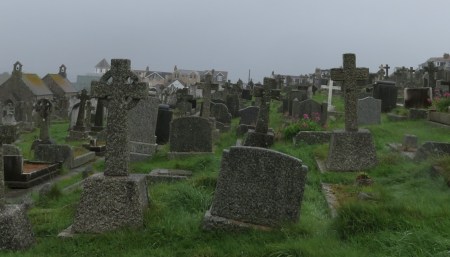
In the graveyard

graveyard.JPG

I met a crying woman
In the graveyard
In the rain
On a humid summer evegraveyard.gif
In the graveyard
In the rain

Rejoice with me”, the farmer says
In Jesus’ parable
I found my lost sheep
But the woman’s sheep was dead
In the graveyard
In the rain

Can’t afford the vet” she said
To find out why she’s dead
Then she got all choked up
Her tears mixed with rain
In the graveyard
On a summer eve

Maybe I can help, I said
There’s a little bit of shepherd too
In each of all of us
And just those words were comfort then
In the graveyard
In the rain

That Great Shepherd of the sheep
Has led our footsteps here
To provide a moment’s grace and rest
For the crying woman
In the graveyard
In the rain

Where is the edge?

I went to the home of a tired old toiler,
A council house with huge TV,
Mother’s Day cards, and a crucifix
Prominent in the hall.

From there I went to a rich man’s house,
A mansion on the hill.
Crunchy gravel on the drive
Flowers on the sill.

I heard about a City Gent,
who had a “Proper Job”
All tailored suits and fountain pen,
And journeys up to Town.

Fountain pens and tailored suits
Are maybe not for me
My suits, and demons,
Middle class, off the peg, and tame.

Where is the edge of the stockbroker belt?
How is culture now defined?
Who shall say what’s posh or not?
Who is, and who’s not, refined?

A line ‘twixt good and evil
Goes through every human heart
Where is the edge of the stockbroker belt?
How shall it now be found?

I went to see a play
In the County School big hall.
I could see that edge right then and there
Directly through that hall.

The Treaty of Seattle

(loosely and colloquially translated from the original Russish)

About that time, there was Treaty of Seattle, which marked end of long and bitter war, between Chinese on one side, and almost everyone else, on other side.  Some called it third world war.  Was last world war.  Major nations of world fought alongside our ancestors against China.  Long term effect of war was to re-ignite democracy in Russia and strengthen weakening culture in rest of world in last decades before start of Diaspora.

Though nuclear weapons were used, and some cities were destroyed, war was never “apocalypse” predicted in the literature and media of the world at that time.  It began some fifteen years earlier after aggressive and sudden Chinese moves into Russian territory.

At same time, Chinese miliary moved south towards continent of Australia.  Were very heavy losses at first – in first six weeks of war, ancient city state of Singapore had fallen, and all Russia east of Lake Baikal was in Chinese hands.  But all that ground was taken back over course of war.

Advance of Chinese brought political chaos across all earth, collapsing political unions and causing other minor wars.  Recent work by historians shows that discoveries in Antarctica, and what happened as a result (see Yekatarinburg offensive, Libby-Sheffield engines, Antarctic Discoveries) were rather more important to victory than once thought.

Human cost of Russo-Chinese War was over 4 million Russian and alliance dead, 30 million Chinese dead, and destruction of some Russian and Chinese cities. Also, Chinese Confucian culture was destroyed forever.

Following war, came launch of Russian starship Yekatarina Velikaya.  Exact date we can no longer be sure of, due to small differences between Standard years and Earth years.  But we believe this was around one hundred years after first man in space Yuri Gagarin.

Rekningen

Rising from the table, he walked through the almost deserted dining room, intending to return to his room.  There were huge oil paintings on the walls, scenes of fjords and mountains, fishermen mending their nets, simple farming folk.  In winter, this hotel was the biggest and most famous of a provincial ski resort.  Now, in autumn, before the snows, it was as  good as deserted.  His route to his room took him through a little glassed over area, formerly a little courtyard.

“Outside in the distance, a wild cat did howl…” the words from Dylan’s song came unbidden and unwanted to his mind – an earworm, he’d heard this called by his kids.  Rain was beating down on the glass roof, gusts of wind driving frenzies of rain against the glass.  The cold, driving, strength-sapping rain of late  October.  No night to be outdoors – a good night to be warm and in shelter.

Tomorrow, he would complete the deal.  In so doing, he would gain access to a whole new market; he would sell more than his competitors, and start to gain an edge over the last few hold-outs that refused to trade with him.  He would show them all, the naysayers, those who did not believe in him.  He cast his mind back to a lecture he had given years ago to a group of beginners in his trade.

You want to see what the world’s greatest salesman looks like? You’re looking at him.

Not long after he’d made that assertion, his boss had walked in, interrupted him, and introduced himself to the students.  Clearly somebody else senior, sitting incognito at the back of the room, had tipped his boss off.  But he’d shown them.  A word in the right ear at the right time, and his boss hadn’t lasted much longer.  He himself had taken his bosses’ job.  Eventually, he’d even found out the name of the guy who had grassed him up.  Soon enough, that one was on his way too.  It was easy enough if you knew what to say, whose ear to plan the seed in; whom to whisper the quiet accusations to.  Now, he was unstoppable.  He was at the top of his game.  At the head of the table.

From the foyer, two sets of stairs.  He decided to walk rather than take the lift, which, in this antique wooden building, was rather slow.  He’d always taken pride in his fitness.  But this old hotel rambled on and on.  It was a number of buildings combined, connected together with funky little open courtyards and cobbled alleyways that used to be outside but now had settees and bookcases in them. It had the feel of a caravanserai.  He walked up to the first floor, and along round a corner, past a picture of a mountain at sunset, very much like Half Dome in Yosemite Valley.

Very good use of light.  Like Joseph Wright.

He touched a metal bannister and got a static shock. The weather? The carpet? His shoes? Up to the second floor, and onto the third. And on up to the fourth floor – the top floor – where the best rooms were.  The doors opened outward, which to him, seemed strange.  The rooms were all different; there was no standard room here in this timber building.  His own was right up in the eaves of the building, but it was spacious enough.  It lay along a corridor with the roof sloping down one side.  Windows were set into this roof, and rain was thrashing against them.  The windows looked like washing machines, so much water was hitting  them.  He walked along the corridor, looking at the room numbers.  432.  433. 434.  And that was it.  No 435.  He must surely have gone the wrong way.

How odd…I’ll retrace my steps.

He turned on his heel, walking back along the corridor, down the stairs and past the picture of the mountain, to the foyer.  The receptionist glanced up at him from behind her counter, and gave a friendly little smile.

The other stairs.  These led up the side of one of the open alleyways to the first floor.  Then along a corridor, past a folded up travel cot in an alcove.  And onto the second floor.  As he went, he thought of hotels, back over the years.  Some hotels seemed to be all the same; others were very unusual and different.  The Oriental Palace Hotel in Tunis, where he’d had lamb and couscous with a colleague, and afterwards, some interesting cigarettes.  He remembered the gaff not because of that but chiefly because that particular colleague didn’t last much longer either.  A hotel at a seedy port in Italy – could it have been Brindisi? – where another colleague had got so drunk that he’d snapped the key to his room off in the lock when trying to open the door.  The Agadir Beach Club Hotel where walking along the corridors felt a bit like one was walking through a computer game – as if at any moment a monster or an armed man might appear from around the corner.  The Okumu Palace Hotel in Libreville where he and a number of his colleagues had tormented and insulted some little Frenchman who they took a dislike to.

The third floor…or was it the fourth floor? And then he found himself at a kind of dead end, in what felt something like a tower.  There were what looked like old servants rooms, and shelves of towels, sheets and cleaning materials.  How had he got here?

Turn back again.  This is getting a bit silly. Back down to the foyer.

He turned around and went back down the stairs to reception.  The girl on the desk noticed him and asked brightly, in Norwegian, “Are you lost?”.  This confused him to silence, though he knew much more Norwegian that he let on.  She asked again in English. “Have you lost your way?”

“Can’t find my room” he mumbled, “but I’ll be fine. I’ll use the lift”.  He hated asking for directions or admitting he was wrong, especially to women or people young enough to be his kids.  He entered the lift and punched the button for the fourth floor.

Remember that time when you put that young chap in the picture whilst in the lift? He’d given a piece of his mind to some cocky smart-ass young hotshot straight out of university, when a crowd of them were in the lift on the way down to dinner one night at a conference.  Some big hotel in the Middle East.  This young hotshot thought he knew it all; the youth had been banging on about this or that, he couldn’t for the life of him remember now what he was on about.

But I surely let rip and told it like it was.  Called a spade a spade. Put him well and in the picture.

“Christ, your diplomatic pin must have fallen out”, a colleague had said, as they made their way to their table, some minutes later.  “That was a bit harsh”, another had said.

Maybe so. But it was hardly my fault the boy killed himself a few months later.

Up to the fourth floor and out of the lift.  Ah – here was familiar territory.  The corridor with the sloping roof.  The rain drumming down; the wind shrieking round the corners.  Room 432.  Room 433.  Room 434.  As he walked past Room 434, another guest walked past him and stared right at him in an astonished and hostile way, as if perhaps he did not belong here.

How rude.

But that was it – there was no Room 435.  Room 434, a fire door, and then a landing leading to some stairs back down.  He went through the fire door and started down the stairs.  Puzzled, frowning, he was going down these stairs when he passed a maid on the way up.  A maid?  At 9p.m? And dressed like she was out of the period drama.  Strange.

Down to reception again but by the stairs.   As he walked into reception, he noted that literally minutes ago there must have been a shift change, for there was now a different person on the counter.  The pretty smiling Norwegian girl had gone.  In her place, a cold and formal looking older lady.

“Kan du Engelsk?” he began. She nodded. “Can you help me find my way back to my room? I can’t seem to find my way in this ancient hotel. It’s all strange corridors and mystery stairways”

“Of course, sir” she replied, with only a hint of a Norwegian accent. “What room is it?”

“435.”

Her eyes widened ever so slightly in the way that told him that she was about to say something disappointing or negative.

“We have no Room 435.  There’s never been a room 435. Perhaps 434 or 335, you meant?”

“No. I checked into Room 435.  All my stuff is in Room 435.  I put my dinner on-“

He’d been about to say that he’d put his dinner on the room bill, to be paid when he checked out.  But then he’d recalled that there’d been a problem and he’d actually paid in cash.  He produced the key, which was an electronic key card, and offered it to the lady.  She looked at it blankly, making no attempt to take it.  At that moment, a door to an office behind reception opened, and a man came out, perhaps the night manager or someone more senior than the receptionist.  It seemed odd for there to be a night manager at such relatively small provincial hotel.  He was formally and anciently dressed, as if going to a re-enactment  of Edwardian times.

The night manager looked at him, professional concern on his face.

“I can’t find Room 435”, he said to the manager, holding up the key to his room between two fingers. All of a sudden he was minded of the time years ago that his hotel room had been inadvertently rented to someone else.  Had the stranger got into his room, he would have lost all he had in his room – more than just clothes and a bit of money.  That would have caused some problems; he would have had some trouble explaining that. He’d left his key at reception that day.   Arriving back from work, he’d asked for his key, and it could not be found.  It was Friday night.  A stag do was going to take place. The hotel was nearly full.  Together with a member of staff he’d walked towards his room, when a clearly drunken man had lurched up to this member of staff and said where is room 116? Holding up the key to his room – the room with all the stuff stashed in it.   A wave of cold fear ran down his back as he leaned forward and neatly snatched the key from the drunken fool’s fingers. “That’s my room, thank you”.

“These are our keys”, the lady receptionist put in, holding up a heavily varnished slice of wood embossed with the hotel’s name, attached to which was an actual key.  He stared, somewhat bewildered, looking between the proffered physical key and the key card in his hand.

“What is your name?” asked the night manager, kindly and slowly, pronouncing each word carefully, pronouncing “what” with a distinct “v” sound.  Vat. Is. Your. Name?

He gave his name and the night manager and the receptionist together started to look through a register on the desk. There seemed to be no sign of a computer.  Mind, he had not been paying attention when he checked in.  Who does?

After searching through the register for a minute or so, the manager looked up. “I’m sorry sir, we have no-one of that name registered at the hotel tonight.  Are you sure you gave us the correct name?”

He gave his name again, and spelt it out.  Again the manager looked in his book, coming back up to shake his head.

“No, I’m afraid we have no-one of that name booked here in the hotel tonight.  And there is no room 435.  There’s never been a room 435.”
The voyage of the Vanguard

Most of us learned in school that the first interstellar crossing was made by the “New Frontiers”. Our very calendar is based on this; the Galactic calendar starts from the year of her return to Earth after her 74 year journey. But what is not so widely known, is that the “New Frontiers” was not the first human starship.  Another vessel had set out from Earth a century or so earlier.  This vessel was ostensibly lost in space – it was never heard from again.  Until now.

This presentation to the annual seminar of the Ancient History Society of New Rome, brings news of that long-lost earlier vessel. Her name was “Vanguard”. She was discovered about a century ago by an Iskandrian naval vessel, patrolling the depths of space between Iskander and Fatima. Because the fastest means of transmitting information from one place to another is by star ship, it has taken 105 years for the news to reach us here on Secundus.

The presentation is multi-disciplinary in topic and scope. It will cover the strange chance by which the Vanguard was detected at all; it covers the unusual engineering techniques used to slow her down, and it addresses the archaeological issues involved in getting aboard and then accessing her computer records.  Finally, it reveals the exciting discoveries that were made from those records, regarding what happened to the ship and the crew.

For when her route was plotted, it could be shown that the Vanguard had passed a planet centuries before.  When the Iskandrians visited that remote and uncharted world, they discovered it to be inhabited by humans – but not from the Diaspora. They were savage and intractable cannibals, but they were very intelligent savage and intractable cannibals.  They were shown by genetic study to be descendants of the Vanguard’s original crew.

(After a short passge in R.A Heinlein’s “Time enough for love“, where Galahad, over dinner, recounts to the table the story of this discovery,  causing something of a shock to Lazarus.)

Ebb

Kenning was ahead, his sledge making a hissing sound as he pulled it over the ice, his red arctic wear bright against the white of the snow and the almost unbearable blue of the sky. The mountains reared to our left, the exposed rock predominantly brown in the sunshine, the snow vaulting gracefully upwards in smooth curves. To the right there was nothing – only the ice-shelf, almost flat out to the horizon, like solid light in the punishing glare of the sun.

A mighty wall of rock was exposed; the lowest ice levels in centuries, prompted by the highest temperatures, had melted so much ice that there was more of the bare rock of Antarctica visible than at any previous time in history. The mountain range curved round, only a part of it visible as the two men trudged towards it.  The shadows of seracs and pillars of ice showed black against the brown of the rock in the light of the sun. And there Kenning’s eye caught an anomalous shadow, a shadow bigger than the ice that caused it. It was still distant; John frowned under his goggles. After three weeks he was tired – and patient. Whatever it was could wait until they were closer. More steady footsteps, pulling hard against the heavy harness, straining against the wide straps that connected him to his sledge. His feet crunched against the ice and snow underfoot. His breath rasped in his ears, his heart beat thundering. The path lay slightly uphill, and the two men slowed down as the slope increased. As the incline leveled off again, Kenning stopped and leaned heavily on his sticks. He glanced around at his companion, and then back at the rock wall. The strange shaped shadow was some form of enormous cave entrance or depression, he thought. It was still a good five kilometres distant.

As they drew nearer to the rock wall, drawn automatically by the strange cave exposed by the retreating ice, something quite appalling started to dawn on them. For as their comprehension of the approaching cliff face grew better, they realised that this depression in it was quite artificial.  It appeared to be the entrance to a tunnel, perfectly round in shape, though half buried in ice. It was clearly enormous, the roof perhaps thirty metres above the surface of the ice, and even then the ice filled half of what was a large round shaft bored directly into the mountain.

Phil Keynes stared into the blackness of the tunnel. Ice filled over half of the wide bore, a ribbon of silver and grey disappearing into the gloom, colouring from white into grey as the light faded. He looked up at the sides, taking in the smoothness of the finish, the grey colour of something that looked like concrete contrasting with the light brown of the surrounding rock. This tunnel entrance had lain buried and concealed in the ice for millennia, brought to light only by the changes in climate that had started at the end of the last century. That it was not natural was beyond any shadow of a doubt; it must have been built in dizzying antiquity, perhaps even before the Antarctic ice cap had come into existence. It clearly predated all of human civilisation. Such a structure might be twenty thousand years old – or a hundred million. A very strange and ancient feeling arose deep inside Phil Keynes, not exactly terror, not exactly excitement. Here there was something awesome, maybe something great, perhaps something horrible beyond human comprehension. The stygian gloom of the tunnel as it disappeared into the rock of the mountain seemed to contain every kind of childhood bogeyman that ever existed. The atavistic fear of the dark that lies hidden even in the strongest men arose in Phil. And against himself, a Royal Marine and experienced soldier who had thought he had seen everything, he shivered.

Eulogy for Toby

We’re here today to remember the life of Toby, who has been taken from us at the age of 18. Toby was a great friend to us all, always cheerful, ready to greet strangers and friends alike, and with a simple, positive and outgoing approach to life.

Much of Toby’s time was taken up with simple, but to him, deeply important, matters. One of these was his compassion and concern for others, particularly for young children and for people weaker or more vulnerable than himself. Toby felt he was born to make others happy,

The other main concern of Toby’s life was food. Those of you who knew him well will recall that. If he was not concerning himself with the affairs of other people, ensuring that they were happy and content, he was looking forwards to his next meal, or indeed, towards any snacks that he might be able to find in the meantime.

For a Labrador to live 18 years is good going. Toby lived a good and long lifetime, and I’d like to remind you now of one or two highlights of that life well lived.

Perhaps most well-remembered is the custard story. On one of the many occasions that Toby got lost, he found his way to the custard factory. For Toby to get lost whilst out for a walk was not unusual, so we were not unduly concerned – he would show up at dinner time. The mere sound of the drawer being opened to get out a can opener would bring him bounding from the other side of the house.

We received a call from the custard factory. Toby was brought home sometime later in the back of a car, laid out on the back seat. On that occasion, there had been some kind of fault with a custard making machine, and gallons and gallons of custard had to be poured away down the drain. It was perhaps unfortunate that Toby found one of these drains and decided to start lapping up the custard. And he kept on lapping up the custard. By the time he was discovered, he was so full he could no longer walk. He did not eat for some time after that.

Then there was the occasion of the dead sheep. A local farmer warned us that there was a dead sheep on his land, and that it would be removed shortly. Not shortly enough, unfortunately for Toby, who saw it and quite naturally and understandably decided that raw mutton was just what he needed. He ate a fair amount of dead sheep before he was dragged off. We arrived back home and by this time Toby was clearly not feeling quite himself. There was something wrong – perhaps something he ate? And then, right at the top of the stairs, he decided to throw up. It’s funny now, years later, but it was no joke at the time. It was like a waterfall of sick, flowing down the stairs, and it stank to high heaven. Poor old Toby was very ill for a few days. But he recovered, dog of iron constitution that he was.

On another occasion my husband was going to work and was already dressed in a suit. But Toby needed his walk, and my husband took the dog out without changing into old clothes. Toby ran into the local pond and was splashing about – as you do, when you’re a Labrador. My husband’s insistence that Toby “Get out now!” fell on deaf ears. He continued to splash and play in the mud and the reeds. And then he caught a frog. Thought he’d eat it. This is pure Toby. As Toby’s jaws closed over the frog, the poor creature, still living, was desperately thrashing its legs. At this point my husband, a simple soul, could take no more, and ruined a good suit by leaping into the pond to drag our errant hound out by the scruff of the neck.

Yet for all his carnivorous instincts, Toby was deeply loving. On at least one occasion when we as parents had told off one or other of our daughters and sent them off to their rooms in disgrace, Toby disappeared shortly afterwards. We discovered him hours later, curled up next to our sleeping daughter, comforting, always comforting the sad or tearful.

Ladies and gentlemen, raise your water bowls and dog biscuits – for I propose a toast: To Toby the dog.

Istanbul

Between the Black Sea and the smaller Sea of Marmara, there lies the narrow passage of the Bospurus, a shallow gorge only a few hundred metres wide. It is bridged several times by new and glittering suspension bridges, and on either side, lies the ancient and noble city of Istanbul.  It is not hard to imagine that this city is not modern Istanbul, but the Stamboul of Graham Greene’s novel, or the Constantinople of the Middle Ages, or even the Byzantium of antiquity. Even the Istanbul visited by James Bond in “From Russia with love” is full of romance. 

To me Istanbul is one of the most evocative and exciting places in the world. At a cross-roads of cultures, neither Islamic nor Christian, not Mediterranean, but influenced thereby. The might of Russia lies to the north like a sleeping giant, the deserts of Arabia are near enough to the East.

And we came there, by ship. Our ship came from Constantza, in Romania, and arrived in the roads on a rainy morning one February. We were taking the ship from Constantza right round Europe to Bergen in Norway, a journey of many weeks, and the majority of the crew were gathered ready to get off and go home – from right here in Istanbul. What a place to go home from…one minute, the exotic banks of the Bosporus, a few hours later – Birmingham New Street. What a contrast!

There were all manner of ships in the roads. Rusting, nondescript freighters from Cyprus. Small fishing boats, huge bulk carriers. The wind whipped the sea, and the rain spattered down. Mist obscured the top minarets of the Blue Mosque and the towers of St. Sophia’s cathedral. It was not a pleasant morning – but this was Istanbul. What possibilities!

Our boss was a man called Marco, a big man in his late thirties, half Italian and half Brazilian, a man who spoke excellent English despite not having heard a word of it until the age of sixteen. Marco took one look at the city and said, “lets go ashore”. Even as our colleagues were climbing onto a small boat to take them ashore to a fleet of taxis and the airport, we were going to be left behind. A word with the Captain assured us we had time to go ashore for an hour or two. A moment to collect our passports and such cash as we could muster, and we were on the boat ourselves – in our work clothes, in sea boots, with no coats. But Marco was taking us to Istanbul.

The rain was against us, but we cared naught for it. Romance was in our veins. Once ashore, the rest of the crew said their goodbyes and melted away. For a brief few hours we were alone with this great city. She would surely give of herself to those who dared for a day to visit her, to those who seized the moment. Could she be romanced for a brief fling? We started with a few beers and a light lunch in a dockside workman’s café – it was that time of day and the place recommended itself to us by being a dry place to sit out of the rain, no more than yards from where we came shore. Thus fortified, we first spent a little time obtaining some local currency, and then we sallied forth in a taxi to see what we could find – we were bound for the Bazaar.

Marco was an interesting character. As a youth he had run carpets out of Iran in the days before the Iranian revolution of 1978. He had spent time in the East and was confident he could find a fine carpet here in the bazaar. He was the kind of person that got things done, quite frequently by breaking or bending the rules. I had a stormy professional relationship with him, but one of the rules of our business, strict and unbreakable, was that work was work, and it was never brought into the bar or the social setting. Here we were amiable companions, work completely forgotten about. Such people as Marco are rarer nowadays, in our modern world of Safety standards, regulations and operating procedures, work instructions, meetings and Powerpoint presentations. And our world is poorer thereby.

The bazaar was a riot of colour and fragrance, all manner of things hung up for sale, every possible variety of cloth, leather and material. Carpets and kitchen utensils, trinkets and tools, presents and gifts. Here of course one had to bargain. Marco, who knew about such matters, warned us solemnly. You MUST bargain. They will not take you seriously otherwise. They will start the bargaining at four or five times the lowest price they could sell it at and still turn a profit. Keep that in mind…

Wandering around the bazaar my eye was caught by a merchant selling waistcoats. These were in gorgeous fabrics, a sweep of colours and styles. I thought they were great, but not so great as to part with serious money for them. The trader saw me and came across to pluck at my sleeve. He named an outrageously high price; insulted, I suggested to him that he might keep his waistcoat at that price. Those were not my exact words. After some bargaining and good natured insults, this peddler of cheap cloth, this charlatan who had tried to get me to part with over sixty dollars, sold me a rather fine waistcoat for a little over a tenner. I was delighted with my purchase. My wife wore on it occasion – it was in very bright colours – for a year or so, and I think it is still in the children’s dressing up box.

I found Marco in a carpet shop, arguing with the owner. He had strung the owner along and had a dozen of so of his finest carpets laid out over the floor, examining them minutely. He clearly knew good from bad in the Turkish Carpet scene, but I don’t think he had the slightest intention of buying a carpet then and there. But Marco was a Poker player and you could not read his face, this not being helped by a big black beard. He nearly caused a scene, mind. One of the pointers to a true Turkish carpet of quality, he had opined earlier, was that it could be washed and would not stain. No substance would stain it. The truth of this assertion I did doubt somewhat, but the evidence at the time – our subsequent escape from the carpet shop –  did point to him being quite correct. The carpet merchant served strong Turkish coffee to Marco, as was the custom in such shops. And Marco, sipping this coffee, quite deliberately spilled some on one of the merchant’s carpets. It all looked quite accidental, of course, and he was all apologies, but we onlookers knew he had done it on purpose. A cheap carpet would be ruined by strong coffee. We do not know if the actual carpet on which Marco spilled his coffee was one such, because we made our exit shortly thereafter, as it became quite clear to the carpet merchant that Marco had no intention of actually buying a Turkish carpet.

Alas, our time was coming to an end. We found a taxi, and made a mad dash through the rainy streets back to the dockside, to meet up with the small boat that would take us back to our home away from home. Istanbul, goodbye! You showed us a little of yourself – just a glimpse, a tantalizing glimpse. Not for us a whole night with you, but just a hint of thigh, a hidden curve of bosom. Istanbul – well we remember you, though we visit you again as older and perhaps not so wise men.

.

A journey through the Peak District

“I am returning, the echo of a point in time” – Deep Purple

Brierlow Bar

A pleasant late morning in Buxton brought back thoughts of the past – the echo of a point in time – now sanctified by memory and the blood of Christ. The past, as C. S Lewis writes, becomes heaven even as we approach eternity. We reach heaven, and realise that we were always there….or not, of course.

I pottered around, visiting “the Dome”, flirting with a shop lady whilst buying a Christmas present for my son. The weather was glorious – very cold, clear and blue. The remnant colur of Autumn remains on the landscape, and I’m looking forward to driving down the Via Gellia later in the afternoon. This is what I wanted – this day is as it should be. I spent time last night and this morning with my son in Lancaster. It is true to say that I drove 300 miles to have a pint with my son.

I love this country, this land. I mean the Peak District, the White Peak in particular. I love it so much it hurts. Why in God’s Name do I live in Surrey? Because that’s where the great God above has put me. But my heart is elsewhere – I love this land. The sense of being a stranger in a strange land in East Surrey, an exile, is heightened by coming here on this November day, in this beautiful sunshine. I admit to alienating myself, separating myself from the very East Surrey I have committed to serve as a senior Scouter for the next ten years. It’s not that East Surrey is not a beautiful land; it is full of good people too. It is just not my home.

Scarthin

It’s 3.25p.m and almost dusk and I’ve visited Scarthin Books in Cromford. I’ve not actually bought anything except cake and tea. Scarthin, for all it’s wonderful, quaint nooks and crannies, has not been a particularly productive bookshop for me. Great place to visit though and one day, the right books will be there for me.

It’s a cold blue afternoon and I’m sat looking out across Cromford pond as evening falls. Soon, beer with an old friend. My day off is unfolding as it should – a little image of heaven on earth.

Social mobility

I was reading an article in the Economist about social mobility in the USA, and reflecting on my social mobility. I came from dust, from nothing. I have come as far or further than anyone older than I  in either branch of my family, the first person in all the twentieth century to have attained to higher education – the first in many generations.  My dad and my mum were clever enough, but the opportunities were not afforded to them.  I have come further and higher than any before me in my family – and the reason is social mobility.  Social mobility in the 1980’s has got me where I am now.  I got A levels, got into a polytechnic, and got a job – all through either luck or just brains.  This illumines my politics and my beliefs.  It is why I have no patience with public school educated sons or daughters of privilege who have got to top jobs through background and education.  This is why I admire Mrs Thatcher – who got into Somerville on a scholarship, and that by luck rather than anything else.  It is why I can feel a bit chippy about many members of the front bench on both sides of the House – they are in the main, public school educated sons and daughters of privilege.  I’m no socialist, but am a firm believer in social mobility.  I believe opportunities should be available for people from the lower depths to rise to the top – the Clive James’s, the Norman Tebbits of this world.  It is why I have little patience or empathy with those who have a huge weight of generational expectation behind them – four generations a clergyman, or four generations an officer of the Royal Navy. I recall talking to the wife of one such officer at a party. What’s that like to be?

A review of “Mud, blood and poppycock” – Gordon Corrigan

A review of “Mud, blood and poppycock” – Gordon Corrigan

This alternative or “revisionist” review of the Great War, written by former Army officer Gordon Corrigan, was always going to put a frown on some foreheads.  It’s always readable, though sometimes you find yourself disagreeing with him, and he is never afraid to editorialise and give his own opinion – always a mistake in my view.

He does repeat some tired old lies. “Britain has never been successfully invaded since 1066” is the purest nonsense, forgivable perhaps, from an Army officer but it would not be acceptable from a professional historian.

And his final conclusion on what it is that wars are won by? Again, rather as is to be expected from a British Army officer, he argues that it is not intellect but courage.  There may be a great deal of truth in that, but I disagree. Wars are won, neither with intellect or courage, but with money.

Curved Ridge

Whilst I was physically unhurt by what happened at Curved Ridge, I don’t doubt that it had a deep and lasting effect on my psyche. Rob and I (Rob was the lad from Kingussie who knocked me from my perch on the ice) had no business surviving such a fall.

I recall falling head down on my back, and tipping head over heels, until I was facing inwards to the snow and ice, head uppermost. I came to a halt. I truly don’t know how that happened, because I had let go of my ice-axes, and they dangled uselessly on their wrist cords. They played no part in my narrow escape from death. One might retain no composure at all during such an event. One moment I was climbing a fifteen foot wall of ice and someone shouted “Watch out”! The next moment I was off and falling. In fact my colleague, hoping to snap a racy and exciting action shot of me battling my way up the ice pitch, had slipped and plunged off downwards, unfortunately landing on me on the way past.

When my wits returned – it was probably no more than a few seconds of confusion – I found myself on the steep snow below the short ice pitch. Of my friend there was no sign. My first understanding was that we had been caught by an avalanche. A few glances about me, however, and I knew the truth, that we had fallen off. I looked around for Rob, but of him there was no sign.

Darren, the third member of our team, bravely made his way unaided down the ice pitch we had been climbing, and together we gazed into the depths. It was entirely possible that a small yellow speck on the snowfield a thousand feet below was the broken body of our friend. He could not have survived such a fall. It was a sour moment.

We could not follow him down the cliffs of Buchaille Etive Mor, the mountain we were climbing. To get down, we had to move on up to the summit. Girding our loins, we set off, hurrying up and over the top. We went swiftly on down into easier terrain, country where we might walk without risk of falling to our death. After an hour or so, we chanced upon some of our colleagues from the mountaineering club, to whom we relayed the terrible news. All of them were stunned to silence, appalled at the news of violent death. Someone immediately set off on foot to raise the alarm – this was 1986, long before the advent of mobile phones. The rest of us moved in a group around the skirts of the mountain, through the melting snow, to search for Rob. At this point I was suddenly struck with a tremendous fatigue. I felt terribly guilty about it, as if I was betraying my friend. I could go no further; I was almost staggering with exhaustion. That I had myself been involved in a serious fall, that I was bruised and in shock, and had narrowly escaped with my life, did not occur to me. I felt bad that I could not keep up with my companions.

And so it was that that paragon of the mechanical engineering department, Mr. Ray Boucher, came into view some time later, with unlooked-for good news. Rob lived yet! The best news ever delivered in a strong Ulster accent. By some miracle he had survived a fall of some fifteen hundred feet. Really this was what I needed to hear; uncaring of anything else, I felt I could retreat to the minibus without further disgrace. I recall stumbling right through the icy and swirling waters of the river, hip deep, unheeding of the cold and wet, the quicker to get back to the minibus.

Much later there was the helicopter, settling onto the car park in the grey and blustery afternoon. In the artificial gale caused by the helicopter, an old Citroen 2CV in the car park was rocking back and forth on its springs to such an extent that we thought it would blow away. From the chopper emerged Mr. Hamish McInnes, mountaineer extraordinaire and leader of the Glen Coe mountain rescue team. He was dressed in immaculate light blue Gore-Tex over-trousers. The Great Man spoke briefly with us, telling me that Rob and I were incredibly lucky to have escaped with our lives. More chance of winning the football pools than both of us surviving such a fall, he said. Odd that. It didn’t feel like I had won the pools. I’ve thought about it a bit then and since, thought about other narrow escapes. Is there destiny? Does God in Heaven direct the affairs of men, delivering one, whilst allowing another to die alone and in pain? I didn’t really consider myself important enough to be delivered from death, and still don’t, but that never stopped me wondering.

Rob dislocated his hip. He fell over a thousand feet over snow and ice and rock and dislocated his hip. And that astonishing luck meant that he made the Daily Mail, as did I myself in a small paragraph in the same article. In hindsight he reflected that the dislocation of his hip had done more damage and hurt more than if he had actually broken his leg. He was on crutches for months and limping for longer still.

 That summer I put the Curved Ridge accident behind me. Three of us went to Glen Brittle on Skye in an old black Mk I Escort, and climbed and walked the Black Cuillin. It is only a coincidence, so I tell myself, that I have not climbed ice since the fall at Curved Ridge. The final word? News of the accident, published as it was in the local press and even in the “Daily Mail”, made it to the ears of a teacher from my old school. He was a very experienced alpiniste, a climber of an entirely different stamp to me. He said to me at beer one night, in jocular reference to an article in the local press,

“So did you fall off the dangerous and treacherous Curved Ridge or was it the easy and classic Curved Ridge?” 

An Anglican temperament?

A faint disdain for enthusiasm is the mark of a decayed and effete culture

Paul Goodman posts today in Conservative Home on “What Cameron can do next for the churches”. I’m not a natural Tory, I’m too right-wing – but the title caught my eye and so I opened it and started to read. I didn’t finish it; I’ve no slight interest in the details of what the Prime Minister can do for the churches. Some way into the article there was a wonderful statement of what Mr Goodman calls the “Anglican temperament”, which was of interest because it defines almost everything that I am NOT – member of an Anglican church though I am.

He writes of David Cameron that he “brings to politics what might be called an Anglican temperament: a certain moderation of tone, a reluctance to get hung up about doctrinal differences, an attraction to consensus, an aversion to “enthusiasm”, a sense of establishment and his own place in it, and good manners (most of the time).”

It’s worth going through clause by clause!

A certain moderation of tone – I’ve never been accused of moderation of any kind, much less of tone.  I have been accused of being “abrasive”, “alienating”, and “undiplomatic”.  As an older man I acknowledge the importance of moderation of tone, but it’s not something that comes naturally to me – I have to work at it.

A reluctance to get hung up about doctrinal differences – here is the heart of modern Anglicanism and one of the core identifying features of Englishness. The English, Anglicans or otherwise, don’t really think that what they believe matters. But doctrinal differences do matter. What we believe is a matter of life and death – in fact, as Mr Bill Shankly famously said of football, it is much more important than life and death. For me, both as a Christian and as a political animal, I do embrace doctrinal differences – I am partisan. The challenge for me and others like me is to be partisan without being tribal, to allow doctrinal differences without violent disagreement – in other words, agreeing to disagree.

An attraction to consensus – Mrs Thatcher infamously had a low view of consensus. I recall that the vicar that married my wife and I telling us that he required his PCC to be unanimous in their decisions. While consensus has it’s uses in places, at the point of crisis, it is a way to avoid making a decision. Colin Powell says that the true leader will have to annoy all of the people some of the time. At the end of the day, someone has to decide – and “consensus” may have to be over-ridden for the greater good.

An aversion to “enthusiasm” – Having spent 25 years in churches where there is a drum kit and people wave their hands in the air, I am not averse to enthusiasm. Bring it on: in fact, a faint disdain for enthusiasm is the mark of a decayed and effete culture.

A sense of establishment and his own place in it – I owe nothing to the “establishment”; I came from nothing. I am the first person on either side of my family in all of the twentieth century, to attain to higher education. I’m not part of the “establishment” – I went to a comprehensive school and a polytechnic, and many people in the “establishment” would likely cross the street to avoid a meritocrat like me. If I could say anything to the “establishment” it would be this: the status quo is never acceptable.

Good manners (most of the time) – As my kids would say: weeeell. Mr Cameron is well known as someone who can be quite breathtakingly rude to people below his station – yet without once being guilty of what he would call “bad manners”. Being decent and courteous to others and “good manners” are not the same thing.

The creeping secularism that permits no dissent

“Nyarlothotep…the crawling chaos…I will tell the audient void” – H.P Lovecraft

Today the Scout Association has published a new Scout Promise that permits atheists, or those of no faith at all (although it seems to me they are two different kinds of people) to be Scouts without having to lie about what they believe. It all sounds rather fine. On the surface this looks like rather a grand gesture to make, all about inclusivity, all about ensuring that everyone who wants to can have the chance to be a Scout.

Surely, anyone who opposes this, is opposing inclusivity? You might think that to oppose this development would be reactionary and inappropriate in the modern world. It is rather like that classic old question with no right answer: “When did you stop beating your wife?”

In today’s Metro, the Chief Scout has published an article with rather interesting wording.

He says: I see this as a positive and inclusive way of allowing young people who do not have faith in their lives still to enjoy the Scouting adventure…

As regards young people who have “no faith” – do we not think that we as adults should be teaching young people to have faith? Do we not think that it is our duty? Oh…just me then.

And you can see in here the real issue underneath – it’s not about “inclusivity” or anything like that. It’s about creating a secular society – it is about actually stamping out faith and removing it from the public arena.

I’ll steer clear of any discussion of Scouts as such, as it is not really the issue here, except to say that to be fair, Scouts is not faith-based or church-based youth work. It never has been and nor should it be: at Scouts we have never really required young people to have faith – not really. It’s always been secular, right from the start. All very relaxed and anglican and it doesn’t really matter what you believe – until you make an issue of it. And then, of course, you are in trouble. We English have never really got on with people that “make an issue” of faith matters.

The real issue is creeping and insidious secularism. Writing very much as a Christian now, I think secularism has a spiritual origin and needs opposition. It is evil. This is why I opened the article with a quote from a H.P Lovecraft horror story.

Alice Bailey (1880-1949) was a 20th century “new age” guru who proposed a ten point plan to destroy Christianity. Some promoters of secularism remind me of the the expression Stalin used – “useful idiots”. They are going unwittingly about the work of the likes of Alice Bailey. If they are not careful they will place themselves and others in our society into the hands of one who is very much more dangerous than Josef Stalin. But then, secular liberals don’t believe in the devil any more than they believe in God.