A London walk – from Westminster to St Pancras

Let us start from Queen Anne’s Gate in the heart of Westminster. Go through one of two entrances onto Birdcage Walk, cross the road into St Jame’s Park, and then take a route diagonally through the park. Keep the lake on your left, and skirt round the tourists of every tribe and nation – it is nearly always very busy here. As you come round the head of the lake, cross over the road and take a diagonal path across the miniature gravel plain that is Horse Guards Parade.  Whenever I cross here, I am reminded of an old picture of Winston Churchill as a young politician crossing Horse Guards in company with Sir Edward Grey, on the eve of the Great War. The building on the left as you cross, the one with the aerials and wires on top, is the Old Admiralty Building. It resembles – as well it might – Britannia Royal Naval College at Dartmouth.

Go through the arches onto Whitehall, turning left towards Trafalgar Square. This the place where the two mounted sentries are often photographed by tourists. As you come onto Whitehall, you can see Nelson’s Column in the distance. Going up Whitehall away from Westminster, on the right there is a pub called “The Clarence” which I highly recommend. My wife and a friend of hers went in here some years back, on a trip to see the Queen, and they had no food left except for some Scotch Eggs, but this they served most graciously and cheerfully. She was impressed with the service. I’ve quite literally gone out of my way to eat there ever since – eaten there with my wife at least twice, with colleagues from work, and on my own. They have some great upstairs rooms which aren’t always as busy as the main room downstairs. 

Cross Trafalgar Square – generally best done by going to the right, from Whitehall, crossing the entrance to the Strand. Science-fiction author Stephen Baxter wrote a novel about the flooding of London, and his tip, if central London is flooding, is get above the Strand. The clue, as he notes in his book “Flood”, is in the name…

Keeping St Martins-in-the-Fields on your right, the National Gallery will be on your left. At this point, Charing Cross Road dog-legs to the left; if you wish you can follow it to Cambridge Circus, and then turn right along Shaftesbury Street. But the more direct route is to turn slightly to the right and then straight on, along St Martins Lane though Covent Garden. It’s a very relaxing walk along a reasonably quiet road traffic-wise, passing different pubs and restaurants. What you will see, is two unusual and complex road junctions. Inner city five-road junctions are fairly common in the UK. But six-way junctions in the inner city – three crossing roads – not so much. And seven roads, as at “Seven Dials” – very much rarer still. One comes out on Shaftesbury Avenue just near the Forbidden Planet store. Along here is a little café called “Franx” which I like to stop at sometimes.

Continue along a pedestrianised section of Shaftesbury Avenue a hundred yards or so and you find yourself on New Oxford Street – the A40 in fact. Take a right along here, and then a slight left onto Bloomsbury Way, with the main flow of traffic, leaving New Oxford Street behind. At this point the streets are broadly NW/SE and NE/SW. The British Museum is about two blocks away on the left. Continuing along Bloomsbury Way, you will see on the right the Swedenborg Institute”, a modest building devoted to the writings of the philosopher Emmanuel Swedenborg. Further along, on the left, a park – Bloomsbury Gardens. On the right, at the junction with Southampton Row, you’ll see Sicilian Avenue, a delightful pedestrianised interlude of Italianate cafes and shops, under repair in these times, but well worth a visit if you’re in the area.

One thing you will notice on a long walk across London, is the changing architectural styles and the changing atmosphere. Once in Southampton Row, you’re no longer in West London. Really, even though we’ve still to cross the Euston Road, we’re in North London. Here there are shops and restaurants, little dentists and minor medical institutes, and as we approach the station district, a number of slab-sided hotels of differing age and architectural merit. Passing Russell Square on your left (and the tube station on a minor side-street on the right), Southampton Row becomes Woburn Place and then, Tavistock Square. In this quarter, we start to see various hospitals and big, important institutes. You will pass, for example, the headquarters of the British Medical Association. The road continues, and intersects with Euston Road adjacent to the St Pancras New Church, a Regency-style church which I still have not visited. At this point, the depressing 1960’s heap that is Euston station, is on your left across the very busy Euston Road. It’s not widely understood that Euston, St Pancras and Kings Cross are all within half a mile of each other.

But we will take a step backward here. If you turn right off Southampton Row near Russell Square, you can find Coram Fields, a rather lovely inner-city park. This is a university quarter too – the streets are full of students from all over the world. Some of them go for lunch, at a branch of King of Falafel on Tavistock Place, where it crosses Hunter Street and Judd Street. I found this quite by chance one day when wandering through this great city. Here is another great place to just sit at a café at a road junction and watch the world go by, some on foot, some, on their bikes. I was sat here once when the bin men arrived, and I watched the proprietor put together a bag of samosas for the bin men, and give it to them with a smile. Heart-warming: another place I will literally go out of my way to visit.

Let’s go back to Euston Road. Euston Road is part of a great E-W arteries across the centre of London, stretching from Shoreditch in the east, curving north-west to the Angel, Islington (which we will cover later in another London Walk), west to Kings Cross, then south-west to Regents Park, Marylebone and Paddington before it becomes the Westway. It is always a busy road, an artery pulsing with the blood of the city, the hustle and bustle of people hurrying from one place to another. Crossing the road with care, you can then see the British Library – that building that King Charles once called a “monstrous carbuncle”. Personally I don’t agree. The Barbican, or perhaps Euston station – now they are “monstrous carbuncles”.

Next door is the still-magnificent St Pancras Hotel, now beautifully restored and consequently too expensive for most of us to stay at. Outside, on the station forecourt, you will see a purple sports car easily worth hundreds of thousands of pounds. I wonder that the hotel keep it here purely as a tourist attraction. I’ve no idea what sort it is. People take photographs of it, but I take Shania Twain’s view – “OK – so you’ve got a car.

Carry on up the slope to the far entrance to the station. Going in this entrance rather than coming into the undercroft where all the shops are, you can catch the full glory of St Pancras, to my mind one of the most dramatic and startling railway stations in Europe. When it was built, it was the biggest single arch iron-spanned roof in the world. It is still eye-catching, painted today in a pleasant sky blue. As someone who remembers St Pancras in the dark days of the 1990’s, the Eurostar terminal it is a vast improvement on what it was. In front of you, there will be three or four Eurostar trains. On the right, the Betjeman Arms: maybe time for a refreshing pint after our walk.
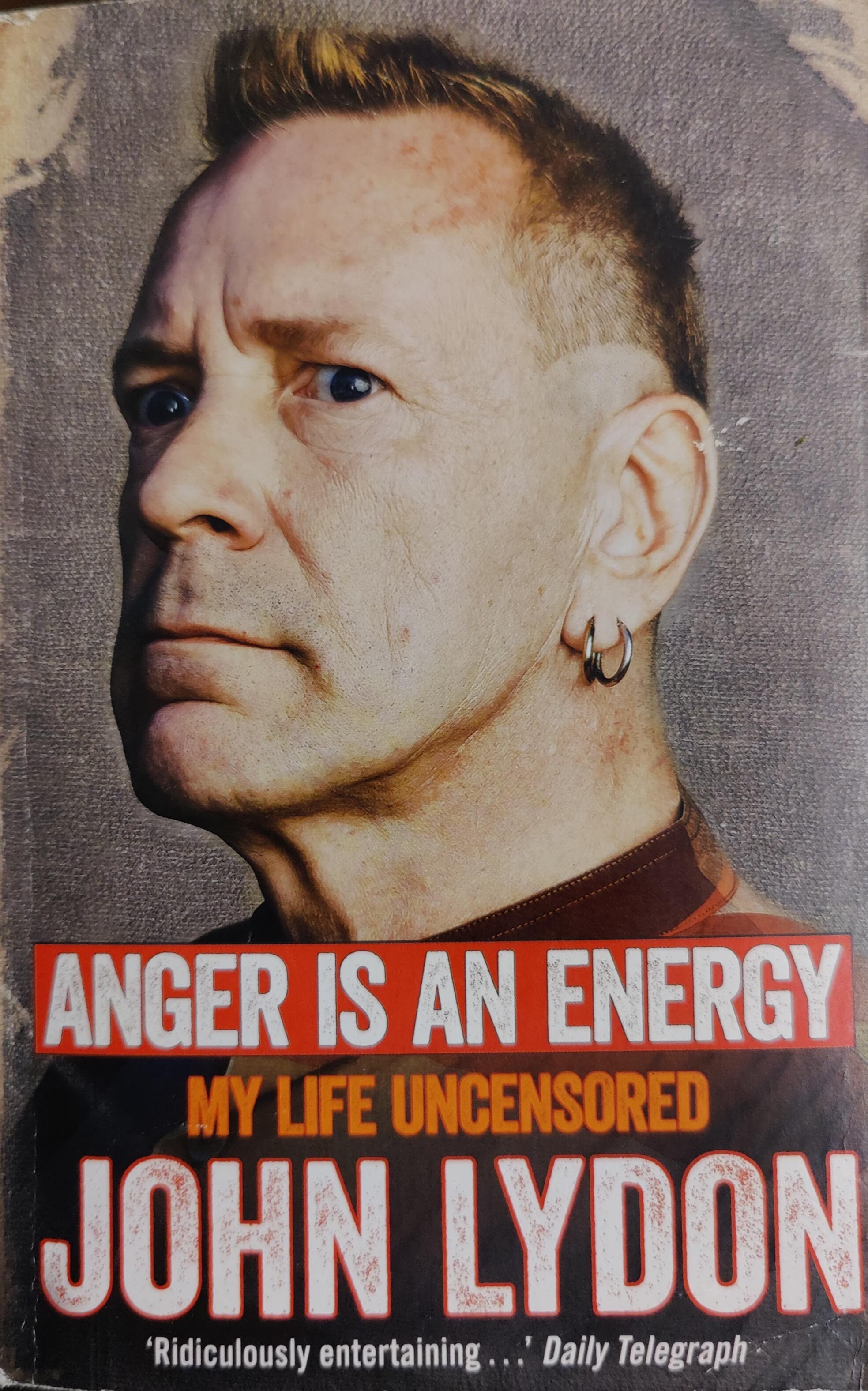
A review of “Anger is an energy” by John Lydon

Foo Fighters front-man Dave Grohl has written a book called “The Storyteller”. I received it for Christmas a year or so back. It was liberally dotted with swearing from the very first page. Now I’m not against swearing in writing or in speech if it is used very sparingly, but this was too much. I gave the book away. John Lydon starts his book with rock’n’roll star swearing from the very first page, but there’s a difference. I guess he has something that Dave Grohl lacks: charm (unlikely enough, given the photo below). John Lydon captured my attention immediately.

I’ve always liked the idea of John Lydon, though I confess I never listened to the Sex Pistols at the time, and not a lot since. His second band Public Image Limited (apart from “Rise”) passed me by completely. But he always always struck me as someone who would say and do anything. Someone who had something to say.

This was entertaining and readable from the get-go. You turn each page and expect something dreadful to happen on the next page…and it does. Lydon’s use of vernacular grammar in writing – the “back in them days it were different ” kind of thing, I found made him more accessible. I did not find such affectation at all pretentious. Others possibly may not agree.

All that said, it only took me about 150 pages before I realised that the author is full of s**t from start to finish, and as big a bullsh*t merchant as the next rock star, or the next person. He’s as hypocritical and as self-important as any pompous High Court judge, bien-pensant BBC news presenter, MP or any other Establishment figure. The story remains engaging – to that extent it is a nuanced story. It is a story I enjoyed reading, for I am a hypocrite myself.

Lydon is an un-English, southern Irish kind of hypocrite; for all his bombast about speaking the truth and calling things out as they were, he knew when to speak up, and he knew when to keep quiet – when under arrest, that is.

I like his politics; he is scathing of the middle-class public-school educated Marxism of Joe Strummer of The Clash. I’ll listen to the politics of almost anyone who is scathing about the malevolent silliness of Marxism. Almost anyone.

For all that I found this account more interesting and better as it unwound through Lydon’s life, I found him to be just another rock star saying “we wanna be different”. Some might argue that he was the first such; others might say there were many before him right back to Mick Jagger and even before that.

My response to this work was nuanced; I didn’t need to read much of it to discern that (paraphrasing Francis Rossi of Status Quo talking about the entire music industry): “95% of this is bullshit….and you know what, the other 5% is bullshit as well”. This book was about the life and work of someone who I found personally inspiring, and if not actually likeable, then admirable.

A review of “Company of Adventurers” by Peter C. Newman

Here is adventure indeed. Here is what used to be called a “boys own” account of derring-do in the Arctic wilderness. This excellent work covers the early history of the Hudson’s Bay Company (still extant in Canada today as a minor department store chain) from even before its inception, through, if not to the present, then certainly well into the late 19th century.

To a degree, the story of the Hudson’s Bay Company is the story of Canada, and the author, the occasionally sharp and acerbic Peter C. Newman, is nothing if not a Canadian patriot. The story of the HBC is also the story of winter, of the Arctic, of the very concept of “the North”. It is the story of the wild north woods and the ice-fringed Arctic sea.

I was pointed in the direction of this work by reading Bernard de Voto’s history of the “mountain men” engaged in the American beaver fur trade in the wilderness west of the Missouri – “Beyond the wide Missouri“. Newman does spend some time comparing and contrasting what happened in the lands further south that eventually formed the United States, with what happened in the northern part of the North American continent, the lands which (Alaska excluded) ultimately became Canada. They are very different stories. In the lands that formed the USA, Newman opines, there was a social contract; in Canada – allegiance (to the British Crown). In the thirteen colonies that became the USA, there was revolutionary will; in Canada – tradition. The Americans enshrined in their constitution, “life, liberty and the pursuit of happiness“. The Canadians valued “peace, order and good government“. In the mostly temperate lands that became the USA, what mattered was individual excellence. In the harsher climate of the Canadian Arctic, what mattered was collective survival. I shall make no public comment on which of these may or may not better.

These differences highlighted by the author do point up the cultural and social differences between Canada and the USA right down to the present day. To me, they also show that the history of the American continent could have been very different. There was nothing inevitable or permanent about the British Empire; there was and indeed is, nothing inevitable or everlasting about the United States.

Where Newman really excels – and this is why I love reading history – is in his looking in between the lines of history, his going off at a tangent, and visiting the less-travelled by-ways of the past. Here is a book two inches thick on Canada and the Hudson’s Bay Company, and there is page after page describing that European aristocrat and warrior Prince Rupert of the Rhine, nephew of the English King Charles I, and notable cavalry general of the English Civil War. I think this form of digression is great: it is found in full measure in the work of the greatest historians. Read Halberstam’s “The Coldest Winter” about the Korean War, and you will learn much about Franklin Roosevelt’s presidency and his early life, and about how the Republican Party has got into the trouble it remains in right up to this day.

Another area I enjoyed is Newman’s dealing with explorer-heroes. Or maybe that ought be hero explorers? He is most helpful in laying out the exploits of a long line of incredibly tough and stalwart adventurers pressing into the Arctic tundra. (Note: I use the word “incredible” in the most literal sense here rather than the modern overused nonsense – that is, to me, it is barely credible that those guys could have been that tough!!)

He covers well the laissez-faire economics of the Hudson’s Bay Company, particularly in the time of the reticent Sir Bibye Lake, and the fundamentally commercial rather than political or cultural purpose of the HBC. This company was not at all the same as the East India Company, although it existed in parallel with the East India Company, and was arguably in some senses similar.

Towards the end, we read the story of the lost Franklin Expedition and of the unravelling of that mystery by the supremely capable but very conceited John Rae. Rae hinted – indeed, as good as proved, that the men of the lost expedition had resorted to cannibalism, but the culture and mores of the British Empire at that time did not permit the idea that British White Men would eat each other in extremis. Rae himself put himself outside the pale of the Establishment of the time by suggesting such things. It would have been quite natural and understandable in the west at that time, far easier for the British public, any public, to feel that the Franklin Expedition had perished at the hands of some terrible cannibal Arctic tribe – Newman notes that the press of that time found the “spectre of an Arctic tribe of man-eaters irresistible“. As a reader of macabre horror, I start to more easily realise how and why writers such as Edgar Allen Poe and even the later H.P Lovecraft, had such a fear of the Arctic and such an inappropriate negative attitude to the Esquimaux.

Reading this, I’ve learned a lot: about Canada, about the Orcadians (the men of the Orkneys whom the HBC hired to do much of the initial work), and about the politics and economics of Stuart and Georgian times. The Orcadians came out to the Hudson Bay and were probably better fed and clothed than they would have been at home in Kirkwall at that time – and they could come back home, if they survived a five year hitch, to five years’ unspent wages! Always interesting to read about prices and profits: some of the initial exploration was conducted by a ketch called “Nonsuch”. It was bought by the Company in 1669 for £290, and sold after the voyage for £125. The Company spent £650 on trade goods outbound, and sold the furs and other cargo after the return voyage, for £1379. And after all that, still made a loss!! But, it was worthwhile “proof of concept” that the Hudson’s Bay Company could trade successfully in the Canadian Arctic. The financial backers, we read, “were pleased” with these figures. It’s a shame that many people look down their noses today at entrepreneurs who have the same energetic attitude to commercial and technical risk.

Walk the city – a poem of praise for London

See the centre, feel the heartbeat
Chance encounter on the street
Quiet moment, stop and eat
Here a station on a bridge
Here a roofer on a ridge.
Jewelry shops, quiet streets
Little cafes, people meet.
A cyclist has a little dog
In a basket – just fantastic.
Bearded men, well-dressed ladies,
Electric cars and tenements.
Leafy streets and Asian grocers
Seedy dentists, Boris bikes.
Students walking through to lectures
Old facades and building sites
Just one policeman standing watch
A vaulted station roof,
A hotchpotch:
Different buildings, places, people.
This is London, Dr Johnson’s London.

Walk the city, see the centre, feel the heartbeat

An old aunt has gone home to glory, full of years; the last of her generation. I travelled to the funeral to honour her memory, respect my family and to catch up with my cousins. Today, to Derby for the funeral of that last remaining aunt: I travel to London from my home and walk north across this great city toward St Pancras. After my walk I sit in the Black Sheep Cafe on the Pentonville Road, within sight of the vaulted roof of St Pancras station, and reflect on what I have seen. I’ve walked almost at random through the city streets. Why? Because I can. Because of what I might see, because of who I might meet, what I might learn.

First, Blackfriars: a railway station built on a bridge across the Thames. I walk up towards Holborn viaduct, crossing Fleet Street. At one set of lights, the first six cars to pass me were electric vehicles. Ladies and gents going to work. Beards and bare legs: it is warm weather. Buildings I never saw before; streets I never walked along. A man rides past with one of those dignified little lap dogs sat in a front box on his bike. I consider renting a Boris Bike, but decide not to. Men are working on rooftops. Here in Holborn, a jewellery quarter. Further north, leafy residential streets and red-brick tenements. A junior school. Dentists. An Asian grocer. This is inner London. On Grays Inn Road, I even saw a uniformed policeman.

St Pancras International: this station is like a church to me; it is a temple of all that the railway should be. Also, it has been close to the start and end of dozens of significant journeys, right back into boyhood. I first came here, to my knowledge, for the Queen’s Silver Jubilee celebration in 1977. Now it is Her Majesty’s Platinum Jubilee, 45 years later. Most of all I recall coming here in the late 1980’s and early 1990’s, to the tired, grimy and neglected station of the old London Midland Region of British Rail. I remember the old high-ceilinged booking office – now a fancy restaurant. There are railway nostalgists who prefer the station as it was then, but I think it is tremendous, and a great improvement. Today, in my view, St Pancras is in its pomp.

Sitting upstairs in front of the silent electric Eurostar trains all lined up in a row, I can see two grey-beard older brothers taking brunch together at Carluccio’s. A warm wind blows food smells over me, and outside, it is sunny. But here amongst the marble floors and under the magnificent pale blue roof, all is quiet save for the murmur of electric motors and the occasional explosive hiss of compressed air from the trains. Here, I am off the beaten track. Recently a colleague of mine was lamenting the Lake District as being “too busy”. Get off the beaten track, I told him. It’s not difficult. It’s certainly not difficult here at St Pancras.

Arriving in Derby, I walked through the “Castle Ward” and the shopping centre, bringing me out onto East Street. I detoured around a bit, having time to kill. Derby is my home town and I would visit it even if it was rubble and ruins, but like many British provincial cities, its heart is blasted, wasted, almost dead. It is unfortunate but it is not unique: Southampton and Aberdeen, provincial cities whose centres I know well, are not that different. The reasons for the death of the inner city are complex, but the collapse of walk-in retail – people going into actual shops – through the rise of the internet, will have played a part.

I walked down Sadler Gate, along Bold Lane and up St Mary’s Gate. Up past the Cathedral and onto St. Mary’s for a Roman Catholic funeral mass, something I don’t do very often. Then, with some relatives to the crematorium, and onto a wake. The wake was held at a pub named after a railway – the Great Northern. The pub stood on a road built to access a railway that no longer exists. It’s still called Station Road, but you’d have to have an interest in industrial archaeology, if you weren’t from round here, to know where the railway station was. That’s modern Britain for you.

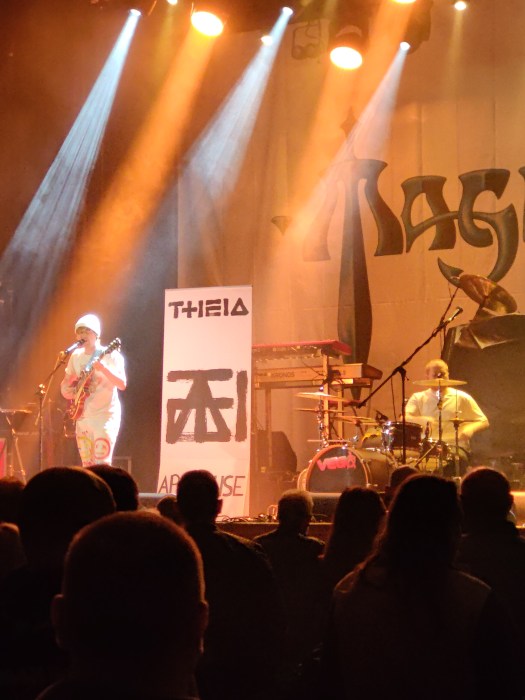
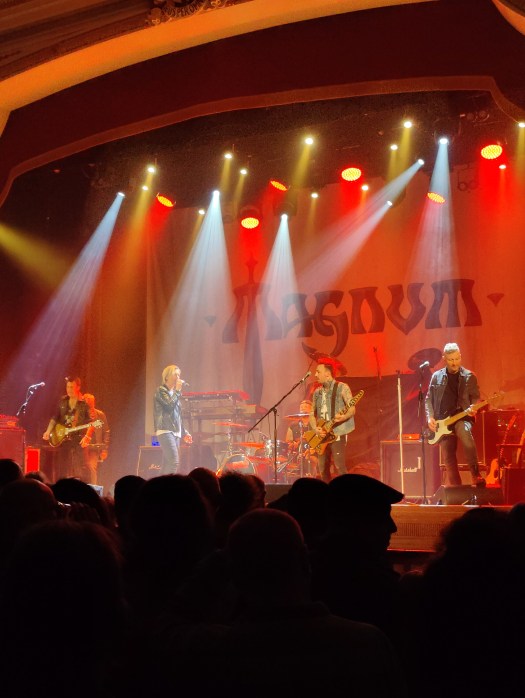
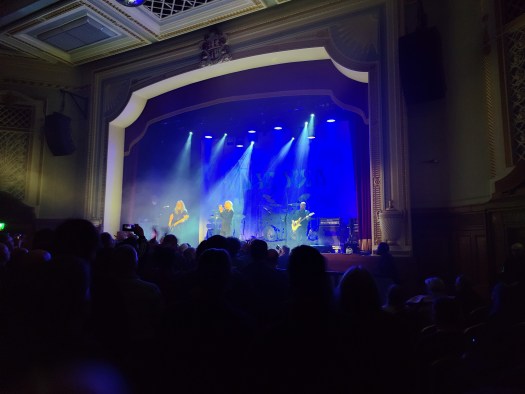
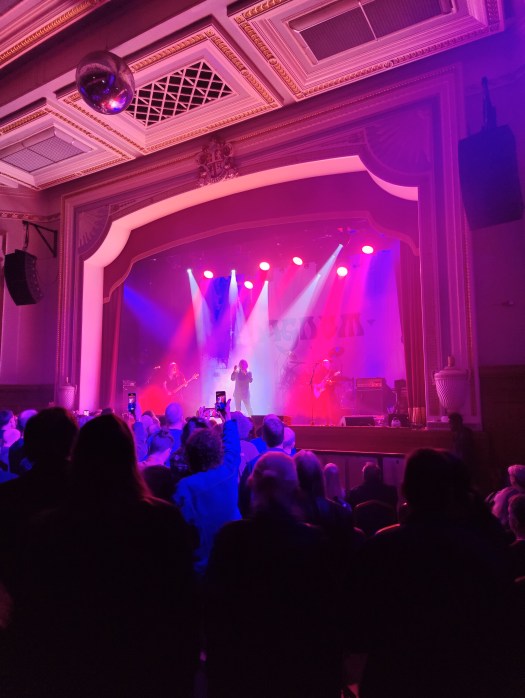
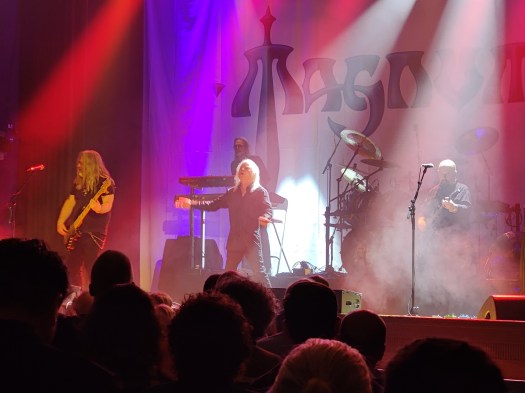
Magnum at Islington Assembly Halls

I’ve been listening to Magnum since the 1980’s. I first heard their single “Invasion” played off a cassette tape at a Venture Scout camp sometime around 1982, and I never looked back. Then, some years later, I heard and then bought their album “Chase the Dragon” with its opening song “Soldier of the line”. To this day, “Soldier of the line” still blows me away. Overblown, portentous and pompous dungeons-and-dragons style heavy metal music at its very best! Strictly speaking I think “melodic hard rock” is the more correct term – that probably just means heavy metal with keyboards.

In recent years I’ve been getting back into 1980’s rock music, whilst not neglecting other more modern musical genres. I can listen to classic old heavy metal, for example Judas Priest’s “Electric Eye”, as easily as I can to Linkin Park, Eminem, Faithless, Madonna or the Indigo Girls. And so it was that I bought myself a ticket to a rock concert, and on a blustery grey late winter evening, took myself off by train to Highbury and Islington, to see Magnum.

I came out the tube station and oriented myself, and set off. I do like the inner city; it is almost a “guilty pleasure”. Almost it were, I should feel bad, because I like the atmosphere – the seedy kebab shops, the little minicab offices, the harshly lit open-all-hours grocers, the rejuvenated Greek restaurants with little tables outside. People bustling up and down – couriers, workers going home, people out for the evening. I passed the venue on the opposite side, and walked on for a mile or so before turning back in the gathering darkness. There’s something about a city at dusk that attracts me, especially London.

Entering the venue, I find myself in a queue of older men and a smaller handful of women. There’s a fair amount of facial hair on show. Everyone is polite. Once inside, I found the bar and had a pint of some Italian lager in a plastic glass. Leaning against the bar, wearing a leather hat, I felt like Paul Hogan in the old Fosters advert: “Do you know any Rolf Harris, mate?” NO. “Looks like it’s gonna be a good night…”

The opening act were a two-piece called Theia, from Burton-on-Trent. I gave them the time of day because they were from my neck of the woods. Harmless; a drummer and a guitarist singer who was in good voice. It’s great to see new people being supported and championed. Not so much them supporting Magnum, as Magnum supporting them.

The main support act were a six-piece called VEGA, very much in the melodic hard rock tradition. Quite listenable though there is a limit to how much of this kind of thing I can take in one evening. There was a tendency for this vocalist (and the first vocalist too for that matter) to sound to me a bit like Jon Bon Jovi. Their final song was great; I was listening to it thinking, this has a great Def Leppard groove…at which point I became aware that they were covering Def Leppard’s “Animal”…

Bob Catley and Magnum came on and opened with a crowd-pleaser, their single “Days of no trust”. They followed this with “Lost on the road to Eternity”, and then the opening song to their new album, “The Monster roars”. Guitarist Tony Clarkin is Magnum’s lyricist, and I’ve been an admirer of his work most of my adult life. In “The Monster roars” you hear the words “stark reality“…these words also appear in their classic song “How Far Jerusalem” – “In stark reality/thy will be done/for you, for them, for me.” It’s interesting to me to see writers re-using ideas and concepts over and over again.

A bit over half-way through, the keyboard introduction to their classic “Les Morts Dansant” rang out and the crowd went wild. This opened the part of the set consisting of very much older material. And unfortunately, “very much older” is also a description of all of us and not excepting Bob Catley’s voice. I had been in conversation earlier with a fellow fan, who reckoned that voices could fail as one grows older, and singing in a different key might be an answer. “Les Morts Dansant” though a great song, was too much for Bob Catley’s vocal chords to really give of their best tonight. They followed this with – by no means tongue-in-cheek – “Rockin’ Chair” – i ain’t ready for no rockin’ chair. Like Jethro Tull, we may be too old to rock-n-roll but too young to die…we’ll see about that. One may hope…

Then there was “Vigilante”, and during this song unfortunately I had to leave in order to get home in time. That ain’t rock-n-roll but it is working for a living. A shame to have missed the last three songs in the set. (I found out that these were “Kingdom of Madness” from right back in the 1970’s, “On a storyteller’s night”, and “Sacred hour” from the Chase the Dragon LP.) All told, a great night: great value, great fun, great rock-n-roll.

Under the apple tree – a concert at Cadogan Hall

Yesterday to London, to see a concert at Cadogan Hall. We took train in the grey afternoon at 1623, accompanied mostly by homebound schoolchildren. We dawdled a little near Victoria. We popped into the “Turkmen Gallery“, a wonderful, rich, deeply colourful shop on Ecclestone Street that is quite literally an Aladdin’s cave of carpets and artifacts from central Asia. Then we went for an early supper at the Thomas Cubitt on Elizabeth Street. My wife had the fish pie, and I chose the fish and chips in order to try the “triple cooked chips”, which did indeed live up to high expectations. We shared a dessert as the light faded outside and the nearby shops lit up.

Thence through the gloaming towards Sloane Square and Cadogan Hall. The hall is a rather beautiful former church, built in the early 20th century, tastefully converted into a venue with 900 seats. It is the home of the Royal Philharmonic Orchestra, and hence a venue with a rich and deep musical tradition.

This concert was hosted by “Whispering” Bob Harris, the DJ, under his https://www.undertheappletree.co.uk/ brand “bringing attention to amazing artists who deserve to be heard by everyone”. I confess that whilst of course I’ve heard of Bob Harris, I’ve never listened to his programmes. In person an affable older gent, he introduced four very different artists: Judie Tzuke, Jamie Lawson, Emily Barker, and Catherine McGrath. The four of them came and sat in a semi-circle on the stage. Judie Tzuke and Catherine McGrath were accompanied by professional guitarists, although the latter did play guitar herself.

They each sang in turn, and the rest of the time, sitting politely and listening. They spoke of it being the first time they had played live since COVID-19 changed everything. Their singing was delightful; there was no bad nor weak song in the entire set. I think each artist sang four times.

Judie Tzuke sang clear and bright. Jamie Lawson spoke rough and ready and a little vulnerable, perhaps, but his singing voice blew the room away and to be honest, for me, he stole the show – even in such august company. A very powerful and distinctive voice. Emily Barker is also a powerful and distinctive singer whose voice soared out into the hall. We saw her play at a benefit gig at a church in rural Surrey some years back, and well I remember her voice from that night. Catherine McGrath proved to be a listenable and engaging Country music singer, clear and sweet in tone, a daughter of the Emerald Isle.

All the songs were accompanied by some outstanding and exceptional guitar. Notwithstanding Jamie Lawson noting in a self-deprecatory tone that he “only knew three chords” his playing, and perhaps that of Emily Barker, stood out for me – but that’s not to do down the other players. As a guitarist myself I found all the guitaring excellent, inspirational and encouraging. Bob Harris did note at the end that Country music has advertised itself as “three chords and the truth”. It was ever true that most modern guitar-based pop and rock music is just three chords – but that misses the nuance and technical brilliance of some of the arrangements we heard tonight.

In conclusion, this was a great show, with four very different artists singing a range of very special songs. I was touched by the relaxed, accessible, normalness of the artists – not megastars, but people who sing and play for a living to bring pleasure and joy to others. If I took anything away as stand-out special, it would firstly be Jamie Lawson’s powerful singing voice – particularly when he got passionate and really let go – and Emily Barker’s songs: her guitar arrangements and sweet singing. A great night out for a first after the time we have been through.

Near Westminster cathedral

15/7/19 – a little over a year ago.

In about half of my ways, O Lord, do I acknowledge You…coming through to spend time in Westminster Cathedral in my lunch break, I take a back street behind the head offices of John Lewis – Ashley Place, SW1. This lunchtime two things struck me.

The first is, the large piazza outside Westminster Cathedral has no cafes – not one. It is remarkable and unique for that reason. London itself, outside Covent Garden and one or two other areas, does not seem to have the cafe culture it could have or ought to have – ’tis a shame. Cathedral Piazza may be one of the biggest and most prominent squares in the whole of Western Europe that has no cafes. In any other city in Europe, a square like Cathedral Piazza would be absolutely crammed with tables and waiters from Easter til late September. Every square foot of building round the square would be tenanted by cafes and bars. Even in northern cities like Oslo or Stockholm, a square like this would be full of people eating and drinking.

The second is the homeless: I have taken this back street for years to avoid the ubiquitous Big Issue sellers on Victoria Street. There is a limit to the number of times you can buy the Big Issue. Over the last few years, it has become a place for homeless people. It is out of the way, hidden from traffic, largely free of uniformed policemen, and hidden from the bustle of Victoria Street. Today, two derelicts, lying in the street. Where did they come from? They were always there – they are not, in general, very young people. They are generally white Anglo-saxon men of military age. Other ethnicities tend to be much rarer, and few women – though there are one or two. I bought the Big Issue at intervals from a gap-toothed but cheerful street lady round here, often from the front of Pret outside Victoria station. The whole issue of mental health – particularly for men – is highlighted by the unfortunate people found in these streets. To say nothing of social justice. But even though it seems an inappropriate question, it is a question deserving of an answer: why are these homeless derelicts nearly all white men?

Emily Barker at St. Peter’s, Tandridge

Earlier this year we attended the first pop concert in 800 years, at St. Peter’s church, Tandridge village. It was an unseasonably cold night in March, and late snow lay on the ground. Tonight, we returned, in mid-October, on what was another unseasonable night. This time, however, the weather was very warm. To be able to walk around on a mid-October night in shirt-sleeves is most unusual.

This event, like it’s predecessor, was a benefit gig aimed at raising money for the fabric of this wonderful and ancient church.  In this case, money is sought to install a much-needed loo: prosaic, but a vital human need.  And this evening was both human and prosaic, warm and uplifting, but friendly and community-oriented.  The Rector, Andrew Rumsey, introduced the evening with a warm-up act of a brace of autumnal songs that might have even been written for the occasion.

The actual support act for Emily Barker were two gents called Roy Hill and Ty Watling. These gents looked and sounded like characters from Mark Knopfler’s “Sultans of Swing”

…Check out guitar George
He knows all the chords…

Mind, Ty Watling did indeed know how to make his guitar cry and sing, and that he went on to do.  Roy Hill was of indeterminate age, and was in good voice, and made banter with the audience about how much better this was than their usual pub gig.  They started dark, with a song about pain beginning, and finished with a deeply moving number about failing mental health, yet, they were always somehow encouraging, humane, and uplifting.

Emily Barker came on and immediately impressed everyone with her beautiful clear voice and her guitar playing.  This evening has seen a series of guitarists bringing great joy and beauty into the world through their playing, song-writing and singing, like Chet Atkins:

…Money don’t matter as long as I scatter a little bit of happiness around
If people keep a grinnin’ I figure I’m a winnin’…

In between the numbers she told us stories of her early life, in a discernable Aussie twang.  It is always engaging when pop stars do that – you want to know that they do go to the shops, that they were once kids in the back of a car going on holiday, singing along to cassettes.  She performed an old Bruce Springsteen number – “Tunnel of love” – to illustrate this story.

Somehow, the fact that she is a supremely skilled professional guitarist and pianist, a powerful and gifted singer and a talented songwriter did not discourage or demotivate. After the concert I was speaking to a lady in the audience who has Downs Syndrome.  She wants to write songs – and she was saying, by no means demotivated, how high the bar has been set by Emily Barker.  The lesson is, everything is possible; anyone can do anything if they set themselves to it.  A lady you might pass in the street, wearing blue jeans and a cardigan, has a voice like Aretha Franklin, a solo voice so beautiful, so powerful, as to carry an entire church in stunned silence.

“To one, he gave five bags of gold, to another, two, to another, one bag, each according to his ability” – Matthew 25:15.  It’s what you do with what you’ve got that matters, not how much you’ve got.

There’s a pattern emerging here with these concerts: Not so much inspiring, as inspirational.  Do new things. Dare to create, dare to do something new with your bag of gold.

Green Park

Here is a young man sketching the skeletal outlines of winter trees, using a blue pencil. Here is an older man, quietly reading a book. Here is an arrogant ass, sprawled on a park bench, with an expression like a King, as if he somehow owned the whole park. Groups of ladies run up and down. A helicopter buzzes somewhere up above – this is SW1.

A little yellow-breasted bird swoops down and lands two feet away from a Smartie, abandoned on the path. It hops smartly forward, picks it up in its beak, and flies off with it. A lucky find! Two men go past, of Mediterranean or possibly near Eastern origin, sharing the same bicycle.

A blonde lady of unknowable age, but svelte and curved in Lycra, is performing somewhat distracting (to me, anyway) stretching exercises on a nearby fallen tree, pressed in to service as a park bench.

Passing the Grand Sheraton on Picadilly, I spy a single open window amongst dozens, set against the sunlit white Portland Stone.