Where to begin, then? At the beginning, or indeed, at the end? It is now Wednesday evening and I have come 58km from Keswick since Monday morning. It has been as planned – as long planned – although there have been three significant deviations from the original plan, for one reason or another. I very much enjoy the idea of planning something down to the last detail, and then doing it – though not being inflexible, and being open to change in the real world. As an older man going off solo hiking and wild camping in backcountry, one doesn’t just throw these trips together. One doesn’t just pack a rucksack and set off happy-go-lucky. These trips are planned, if not down to the last kilometre, then certainly down to the last hour.
I joined the 0703 to Sheffield, a rare and very useful main-line train out of Belper – there are a handful each day. At Sheffield, a coffee and something or other. Then I joined a Trans-Pennine Express train to cross the Pennines to Manchester, a class 185 diesel multiple unit with a particularly nice first class section, with cream faux-leather seats. My ticket would have had me change at Manchester Oxford Road. Common prudence as an experienced train traveller, or possibly a hunch, made me change instead at the much bigger Manchester Piccadilly – where the trains must all go anyway. Always follow hunches: My train to Penrith, at 0921, was cancelled. I was able to buy some outstanding groceries – bread, mini-oranges, baby tomatoes. The 1021 train was cancelled too. We knew by then that there had been what the railway company politely calls a “trespass incident”. We spend a minute in silence to think about the people involved, and about mental health in general. Talk to people! You’re not alone.
I got to Keswick around 2pm, around two hours late. I had to change additionally at Preston, then, of course, take the X4 bus towards Workington. From Keswick, out through Fitz Park, past a grand hotel, and upwards through leafy lanes to a right turn leading northeast over the bypass and on towards Latrigg. There were a lot of local hikers in evidence. The path led straight as a die along the edge of woods, strongly upstairs, before rising over a hillside. This is the Cumbria Way, and my route lay along it for many miles. I reached a tarmac roadhead, at NY 280253, at which point a lady in a small van was selling coffee. Laughingly I declined; I needed no last minute refreshment today and my bag in any case was pretty much stuffed with food and confectionery. Thence, straight across the moor to the first decision of the trip. Skiddaw, or not Skiddaw? As I arrived at the junction in the paths I met a fellow coming off Skiddaw, whose timing information was most useful to me. It was about 3pm. Had I gone up Skiddaw I should have not have been descending to Skiddaw House until getting on for 6pm – closing darkness. There just was not enough daylight. I opted to eschew an ascent on this particular occasion.
I followed the Cumbria Way east across the side of Lonscale Fell, before curving left and north into an immense ravine, the steep and narrow valley of the Glenderaterra Beck. It is a wild and picturesque place, but one false step and you’d be precipitated down the very steep grass to the beck far below.
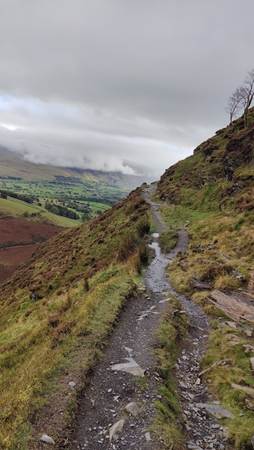
Up this valley, past ruins of ancient lead mines far below, rising steadily, up past a hillside marked on the map as “Burnt horse”, onto the brown moor. It was getting on for 5pm. Skiddaw House itself is protected by a screen of trees, which were black and threatening against the greying of the sky. It is a blank-faced row of terraces in the middle of nowhere. Midweek in October, of course, it was closed. Though a hostel, distinctly unhospitable in the autumn dusk. Doubtless a delightful haven in summer. In the October witching hour around 6pm, under lowering cloud, it was eldritch and gloomy, even threatening. “Stay off the moors, lads…”
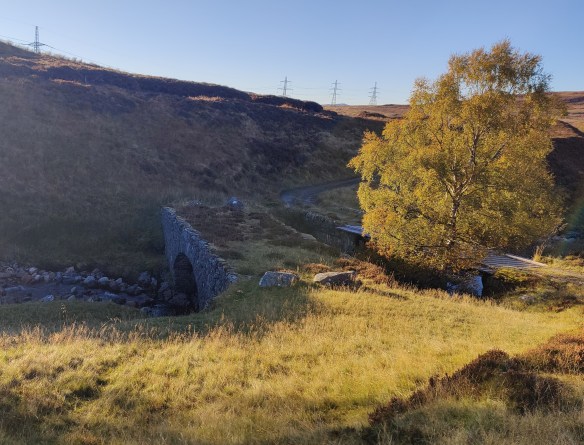
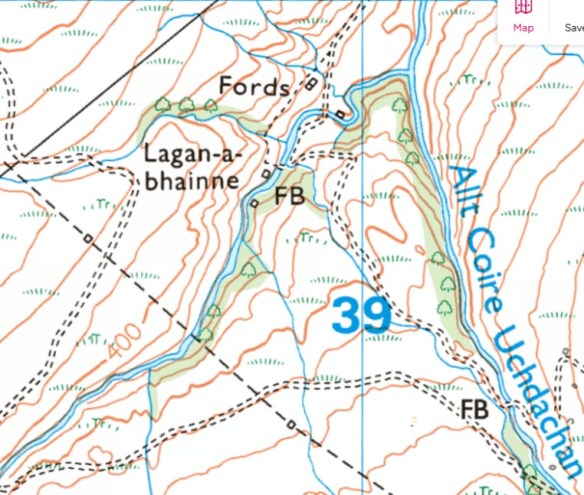
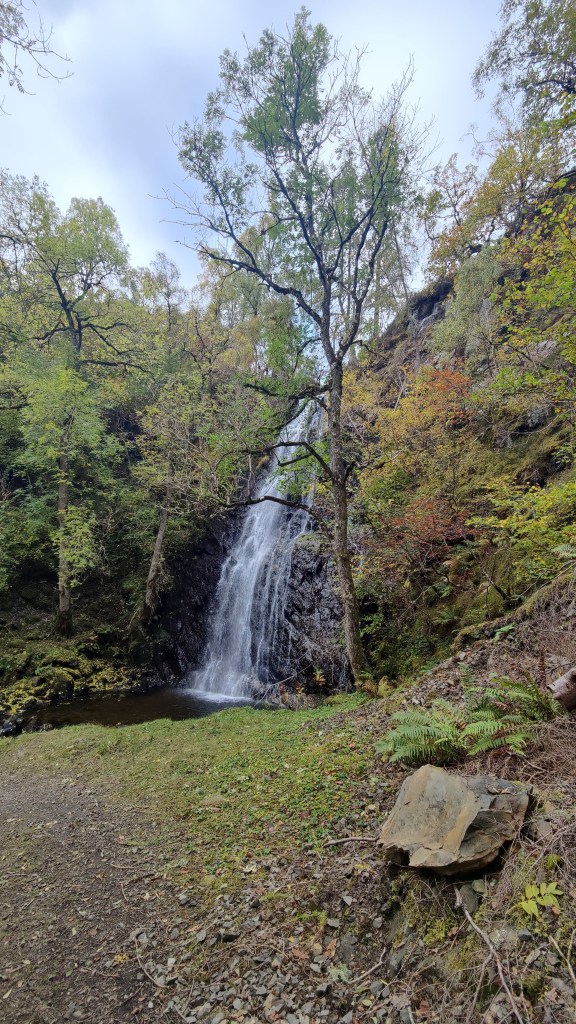
Another 2km walking was necessary to find a good camp ground. One needs access to good running water, and flat grassy ground. Neither were easily apparent on the brown moor. Plenty of water underfoot; not so much clean running water. Plenty of tussocks and hummocks and coarse moorland grass. Not so much flat and green. I found myself a spot near NY 300308, by a footbridge over a stream – Wiley Gill – near a curious circular sheepfold full of the very greenest grass. I did not camp inside the sheepfold. I made a good camp by the babbling brook.
13/10/26
During the night there was – as forecast – tremendous violent rain (though rain always sounds worse from inside a tent than it actually is). The rain did not affect me in the slightest apart from having a wet strike in the morning. I was up by 6.15a.m and although the rain had stopped at that point, the wind had risen and was rattling away. When it came to striking the tent it was all rather difficult, and the whole lot – footprint, inner and outer – went away soaking wet. This is why we use dry bags. Not only to keep water out, but also to keep it in.
Much rain had fallen, and the stream beside which I had camped has risen in fury. My route lay northeast along the valley of the Caldew River, and this was an absolutely unfordable torrent. This was water not merely risky to cross, but white water that would sweep someone away to their doom. My intent had been to cross this river and join a path (or at least, a Right of Way – more on that later) up the Blackhazel Beck. I had not thought that the river would be unfordable, nor had I read the map closely enough to see that the two paths (the one I was walking on and the one I wanted to join) did not meet.
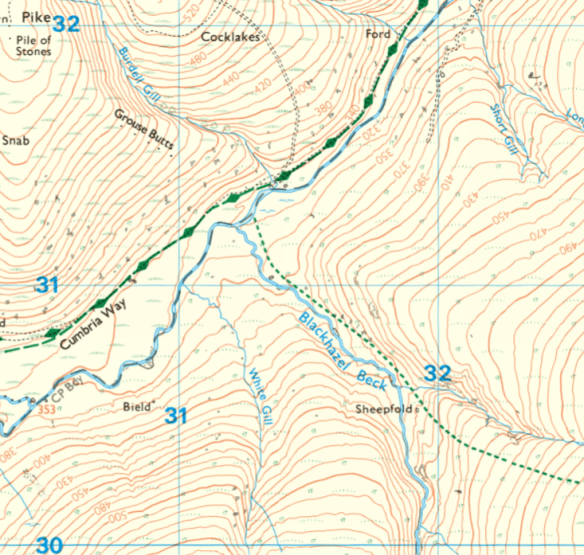
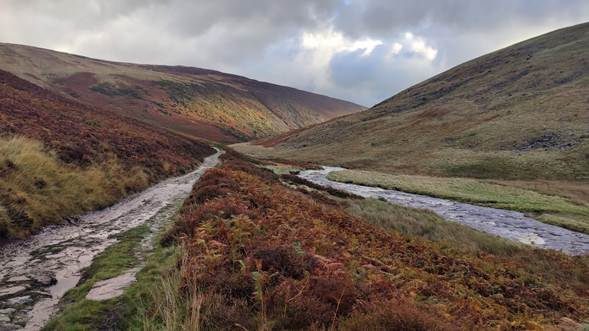
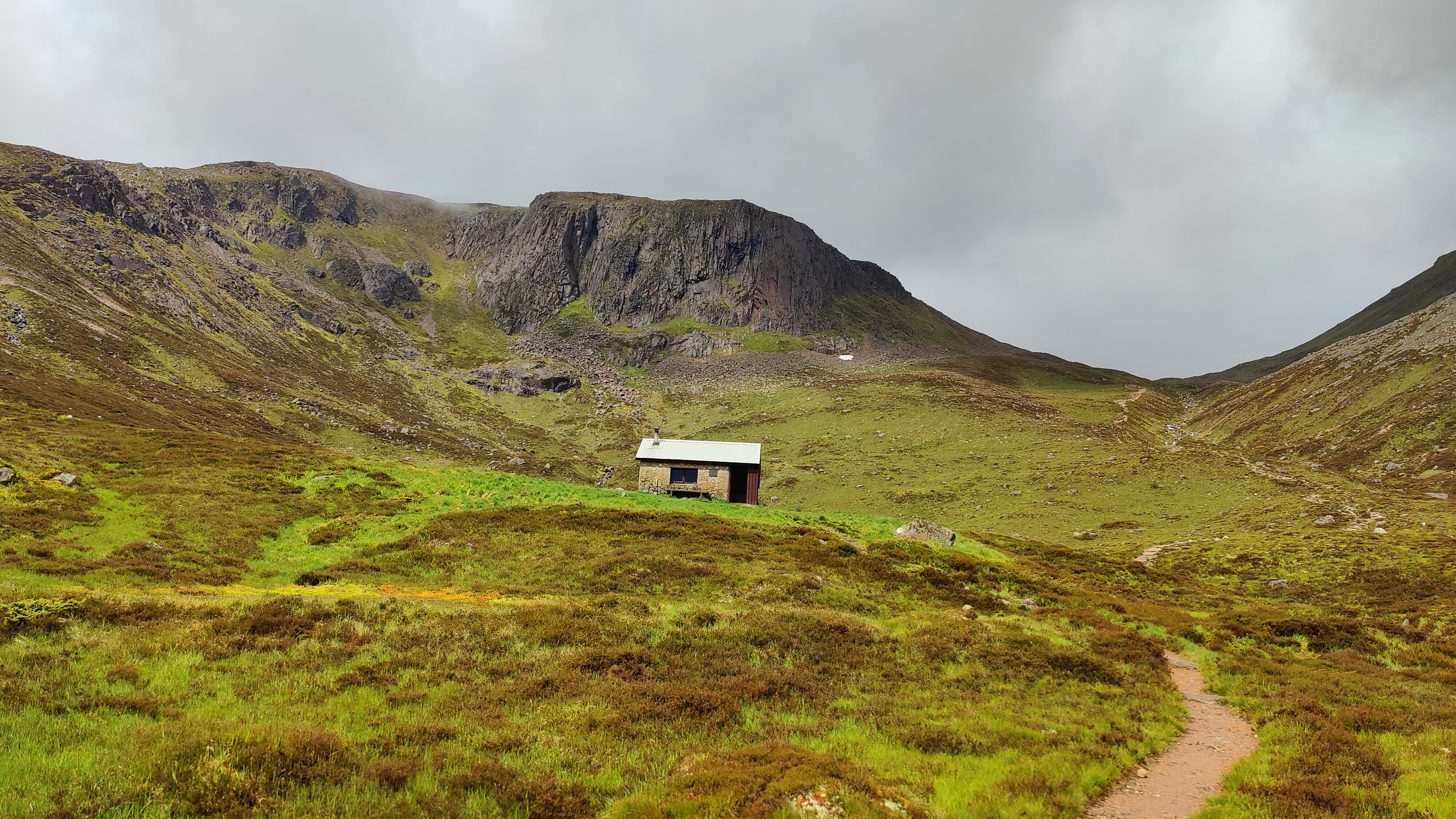
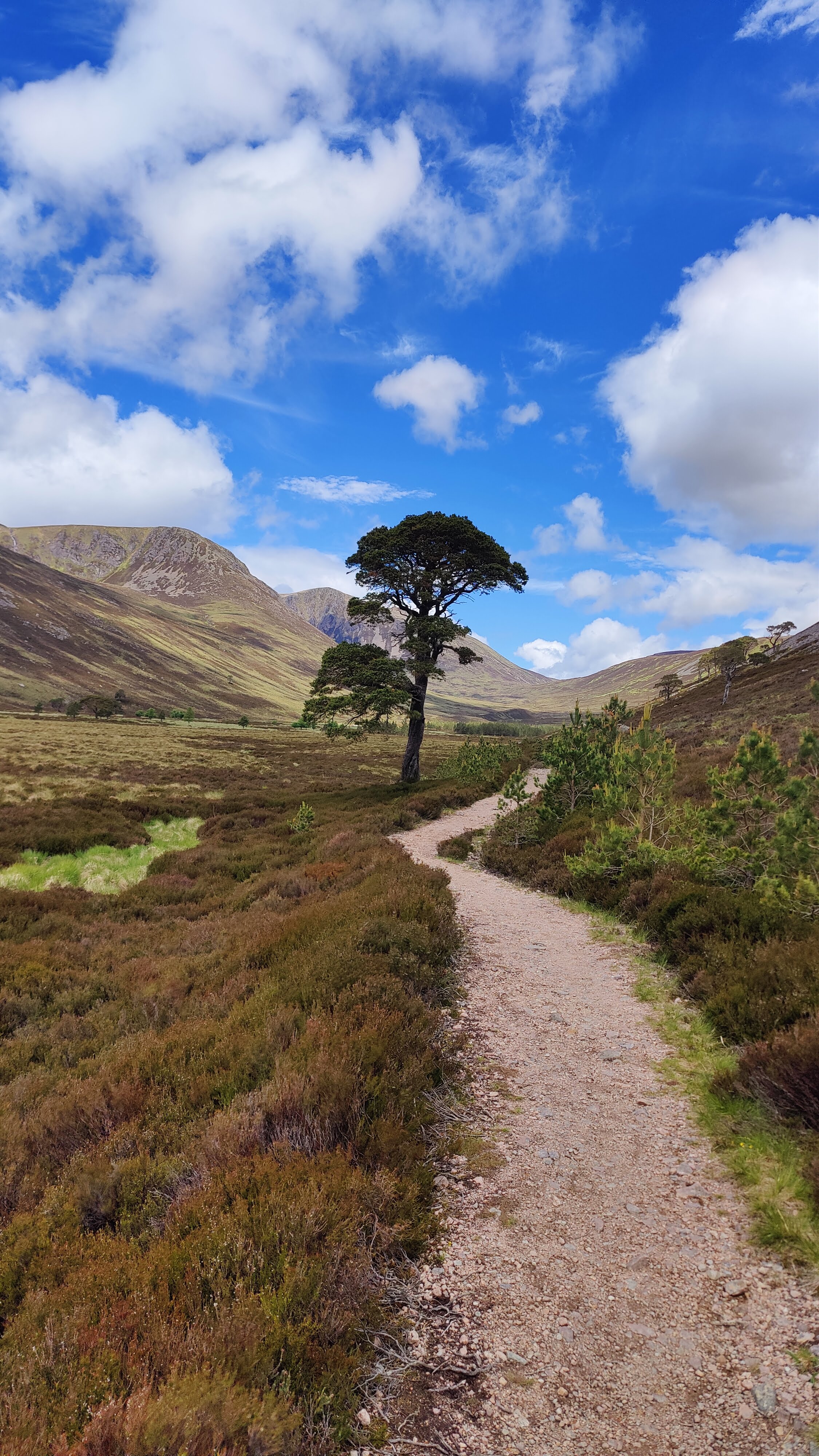
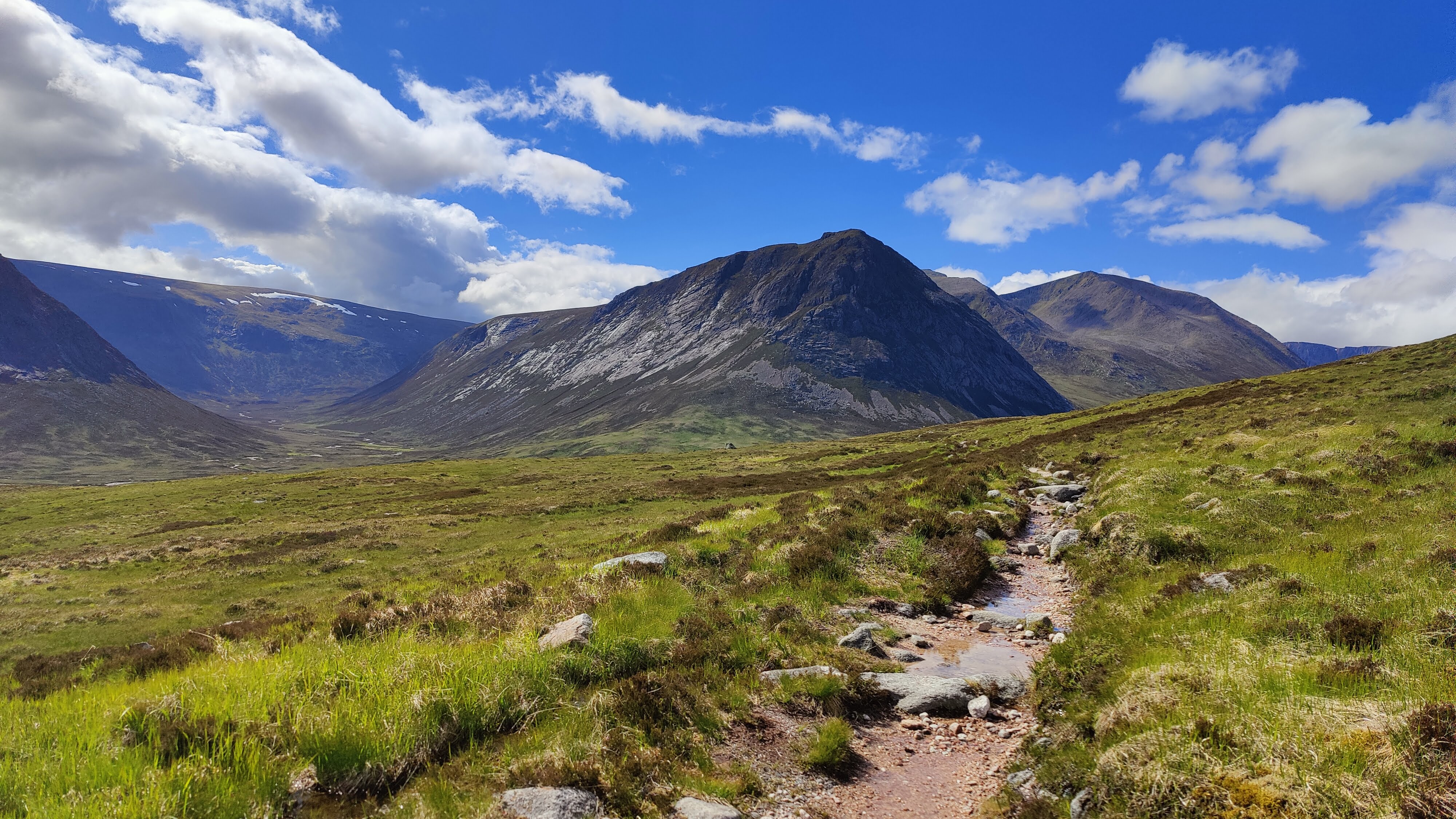
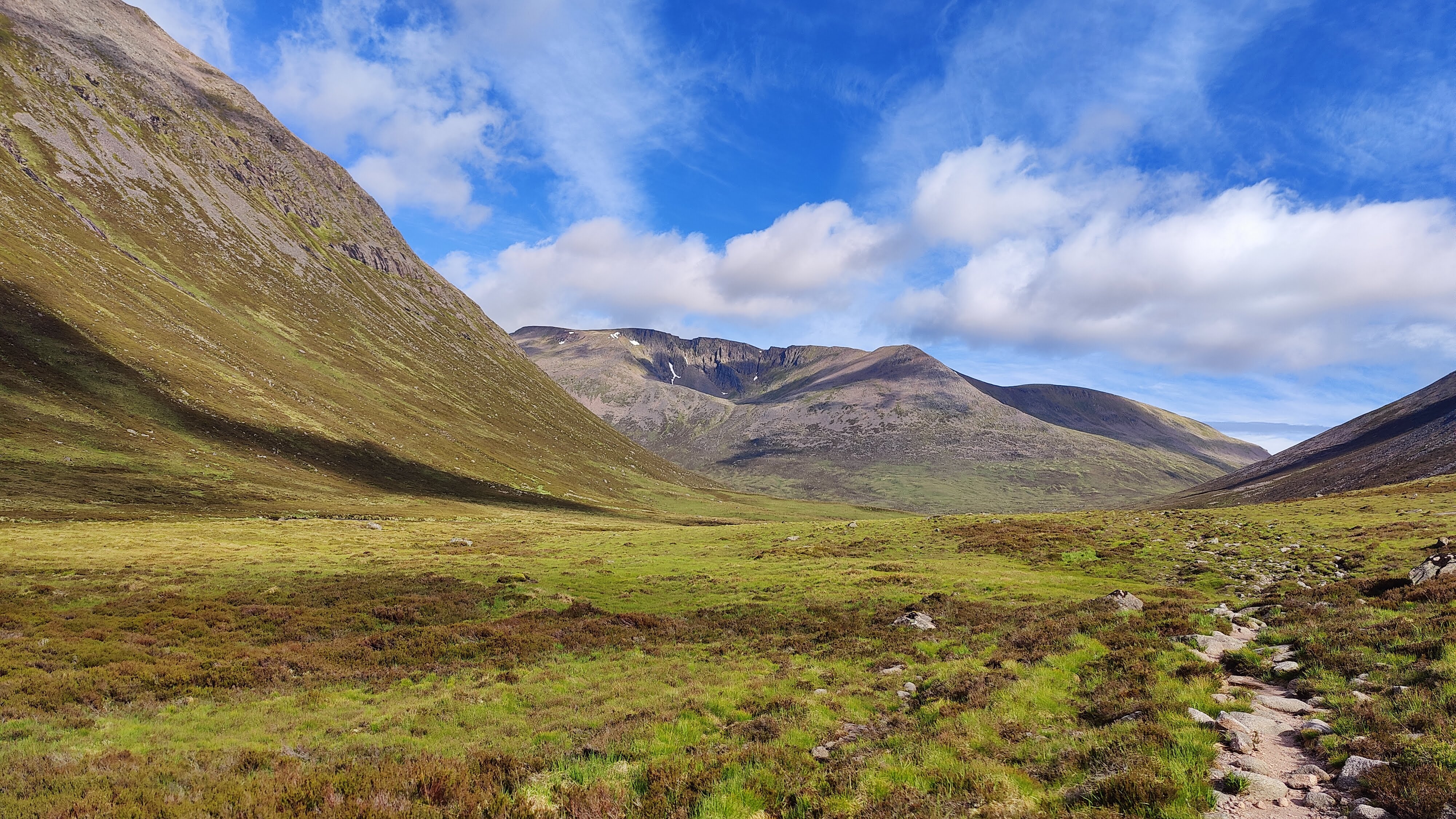
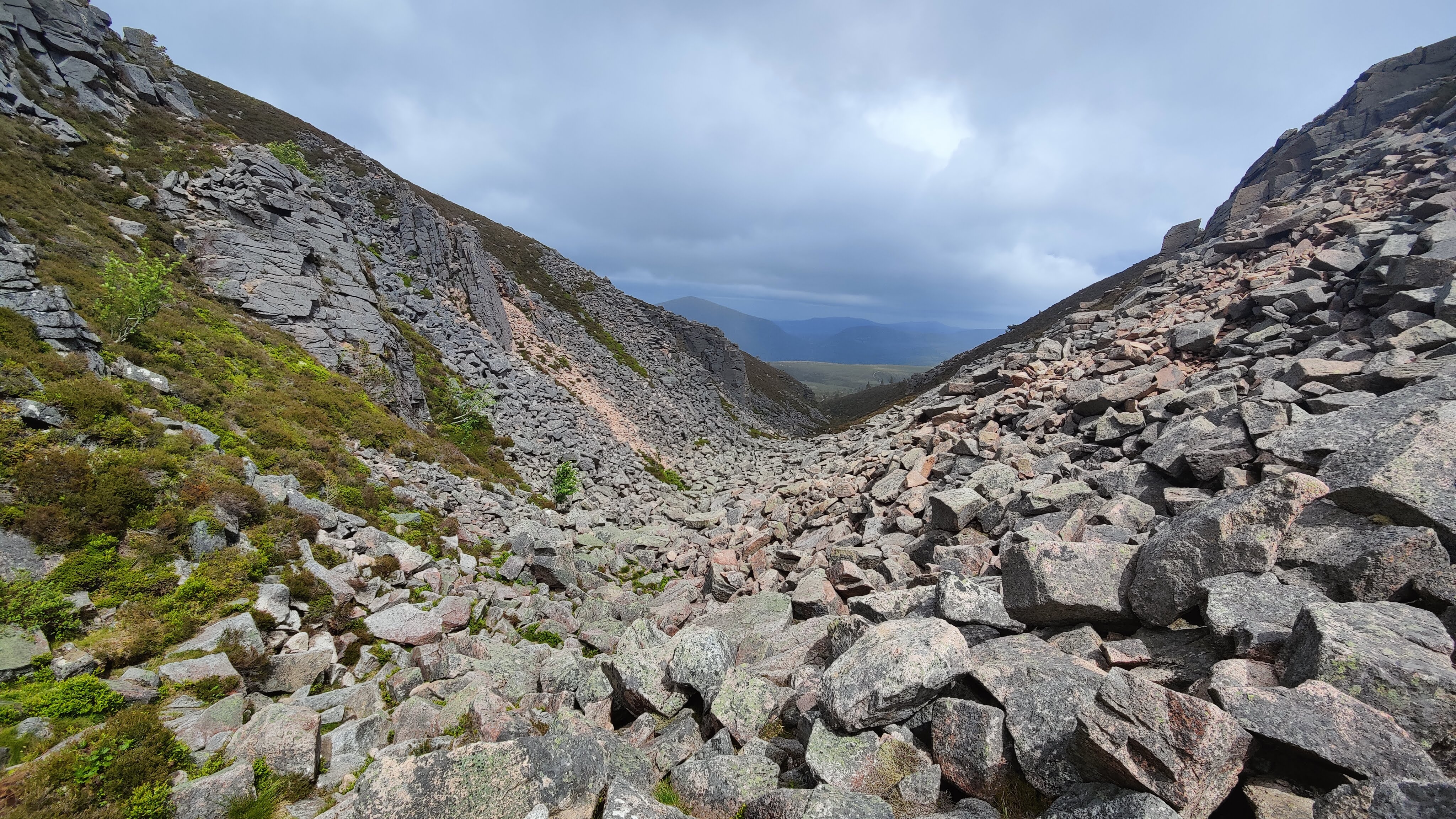
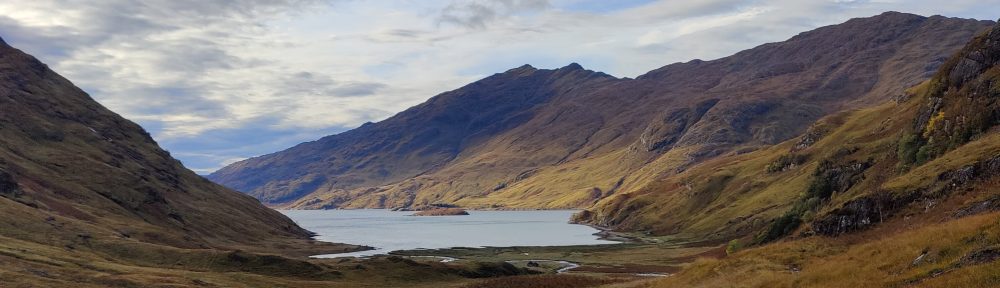
I had to continue down the valley – which as can be seen from the photo, was deeply beautiful walking in very wild country – another 3km to the footbridge at a place marked “Roundhouse”. From there, up onto Bowscale Fell, though unfortunately not visiting Bowscale Tarn, the northernmost corrie tarn in the Lake District. Another time, perhaps. This was hard going uphill – but not too hard. One of the greatest advantages on the hill, of being very fit, is that I need not feel the existential dread faced by many people, even accomplished hillwalkers, when confronted with a huge climb up some steep mountainside. Up here, absolutely stupendous scenery in a forgotten and ill-visited corner of the Lake District. I saw no-one from 3pm yesterday until almost 2pm today. The weather was improving.
Whatever I did, in order to get down to the road and onwards with my day, I must perforce go to an unnamed col at NY 328291, between Bannerdale Crags and Blencathra, the head of the valleys of the Blackhazel Beck and the Glenderamackin River. Had my original plan worked, I should have got there late morning. As it was, I arrived at noon and took lunch there. Here I took the second decision, the second change of plan, of this trip – and that was, Blencathra, or not Blencathra? I was already at least ninety minutes down on a long 26km day. Had I gone over Blencathra, I would not have been descending to Threlkeld until late afternoon, with the 7 or 8 kilometres uphill over Threlkeld Common and onto Matterdale, still before me. I should have been adding complexity and uncertainty to an already long day. Though the weather looked to set fine, I opted to eschew a trip over Blencathra. This was the right decision, as we shall see.
So I descended the Glenderamackin River. This was always a backup plan in any case. The valley is very steep-sided, another deep V-shaped ravine. There are disused mines here also. As one descends, a tremendous back view develops of the Sharp Edge of Blencathra.
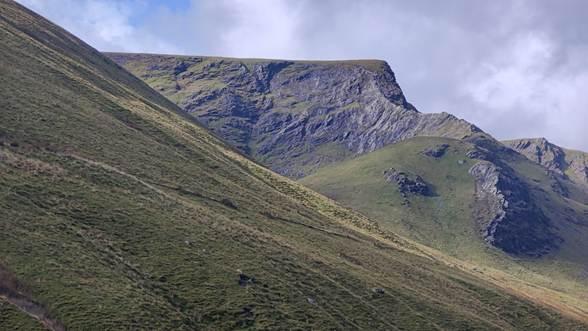
The river makes a very sharp turn left northwards – this is a most interesting area in terms of geology and geomorphology, quite unlike anywhere else in the Lake District. The river was also quite unfordable at this time of year. One must follow the path over a footbridge, gently up over the shoulder to a col, and then down to the road through Mousthwaite Comb. Mousthwaite Comb I know very well, having climbed Blencathra often enough. Here, early afternoon, I met the first people I had met all day, and there was a violent squall.
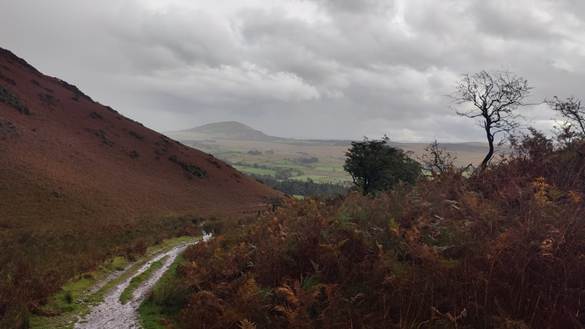
Down to the A66 via Lowside Farm, carefully cross the trunk road, and onwards along a metalled side road to what was clearly the old A66. The sun came out. This was pleasant valley-floor farmland. Then, about a kilometre across farmland to Wallthwaite Farm. One sees a Right of Way (a green, or pink, dashed line) on an Ordnance Survey map: does a path actually exist on the ground? This is not so easy to discern in active farmland where the landowner may have their own views about Rights of Way, notwithstanding the law, and possibly very much at odds with those of the average walker. A straight green dashed line is somewhat suspicious; it does not follow that the path – if path there even be – is nearby. There could be Rights of Way with no path; paths and Rights of Way could be congruent or nearly so, and paths can exist on the ground where in theory there is no Right of Way – at least in England.
I managed to get through without crossing barbed wire, meeting a bull, or offending or even meeting any human individuals. I crossed the former Penrith to Workington railway, unfortunately disused these five decades past, and then continued more or less due south in a straight line along the Right of Way through the lands of Highgate Farm, Highgate Close Farm, and Lobbs, climbing all the way, before once again reaching the brown common. Behind, a view of Blencathra emerged as afternoon wore on.
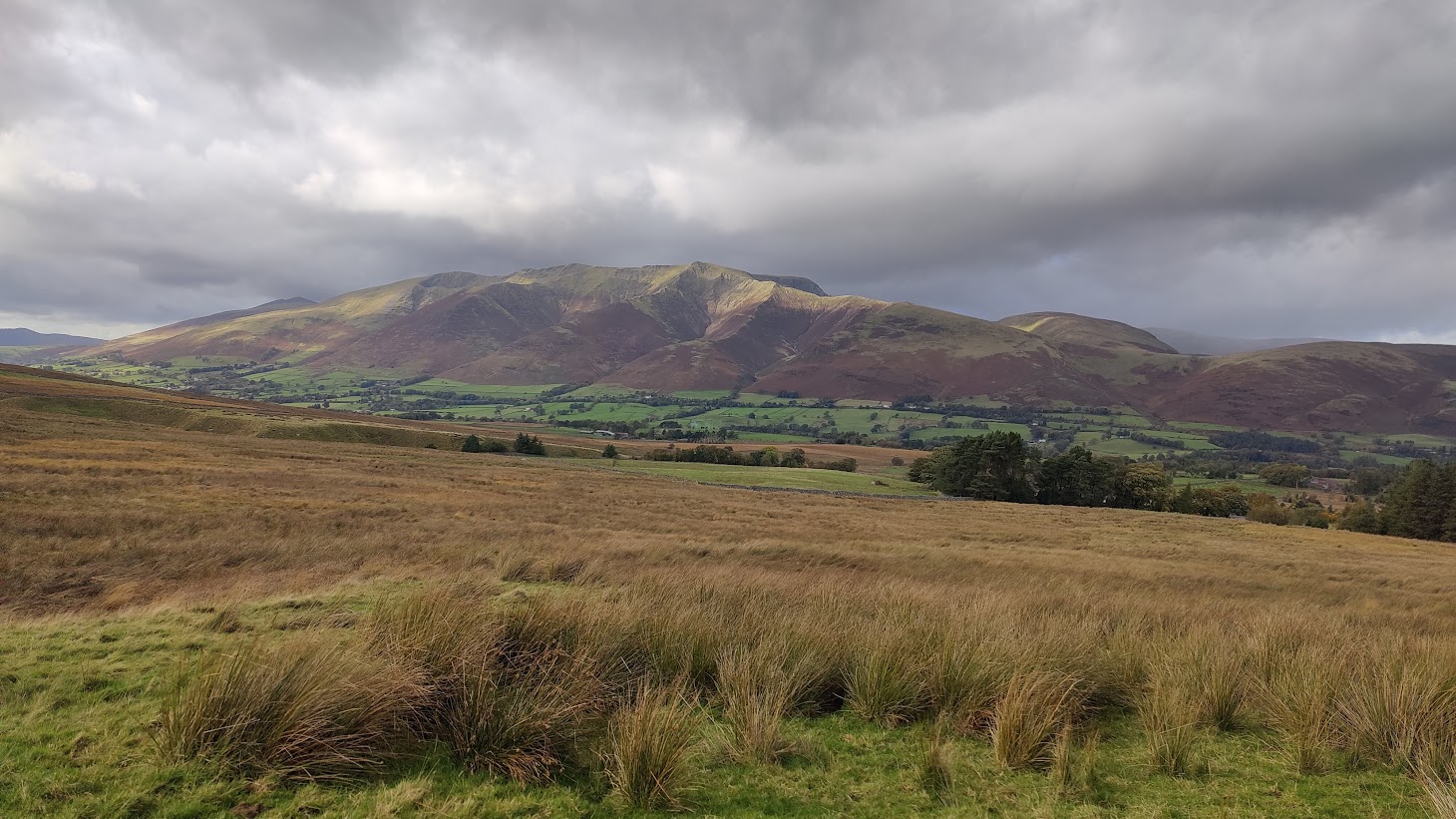
From the dismantled railway to the “old coach road” across Threlkeld Common, was about 3km, relentlessly uphill, very heavy going over very muddy, very wet and heavy grassy terrain with scant path. The “old coach road“ connects St. John’s in the Vale at the top of the Thirlmere valley, with Dockray and Matterdale End near Ullswater. It was a blessed relief to reach it – only a rough unmetalled road but flat, easy going, along which I could peg along at 4km/h. It ran at this point in the shelter of a line of low, unnamed hills. This line of brown hills reminded me of the four hobbits accompanying Aragorn through the “long leagues of Eriador” towards Weathertop.
My day was almost done. I continued round the contoured road to a rough crossroads at NY 373221; instead of leaving the “old coach road” and continuing straight along a path, with my brain in late afternoon neutral, I “followed the road round” to the left, and found myself at a more formal crossroads, a road-head in fact, High Row. Here there was a small car park and a few people were in evidence. This was about a mile to the east of Dockray on the Troutbeck to Ullswater road – that road passing the famous waterfall Aira Force.
At this crossroads, right into a cul-de-sac, one of the wilder side-roads of the Lake District. This particular road is barely a kilometre in length and serves a handful of farms including the one at the roadhead, my destination: Dowthwaitehead. I had planned to camp wild in an upland valley called Deepdale, beyond Dowthwaitehead. Even when I planned this trip, it was clear that though there were paths, there was no Public Right of Way into this valley. There was always a risk that I would not be able to access the valley to camp wild, except by permission of the landowner at Dowthwaitehead. So it proved – there were people about, busy with their tasks, but I did not think they would allow me access to Deepdale, nor did I ask them directly. Wild camping has a very bad reputation in the Lake District at present, owing to the rise of social media drongos who will camp anywhere and leave their litter and worse, quite openly behind them. I seek to camp in a more sustainable and more discreet way.
But nonetheless, wild camp I must, and soon. It was well after 5pm; darkness impending and and a squall coming, and I did even know where I might camp. I was tired and worn at this point. I asked a lady shepherd for directions and she was helpful enough – there was a path out of the valley, to which she directed me. I could not camp near the farm, even on the common ground, though it was a veritable Eden by the river and the trees. I started on the path uphill out of the valley, ignored by some somewhat incurious Belted Galloway cattle, and left it after a kilometre or so to find a suitable pitch out of sight of the settlements below. I found a secluded and wild flat spot on the common land, but not secluded enough – I was careful with my lights all night. My tent was wet but dried out quickly enough. I slept very well.
14/10/26
I awoke at 0545 after a good night’s rest. I was not minded to lay slug-abed any longer; I wanted to be away before I might be spotted by any farm workers out and about below. I’d had tea, porridge and a cooked breakfast and had tidied up before 0630 – definitely peaked too early. I could not strike my tent and set off until there was enough light to do so without a torch. A moving torch up here in this dark early morning would be visible miles away. I struck camp and set off in good order, starting my hike timer at 0750.
My path lay uphill over the wet, brown, soggy moor. Gaiters were absolutely essential this trip, as were waterproof overtrousers. The path ran roughly southwest, rising literally over “Brown hills” as seen on the map. As I climbed, the wind became apparent, harsh and strong. At a broad col, there came a stone wall, drawn like a pencil line NW-SE across the landscape, with no regard whatsoever for the terrain. I was happy to hide behind it briefly for some respite from the wind, and take a mouthful of water and some chocolate. There was a stile, at NY 369193; through this stile and downhill slightly, into a wild and uninhabited side valley called Glencoyne. This strange and obscure glen has a rather curious path marching right round it, following the contours the whole way. It is quite high up, quite flat, clearly ancient, and clearly passable with care by pack animals. Far below, one can see the lower part of Ullswater.
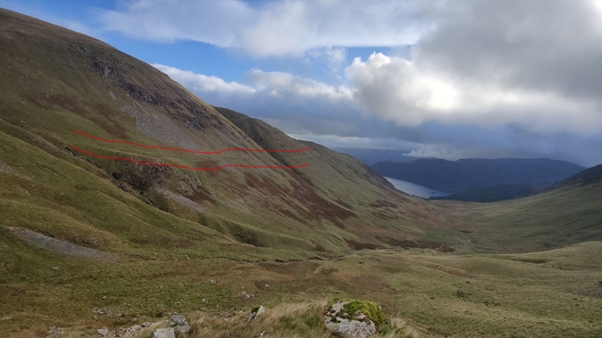
The path curves round over a shoulder into another valley – Sticks Gill – which heads westward deeper into the hills up to Sticks Pass. In this valley, a post-industrial heritage of spoil heaps and tips. Sticks Pass is a featureless wasteland and was in the clouds. It is called Sticks Pass because the old miners and drovers erected a line of sticks over it as an aid to navigation in snow or thick mist. I arrived here at 1100. This morning’s route though interesting, was not what I had intended. I had intended to climb out of Deepdale and visit Watson’s Dodd and Stybarrow Dodd, but my altered camping position had changed all that.
From Sticks Pass uphill through the cloud and howling gale to Raise (883m). The gale force wind would remain a tangible physical presence throughout the whole traverse of the ridge down to Grizedale Tarn; relentless once out of shelter, baleful, enervating if not properly dressed. Yet not too cold: I was properly clad and not personally cold. This was not the biting, cutting wind of true winter. I started to meet a few people, mostly day hikers up from Glenridding; few if any mountaineers, as I continued over Lower Man and onto Helvellyn (950m) itself.
That said, I was feeling risk-averse. In this wind, should I turn back and go down White Side and down to Glenridding that way, or continue to Grizedale? Risk aversion is sometimes wise. It is sometimes no more than common prudence; it can be good mountaincraft. It can also be habit-forming. One would do well not to allow risk aversion to become a habit. Risk aversion is not a virtue. The facts? There was no more risk here than anywhere else, notwithstanding the wind and the altitude. I left Sticks Pass at 1100. I was dry, warm, carrying food and water and sufficient clothing, and did not need to be in Glenridding until evening. Route finding was not a problem: there is a motorway of a path over this ridge; I knew the ridge in any case, and in a number of places there are lines of cairns to guide one along. The full traverse through to Grizedale Tarn wouldn’t take even four hours in the worst likely weather. I went on.
On Helvellyn, the idiots. These big famous hills are idiot-magnets. I saw at least two or three people – older men and younger women – in shorts. I offered advice to an Italian man and his girlfriend, up from the Thirlmere side, a couple barely even capable of reading and pronouncing the word “Thirlmere”. They were wearing trainers and windcheaters; no map, no compass, no food or water, no torch. Just mobile phones. My advice was, “go back the way you came”. A pair of harmless fools possibly: but this is why local mountain rescue teams end up being so stretched.
Over Helvellyn to Nethermost Pike and Dollywagon Pike. Around this time the gale brought with it heavy rain for a time, and I found myself hiking in shocking, dreadful conditions. My gloves were getting wet and my fingers getting cold. I’m very careful of my fingers – an attack of Reynaud’s Syndrome up here in this weather could render me unable to do the most basic tasks – zips etc – with my fingers. I switched to my heavy winter mittens – but I could not get them on, with damp or wet hands. A very tricky few minutes was spent pulling the mittens on. After that, I was OK.
Onwards through the clag and the relentless gale, until I found myself on the stairs down to Grizedale Tarn. These Lakeland staircases of local stone, so expensively and lovingly installed, are an asset to the landscape wherever they are. The prevent the unsightly erosion and ugly scars on the mountainside caused by heavy pedestrian traffic. But in the wet, going downhill, in a howling gale, I find they can be lethal. Maybe it’s just my boots.
As I dropped below the cloud deck I could see Grizedale Tarn far below, black and dour as it always is, but with conspicuous white horses at the eastern end, raised by the tremendous wind. I got to the tarn at around 2pm – three hours from Sticks Pass. These were severe, rough and very windy conditions. Descending into Grizedale, the wind, if anything, became even worse. It became not merely relentless, but capricious and malevolent, gusting to the point where I might easily be knocked over when stepping down from one place to another. Nonetheless I made a good pace down Grizedale, though much troubled initially by the wind. I was last in this valley in 1979 – only my second ever trip to the Lake District.
I crossed the footbridge and took the left-hand path on the north side of the valley continuing through pleasant terrain which became emerald-green farmland with sheep and stands of ancient tree. The path leads upwards briefly to Lanty’s Tarn, which I read afterwards in Heaton Cooper, was extended by the landowner in order to provide a year-round supply of ice for his table!
From Lanty’s it was but a few minutes walk through the rhododendrons and the woods, to the Ullswater Hotel, and my hike was done. Check-in was harmless; a South African fellow sorted me out in seconds. Through the bar to my room, where initially, I just sat, raincoat on, boots on. Then, raincoat off, boots, sweaty clothes off, kettle on. A Nice Hot of Cup of Tea. And there is a even a bath, and a nice long one at that. I poured a bath and sat in it to unwind, sipping sweet tea. I had a shower as well, to get properly clean and get some hot water on those stiff shoulder muscles.
Another successful hiking trip completed, another excellent hotel stay in prospect. I had wanted to recreate the pleasant feeling of tiredness I had when I stayed at the Old Dungeon Ghyll Hotel after my October hike a couple of years ago. I had deliberately tried to engineer that feeling, by making this hike more arduous towards the end, than at the beginning. But in the real world of course, things can often turn out slightly differently.
Day 1: Keswick to Skiddaw House, Keswick to Skiddaw House, 12km, 3 hrs 21 minutes.
Day 2 Skiddaw House to Dowthwaitehead, 25km, 9 hrs 30 minutes
Day 3 Dowthwaitehead to Glenridding via Helvellyn, 21.1km 9 hrs 30 minutes.
My kit – with the possible exception of the winter mittens which I struggled to put on when my hands were wet – performed exceptionally well. My tent, an MSR Elixir 2, did very well – it dries quickly and the base of the inner is more waterproof than it looks. My overtrousers (Berghaus Goretex, very lightweight), gaiters (Rab) and jacket (Mountain Equipment “Lhotse”) all performed in heavy weather. There is almost nothing I used that did not work well.
On the Thursday I had a train back home, out of Penrith at 1423. The fundamental unreliability of public transport in the UK means that I could not afford to take the last possible bus to catch that train – were that bus not to turn up (which would be more than possible) I’d be missing my train. So I had to take bus at 0955. So it was that after breakfast, I took bus #508 in the rain along the side of Ullswater, 45 minutes to Penrith.
Me and a college friend I once walked the whole length of Ullswater on a sunny winter Sunday morning. All 14 miles of tarmac road from Glenridding right out to junction 40 M6, in 4 hrs. But I was 19 then and I thought nothing of it.
In Penrith I looked round and sat in a cafe for a couple of hours, before retreating to the station to take train back home: an excellent few days away.