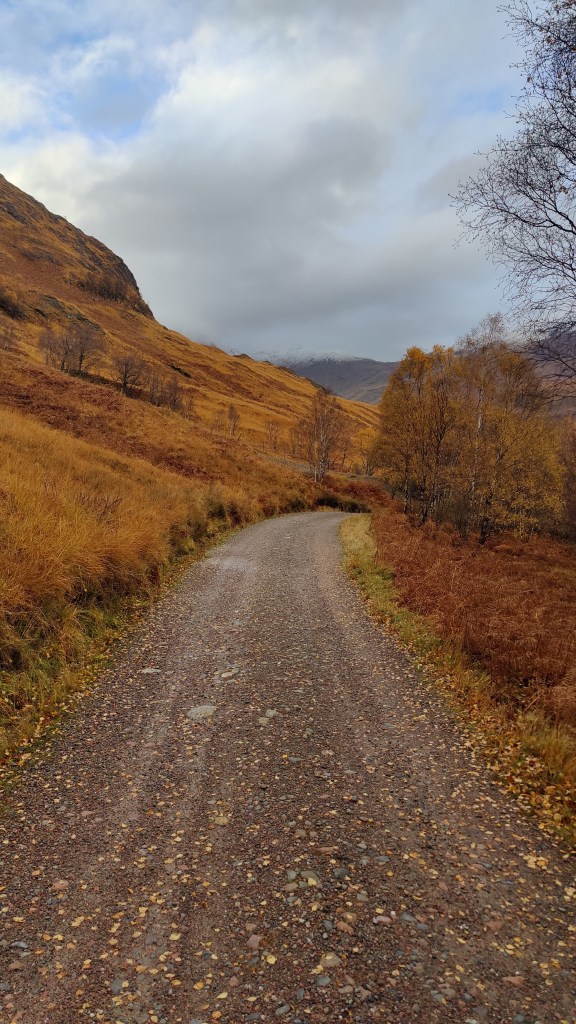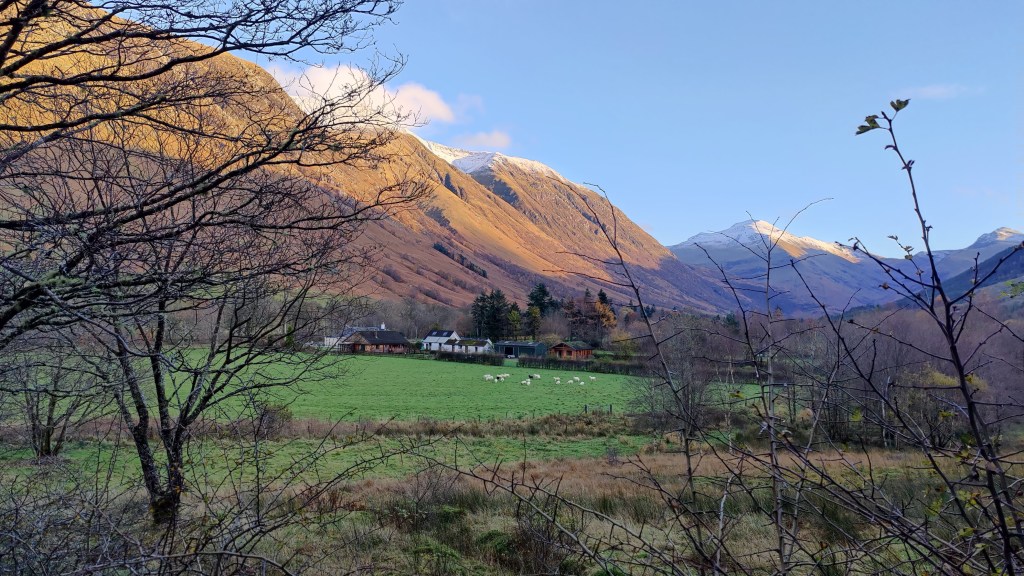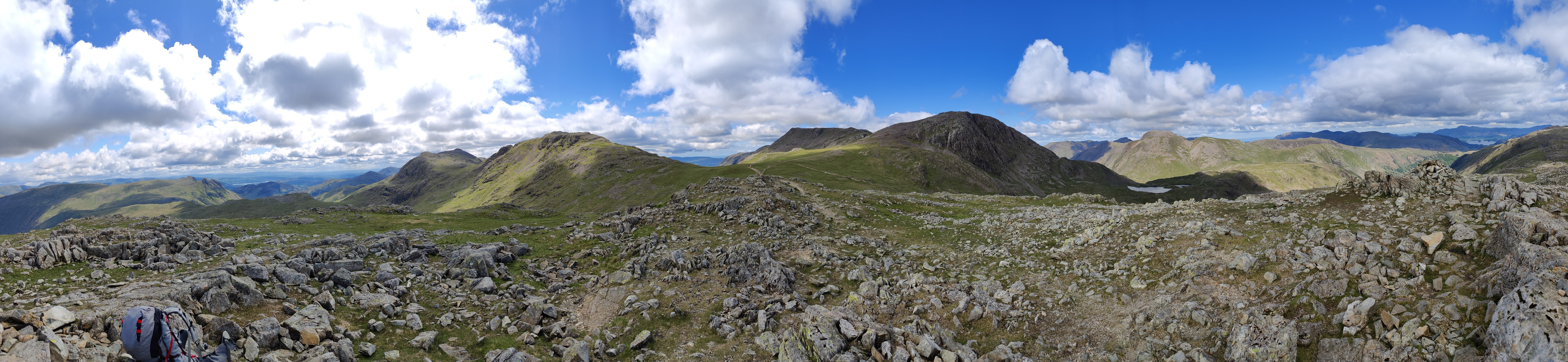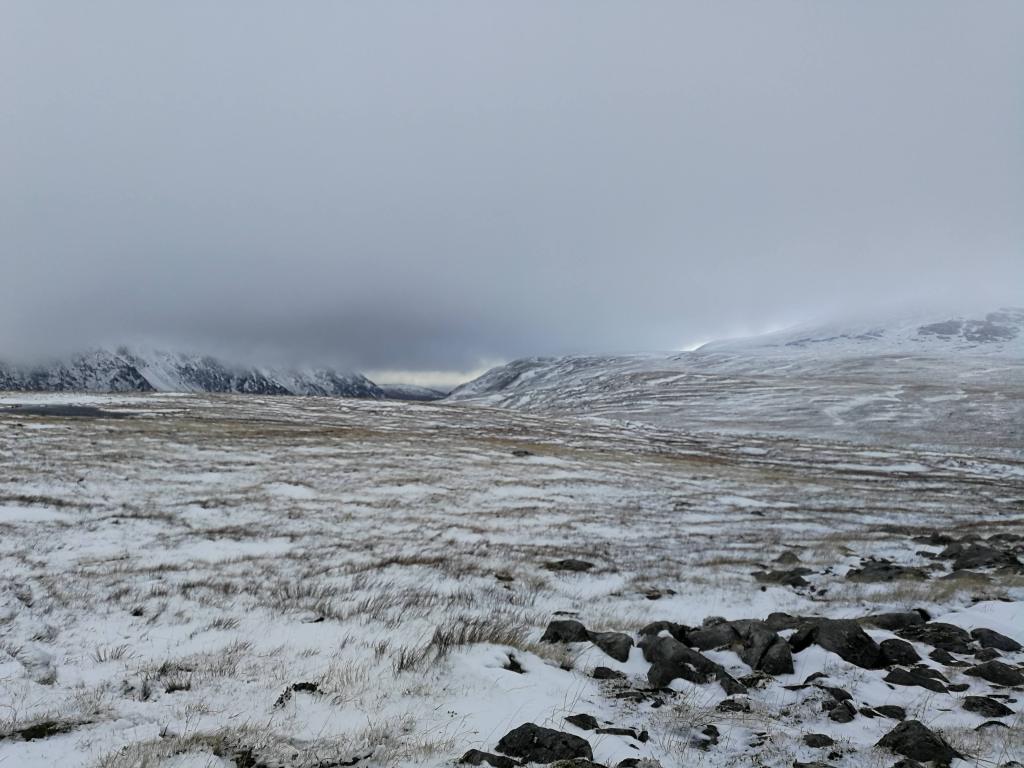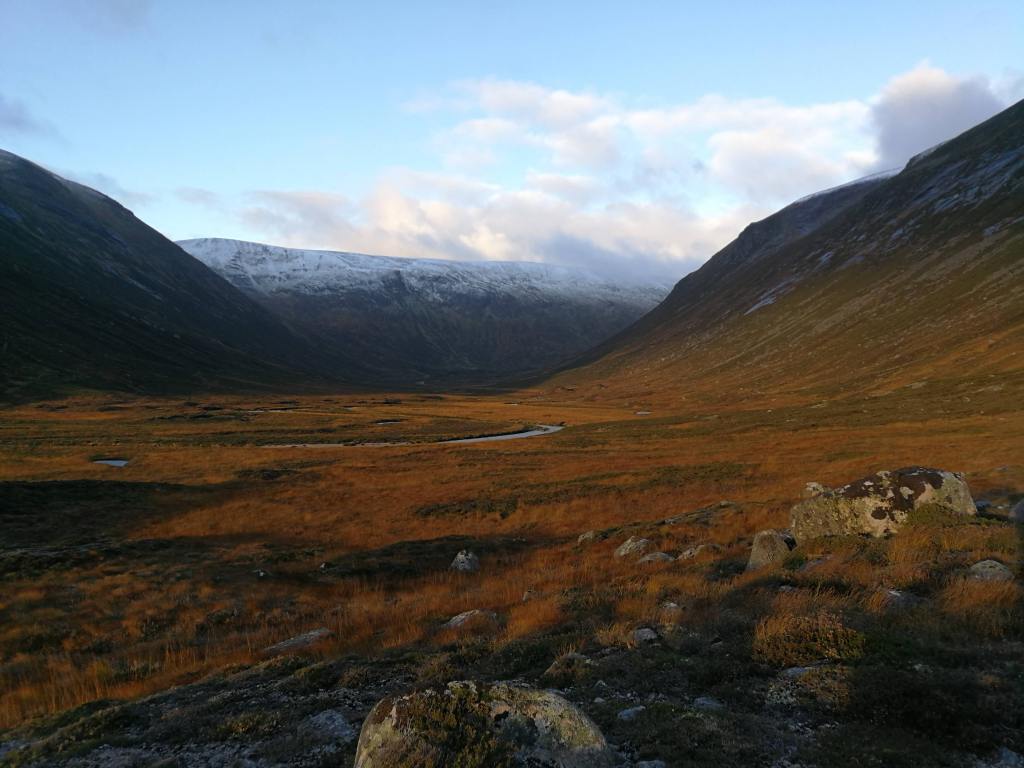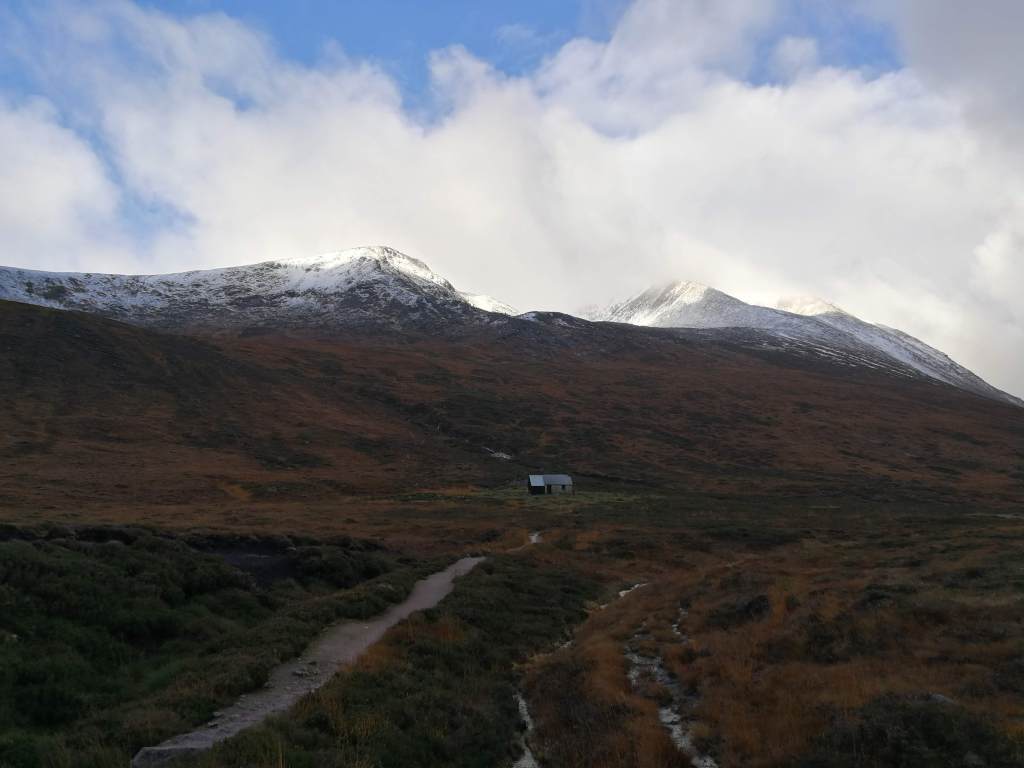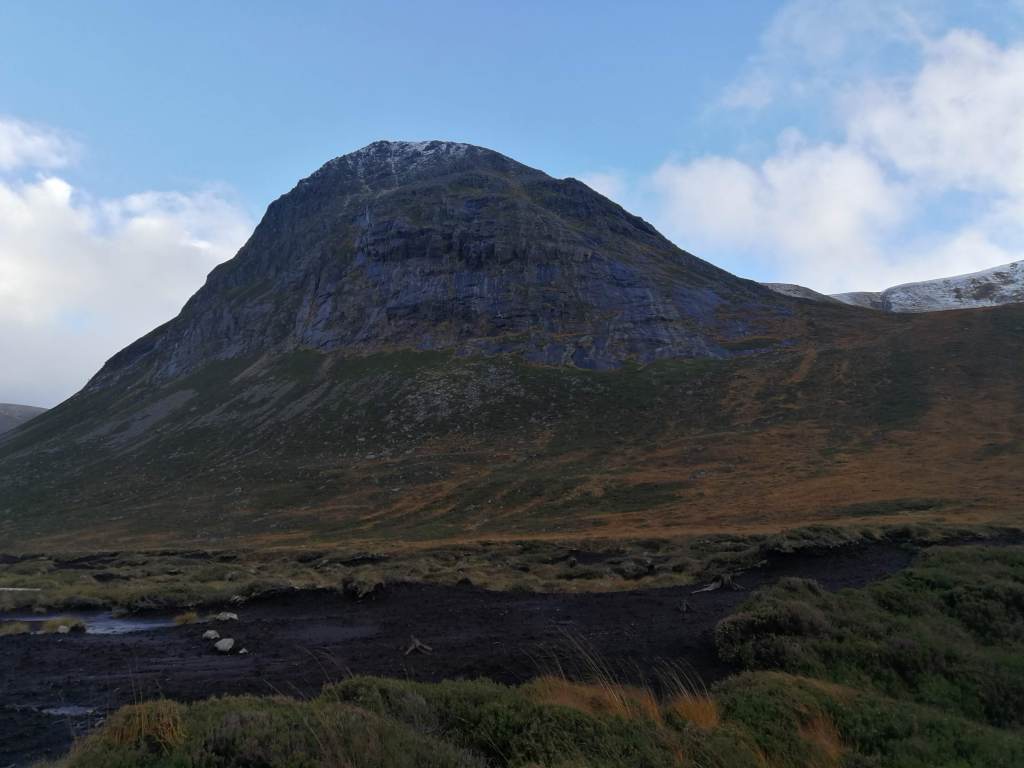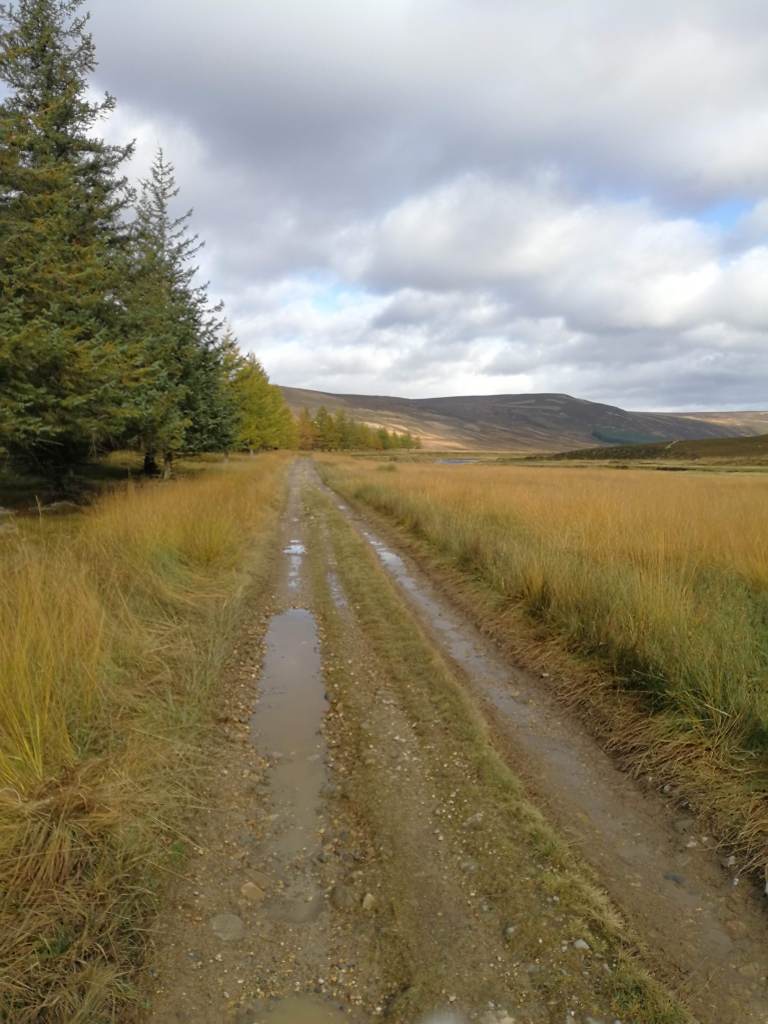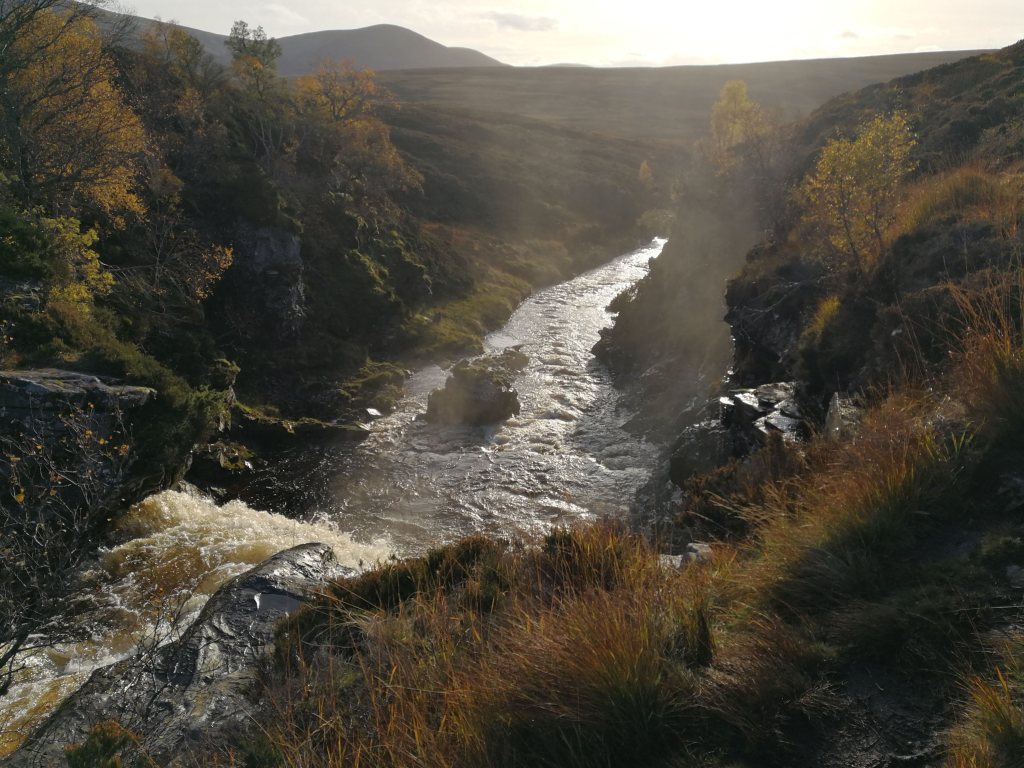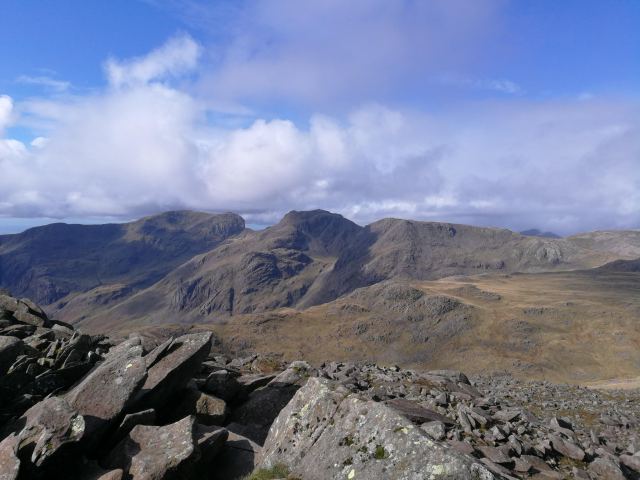
From Newtonmore to Fort Augustus via Laggan and the Corrieyairack Pass

After work, in the afternoon, to the shop to buy various bits, and then pack a bag. The rucksack, which had been 13.9kg with equipment less about two kilos of batteries, Kindle, notebook and pens and trail poles, was 22kg on the eve of departure – all up: all clothing, all food, and some water. Heavier than I anticipated, but manageable. Where had that weight crept in from? This was to be my ninth solo backpacking and wild camping adventure. To Cromford then, and by train to London.

Arriving in London I had a bit of time – trains in the UK are just not reliable enough to cut things fine and not leave plenty of time. I was at St Pancras at 19:38 for a 21:15 train out of Euston, up to Scotland. Why was I travelling from the Midlands down to London to go back up to Scotland? Because the alternative was taking the train to Crewe and picking up the sleeper there at midnight. If you’re going to wait for a couple of hours on a draughty railway station platform at night, I don’t recommend Crewe. I did that once; it won’t be happening again. I had a pint and a sausage roll in the Betjeman Arms at St Pancras, then strolled along the Euston Road to join the sleeper to Inverness, the longest train in Britain, and my carriage right at the front of the train.

I slept well enough on the train and had to hurry through my full Scottish breakfast in a paper bag. I found myself on the platform at Newtonmore at 07:15 on a drear and misty morning, barely starting to get light. I dragged on everything I had, to keep warm, and in Goretex over-trousers, gaiters, waterproof jacket, gloves and woolly hat, set off into the pre-dawn gloom. I had in reserve only a thin Rab mid-layer and at that point in the morning wondered if I had come onto the hill ill-clad. I walked out of town up onto the heath; had there been no mist this would have been glorious and scenic. You could tell it was a temperature inversion – there’s a look about the sky when you can sense that radiant blue sky and sunshine are only inches, as it were, above the steel-grey ceiling of mist.

I ascended the Calder River up Glen Banchor, meeting no-one, listening to the fearful noise of stags rutting. This noise reminds me, with my taste in films, of the zombie apocalypse. At one point I needed to take care fording a stream. Late morning, I was approaching a tin hut somewhere round 648984, where the map marks “township” at Dail na Seilg. A stalker strode out to speak with me. We had a polite conversation about my plans, and his plans, and I saw that I needed to change my plans. It suited me to do so, to be fair – it wasn’t simply a matter of me rolling over. That said, this is pure stalker’s country, not at all walker’s country.  I followed a tired old land-rover trail and became aware I was going in the wrong direction. I was soon lost and disoriented in the brown upland, stumbling over the heather looking at my compass. It took some close map and compass work to get me onto the right trail, a good and substantial unmade road, which I followed south-west down Strath-an-Eilich.

Early afternoon I came out at Castle Cluny, a nice-looking Scottish Baronial pile in the usual grey granite. Through the delightful autumn colours I trod through the grounds out onto the road. Without a detour, there followed a tiresome 2.5km tramp along the A86, a single track road at this point, but still with a fair amount of traffic. This brought me to Laggan, around about 3pm. From here, another tarmac road tramp of 4.5km brought me to the “Spey Dam”. I had not been aware I was walking up the Spey valley. I met no mountaineers or walkers. At this point, around 4pm, I’d been 7-8km on metalled roads and much of the rest of the distance on good unmade roads. I admit that had I known so much of this route lay along actual roads, I might have chosen differently.  

Resting by the dam, I saw a couple of cyclists whizz past. I set off along the road under the dam and arrived at a kind of industrial yard, with piles of rubble and hardcore, and big spotlights ready to be connected to a generator – there’s no mains electricity here, even though this countryside isn’t the ostensible wilderness of the Cairngorms. All around there are very robust and well-maintained deer fences, with proper access for vehicles and pedestrians at the appropriate places. At this point, early though it was, I was looking for a place to camp. I could continue along the unadopted and private metalled road along the north side of the reservoir created by the dam, or I could hike uphill into more wild country further up Glen Markie. I opted for the former. I went through a metal gate, pulling back the bolt. The bolt made a displeasing sound that in the pristine silence of that place, sounded like a lamb being slaughtered. I walked a hundred yards before repenting of my decision and turning back. Such sudden changes of mind have served me well in the past. Being willing and able to change your mind is a virtue, not a vice – don’t let anyone tell you that stubbornness is a virtue.

I detoured uphill into Glen Markie for about an hour, past a wasteland of industrial plantations, until I came across a place where I might camp. I would have to hike back downhill to the reservoir tomorrow morning, but this was more or less where I thought I would end up when planning this trip as a desktop exercise back in June. I camped near the ford of the Allt Tarsuinn Mor, just before it joined the Markie Burn, a substantial river. I had a very cramped and limited pitch, but it had the advantage of being bone-dry heather. I was just below the tributary stream as it flowed down a ravine into the main river. I could hear running water in three different registers: the roaring or rushing of the river, the chuckling of the brook over stones, and the sound of small waterfalls. In spite of the limited pitch, it was supremely comfortable and I took one of the best nights’ sleep for some years, from around 7.30p.m right around until well after 6.30a.m next morning. I had a completely dry strike and was away from camp around 9 o’clock. There was no hurry. In any case, at this time of year in this place, daylight comes late and lingers late. There was little usable daylight much before 7.30a.m.

I hiked back down to the bottom of the glen, and turned right, resuming my route of the afternoon before. There followed 12km along metalled road – a single track road through glorious, empty country – but a metalled road all the same. The adopted part of the road (that is, the part coloured in yellow on an OS map) ended at Garva Bridge. Here there was an ancient bridge of 18th century military origin. Two cyclists whizzed past. I stopped for lunch and sat between the road, the woods and the Spey, under the cathedral of a clear blue sky. Today’s weather was better than yesterday’s. The tarmac gave out at a place called Melgarve – an empty house. At this point, in the heart of the Monadliath, you’re about 16km from the main road at Laggan, and perhaps a little further from Fort Augustus.
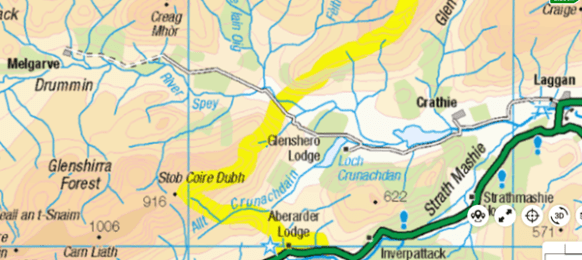
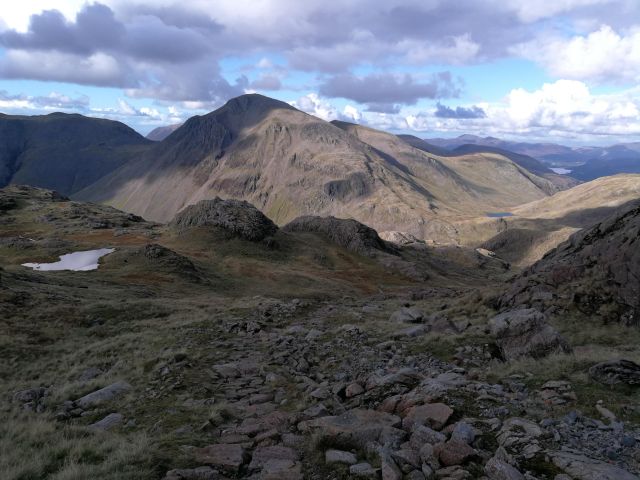
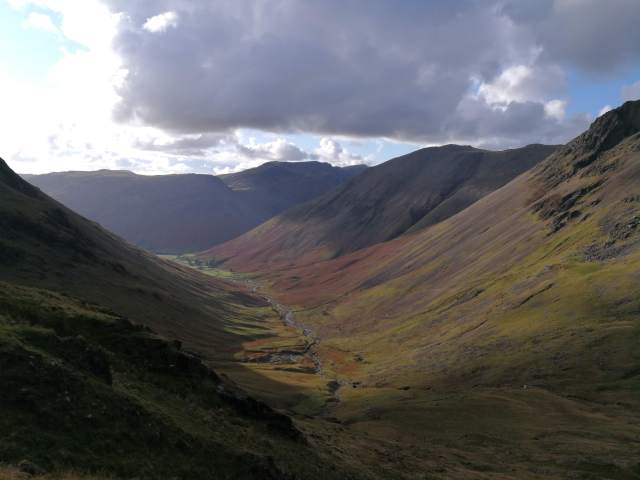
Beyond Melgarve, first a very conspicuous “Road Closed” sign, secondly, an actual half barrier blocking the way ahead to vehicles. The road itself continues up into Corrie Yairack, though without benefit of tarmac. This is one of “General Wade’s Military Roads”; to walk this route is why I was here. The afternoon’s walking ahead of me was the crux and heart of my trip.

Corrieyairack Pass

To the chagrin of some, a mighty high-tension power line marches up the valley, into the corrie and up and over the pass. All should have access to electricity. I remember in the 1980’s hitch-hiking in the Lake District and getting a lift from an estate agent. He told me that the Friends of the Lake District – every one of them living in a home with electricity – had opposed the building of power lines over a wild valley, which would have brought electricity to houses that did not at that time have access to power. Ever since then I’ve had little patience with the sort of environmentalist who sits in comfort opposing construction that would being the same comforts to others.
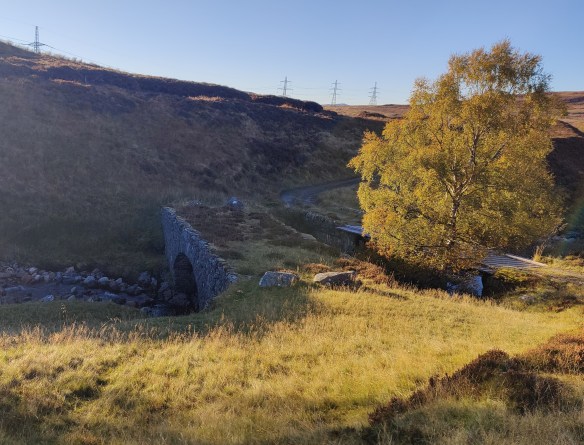
One of General Wade’s original bridges

Near the foot of the pass proper, I met a cyclist, the first outdoorsperson I had spoken to in days. I had seen no walkers, nor even so much as a footprint, along this route. The crux of the pass was six zig-zags, six legs of which were at this time of day (mid-afternoon) walking directly into bright sunshine. I was bareheaded. I had not thought to bring a sun hat, though I did have sunglasses. I blazed up the zig-zags barely out of breath. I’ve had eye trouble this year, and for that reason I chose this route because it was not so physically challenging. I also reflected that I have become successively more physically fit, particularly upper body muscle tone, on each one of these nine solo camping expeditions I have undertaken since 2021. I came off the hill on that first trip and had some unpleasant muscle problems in my shoulder, and had to visit a sports physiotherapist at the cost of several hundred pounds. Since then, on the advice of the physio, I try to do regular upper body strength exercises. Coming down to the Dungeon Ghyll last October, after two hard days on the hill, I was absolutely shattered – and part of me, misses that feeling. Being immensely tired sharpens one’s appetite for the simpler comforts in life –a hot shower, clean clothes, a Nice Hot Cup of Tea, a pint of beer and a pie, a warm bed.

At the top, a squalid guard-house stood, with an open door and bunks visible inside. In the long and golden afternoon I followed the path down towards Fort Augustus. I passed a 4WD vehicle with three fellows in it clearly observing deer. Another thing I noticed which I found unusual, was overflight by a small fixed-wing aircraft – repeated overflight, three or four times. Helicopters would be unremarkable, but a light aircraft, I found unusual: this is wild country. It was certainly not a sight-seeing flight. Far more interesting and dramatic mountains are available within a few minutes flight time for even a light aircraft. My best guess, looking at the heading and direction it was taking, was that some form of commercial survey was taking place, probably of the power lines in the valley.
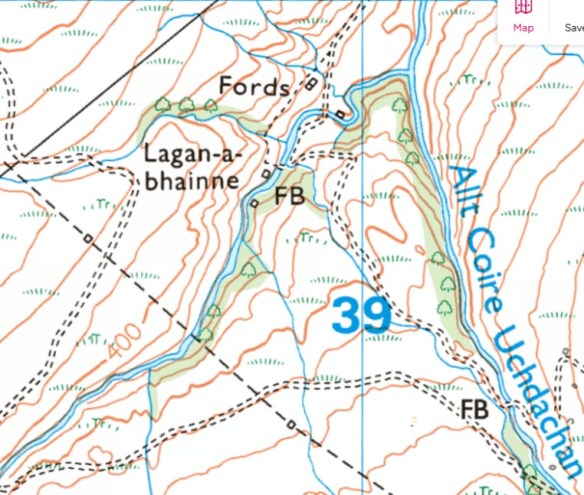
It was my intent to camp at a place called Lagan-a-bhainne, a wooded area of small valleys about 12km out from Fort Augustus. Still in the wilds, but off the high moors. When planning the trip I had spotted the area and thought it looked like a likely spot for a wild camp. My eye as someone with some experience in map-reading, was drawn to it. As on the map, so the reality on the ground: it was indeed a quite magical area where a narrow wooded valley cuts through the high moors. I found a spot to camp, taking quite some care that my tent could not be seen from the dirt road: it seemed to me that the three men I’d seen earlier would be employees of the landowner, and they might be driving through later on. Unlike in England, it is still perfectly legal to camp wild in Scotland, but why draw attention to yourself?

This was my second night by a babbling brook. I find the sound thereof, very restful. For supper I had my usual Indian: a spicy red lentil dhal, chick pea flour pancakes, and fresh spinach, all washed down with about 200ml of rather nice Shiraz. I always say, wild camping does not mean roughing it. Wild camping – any camping for that matter – is not, for me, a means to an end (as in merely low cost accommodation close to the mountain), but an end in itself. It is time spent alone outdoors, time spent in the wild countryside, time to collect your thoughts and prayers, time to be still. I came away carrying probably 22kg, of which 3kg was food and drink. I was not troubled thereby.

Interestingly, though I had picked a reasonably flat place to pitch, I could not settle comfortably at all – there was incipient backache, tossing and turning whichever way I lay. I moved through 180 degrees and slept like a baby. I woke up around 0600, which is too early at this time of year and latitude – there being another ninety minutes of darkness. But I was awake. I got up and prepared for my day. I had a breakfast of champions – cubes of bread, cubes of cheese, and chorizo sausage, all fried in a little olive oil and butter. Porridge of course. Black coffee. I did not have a dry strike, but it was a lovely morning and there was no rain – it was all condensation. I am using three separate dry bags for the different components of my tent – outer, inner and “footprint” (ground sheet), and this technique is a useful convenience, making the tent easier to pack in my rucksack, and ensuring that the wettest bit (generally the outer) doesn’t get the drier bits wet during the day.

Around 0800 then, onwards through the grey morning, trending ever downhill on a good road across the moor. After an hour or so, Loch Ness and Fort Augustus came into sight, and my heart fell – was it so close? I didn’t  want to arrive there mid-morning. Actually the route has not so much a sting in the tail, as the walk-out is longer than it looks on the ground. On the map it was 12km; it just didn’t look that far. On my way down I passed an estate 4WD rumbling uphill, and a cyclist labouring along. It is a long and seemingly everlasting hill from the Fort Augustus side – rather like climbing Helvellyn from the Thirlmere side.

The road came down to another area of confused drumlins and narrow valleys full of trees, all very picturesque and rather reminiscent of the western Peak District. The road splits round a height of 228m at around 371055. General Wade went left; on a whim, I went to the right, along a 4WD road clearly very overgrown and ill-used. Well, not quite on a whim – a study of the map seemed to indicate that there was a way through some rather promising wild woods. I made the right decision! On the mountain, as 1930’s Scots climber W.H Murray noted, it sometimes pays to turn aside commonsense routine.

My path led down a long-abandoned un-made road by the side of the stream, down into the most magical valley, a beautiful and silent dell, peopled only by the sound of the rushing waters of the stream. This was the highlight of the trip! I had to carefully ford the stream. I continued, in a little trepidation that should have to turn back at the last. And indeed, the track to Culachy House was gated and very clearly marked “PRIVATE”. But there was another way – a hairpin to the right, down into another deep valley where I found, by chance as it were, the most beautiful waterfall: Culachy Falls.
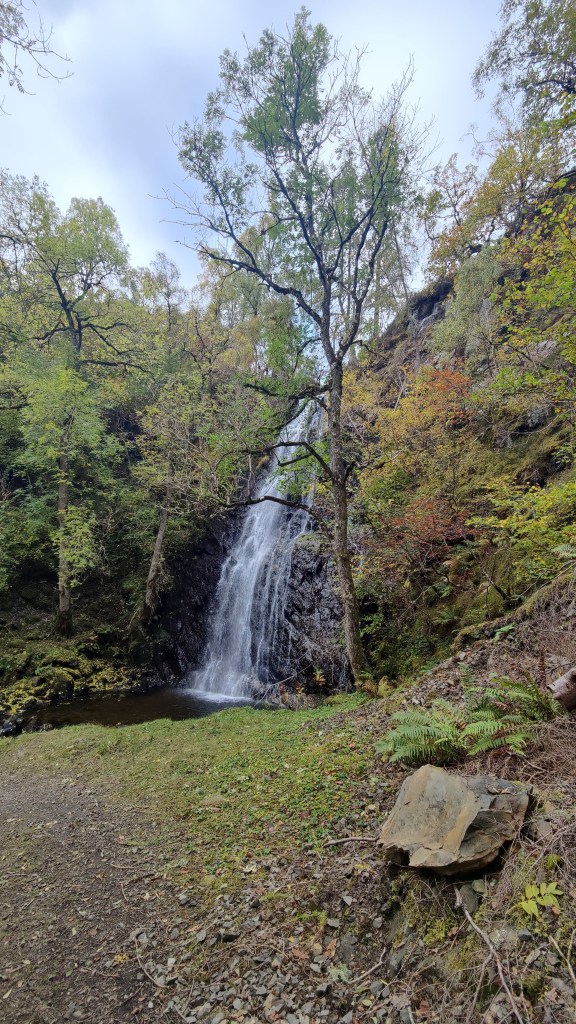
From the falls a pleasant walk along a path through the woods, across the road and into a graveyard by the river. A little further on, the main road, and my walk was done.

  • Day 1: From Newtonmore to Glen Markie, 25km in 8 hrs 33 mins
  • Day 2: From Glen Markie to Lagan-a-bhainne, 27km in 8 hrs 7 mins
  • Day 3: From Lagan-a-bhainne to Fort Augustus, 12.3km in 3 hrs 28 mins.

I stayed at Morag’s Lodge in Fort Augustus, a former hotel now trading as a hostel. For a modest fee you can share an ensuite room with bunks. For slightly more money but still well below B&B prices, you can buy an entire room to yourself. Morag’s Lodge serve supper and packed lunches and a continental breakfast, and they have a drinks license. There’s a members’ kitchen as well as a proper bar, so it has the best of both worlds. The staff were super friendly and helpful.

The first time I came to Fort Augustus was in May 2012. I’d camped wild the night before further north in the Monadliath. My diary of the time records the following:

Yesterday I drove west from Aberdeen, in wonderful hot mid-20’s weather, enjoying the quiet roads and rolling wooded hills of Deeside. I pressed on over Lecht to Tomintoul through the summer afternoon to Nethy Bridge. Then over Slochd and left down minor roads towards Fort Augustus, at this point looking for somewhere to camp. I turned left again, up a minor side road, going right up over the top into the heart of a dark and wild corner of the Monadliath. The sun was behind me as I drove, and it was glorious. I found a place to camp amidst sufficient dry fallen timber for a jamboree of Scouts to make open fires. I camped in a little copse of pine above the road. It was 9.20pm and full daylight. Sunset at this latitude in late May is 9.45pm. There was sufficient wood from where I sat to make a lovely little fire, on which I prepared sirloin steak (medium) and courgettes and (alas) instant mashed potatoes. A nice S.E Australian Shiraz made it the pleasanter still. I had brought with me 2 litres of water, for there was no running water here – I could not have camped had I not brought water in myself. A couple of times, an estate factor’s landrover drove past and stopped. My fire was making a fair bit of smoke; there was no wind and the smell was unmistakable. They could not see me, and perhaps they cared less, for they did not come looking for me. I went to bed at 11p.m and woke at 5a.m, thence dreaming my way through to 7a.m. Morning was misty, yet dry. No single drop of dew fell, which was remarkable. My breakfast was bacon, mushrooms, tomato, roll and butter, served with fresh black coffee. A breakfast of champions, particularly when served outside.

What struck me most about this camp was the silence. The only noises were the calls of birds, particularly the call of cuckoos, and the sound of sheep. I set off at 8.30a.m in deep mist, back to the Great Glen, and on down to Fort Augustus, where the sun burnt the mist off, leaving a cloudless sky, a glorious summer day. I took coffee and cake at “The Scots Kitchen” in Fort Augustus, and read the paper. Could I ask for more?

An important part of this journey today was the adventure of doing it solely using public transport. I took bus Scottish CityLink bus 919 down Loch Lochy through Spean Bridge and onto Fort William. Once in Fort William I then had to wait a couple of hours for the sleeper train to London, which left on time and arrived more or less on time at Euston at 0800 the next morning. Thence along the Euston Road again and back into St Pancras station, where it was so early, there were no decent coffee shops open yet, and I had to get a coffee from Costa. Onwards home to Derby, and my trip was complete.
On foot from Bridge of Orchy to Fort William

I took train to Crewe, arriving in good time for the sleeper service to Scotland. The train slipped into the platform almost in silence, as if to not disturb the sleeping customers. I boarded, and off we went. In the morning the train stopped for a while at Tarbet on Loch Lomond-side. I could hear the rain drumming on the roof of the carriage – but that was at least forecast. I was allowed by the male provodnik (Russian for “sleeping car attendant”) into the “Club Car” for my breakfast, and told somewhat loftily to sit “over there” clearly away from the very few first class customers. Feeling less than welcome, I had my sausage bap and cup of tea, and left.

At Bridge of Orchy I got off, and under the shelter of the station canopy, prepared for hiking. It was raining. The buildings of the station have been converted into a low-cost hostel, although I saw on social media that this hostel has a poor reputation as being somewhat spartan. The West Highland Way, or proximity to it, is an opportunity to sell excellent services to travelers, or perhaps, in some cases, a magnet to less scrupulous property owners hoping to make a fast buck from accommodation. The railway station itself is uncrewed – as was the hostel, at this time of year.

I left, in the dripping rain, and almost immediately passed the only southbound hiker I saw in two full days on the hill. It was 9.a.m. The initial part of the route lies over the summit of Mam Carriagh and is marked on the OS map as an “Old military road”. It is one of General Wade’s roads from the early eighteenth century, from the years of the Jacobite rebellions. As I walked, the rain rose to a crescendo, and I made full use of my new Mountain Equipment “Lhotse” jacket, which I bought heavily discounted from Cotswold. It is has a great hood, but as a tall man I could do with a waterproof least six inches longer in the body – a coat in fact, not a jacket. Why are modern mountaineering waterproofs all jackets?

I came down to the Inveroran Hotel, all shuttered up now for the winter, in grey and spitting rain. Onwards onto what was referred to on a sign as the “Old Drovers Road” to Glencoe, which was ostensibly the main road before 1933 when the current road was opened. Of the current road, arrow-straight across Rannoch Moor and with sweeping curves down through Glencoe, the Scots mountaineer W.H Murray once said (a propos of complaints that it spoilt the landscape) that the new Glencoe road could “no more spoil the landscape than the facade of Chartres Cathedral could be damaged with a pen-knife”. Murray was quite right – and he was an early environmentalist.

The drovers road across Rannoch Moor

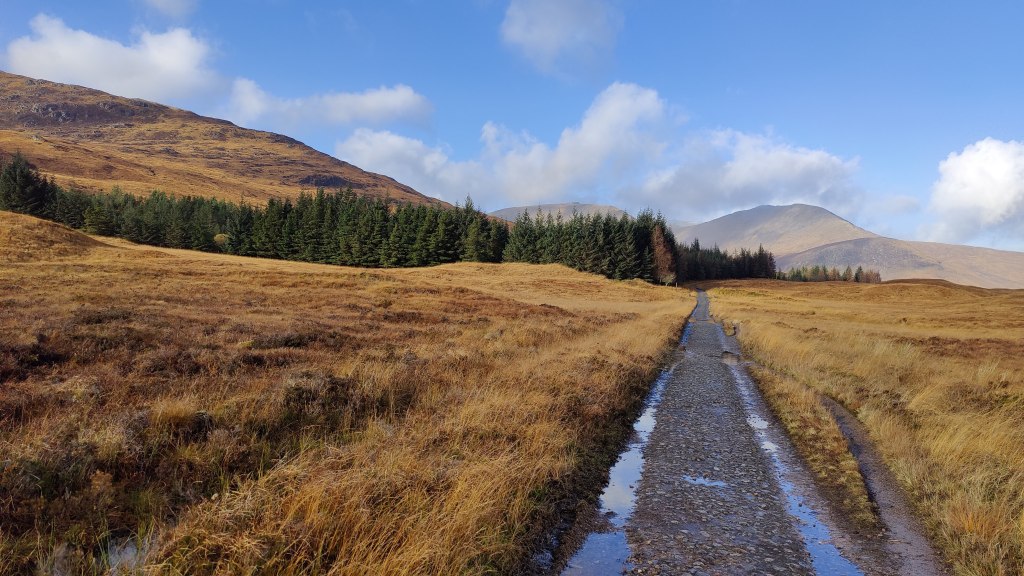
There is no evidence that this road was ever covered in tarmac – it is stones and cobbles now. Ninety years is a long time; the tarmac could be long gone, but I somehow doubt it ever was a tarmac road. I found the road very hard on my feet, but that may be because my current boots are approaching the end of the natural life and may in consequence be a little thin in the sole. But it is a good road, passable by car even today (were it allowed – of course it is not), albeit at not much faster than 10mph. It rises gently from Victoria Bridge at 174m to a summit of 353m over 7km, before falling again down to the access to the “Glencoe Mountain Resort”.

Is there a sport less sustainable than skiing? I am a mountaineer. I seek to cross mountains for pleasure, doing so on foot, doing so safely, and leaving no trace other than footprints. There are few things I find much more depressing than a ski resort in off-season. (Maybe a British seaside town in February…) A ski resort needs good roads, ski lifts, hotels and shops, bars and restaurants, accommodation for staff. It needs street lighting, drainage and all the other municipal services we take for granted. All these things are good things of themselves. But out here in the beautiful autumnal brown of the Blackmount in November, I find it all rather jarring. Even as I stood by the roadside thinking this, a 32 tonne truck rumbled past carrying a snow-mobile and ski-lift pods. I finish where I started: can there be a sport less sustainable than skiing?

Crossing the A82 as quickly as possible, but with great care, I continued. From here to the Kingshouse the way leads along what is clearly a former tarmac road. The Kingshouse, once merely a hotel, is now a small community. One day, it seems to me, it may be an actual village called “Kingshouse” – there are diverse lodgings and houses, and a community centre, as well as the eponymous and famous hotel with its extensive car park. It even had a roundabout. In the car park I had to detour round tourists taking photographs of a red deer which had wandered in. The weather was darkening.

A hundred yards past the hotel, once again in open country, I decided to stop for a snack. My mountaincraft is sharper and better than I know; it works at a subconscious level. I had barely finished my chocolate and so forth, when a squall of rain and hail descended. I was hard put to get my hat, gloves and scarf sorted and my coat zipped up before the onslaught. How had I known that the squall was so imminent? How did I know to take this last opportunity for a snack for an hour or more? It was surely neither luck nor coincidence.

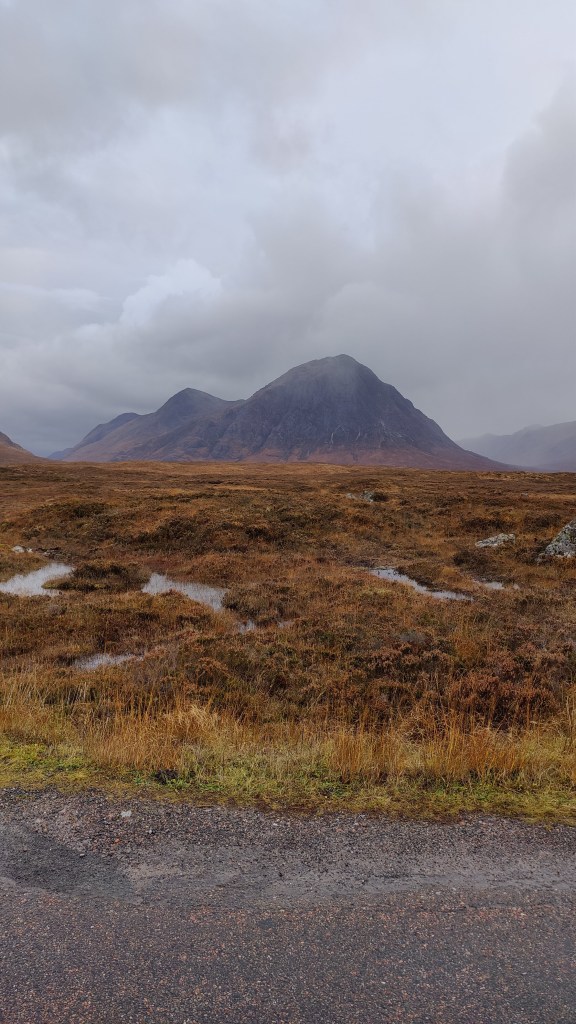
The next stretch of the road was again an “old military road” more or less parallel to the A82, finishing at Altnafeadh. The weather was dreadful; grey cloud and squall, brash wind and rain. I would have taken more pictures of the magnificent towers of Stob Dearg (“Buchaille Etive Mor”) on my left – perhaps the most recognized mountain in the UK. But others have photographed that graceful hill more effectively than I, and I was loth to take off my gloves in this rain.

Stob Dearg (“Buchaille Etive Mor”)

At Altnafeadh it was 3pm. The traffic rushed past; the clouds lowered. Time-wise I was on target. I had thought I might camp here, having at very best maybe ninety minutes of daylight remaining, and not wishing to be caught in the hills above the Devils Staircase. But there was no suitable location, and the rain came down. I had a little snack and a fat little robin came and sat near me; I fed it with some of my wife’s Rice Krispy cake. Onwards: in heavy rain and hail I started up the Devils Staircase. A struggle if you’re not fit, that ascent, but I pushed very hard and fast uphill, to the point of starting to overheat. Time was of the essence now. I had to find a flat and sheltered place in the hills to pitch my tent, and I had to do so pretty much within the hour.

I thought, looking at the wind direction (this is mountaincraft again) that the weather would be better on the far side of the hill up which the Devils Staircase goes back and forth. I was right to think that; so it proved. On the Rannoch/Glencoe side, grey rain, clag and wind, hail and storm. On the far side, calmer, even to some blue sky. I pushed on over as late afternoon became evening and dusk, looking for a camp ground. I had limited daylight and my salutory experience in the Cairngorms two years ago was fresh in my mind. I found a flat place right next to the trail, right next to a stream. Not a place I’d choose in summer. The place was more or less where I had predicted from theory beforehand that I ought to camp, in order to make this passage from Bridge of Orchy a two-day rather than three-day hike. It was the stream of Alt a’ Choire odhair bhig.

My tent went up easily enough, pitched outer first as rain looked imminent. In fact I had not long been pitched when there was a tremendous hailstorm turning the world white. I found it hard to get warm, but once I’d eaten and gotten into bed, I warmed up in due course and slept passably well, being in bed for nearly 12 hours.

I awoke respectably late, but still before dawn. Surprisingly so given that I had been in bed for almost 12 hours. I went through the drill of having breakfast (porridge with an admixture of chocolate, sugar and sultanas and a little malt whiskey) and striking camp. The practice of solo backpacking and wild camping, particularly in autumn or winter conditions, is the practice of detail, the practice of method, the practice of doing things right, in the right order. In other words, it is the practice of mountaincraft. This is one of the reasons why I put myself through it. It is no ordeal; it is a pleasure and a privilege. It is a pleasure and a privilege to be alone in the wild. I can put myself, in an uncontrived way, in a place where doing things right, in the right order, is the difference between, on the one hand, an enjoyable and relaxing experience, and on the other, a dreadful or even life-threatening experience.

I was on the hill, full of breakfast, by 8a.m. I had a long day ahead of me of 32km, but I knew I could make Fort William, if not by nightfall (about 5pm) certainly not much later. I started out in Gore-tex over-trousers but today’s weather was much more forgiving and they soon came off on the descent to Kinlochleven. Early on, I had problems with very cold fingers, as my gloves were wet from the previous day. I had to use my big mittens, which were still dry. One action from this trip is that I need to think carefully about carrying multiple pairs of gloves (as one carries multiple pairs of socks), or, look into waterproof gloves. The light and the views this morning were lovely.

Coming down into Kinlochleven one sees six tremendous pipes marching across the landscape, bearing water from the faraway dam on the Blackwater Reservoir. At the bottom of the hill by the river, an enormous and striking mill, Edwardian architecture with some Edwardian technology inside and out, as the rushing water from the great pipes feed the hydroelectric plant inside. Kinlochleven at 9a.m was quiet and cold, only dog walkers were around. I’d been aware that I could have resupplied here to save weight, but it turned out that I needed nothing, and I walked on out of town without stopping. Kinlochleven is rather sleepy and forgotten since the opening of the Ballachulish Bridge in 1975. Today it seems little more than the start of the final stage of the West Highland Way. That said, its location is stupendously beautiful, central to a wide range of wild country and high mountains. It reminded me, however – particularly in cloud-streaked autumn at that time of day, of the town in the Pacific Northwest in Sylvester Stallone’s film “First Blood”.

I climbed up out of town through pleasant and fragrant managed pine woods, emerging into a higher, colder valley. “Footpath to Fort William via the Lairig” the sign had said. The path runs true up the right hand side of the valley, reaching a bealach at which there is a substantial ruined house. From here, one cannot see where the route goes, but it curves round to the right and to the north. I passed a young woman out from Kinlochleven; she said she was just doing this last stage. Only the second person I had seen hiking for two days.

The ruins at Lairig Mor

The path continues northward, a little open on the left, with higher mountains on the right. Such trees as there were in the area were not entirely consistent with their representation on the map – this is a working plantation. I had been saying to myself, “Ben Nevis dominates Fort William, but I cannot see it yet. When will I see it, and know that I am getting closer to my destination?” The path kinks round to the right, trending more north-westerly, and finally, in the afternoon, I found myself in a place where I knew that just beyond, lay Glen Nevis. At the head of this valley was a confusion of hillside, rather strange looking. Some odd geological effects were at work here. In the heart of the confusion, lies the ancient fort “Dun Deadail”.

Nevis seen from the trail not far from the fort “Dun Deadail”

From Dun Deadail, the way lies along forest road all the way down to tarmac in Glen Nevis. In the deepening cold of late afternoon (that is, 3pm at this latitude and time of year – it’s great to come to Fort William in May when “late afternoon”, from the perspective of the sunshine, is 8.30p.m!!) I trod the forest road down, and then tramped the final tough tarmac mile or so into Fort William.

Glen Nevis

In Fort William I was met by a friend of mine who kindly arranged for me to stay at the excellent Fassfern guest house on the shores of Loch Linnhe. We had a couple of pints and some pizza at the Black Isle pizza bar in town, but to be honest, after my trek I was shattered, and was glad to be in bed by 9.30pm.

A ten-hour train journey

This first leg of the immense train journey back to the English midlands leads through a brown, grey and relict green autumn landscape, towards Spean Bridge. In the distance, cloud-draped mountains have winter’s first coat of snow. Behind me in the tiny two-carriage train, are five mums with at least that many toddlers, dogs, bicycles and pushchairs, all off on a short winter’s day’s outing to Corrour. The toddlers are all of a gurgle; at my feet, one of the dogs has settled down to hide from the youngsters. The train wends its way along a gorge; the frothing river is the colour of Guinness being poured. You can hear the engines straining as the train climbs the grade up onto the moor. I could be on worse train journeys and I probably will be later today.

Crianlarich: nearly two hours out from Fort William. It would take an hour to drive here from Fort William, though to be fair to the train, it does take that huge detour up to Spean Bridge. As someone with a passing interest in railways it is interesting to note that some of these Highland stations still retain a substantial yard with sidings. Generally these are used, on this remote single-track railway, to store modern permanent way repair equipment. In England, many of these yards have long since been converted into car parks, particularly in the metro area where commuters dominate the market. This little train dates from the late 1980’s, and the technology in it is much older than that. Hearing the sound of the antique brakes, though I’m sure they are perfectly good brakes, makes me feel about 12, so much does the sound remind me of 1970’s trains.

At Queen Street station in Glasgow, a delightful Victorian arched train shed, I join a brand-new electric train to Edinburgh. The Scots at least, have a constructive view on railway electrification: that is, do as much as possible, as soon as possible. I have a sneaking suspicion, however, that English tax-payers will be picking up the tab for it, even if the Westminster government and the Department for Transport feels it can’t afford the same for England. Who needs joined up thinking? I read that these new and shiny 21st century trains are actually owned by a Japanese bank.(https://en.wikipedia.org/wiki/British_Rail_Class_385). Another piece of evidence of the chronic short-termism of the people who manage and finance our railways.

Arriving at Waverley station in Edinburgh, I had to make a decision quickly. I had a seat booked on the 1707 X-Country service straight through to Derby. It was cancelled. The time was 1636. I might travel at 1710 down the east coast route towards Kings X, and change at Newark, and then across to Derby. Or, I might travel at 1652 down the west coast towards Euston, and change at Crewe, and then across to Derby. Which is better? Six of one and a half dozen of the other…or is it? this is advanced travel knowledge. I opted for the latter and joined an Avanti West Coast Pendolino bound for Euston. That was a good decision. As I’d opted for a very reasonably priced first class ticket, I got a nice panini and at least two Gins and Tonic, thrown in. That enlivened my journey to my home, which took until nearly 10.30p.m. That said, I left Edinburgh at 5pm and arrived at Derby about 9.30p.m, and that involving a change of trains. You’ll nae be driving from Edinburgh to Derby at that time of day, or at any time of day in fact, in four and a half hours.

On foot across the Lakes: from Kirkstone Pass Inn to Great Langdale

About eighteen months ago I went to the Lakes for a bit of wild camping. In the final paragraph of my trip report here, I wrote this: “had I known that public transport in the Lake District was so comprehensive and so well co-ordinated, I would never have brought the car at all. From where I live in East Surrey, the train would be about the same journey time, maybe slightly quicker, and a good deal less tiresome than trudging up and down the M40 and the M6. The train might cost a good deal more than the cost of the fuel – but as any fule kno, the cost of fuel isn’t the true or full cost of motoring.

I journeyed to Windermere by train. Leaving my home in East Surrey just before 0700, I was in Windermere just after noon. It is the Pendolino tilting train that makes this worthwhile and possible, from Euston to Kendal in three hours. The cost was not excessive at £133 return in standard class. After a scotch egg and a bottle of pale ale sat in a sun-soaked corner in Windermere, I took bus 508 up Kirkstone Pass, for £5.10, with a very cheerful and friendly driver who said, “It’s a while since I’ve driven this route. Let’s hope I can remember it”. There were two other passengers.

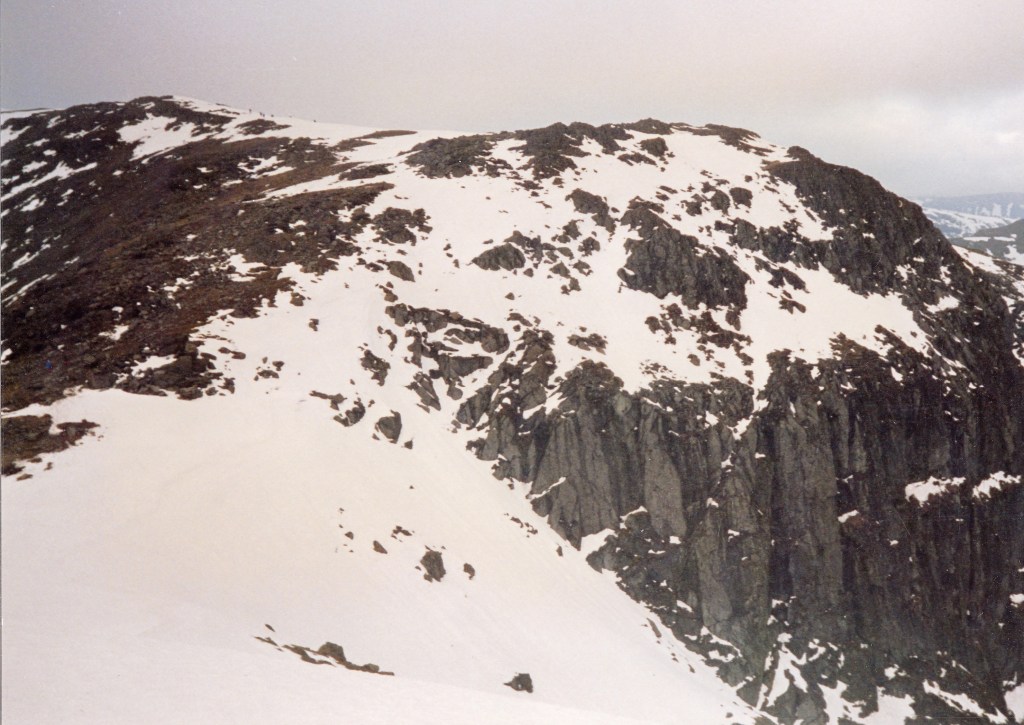
At the Kirkstone Pass Inn I hopped off in bright sunshine. As I was rigging my bag for hiking, seven or eight motorcycle warriors of one tribe or another roared through on their throaty Harley-Davidsons. It was 2pm. Grinning and confident in physical fitness, I set off up the hill, and was on the first top, Red Screes (776m). From there, along to Scandale Pass and little Scandale Tarn. Here there was a squall and in five minutes I went from using a sun hat to wearing gloves. That’s the Lake District for you – never underestimate the mountains. Further on, to Dove Crag, Hart Crag and finally Fairfield (873m) whence I arrived at 5.10pm. I’d been this way before, some time in the 1990’s. Here you can see the difference between winter and summer conditions:

The first time I was on Fairfield was in shouting rough conditions in about 1979 or 1980, with a school party on a YHA trip. It would hardly be allowed now. From there, down to the somehow ever-gloomy Grizedale Tarn. It is a long way down. Another location with deep memory for me, from that same YHA trip, only the second or third time I’d ever visited the Lakes.

It was with some difficulty that I found a place to pitch my tent. The aspect was geographically similar to that tarn in the Cairngorms (Loch nan Stuirteag) where I’d experienced difficulties last November. A high tarn flowing east down into a wild valley, no obvious camp ground at the outfall and a rising wind. But, a place to camp I found, by the babbling brook, and soon enough it was supper time: fresh tortellini and a tin of 8% stout. I was drowsy; I hardly thought at all. I was in bed asleep well before 9pm. I found that lying in my sleeping bag in the tent, listening to the babbling of the brook, I could be in a place where I was not thinking about anything: awake, but barely even conscious.

I was wide awake by 6a.m and set off at 8a.m, tent dry, ready for adventure. I was on Dollywaggon Pike before 9.30a.m, and from there to Nethermost Pike (891m) and onto Helvellyn (969m) before 10a.m. The first and strongest of the day-trippers were already there, some Scotsmen with good camera equipment. Absolutely stupendous visibility!! Just look at these below. I spent some time talking to the Scotsmen, reflecting that the last time I was here was in winter conditions in 1997.

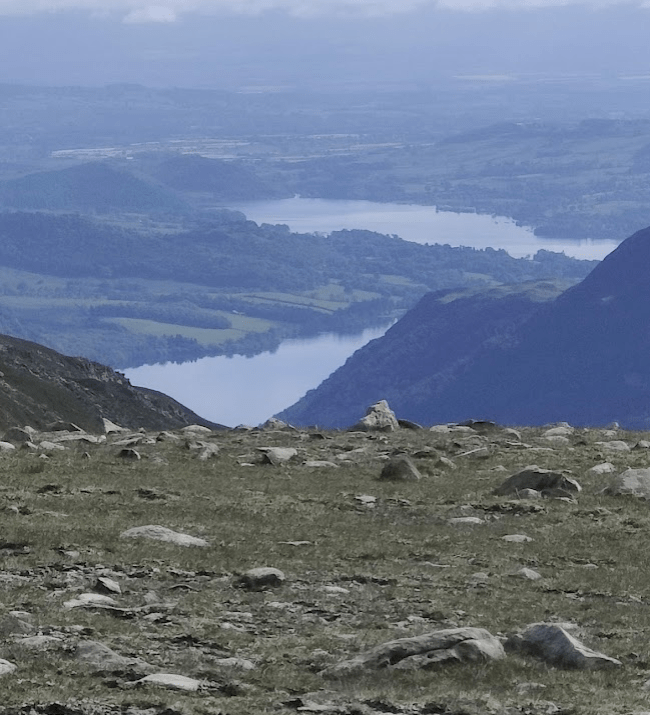
Ullswater
Striding Edge from an unusual angle
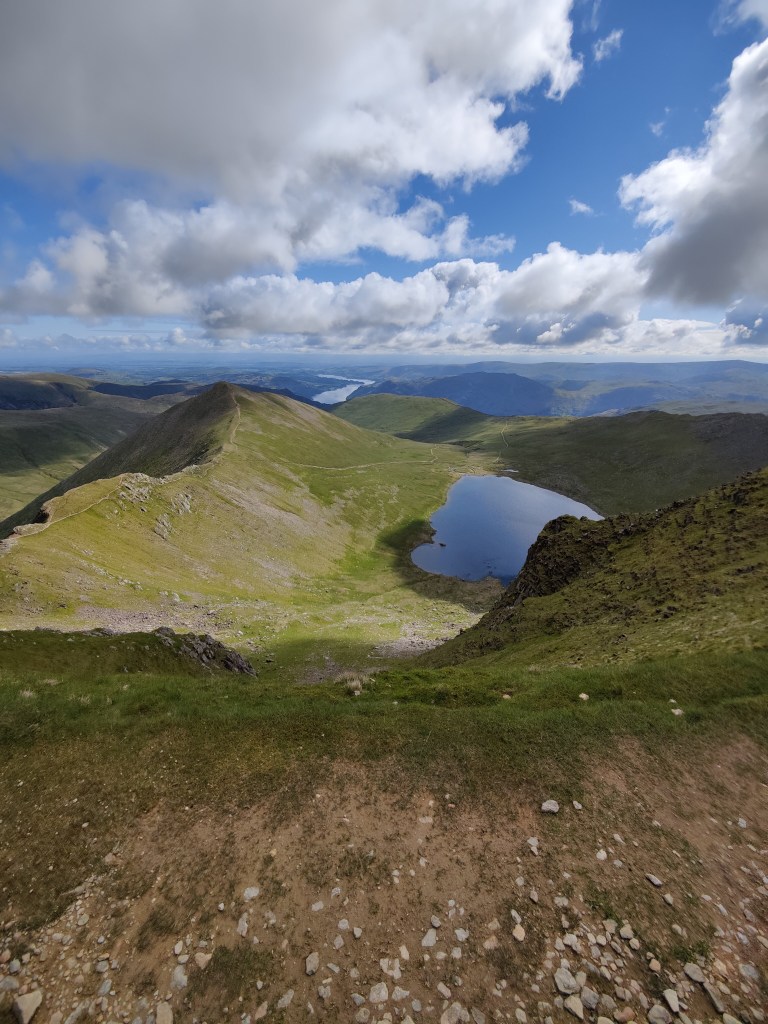
Swirral Edge, Red Tarn, and almost the entire length of Ullswater in the distance

And then, down, through the long morning. Although earlier on there had been few enough people on the mountain, I passed many dozens of folk toiling up the long and arduous ascent of Helvellyn from the Thirlmere side. Why would anyone climb Helvellyn from that side? A dreadful slog, it is. I suppose the ascent from the Patterdale side, involving as it must, either Swirral Edge or Striding Edge, is not for everyone. And not for me, is that steep downhill to Thirlmere: by the time I got to the valley floor, about 11a.m, I was tired and I had stubbed toes. It was very warm and sunny – again, absolutely delightful conditions for photography.

I was starting to think, where will I fill up on water? Odd to be in a reservoir valley, yet for there to be no instantly available drinking water. Water, water, everywhere, but not a drop to drink…there was a long and somewhat tiring slog through admittedly delightful woods up along the eastern shore of the reservoir, as far as the dam, where I stopped for lunch. Boots off, charge my devices, and sit in a sun-soaked corner. Lunch was bread and butter, cheese, tomatoes, and a little Chorizo sausage. An orange, some chocolate and some trail mix. I drank the remainder of my water. Now I really needed to fill up.

As I set off again, a trio of hikers passed me, two young women and a young man, all festooned with clanking cups and pans and camping equipment hung on their rucsacs. I confess I don’t like it for there to be any stuff attached to the outside of my rucsac. I prefer the clean lines of climbers’ rucsacs and generally don’t even do side-pockets if I can avoid it. One of the girls stopped to chat. It seems that they perhaps, did not realise when they arrived last night, that camping is strictly prohibited on the Thirlmere valley floor. I was just pleased to hear someone speak in a Lancashire accent, whatever this youngster was telling me.

At Armboth, I managed to fill up my water bottles, though I deemed it necessary to add purifying tablets. Onwards and upwards literally; the second ascent of the day, from Thirlmere up over the moor to Watendlath. I shouldn’t have cared to come through here in claggy conditions; the moor, as well as being boggy, was pathless and featureless; one should find oneself very soon resorting to the compass in poor visibility. Initially it was a very pleasant walk through steep meadows with unusual flowers, leading up onto a rather boggy moor. I found this hard going as it was now mid-afternoon and I was carrying 3kg of additional water. And so it was that for the first time in my life I found myself visiting the little hamlet of Watendlath, nestled in a hanging valley between Borrowdale and the Thirlmere valley. There was a tea rooms, and I stopped for a pot of some of the best tea I’ve had for ages, along with some rather nice tea bread. It was 4pm.

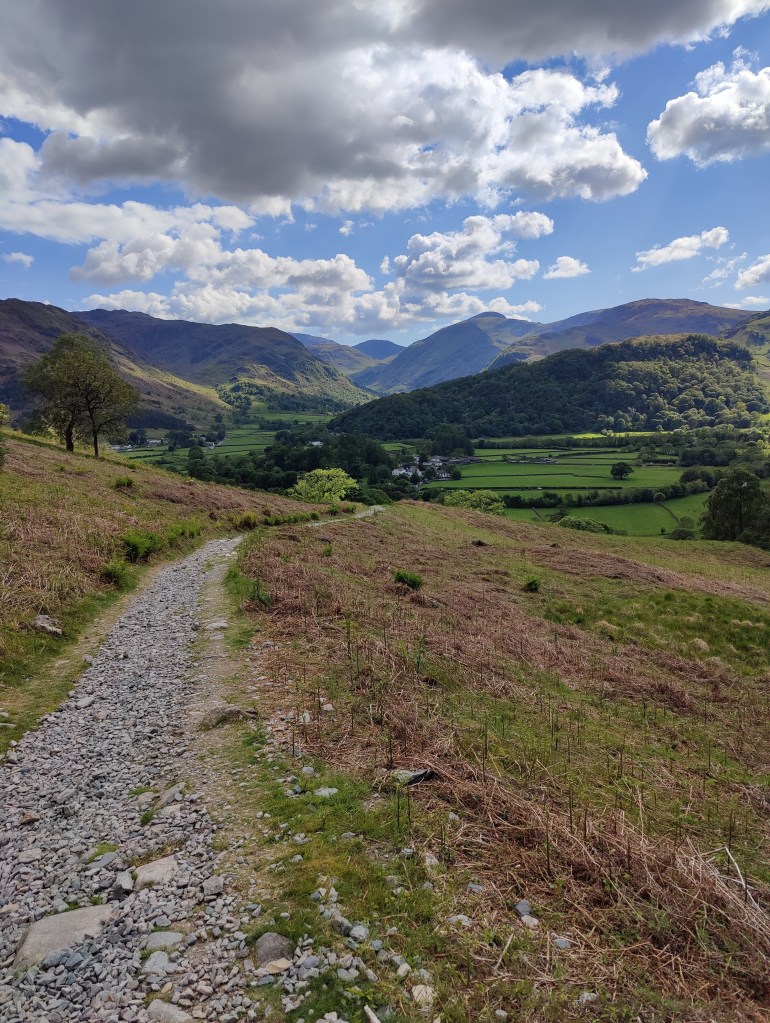
From Watendlath, one skirts the eponymous tarn and sets off up a good bridleway to Rosthwaite in Borrowdale. This was an ancient, traditional and much-trod road. It made me think of those many passes of Lakeland through which there is no tarmac road. Sticks Pass across these very moors. The Walna Scar Road between Coniston and Dunnerdale. The Black Sail Pass from Wasdale to Ennerdale. The Scarth Gap between Ennerdale and Buttermere, and the biggest and most important of them all perhaps, the central pass of the Lake District, Sty Head between Borrowdale and Wasdale. There will be others. I came down towards Rosthwaite late afternoon, again, in glorious sunshine, with the aforementioned Sty Head pass visible in the distance, as well as the bright specks of distant cars in the Honister Pass reflecting the sunshine. And all the time, the sound of lambs, and occasional cuckoos.

Sty Head is the notch in the middle of this picture, with the dark mountain behind it.

At Rosthwaite I stopped at about 5.20pm for a pint of ice-cold lager, primarily so I could sit in range of WiFi and update my wife on my location. Though the pint was very welcome, it was secondary to my purpose. Clearly EE don’t have a mast in Borrowdale.

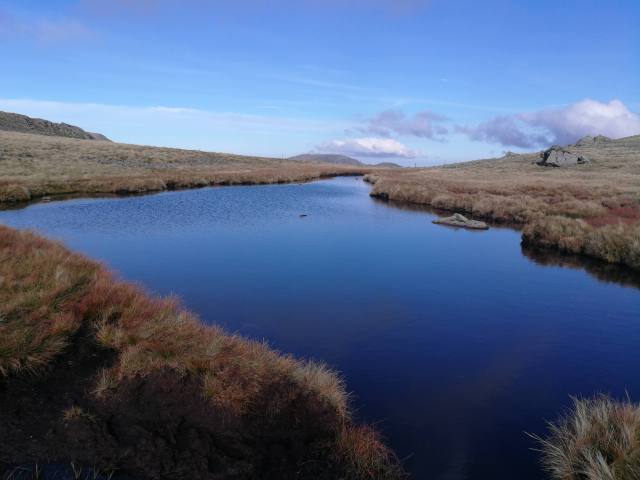
Onwards: first, another tiresome road tramp along around 2km of tarmac, before turning left into the fields again on a path to my final destination today, Tarn at leaves, where I planned to camp. Though at best 2km from the road, it was strongly upstairs, really quite steep. The sun was at my back and though I was flagging towards the end of the long day, I knew I needed to get there. “You’ve got this” I told myself, and I had. I was a little concerned though, that there were no paths onwards from Tarn at leaves. This concern had some justification; the map, as far as it goes in terms of detail (which is not far even on the OS 1:25000 sheet) showed none. But this isn’t the Cairngorms in November. I finally got to the tarn and found it very boggy, going in up to my knees and getting my boots wet right in the last two minutes of an immense twelve-hour day on the hill. But it all dried out quick enough.

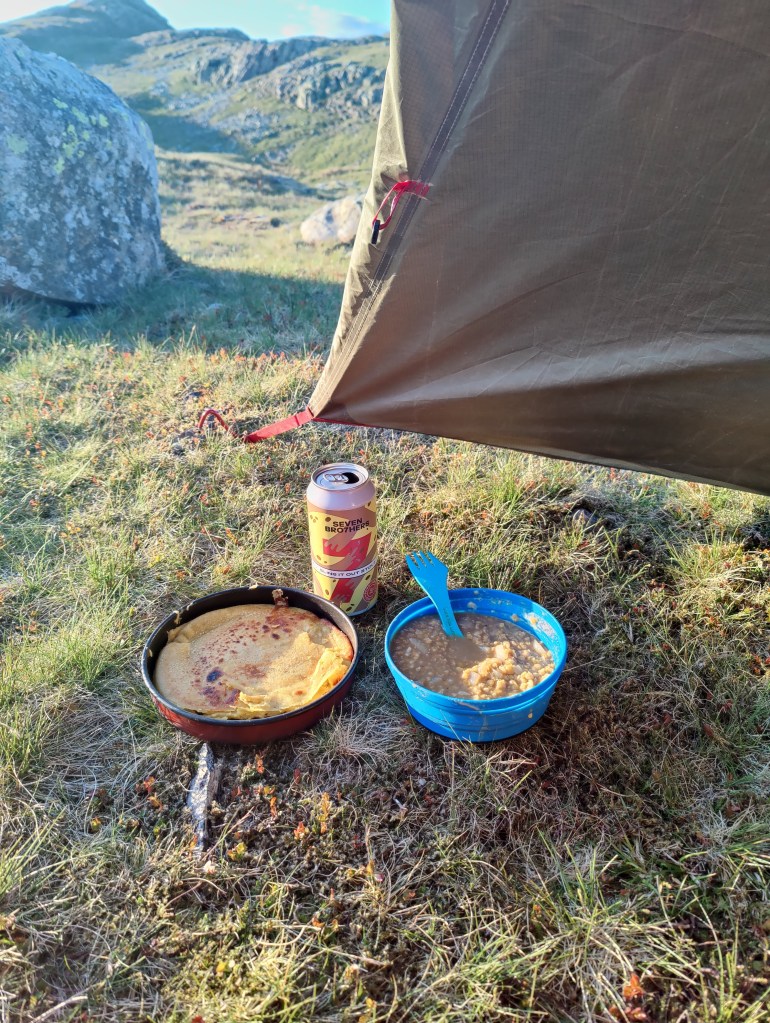
I was sat down to my supper quite late – about 8.30pm. For supper I had spicy red lentils, and a chick pea flour pancake – a “faranata” the recipe for which I learned from my son Nat. I can’t be doing with not eating and drinking well when camping wild. To wash my dinner down I had some remarkable and very tasty 8% proof “Sling it out Stout” (though to be fair after that walk of nearly 25km, even Carling Black Label would have tasted like nectar. Well, that’s pushing it a bit, maybe…

The place was well deserted. Though I was happy enough, it reminded me of a sad part of Tolkien. Hurin, released by the devil Morgoth after 28 years in captivity, wanders over the land trying to find the hidden city of Gondolin, whose king Turgon, was once his friend. He knew roughly where it lay, but not exactly. And on some deserted moor, where the wind whistled endlessly through the grass while no-one was listening, he cried out in grief and rage, “where are you, O Turgon, in your hidden halls?” But someone was listening…Morgoth’s hidden servants reported those words back, and the betrayal of Gondolin began.

This tarn is one of those past its former glory, slowly drying out. Slow by no human perspective – it’s climate change alright, but not as we know it. It’s nothing to do with man-made climate change. Tarns like these have been drying out in the Lake District since the ice receded these 10,000 years. There are dozens of them. The word “moss” is often a giveaway, for example, at the Great Moss under Scafell Pike: even a cursory glance at the map tells you there was once a lake there. For all the boggy areas in which went up to my knees when I arrived in the evening, it was a dry camp and a dry strike. After a breakfast of mushrooms, spinach and fresh coffee, I was away again by 8a.m the next morning. What I could not do, is find fresh water to drink. I set off onto the hill with less than a litre of water left, but with a few little oranges and tomatoes.

It was not clear to me where to go from the tarn; I did not want to end up scrambling up and down bands of cliffs: unwise at any time if you’re on your own, a recipe for a coffin or worse if you’re carrying a 20kg rucsac. Once you stumble, down you will go. Don’t stumble!! I pressed on, keeping the dark and seemingly endless (and appropriately named) valley of Langstrath on my left. I remember being in it once on a rainy day, thinking it went on for ever. And I found a fence. Where a man can build a fence, I can safely walk. I followed that fence for quite some way before leaving it, saying farewell as to an old friend, and striking uphill towards Glaramara (783m). I was an hour and ten minutes walking this morning before I encountered a path. That is unusual for the Lakes.

Glaramara unfortunately has a short scramble which I did not recall from last time I was here (which to be fair was 36 years ago when I was a callow youth.) But keeping one’s weight forward works for climbing with a big bag; slightly less unnerving than climbing downward face-out, when the weight and centre of gravity must be kept back to avoid to avoid toppling over and down. I did not expect to see anyone here this early (9.30a.m) on a Sunday morning – way too early for day trippers to get to this location. The summit was deserted and cold. For a short while it was cold enough for me to wear my woolly hat. On the next summit I did in fact meet and have a pleasant chat with a young backpacker, who had camped on the shoulder of Scafell Pike at over 950m above sea level. We spoke of obtaining water; he noted that water flowing in streams off the central massif could be polluted and a problem: he was planning a two-night Mountain Leader Training exam expedition soon, and obtaining water in summer conditions, was a challenge. I was drinking water I’d carried all the way from Thirlmere.

Again onwards to Esk Pike and Esk Hause, the central col and cross-roads of all the Lake District. Also about as far as you can get from a road-head anywhere in the Lakes, although paradoxically enough, probably not the remotest location. Here there were day trippers, mostly up from Seathwaite, Borrowdale. Round here one reflects on the centrality, not of Esk Hause, but of Great Gable. It’s not the highest mountain of course, but it is the central boss, the ice-worn stub of whatever original mountain stood here millions of years ago. Near here I saw some classic “roche moutonnee” (literally “mutton rock”, rock like sheep) whereon there were clear scratches from the ice, quite at odds with the rock’s natural bedding plane, the scratches pointing towards Great Gable in one direction, and down-valley in the other. I do like the landforms left by the glaciers. The hanging valleys, the corries and cols. Truncated spurs. Misfit streams. Terminal moraines. Eskers and drumlins.

Drumlins in Langstrath

Round to Bow Fell, where I started to feel hungry and took lunch. On Bow Fell I encountered an older fellow with his young son, and he was teaching him the names of the summits on the skyline, testing him so he would learn them. I know them, and no-one taught me their names. But I am an older man and I’ve been coming to the Lake District for over forty years. My first trip was in 1977, to the Newlands valley with the Scouts, and we climbed Dale Head in claggy conditions. I remember it fondly. But it is something that would not be permitted today, for two Scouters with no Mountain Leader certification or formal training to take 16 young Scouts on a hike like that.

From Bow Fell, descending carefully, I went down to Three Tarns, where I saw that fellow again with his young son. I was most careful going downhill, though it seemed straightforward enough. I became aware that having climbed Bow Fell half a dozen times at least, I’d never come down this route, only up it. From Bow Fell, at a little after 2pm, I went down The Band, increasingly footsore, until I found myself very slow and very tired at Stool End Farm, about 3.30pm. A child was playing in the farmyard as I passed through, and my hike was over.

The geeky stuff

On day 1 I walked 9.57km; on day 2, 24.46km, and on day 3, I walked 14.28km, to a total of 48km in just a bit less than 21 hours total. On the second day, the 24km was taken over 9 hours and 49 minutes and involved four separate ascents, three from the road.

I used an Osprey Aether Pro 70 which weighed 14kg laden with no food or water. Add to that around 3.7kg of water, 900g of beer and all my food, means that at the start I was packing somewhere between 20kg and 21kg. This is a lot less than I was carrying with my previous rucsac which was about 10 litres larger but a good deal heavier. I’ve written about this before.

I slept in an MSR Elixir 2 tent, and used an Alpkit Skye High 700 4-season down bag, a silk liner, and a Thermarest self-inflating mattress. I used a small Trangia 27 and a small (750ml) metal bottle of bioethanol. I carried gloves and mittens (and used the gloves), a woolly hat and a sun hat (and used both), Goretex waterproof trousers (didn’t use) and Goretex gaiters (did use). I carried about 800g of Lithium battery power packs as well as a cellphone and a smart watch. Spare clothes, waterproof coat, fleece jacket, first aid kit, small pair of field glasses, and a few other bits and bobs, made up the kit list.

I found the Aether Pro too small for my purposes and the tent had to be strapped to the outside. But the extremely light weight of the Aether Pro carries all before it – I love that aspect of it. After a day or so I became adapt at re-packing and found things fitted better, and eventually the tent fitted inside. I have not yet had the Aether Pro out in heavy weather, so I don’t know how waterproof it is without a rain cover.

Backpacking in the Cairngorms

Part 1: To the Highlands by Caledonian Sleeper

When I began my journey from East Surrey at 1853 on a Wednesday evening, it was with a heavy heart, for a number of reasons. A lovely old fellow we all knew was dying; he did in fact go home, early on the Thursday morning. A little later, arriving at Euston, I went for a pint in that favoured spot, the Doric Arch at Euston station. This marked the start of my holiday. Later, as I boarded the sleeper train, there was an oddly sudden and very heavy rain shower. My wife informed me that this rain was quite extreme back in Oxted, shorting out house electrics and causing minor flooding.

Arriving in Inverness, I was straight into gloves – it was one of those cold and blustery mornings. The train was almost an hour early. I recommend the Caledonian Sleeper; it is costly, but good value for money when you look at what you’re getting – return travel from London to Scotland, and two nights accommodation. You can of course just buy a seat rather than a berth, and sit up all night. This costs maybe £100 return and would be pretty much the equivalent of taking a 12-hour flight in economy. Sooner you than me: I say, what price money? If a journey’s worth going on, it’s worth going on in comfort.

Inverness is a long way from London and indeed, a long way from Edinburgh. The atmosphere is very different. I started by taking coffee and a breakfast roll in the bus station cafe. You can’t beat a bus station or train station cafe; no-one cares how smart or untidy you are, or how big your bags are. As a very tall man, I do sometimes value not being noticed.

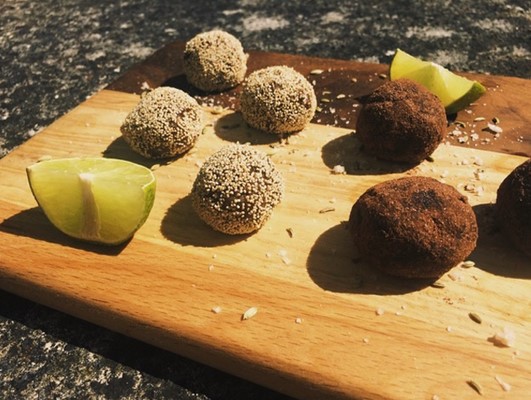
To the co-op to pick up some groceries: I bought bread, butter, cheese, tomatoes, little oranges, an onion, fresh spinach, chocolate, fresh tortellini, and water. I carried in from home, coffee, sugar, spices and salt and pepper, porridge oats, red lentils, gram flour, and chorizo sausage, and also a trail mix of “date, nut and seed balls” – these were absolutely superb. Thence, by cab to the airport to pick up a rental car. Then I motored back into town, swiftly over Slochd and down into Glen Feshie, to park up at the road head and prepare for hiking. Leaving home, my rucsac was 16kg: now with food for three days and water, it must have approached 20kg.

date, nut and seed balls

Part 2: Glen Feshie to Glen Geusachan – across the Great Moss

After a climb through some pleasant woods, the route to Carn Ban Mor goes up the left-hand side valley of the Allt Fhearnaghan. I was feeling very fit and strong as I climbed, and I did notice far more snow than I had thought there would be. This seemed to be more than the Autumn icing-sugar dusting of snow I had anticipated, and was closer to real winter conditions. Up onto the Great Moss, I did not go to Carn Ban Mor, and also made the error of leaving the track, and thus wading through heather and fresh snow occasionally drifting a foot deep. It was blustery, showery weather. One moment, I could see Angel’s Peak and Cairn Toul, the next, there’d be a squall and a snow shower. I made my way to the summit of Tom Dubh – just a slight top in the midst of the Great Moss, though at 918m as high as most Lake District summits.

View from Tom Dubh

From Tom Dubh, downwards into an area of fens, marshes and little tarns where I found myself going in circles and doubling back away from half-frozen watercourses I could not possibly ford. It was an oddly blue-grey world, and the snow started to pile down. I got on down to Loch Stuirteag, where I had hoped to camp! This was a wild and inhospitable place, wholly unsuitable for camping in anything but summer conditions. In any case, a howling wind was at my back; I sought in vain for shelter. Lower down, at the very top of Glen Geusuchan, I thought I found shelter, and laid my tent out in a flat spot. But the outer was nearly torn from my hands in a violent gust. What was I thinking of? I should have been in grave trouble had I stayed there. I packed up again and struggled on downwards into a glen of deep, trackless heather. I fell over and picked myself up again; I found myself on the edge of steep slopes down into the river; my feet fell into hidden water; I stumbled, carrying 20kg. To be fair, I had bought a new rucsac, an Osprey Aether Pro 70, and it was an exceptionally good carry. Nearly 2kg lighter than my previous rucsac, this one sat very comfortably and caused me no problems at all.

I could find nowhere to get out of the wind. I didn’t feel desperate, but it was quite a desperate situation. Darkness was impending; I was already tiring. I could not realistically make it to the Courrour Bothy in daylight. I should have been left floundering uphill through the trackless heather, in the dark and the storm, trying to find Courrour – an unlit speck in the mountain fastness.

Eventually I found a place in the river bed – can I pitch a tent on sand and pebbles? Yes. At least this place was sheltered by an old river bank, a six-foot wall of peat and heather, and was as out of the wind as I could find. I struggled with the wind whilst getting pitched, and pitched the tent outer first, though it wasn’t actually raining at that point. Almost the last thing I did outdoors as darkness fell (apart from getting water from the river) was collecting heavy stones to pile onto the guys and tent pegs. Well that I did so now rather than in the dark. I had a good camp – I cooked dinner, ate, and turned in soon after. I certainly slept some, though the noise of the wind and the frequent rain showers kept me awake much of the time.

I was awake at 5a.m when the storm reached its crescendo. Lucky I was that it had not been earlier. The wind redoubled in strength and tore out the pegs on the windward side of my tent, though the guy-line held. This made the outer tent flap in the wind unto destruction, unless it was fixed. The noise of the tent flapping wildly in the gale, particularly in the dark, could easily induce panic if you allowed it to. I managed to fix it from the inside, with rocks and moist sand. Then the pegs on the lee side came out, then on the windward side again. Four or five times I had to jam the pegs back in again, getting wet sand all over my hands and in the inner tent. By this time I was awake and dressed for the day and had started to pack up against the possibility of ultimate catastrophe. I did manage to make porridge and coffee, and dress a pre-existing cut on my forefinger, whilst using one of my trail poles to keep one peg in place on the lee side of the tent. This was a remarkably difficult moment and I seemed to get through it without too much trouble. The tent flapped; I was somehow able to rise above doing so. Panic, worry or getting things wrong was just not an option in these conditions: everything had to be done quickly, methodically, correctly, and in the right order. I packed up, dropped the inner, and took down the outer, but by this stage as daylight strengthened the storm ebbed; the worst of the squall was over.

From Achlean to my camp on Geusachan Burn at around 974943, was about 17km, which took about six hours. It is a very great shame, but buried somewhere in the sand of that river bank, or blown off into the wilds, there is a small slice of thin flexible polypropylene chopping board, bright blue, about 6″ x 6″ – for I never saw that again. Breaks my heart to leave litter, but the wind must have carried it away. There was some slight damage to the ends of my tent poles, which was easily fixed.

Part 3: Glen Geusachan to Glen Feshie

Let’s look at the positive – remember that bit in “Apollo 13”? “what have we actually got on this spacecraft that works?” …er, let me get back to you on that, chief…actually quite a lot. I was warm, dry, clean, my kit was packed and complete and dry, I’d had a hot breakfast and even some coffee. The world was at my feet.

Glen Guesachan at dawn

In the glorious light of dawn, I walked out of the side glen and round into the Lairig Ghru. Fording streams and rivers is a serious challenge in the Cairngorms – it is rarely an issue in the Lake District. One cannot ford the Dee even this high up, certainly not in cold weather, though one might try in high summer. I had to detour all the way up the the Courrour Bothy to cross the river. It was an uphill slog through heather, with only the occasional hint of a path. I reached Courrour on a bright and pleasant morning, about 10a.m.

Courrour

I crossed the Dee on the footbridge, and had brief converse the only hiker I saw for two days, an older man from Edinburgh. He was in for the day to climb the Devil’s Point and Cairn Toul. Approaching Courrour at 10a.m in late October, he must have made a very early torchlit start from the Linn of Dee – that’s a long walk in. God only knows what time he started from Edinburgh! He did mention that there had been driving rain on the drive in – probably about the time my tent was getting hammered by the gale.

Bod an Deamhain – “the Devil’s Point” (although I understand “point” is a Victorian euphemism for another quite different word beginning with P.)

I powered on down the valley, consciously keeping the pace fast. I was fortunate in being very fit: when backpacking, many issues conspire to slow you down. Hips hurt, shoulders hurt, feet hurt, blisters, hungry, thirsty, exhausted etc etc. The last of these, when you’re very fit, is almost an irrelevance. Walking at 4km/hour all day long while carrying 20kg becomes merely doable rather than requiring a mighty effort.

A chopper searched the surrounding summits as I walked south. Early afternoon, I came into phone range and also into sight of the White Bridge across the Dee. I saw a couple with a pushchair and a dog – I didn’t realise how near the Linn of Dee car park was at that point – about three miles away. I saw two estate workers. The next part of my route lay for many miles along unmetalled roads, and in fact I was passed by a car once.

To the Red House, and on up the Geldie Burn – though no burn this, but another wide and deep river unfordable in cold weather or winter conditions. The Geldie Burn is technically a “misfit stream”. The valley in which it lies is glacial in origin, not carved by this or any river. Geldie Burn has enormous relict banks indicating that at some point in the geological past, when the ice melted, it must have been ten, a hundred times bigger than it is now – a torrent like unto Niagara.

Through the golden afternoon over lovely brown moorland, and endless path, which, once the un-made road ended, was never less than a clear trail. From the White Bridge, up the Geldie Burn and to the unnamed waterfall at the head of Glen Feshie, at least 12 kilometres. I started to experience muscle pain in my left shoulder; I found that Voltarol brought very swift and very effective relief.

Sometime before arriving at the unnamed waterfall, I fell over. I was negotiating some deep and evil-smelling pools of mud in one of the ruts of the road. Whatever…I twisted and slipped. Or I slipped and twisted…carrying 20kg, once you’re going down, you’re going down – there’s no stumble and recover with that kind of weight on your back. I ended up on my back in a foot deep puddle of thick, black runny mud. Desgustang! With some difficulty I got myself up and out again. Strangely enough, I personally was untouched – wearing a Goretex raincoat, gaiters and overtrousers, no actual mud penetrated to my clothes. My rucsac took the brunt of the mud and was very dirty. If I had a minor criticism of the light grey colour of the Aether Pro, it would be that the straps and hip-belt show the dirt very easily.

This remarkable waterfall was, to quote C.S Lewis, “a terror in the woods for miles around”. It was audible long before it could be seen. It has no name on the map; it is comparable to High Force in Teesdale, and were it within a hundred yards of a road in England or Scotland, people would drive 100 miles to see it. In the Cairngorms it is at least five hours walk up-hill from the road head in wild and remote Glen Feshie, and probably five hours walk from the car park at Linn of Dee. So almost impossible to access in a day-trip except in high summer. How remote! How excellent that remoteness is.

I was now in the descent into Glen Feshie and ready to look for somewhere to camp. Trees appeared, larch and other kinds. Suitable places to camp emerged, albeit far from water – the river was running in an inaccessible gorge. I had at this point run out of water, so I needed to camp right by a stream. Better yet, there was no breath of wind. I needed to stop a little earlier to allow enough daylight to ensure that my tent was OK after the beating it took this morning.

I found a place by a ford, and camped right next to the path, in as wild and remote a location as ever I have camped in…except for, oh, last night. The tent went up easily and the ground took the pegs well. Once established, I made a faranata – a pancake of chickpea flour, as recommended by my son. On a Trangia stove it worked a treat. For afters, some chocolate and a sip from the hip-flask. To drink I had litres and litres of stream water: slightly brown from peat. There’s no sheep up here – no need for any purification tablets. Though the colour was off-putting, and the water was so cold as to induce a blinding headache, it was like nectar, like Ambrosia, like ice-cold lager. It is a pleasure to be that thirsty and have a pure mountain stream in which to slake that thirst.

On day 2 I walked 30km in approximately eight hours. I used Black Diamond trail poles, Gore-tex gaiters and over-trousers, walking trousers, merino wool base layers, a thick cotton shirt and Berghaus fleece and waterproof coat. I get cold easily these days: a merino wool hat helps, and gloves are a big deal. I had a thin and a thick pair of gloves, and also some heavy mittens. I wore gloves at all times outdoors when walking; up on the plateau I found it necessary to wear all three pairs at once.

Part 4: Glen Feshie

I packed up in good order as the light started to improve, and was ready to hike by a little after 8a.m. I continued down Glen Feshie, through an absolute Eden, a veritable wilderness paradise. When I was a youth in Derby, I borrowed from the local library, an old book about the Cairngorms. And in that book, there was a snatch of an ancient Gaelic poem, which has remained with me ever since: Glen Feshie of the storms, I had the longing, to be in thy shelter…and now I had the pleasure of walking the whole length of this wild glen.

There were high and low spots to my morning’s walk. It took me until noon to walk out to the car, and on the way I got lost in the woods; there was a rain shower, and there was a washed out bridge over a tributary stream. There was much fording and crossing of streams, brushing through vegetation, and climbing up and down along the side of the gorge. For most – but not all – of the way, the path led along an unmetalled road. In places, where the road had been washed away, the path detoured up the mountainside.

On the walk out I found my hips were very sore under my hip belt. So I stopped on the path and took off my pack, and got out the Voltarol. I dropped my trousers without a moment’s thought, in order to put the gel on my hips. I’ve spent two days on the hill and meet one other hiker; I met no-one all day Thursday, and I met no-one after 10a.m on Friday. I camped in the wildest places where there was absolutely no chance of anyone coming past. Yet, no sooner had I dropped my trousers to apply the medicine, a man and a woman appeared from nowhere to walk past me. They never turned a hair. “Morning!”.

“Morning.”

I arrived at the car at noon: It took just under four hours to hike down the valley – a journey I’d estimated would take at least six hours going uphill. And my hike was over.

Kit

I carried approx. 20kg using an Osprey Aether Pro 70. This rucsac is one of the lightest expedition bags available, weighing 1.8kg – which is why I bought it. It feels lightweight, even flimsy, and I admit I was sceptical when it arrived, particularly given it’s relatively high cost. My scepticism lasted only until I got it packed and set off – on the hill it proved durable and a very comfortable carry, a much easier carry than any other rucsac I’ve ever used. This rucsac has replaced a much older Berghaus C7 1 series 65+10, nearly 2kg heavier, but with a good deal greater carrying capacity. I think we can safely say that when the manufacturer Osprey says 70 litres, that includes the hip-belt pockets.

The hip belt tightening arrangements are particularly inspired, and I liked the pockets on the hip belt. I will say, it’s not quite as clever as the manufacturer thinks it is with regard to attaching things to the outside, in spite of a wide range of straps. I could not easily see how to attach trail poles, and I still can’t obviously see how to put an ice-axe on it – the big first rucsac I’ve ever had where this is not completely obvious. Heavy items – tents, tent poles etc – may have the tendency to slide through the straps eventually. Also – as I found when I fell over – because the rucsac is light grey, it does show the dirt, particularly the straps and the hip belt. Getting it back home, it also became the first rucsac I’ve ever had to strip down and wash. Overall though I would highly recommend it.

I used a Trangia 27 (the smaller Trangia). I’ve been using Trangia stoves since the 1980’s and have never had a problem with them, nor been tempted away from them. Durable and reliable if a little heavy and – at least some say – a little slow. Two things I like about the Trangia – it has a low centre of gravity, and all the pans are included as part of the stove. I slept in an MSR Elixir 2 tent using a Rab Alpine Pro 600 down three-season sleeping bag.

Wild camping in the Lake District – October 2020

Part 1: To Windermere

I set off from Surrey around 3pm, starting a 300 mile drive in to the Lake District. Whilst without incident as a drive,there was very heavy rain in the Chilterns and then again around Stoke-on-Trent. The M6 Tollway I think highly of – belting along there cost me £6.90 and probably shortened my total journey time by six minutes. What price money? There are people – quite a lot of people judging by the emptiness of the toll road – who refuse to use it as a matter of principle. I confess I cannot get my head round that attitude. Arguing that you can’t afford it, for a one-off journey, cuts no ice. Commuting might be different, of course. Maybe they object to the principle of roads being private property rather than public infrastructure.

I got to my B&B in Windermere in heavy rain, a little after 8.30p.m. Mine host was a rather eccentric and somewhat peremptory older man. Eccentric, in that he’d already admitted (as a businessman and B&B owner) to not possessing a mobile phone. To not own a mobile phone in Britain today, is in my view little more than a fashion statement. Not owning one as a B&B owner indicates an indifference to customers that I don’t find encouraging. Peremptory, in his attitude. Breakfast was exactly 8a.m and appear here in the hall and I’ll show you into the dining room. (This beats by some margin the narrow window “breakfast is 8.30 til 9, any time” offered by a cheery Australian landlady in Weymouth, which became a standing joke in our house for years afterwards.) Always remember – Fawlty Towers was not a sit-com: it was hard-hitting documentary.

My room was a typical B&B room, woodchip on the walls, a sink, no en-suite, comfy bed, tea-making facilities. I went out for a rather dank pint in a local pub, and went to bed, to sleep well enough.

Part II: from Great Langdale to Styhead

Next morning I went down at exactly 8a.m and mine host was waiting for me. He showed me into an empty dining room set for over a dozen people. He served me as good a Full English as ever I’ve had, with a pot of the strongest and tastiest coffee I’ve drunk in years. An excellent start to the day. Before 8.30a.m I had left – through the misty moisty morning to the head of Great Langdale, where I parked the car in some flat land near the road, a mile or so beyond the Old Dungeon Ghyll Hotel. Getting my gear right took some time, and it was probably near enough 10a.m before I set off.

My rucsac had weighed 16kg at home before so much as a bite to eat went in it. Now, it must have been well over 20kg. I hadn’t walked thirty yards before I wondered if I needed to take a longer warm-up. I considered walking the length of Mickleden, nice and flat, but that meant the horror of climbing Rossett Gill at the end. I decided to stick with going up The Band, so off I went towards Stool End Farm. And as I climbed, I came across the true deliverable of physical fitness. This last six months I’ve been running 20km a week. I walked up The Band in an hour and forty minutes, carrying a 20kg rucsac. I don’t say I didn’t break sweat, nor that it didn’t take it out of me, but my pulse stayed under 120 all the way. Happy with that!! At the top, a rest before continuing up Bow Fell, which despite it’s daunting aspect I found a straightforward ascent. At the top it was almost noon and there was a squall coming, so I stopped for lunch.

Scafell and Scafell Pike

From Bowfell I continued round the Scafell horseshoe. Ore Gap, Esk Pike, Esk Hause, but missing Great End. The weather was glorious, so I continued right on up to the summit of Scafell Pike itself, where I arrived at 4p.m.

Here you can see so much: an unnamed tarn on Middleboot Knotts, Great Gable, Styhead Tarn, and in the far distance, Derwentwater with Skiddaw clearly visible behind

It was cold. On a few occasions I had cause for concern that I should have brought mittens – as well as gloves. From Scafell Pike back down to the col and down the Corridor Route, starting to feel tired. But what wonderful light: Here’s the view down into Wasdale:

At one point, in the pleasant later afternoon sunshine, the path went down some very steep and rocky ground. You can do without that, when carrying a 20kg expedition bag. In Frank Herbert’s novel “The Dragon in the sea“, an old and wise submariner says to a more junior officer, “As a submariner, you only make the same mistake once“. For me as a man in my fifties carrying a huge rucsac, descending a rocky scree or boulder field, that was true. Here, I would only slip or put my foot wrong once. There would be no second chance. Taking the greatest care one does get down, though the thigh muscles ache. One has to be in the position of being able to lower, in a controlled way, your entire body weight, just on one leg. You have to keep your centre of gravity behind you – if it gets in front of you, you’ll topple over in an instant and game over man, game over…

Very tired, I reached Sty Head, and opted to camp there, on flat ground by a babbling brook.

Styhead

For supper I had fresh tortelini and some sausage, with onion, garlic and pesto. I use a very old and battered Trangia stove, the smaller “27” model. It has served me well for nearly 40 years. With this stove I feel rather like the proverbial man who has his father’s axe – I may have replaced some of the parts. On the hill I was munching through a small tiger loaf bought in Windermere, with Red Leicester cheese, butter, cherry tomatoes, and a satsuma. I was also using a trail mix of sultanas, raisins, seeds, salted peanuts and chocolate chips. This was inspired stuff – a mix of fast and slow energy. I learned this trick from a teacher when I was in school. And because I can afford the weight, a counsel of perfection for my evening meals was a bottle of Malbec, though wine and bottle weigh over a kilo. It’s an absolute fundamental to me that wild camping doesn’t mean rough or hard living. Camping doesn’t imply “roughing it”. Life offers enough difficulty as it is without adding further artificial complexity.

It was very cold overnight – an unpleasant cold breeze blew in through my air vents, til I shut them, at the expense of increased condensation. During the night the moon came out, which caused me some odd dreams and I did wake up briefly.

Part III: from Styhead to Buttermere – a round of Black Sail

My breakfast was porridge with a dash of Scotch, black coffee with a good deal of sugar, and a sausage. Breakfast of champions. Despite the cold and clear sunny morn, I had what was effectively a wet strike because of condensation. I shouldered my pack and set off towards the path. I passed a fellow out running with his dog, going in the Wasdale direction. It was about 9-ish. I reached the bottom of Aaron Slack and started up. The last time I was here, was twenty-odd years ago, coming off Great Gable with a friend of mine in absolutely dreadful weather: it was the time we met Todd, a lone American youth. Taaaarrrd, as he pronounced his own name, was rather over-equipped, we thought, at the time – probably August. I didn’t feel over-equipped now in October.

I was carrying an MSR Elixir 2 hike tent, an Alpkit three season down sleeping bag, a Thermarest mat, the smaller (size 27) Trangia and about a pint of fuel. A full set of spare clothes, a first aid kit, maps and compass, a hip flask, two litres of water, and food for two more days on the hill. Don’t forget the (hic) half a bottle of Malbec. And of course a pen-knife. And a small pair of field glasses. Waterproof trousers and jacket, fleece, scarf, gloves, wooly hat. And I carried that lot up to Windy Gap between Great Gable and Green Gable. And there, I met a chap with a dog. “Don’t I know you from somewhere?” I almost said. Sure enough, it was the same guy. In the time it had taken me to grind up Aaron Slack, he’d RUN up Great Gable and down the other side. And I thought I was fit. He had a friendly and well-mannered grey dog, which whilst I was sat down, came over to see me.

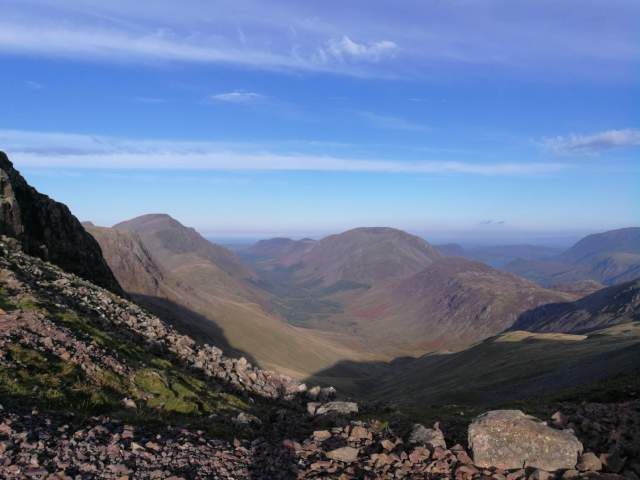
Just look at the view: Pillar is on the left there. Ennerdale centre, and Red Pike just right of centre. Crummock Water is visible to the right, and the coastal plain beyond all.

From Windy Gap onto Kirk Fell: my first navigational tactical error of the day. Staying high is always good advice when hillwalking, of course, particularly in such beautiful weather. I could descend all the way down to the Black Sail hut and then back up the Black Sail Pass to Pillar, or, I could stay high on Kirk Fell, but come down off the fell to the top of the Black Sail Pass. I could see on the map that the descent went through “Kirk Fell Crags” but I didn’t pay enough attention to the detail. Coming off Kirk Fell, I not even see how steep; the land dropped away. The path descends very steeply through rocks and screes. Indeed, no-one could come up that path without actually climbing or scrambling – and I must descend with that huge heavy rucsac.

Mixing down-climbing – descent face-in (making one feel very exposed, but much safer) and going down face-out (you can see where you’re going and you feel safer, but it’s always more hazardous and you’re more liable to slip) – I got down. I recalled advice about visiting the Black Cuillin of Skye. It was simple: if you’re not comfortable climbing downwards, don’t. Don’t go to the Black Cuillin. Down-climbing is a tricky technique to learn and you have to learn to trust your hands and feet. It is the better way down steep places, especially if the rock is wet and greasy. Here, all was dry. Had it been wet I would probably have turned back. Concentration and effort took their toll and I was morally shattered by the time I reached the col. Were it not even 11 o’clock in the morning I should have been tempted to reach for the hip flask for a swift steadying double. I resisted. Climbing onward toward Pillar, I was starting to feel a little jaded. I stopped for my lunch half way up at a “Pile of Stones”. Again, lovely scenery and such clear air.

At Pillar I needed to think: whilst there was no pressing rush, it was decision time about my further route and my final destination. Would it be Haycock and Steeple and then down, or would I go down from here, and then up and over into Buttermere or onto the Haystacks? I needed to start curving round and positioning myself to be within 4-5 hours walk of Great Langdale by nightfall. Here, the second tactical navigation error of the day. Instead of dropping directly off Pillar towards Ennerdale, I dropped down to Wind Gap, the next col, and down from there. The paths looked similar even on the 1:25000 map. But the valley route was the steeper and rockier, down into a deep corrie wherein, to my ears, were nesting some raucous birds of prey of some kind. A wild and little-visited spot for Lakeland.

A boulder-strewn hillside above Ennerdale

Some way down, I found I had lost my fleece; it had fallen off my pack where it was strapped on. I dropped the bag and set off uphill in the sunshine to look for it. But how do you find a dark grey fleece on a boulder-strewn sunlit hillside? I had neither the time nor the energy. By mountaincraft and not by luck, there was nothing of any value in the pockets of the fleece – save for all my alcohol gel and a mask.

Downwards to the edge of the industrial forest of Ennerdale, crossing a stream on a fallen log, on through the dank moss-ridden woods. I do love a forest but this place made Fangorn look friendly. In the distance far below, orange. I emerged onto a forest road where three absolutely enormous tracked logging machines stood. This is a deeply industrial environment, in the heart of some beautiful countryside. Then, a long and tiresome five kilometre tramp uphill alond the forestry tracks to the Black Sail Hut.

The Black Sail Hut – probably the most remote youth hostel in England

After a brief snack of bread and cheese at Black Sail, my final climb of the day, through the Scarth Gap into Buttermere – this was familiar terrain. Down into Buttermere for supper and camp at dusk.

Part VI: Buttermere to Great Langdale by bus

I camped in a little dell by the lake. It was a warm night on the Buttermere valley floor – much warmer than up at Sty Head. The forecast rain started at 7a.m, so I had a full wet strike. My supper and my breakfast were the same as the night before – for supper, tortellini, with sausage and pesto, and for breakfast, black coffee, and porridge with chocolate chips and a dash of Malt Whiskey. Dalwhinnie, I think this was, though after being stored in a hip flask it might as well have been Grouse. The second half of the Malbec slipped down nicely and I did not begrudge carrying the extra 1.2kg. As I weigh 91kg, I feel I can afford it. Nor did I begrudge carrying 250g of butter, 200g of cheese, 400g or bread, or an onion. Camping wild and backpacking doesn’t imply living rough.

I walked out the mile or so to the Fish Hotel in light rain, and was very pleased to find a bus to Keswick leaving in half an hour! Just enough time for a quick latte in the absolutely excellent Syke Farm Tea Room. The bus was driven by an amiable scotsman who a number of times had to stop and grab a seat cushion which kept falling to the floor each time the bus went round a corner. It cost £6.40 and ambled through the rain along the shore of Crummock Water, before climbing over Whinlatter to Braithwaite and Keswick.

At Keswick what to me appeared to be luck continued: twenty minutes stood outside Booths in heavy rain and I was onto a big double decker, bus 555, for the journey over Dunmail Raise to Ambleside. Cost: £9.40. At Ambleside I got off a stop too early even that didn’t prevent me from catching bus 516 to the Old Dungeon Ghyll, cost: £6. My journey by road from Buttermere took barely three hours and cost £22. A private car couldn’t have made the journey in much less than half that time. I would have been ready – though perhaps not so happy – to have paid three or four times that amount for taxis.

Had I known that public transport in the Lake District was so comprehensive and so well co-ordinated, I would never have brought the car at all. From where I live in East Surrey, the train would be about the same journey time, maybe slightly quicker, and a good deal less tiresome than trudging up and down the M40 and the M6. The train might cost a good deal more than the cost of the fuel – but as any fule kno, the cost of fuel isn’t the true or full cost of motoring.

Back in Langdale, I swiftly changed into town clothes, under grey lowering skies and pouring rain, and retreated back to Ambleside.