Unknown's avatar

About Nick Hough

Don't get rich quick - get smart forever: I believe in knowledge. I'm interested in politics, economics, religion, science, and engineering. I'm a Christian, a family man, and a Scouter. I also tweet @enough32.

A review of “Dune”, by Frank Herbert

Classic sci-fi: A review of “Dune”, by Frank Herbert

It is quite odd, re-reading Frank Herbert’s classic science fiction novel, to see his ideas  – written down in the early 1960’s and ahead of their time then – in relation to how we stand today in relation to Islam.

Dune, at one level, is a sweeping space opera, an adventure where two noble families battle for supremacy in an imperial setting – but set in a strange and far future.  Imperial politics are what they usually are – but are also subtly controlled by a shadowy and all-powerful female priesthood, the Bene Gesserit.  Interstellar space travel is controlled exclusively by the Guild of Navigators – and they accomplish it only by use of a difficult to obtain mind-altering drug.  This drug is made from a strange spice available in one place only in all the universe – the desert planet Arrakis, or Dune.  The novel is the story of two families fighting for control of the spice.

But at another level, Dune explores the culture of desert Arabs, and draws heavily on Islamic ideas such as jihad or holy war.  I don’t think a publisher would touch it if it was written today.  Indeed, even writing such a work would put you at risk from those who see Islam as completely beyond or above discussion – much less actual criticism.

Whilst is is broadly sympathetic to Islam and to desert culture, we see parallels drawn between the rise of the prophet, and the rise of Frank Herbert’s central character Paul Muad’Dib, and the holy war or Jihad that Paul Muad’Dib is so keen to prevent.  He sees it in visions and dreams: war, suffering, warriors and fighting, spreading out unstoppable from Arrakis, across the known universe.  And it is the last thing he wants.

As a writer though, two things to note: firstly, Dune as pure story seems much less sophisticated than later science fiction, and second, there is some wonderful mixing of metaphor and adjective, which I record here.  The central character Paul – at this point just fifteen but the son of a Duke – and his mother are marooned in the desert after a plane crash, and “…he inhaled, sensed the softly contralto smell of sage climbing the night…it had brought a stillness to the basin so unuttered that the blue milk moonlight could almost be heard flowing across sentinel saguaro and spiked paint brush. There was a low humming of light…”

I was charmed by the idea that moonlight could be heard, or that the smell of sage could be contralto, or stillness, unuttered.

A visit to Rum

I made a short stop at Bellabeg, to the west of Aberdeen, and with eager anticipation, bought a “locally sourced” Scotch Egg. I thought, that’ll do me. I chatted with the affable English shopkeeper, who waxed lyrical about his local Scotch Eggs. But then he ruined the moment by telling me that his Alford-based local butcher had sent him a Scotch Egg with a Cadbury’s Creme Egg inside. “FFS” is the politest response to that!

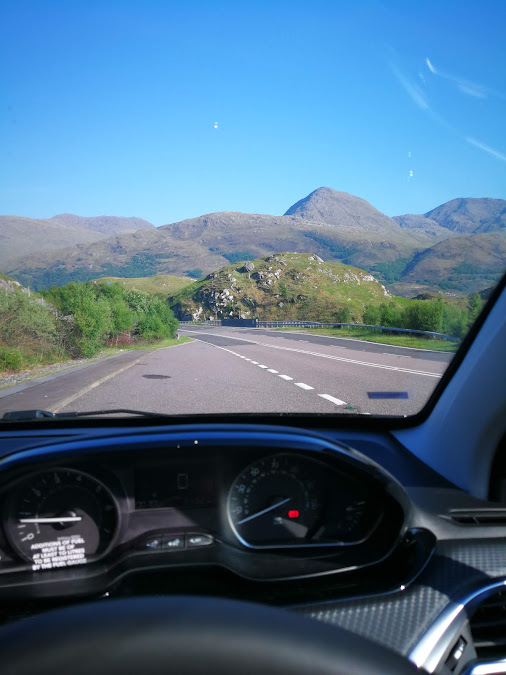
I crossed Lecht, did not stop in Tomintoul, and went on through Nethy Bridge, and onto the long, long pull through the central Highlands to Spean Bridge. Lovely motoring; the weather was kind, not a cloud in the sky. I refueled opposite the Ben Nevis Distillery, with the snow-spattered majesty of Nevis behind, against the blue sky of late afternoon. I say late afternoon: it was 8.30pm. At this latitude, in late May, it doesn’t get dark until almost midnight.

I camped wild not far from the shore of Loch Eilt. Apart from midges, which were, to be honest, a bit out of order, it was all I could have wished for. Dry, quiet, beautiful scenery. A lovely gloaming. At one point, a train clattered along the Mallaig Extension, which ran along the other side of the Loch. As soon as my tent was up, I lit a fire, and also got my trusty 35 year old Trangia stove going. Camping, whether wild or no, should not mean roughing it. I had Fillet steak, mushrooms, courgettes and fried potatoes, with tomato and avacado. A bottle of Badger beer to wash away the dust of the road, and a bottle of Malbec with dinner. I sat outside until 11.30pm and even then it wasn’t fully dark. It was a moonlit night. As I prepared for bed, I was casting a shadow in the silent, silvery moonlight.

In the morning, the midges were biting. I flung the tent into the back of the car, and made a swift, itchy escape. I arrived in Mallaig before 8am, and had a full cooked breakfast in the Seaman’s Mission, served by a cheery Polish lady. The Mission here in Mallaig has a remarkable second-hand bookshop. I picked up a little book of photographs of Derbyshire railways (I was brought up in Derby) and Jeremy Bowen’s account of the Six-Day War of 1967.

Later, I sat with coffee as the terrace of the Tea Garden Café. A very expensive latte at £3.40, but worth it to be able to sit outside in this glorious sunshine. Sitting watching the people go by, it was interesting to be able to spot the tourists. Generally older, thinner, English, German. And the songbirds here are tame.

MacBrayne’s ferry “Loch Nevis” sailed at 12.30p.m. Crossing to Rum and Canna, my fellow passengers were young families on holiday, older and younger sea-canoeists, mountaineers, and quite a few hard-drinking holidaymakers.

On the first evening, we took a stroll and walked into a First Response drama. A lady hillwalker had fallen ill, and advice was sought from the mainland. Modern mobile telephony can make these outlying islands much less remote and difficult to access than they formerly were.

The Air Ambulance was dispatched from Inverness. From far-off Inverness, realistically almost a day’s journey from here by ferry and road, in 45 minutes. The chopper swooped in and took the poorly lady off to hospital. It later transpired that she had a brain aneurysm. Whilst this drama was unfolding, we got talking with a gentleman I’d seen on the ferry – one of the hard-drinking holidaymakers. Turned out my sister knew him; a local electrician who had helped build the Rum Bunkhouse. A very friendly and helpful fellow with a strong Skye accent.

Next day, by Jeep over mountain roads to a beautiful and deserted beach, for a picnic. Pale sand, blue sky, hot sunshine. In the distance, the Black Cuillin of Skye could be seen. The sea listlessly gathered itself into miniscule ripples. Even in a full wetsuit, the water temperature could best be described as “Baltic”.

Someone noted of “island life” here, that there was not a glimpse of reality in any direction. Just this morning for a run out through the woods on the south side of the bay. There, for all to see, is a hidden village. Here is a complete village, concealed from view by trees planted some time during the 1950’s. The village is deserted, I’m thinking, since the Highland Clearances. People once lived here: hidden in the woods, are derelict houses, even a complete street facing the shore. Long overgrown, they are a testimony to an almost unwritten history of sadness and pain.

Rum was never a wilderness, even if it is a “national nature reserve”. As someone with strong ideological views myself, the hidden village acts as a reminder how far from reality, how far from the needs of real people, you can drift when you have the means to put your ideas before reality.

On the way back from visiting the woods, I passed the new wooden bunkhouse. A man was sat outside at the morning sunshine. He was nursing a beer. It was not yet 7.30a.m. We finish where we started: not a glimpse of reality in any direction.

A ride on a mountain bike, over a mountain pass, through rocky countryside oddly reminiscent of the macabre fiction of H.P Lovecraft.

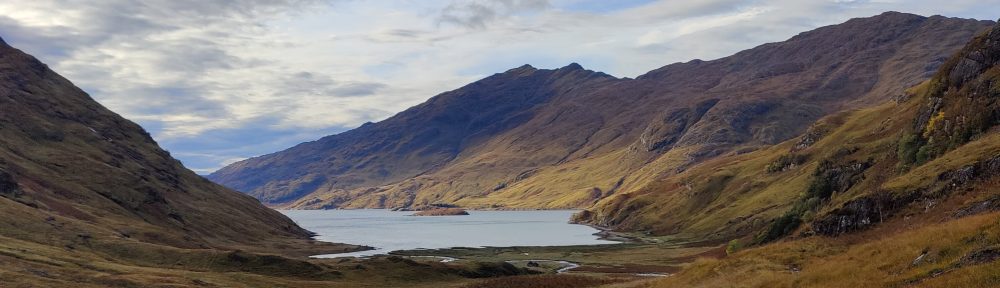
Everything seems to be arid and brown, yet this is no desert – there’s plenty of water around. I went to a place called Harris, to see the “mausoleum” built by the previous owners of the island.

Deer appear everywhere, even in the garden, and particularly at night and in the early morning. These are huge creatures, not at all like the tiny Muntjac and Roe deer seen in Surrey. In recent years, the deer fence surrounding the village of Kinloch has fallen into disrepair. It is a big deal, and would be expensive to repair. It is pointless to keep any kind of garden here. Any growing fruit or veg they will consume. Once resplendent bluebell woods have been eaten up. On the plus side, there are no foxes on Rum: the chickens roam free. They can safely go where they please. It makes for tasty egg yolks – if you can find where they were laid.

I visited my sister Fliss Fraser, who runs Ivy Cottage guesthouse on the Isle of Rum.
A review of “A Winter in Arabia”, by Freya Stark

A review of “A Winter in Arabia”, by Freya Stark

Delicately, beautifully written.  Rather like Wilfred Thesiger, she draws attention to an Arabia that no longer exists, an Arabia she may have, however inadvertently, contributed  to the end of.  She writes of hidden pools hardly visited by anyone but Bedu shepherds, of strange castles on the dusty, arid, windswept plateau of what is now Yemen.  Of villages where few if any of the villagers have seen a European.  Of casual vendetta and war continued through generations, brought to a fragile and not entirely permanant stop by the “English peace”.  She writes of men with great vices and great virtues, of small men capable of much when tried; of big men who do mean and small deeds.

She is eminently quotable and copyable for inspiration in one’s own thoughts.  She writes, inter alia, “the fear of disturbing the peace tended to limit our plans more than the wars of the old days, when a casualty more or less could make no odds”

The point here being, war tends to collectivize us and dehumanize us, strip away our importance as individuals.  In war, the individual, at least ostensibly, matters less and less.  “One casualty more or less”, one more or one less dead person. But people do matter; individuals do matter.  One person dying matters.  “Jesus wept” – John 11:36.

Freya has a subtelty, a delicacy of tone, reminding me of the sky at dusk, that pastel shade that is so fragile and short-lived. She writes of Arabs, the sons of Ishmael, “a patient and pleasant people, not roused to petulance by the want of supper or by the fact that they had only a cotton shawl between them and the rigours of the night”.

How challenging for us in the west, to me, right now. In this respect for the bedouin she is also like Wilfred Thesiger, who acknowledged in the bedu true and deep nobility and greatness, to which he could not aspire.

Jet: when Britain ruled the skies

Nostalgic, sentimental, patriotic, a little gushing, perhaps. These programmes are redeemed, for me, by the presence of Lord Tebbit. Tebbit is one of the few politicians who actually worked for a living before going into politics. We’ll learn a lot by him; when he goes, we shall not see his like again.

These programmes look back at the UK’s all too brief period of air supremacy in the ten years or so after the second war. It can be exemplified, distilled, as it were, by that image of a Vulcan bomber flying alongside a Lancaster. Two Avro machines, separated in design by a dozen years at best, but worlds apart. One, a creation of the late Thirties, the other, of the Atomic age.

We might look back on that period in the early 1950’s with a sense of wonder and not a little unbelief. From the end of rationing, until Suez, something golden was happening. A short renaissance of Empire, perhaps. A final gleam of sunshine out from under lowering clouds. A last fling of power; a final throw of the dice. We might well look back and feel justified in saying, hell, what went wrong? The historians might give a blunt one-word answer: Suez. But, it might just be a little bit more complicated than that.

Notwithstanding that potential complexity, it’s fair to say that our embarrassing failure at Suez was a milestone in the fall of the British Empire. After Suez, post-Imperial Stygian gloom. Before Suez, you might have kidded yourself, were you thus inclined, that the British Empire and it’s Commonwealth might have endured.

Directions were taken in those years that might have been otherwise. Were there really “cusp”points in those years? Could it have been different? Given the financial and economic reality – the Marshall Plan – post WWII, it seems unlikely.

But what, they built some magnificent flying machines.

Spring

Spring appears just like that
Almost like the turning of a card
Maybe there are such cards
Four suits – Winter, Spring, Summer and
Autumn.
Perhaps the gods themselves have such a pack.
Maybe they play for keeps
At certain times of year,
And perhaps the seasons turn
On whoever wins the game.
What would be your favourite card?
Perhaps the Jack of Spring, all mischief:
Loki, or the great god Pan.
There’d be a terrible Queen of Winter
Black Maria, or maybe
Just Tilda Swinton in “The Lion, the Witch and the Wardrobe”.
The Nine of Autumn,
Brown leaves and woodsmoke.
New England Fall would be the King of that suit.
Or the Two of Spring – the first snowdrops, daffodils.
The Queen of Spring,
Surely Bluebell woods.
The Ace of Summer,
The best is yet to come.
And maybe a Joker too…
Especially for the English. Musn’t grumble:
Snow on Buxton cricket ground in June, or
February sunshine, unlooked for.

China by train

From Guangxhou to Guilin by bullet train

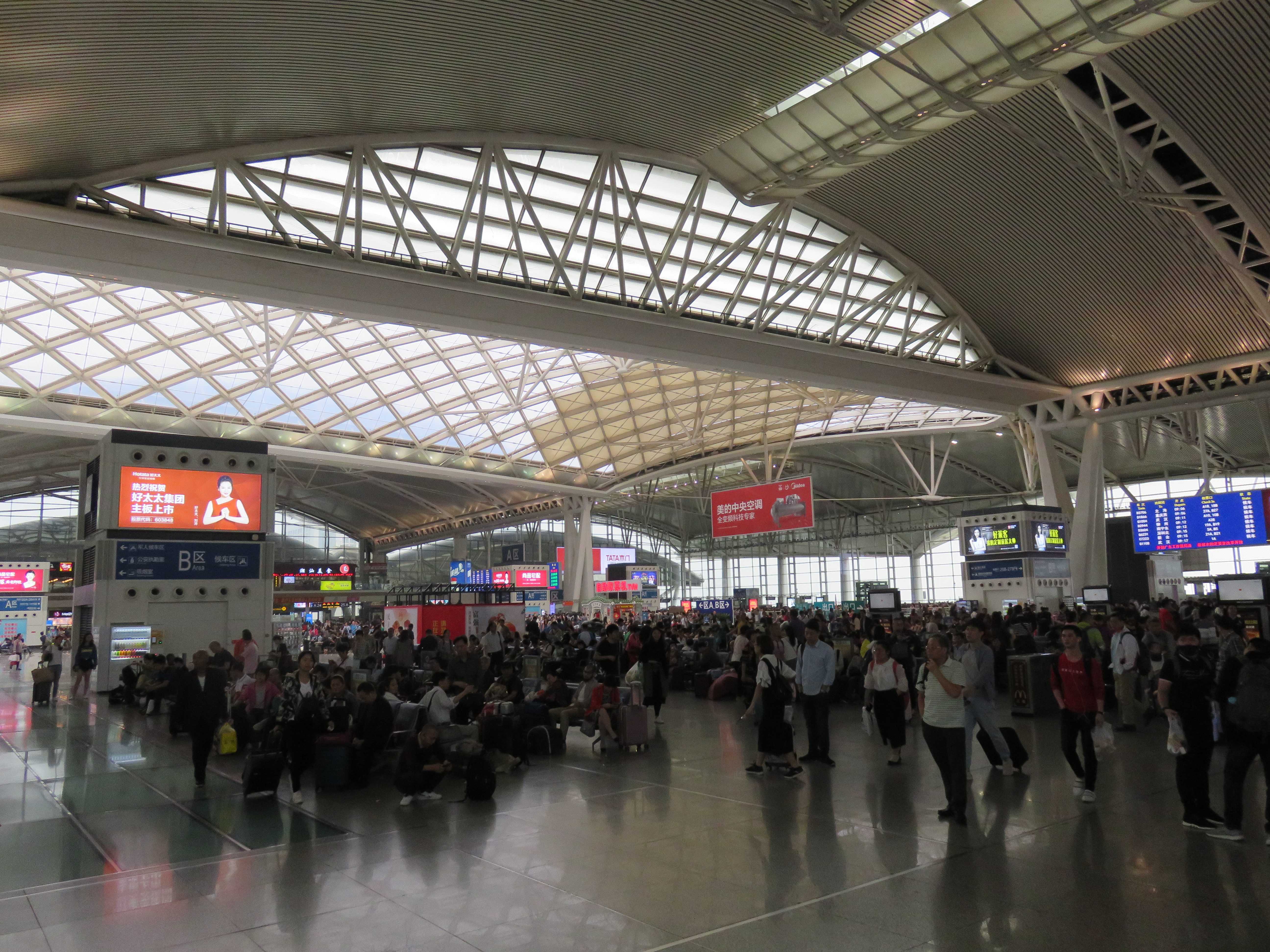
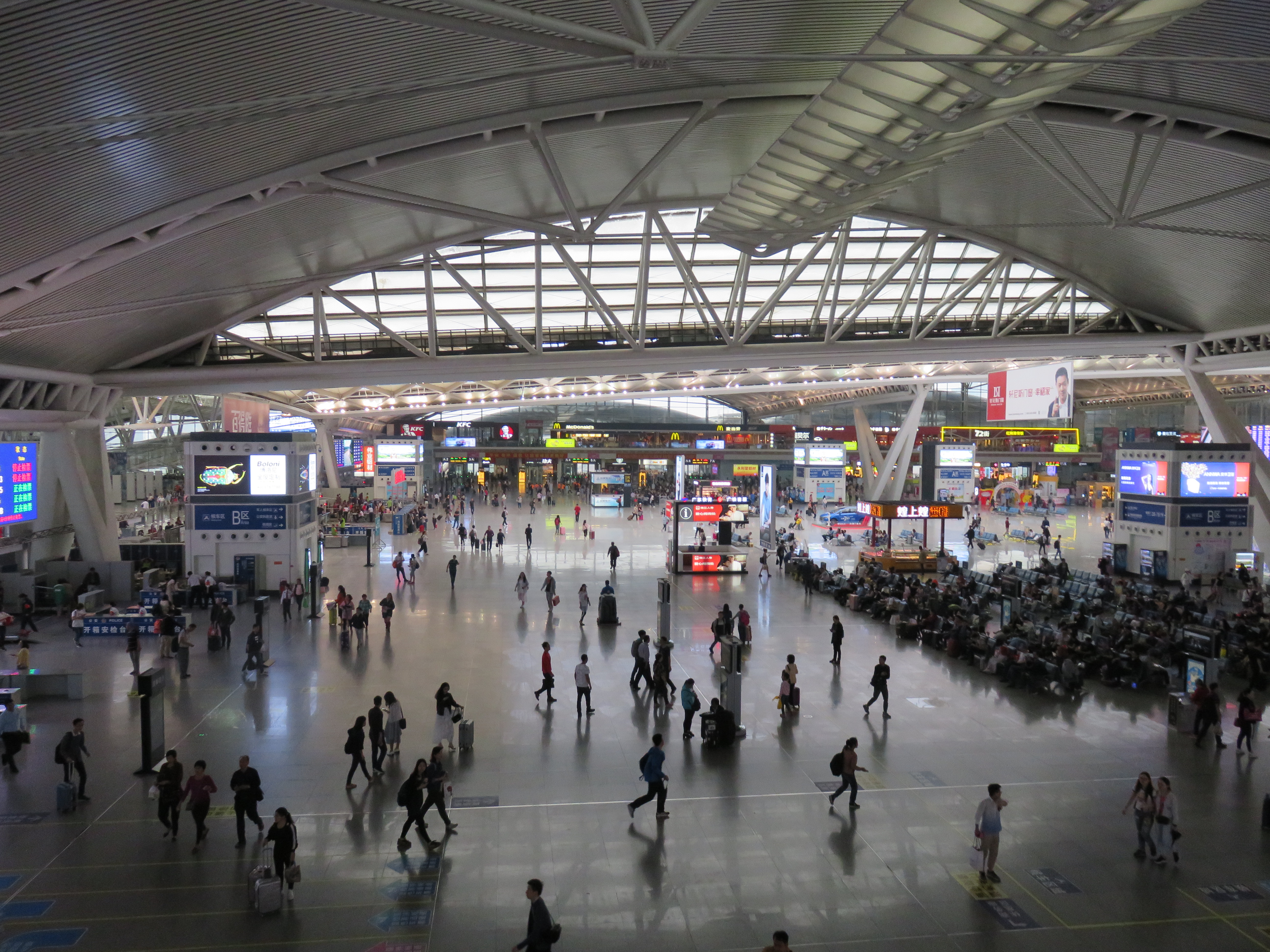
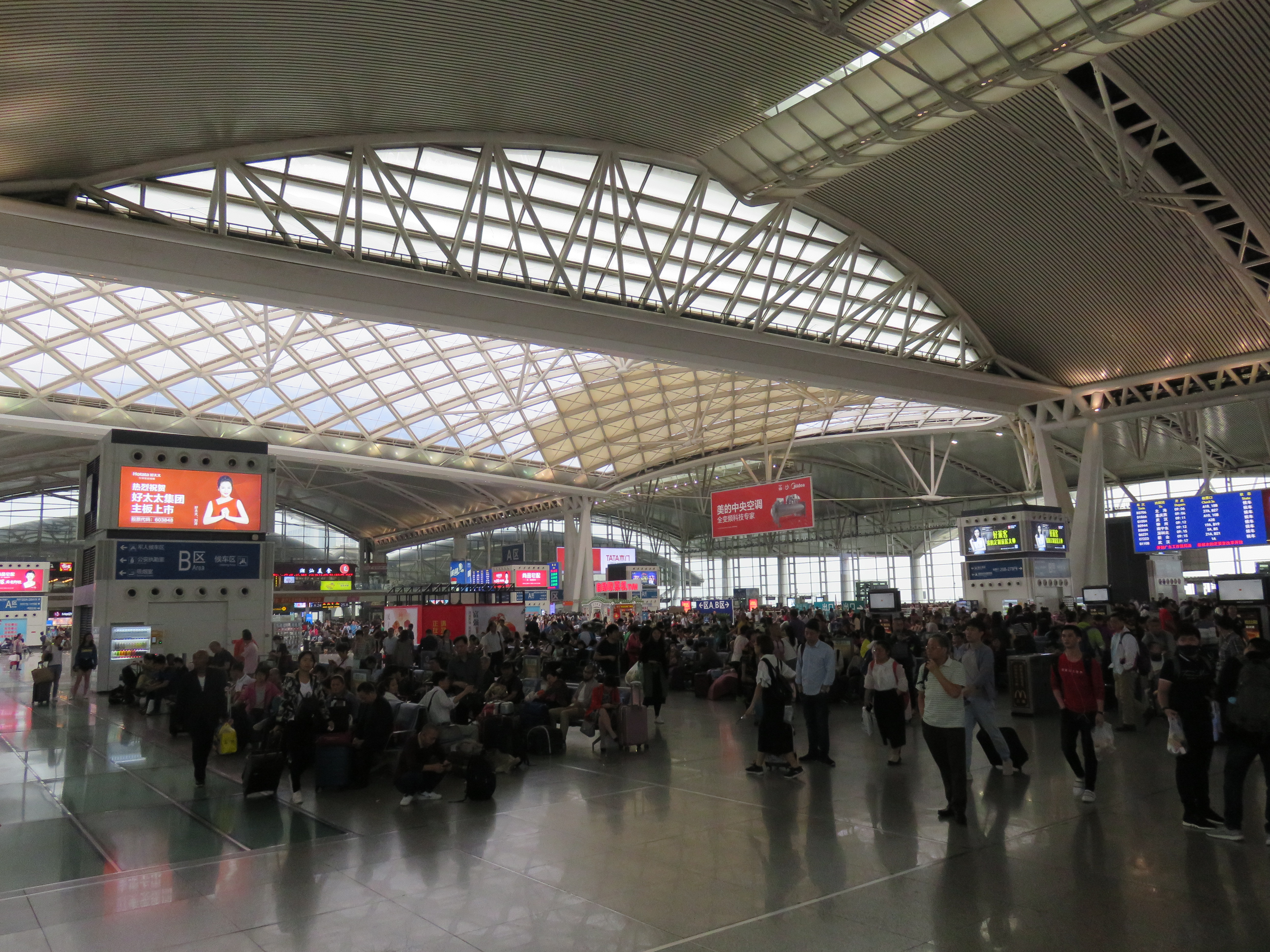
Arriving at Guangxhou South Railway Station, I am quite literally stupified by the size of the place.  It is a Terminal 5 amongst railway stations.  It is hardly distinguishable inside from a large international airport.  It is over three floors – like an airport, departures and arrivals are on separate floors.

IMG_1302
IMG_1304

This is a through station, not a terminal. Coming in by taxi, I counted at least 12 separate tracks coming out from under the canopy, all grey concrete on stilts.  The  floor is granodiorite tiles; the passengers are everywhere.  There are shops, booths, queues, scanners. It does not smell of decay and weak air-conditioning, as do so many large municipal buildings in hot climates.

IMG_1302

It is to my eye, no St Pancras: it is not built to last, and I suspect that, rather like Terminal 5, it may look distinctly jaded by 2050.

All must go through luggage scanners merely to get into the building. This is common enough at municipal buildings in China and increasingly so in the West. That said, the people doing the scanning and body pat-down work showed little interest – the scanning process is not strict.  Once inside, you then find what train you are on, and go through the ticket check to go “trainside” as it were.  Chinese high speed train tickets are not usable by any bearer, as train tickets are in the UK and elsewhere in the world – they are specific to you, as well as to a given seat in a given carriage.  Indeed. ours had our passport numbers on them in addition to our names.  But once through the ticket check, no-one was interested in our ID.  Once “trainside” and upstairs, it just felt like the airside of an big international airport. And the other similarity is, access to the platform is tightly controlled – no trainspotters welcome here.  We weren’t allowed onto the platform until only a few minutes before departure,  The train had already swept in.

The station is only a few years old. It speaks of tremendous economic growth, this outpouring of concrete: Bill Bryson once wrote something to the effect that half of all buildings in the United States had been built since 1980, and fully 90% of all American buildings, since 1945.  A similar thing is happening in China.  Natalie Merchant sings, in her song “Motherland”

Where in hell can you go
Far from the things that you know
Far from the sprawl of concrete
That keeps crawling its way
About 1,000 miles a day?

It is applicable here in China, at this time of expansion, as viaducts arc across whole cities, as 150mph bullet trains flash through tunnels so expensive as to defy understanding.  How do they do it? The growth of high speed rail in China today is rather like the development of the Interstate network in the USA of Eisenhower’s time.  And just as the Interstate highways changed America beyond recognition, high speed rail is changing China.  The old China is still visible, but it is disappearing. Go there and see it while it still exists. The old ladies brushing the street with straw brooms.  The scooter riders with no helmet but an umbrella. The little stalls selling foodstuffs. The little motorcycles converted into vans, burdened under seemingly impossible loads.

Off we go and there are almost continuous announcements in Mandarin.  Once through the suburbs, the train perceptibly speeds up and shoots along at 150 mph.  The acceleration is noticeable, and audible, an indistinct and distant hum rather like the sound of the original Starship Enterprise at Warp Factor 10.

We plunge through misty green forests and mountains, brown rivers, farms and rice paddies. There are endless tunnels. Some long, some short. Billions of dollars have gone into building this railway – and it is only one of many.

We arrived at Guilin Bey (North) Railway Station at 12,30pm on a hot and humid afternoon.  We  got off the bullet train, along with myriad Chinese, and followed them down the stairs into the underpass. Chattering, walking, kids laughing, suitcases on wheels rumbling along. The Chinese experience is to be surrounded by people.

IMG_1578

To Liuzhou and on to Zhiangziajie

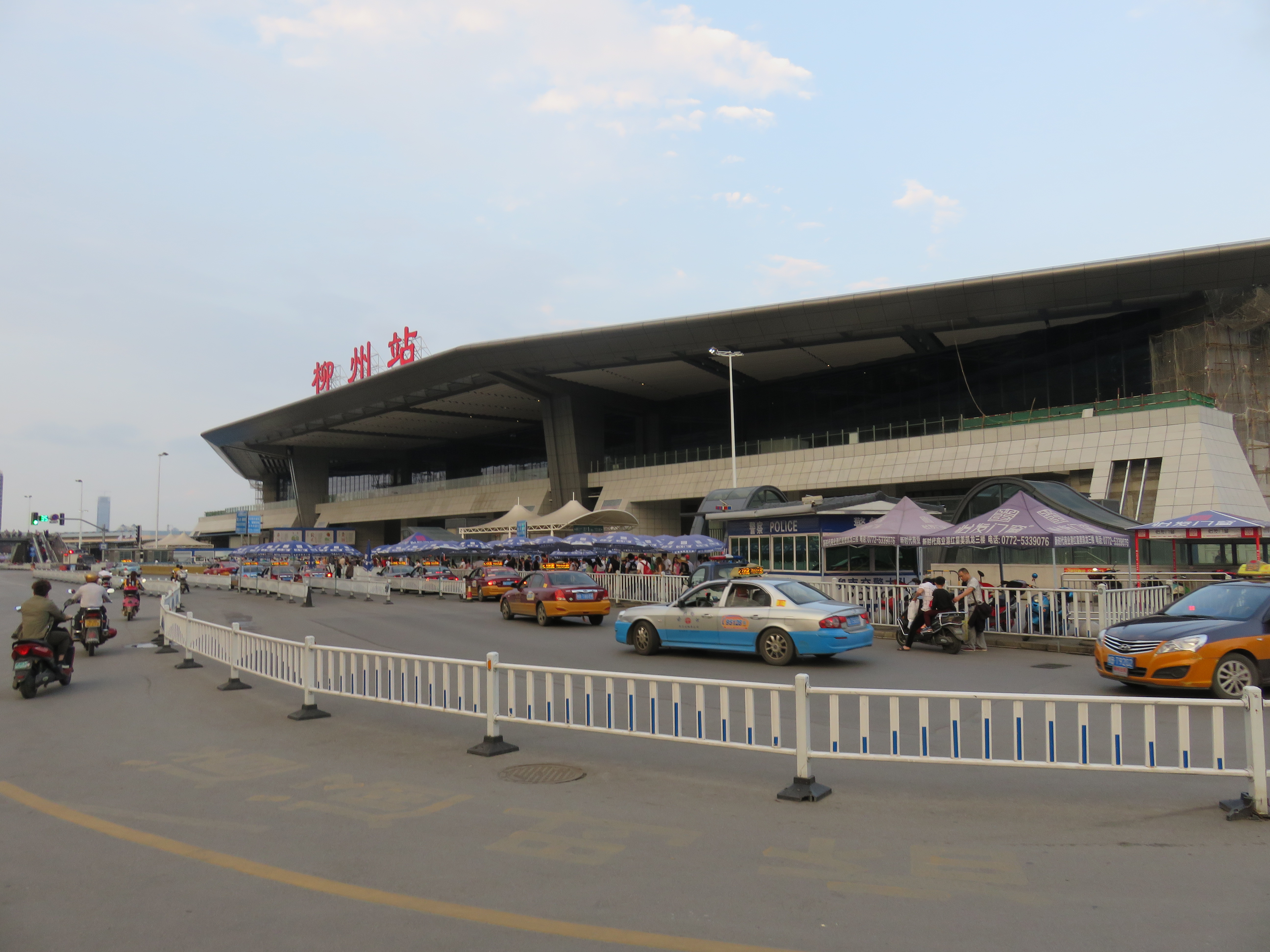
Onwards: another city, another railway station.  This one is different; older, more prosaic.  The first two, at Guangxhou and at Guilin North, were grandiose to the point of being ridiculous.  This one is more intimate, more obviously a railway station rather than a palace, and very much older, dating from the 1970’s or even older.

In the huge waiting room (a departure lounge really) we’re enjoying massage chairs at Y4 (about 40p) for 10 minutes.  I say “enjoying”.  My wife and daughter think they are great, and had two goes each.  I found the massage a bit heavy handed.

cof

By bullet train from Guilin to a city called Liuzhou, from whence we will take sleeper train to another city called Zhiangziajie. So many cities I have never heard of.  Here is a train with a front like an aircraft, like a TGV, based in fact on a Japanese Shinkansen train, and the “dwell time” at this station (the time spent stationary in the platform) has been over five minutes.  That said, the train did arrive early.  As a commuter in the Home Counties, I’m accustomed to “dwell times” of less than a minute – in and out, quick quick quick…

Liuzhou is a city of over three million people. I’d never heard of it, and it is just one of hundreds of cities of this size in China.  Here is the railway station:

IMG_1640

We walked a little away from the station, having to run some light interference from taxi drivers, in order to be far enough away from the station to find somewhere to hail a “Didi” (the Chinese equivalent of Uber) where it might safely and legally stop.  We took the taxi to a second railway station, called Liujiang, located in in an area of the city called Labao – a good 40 minutes by taxi.  The driver was an affable fellow; himself a Chinese teacher, and he took our photo when he dropped us off.  The second station, whence we arrived at dusk, was something of a disappointment.  More in the “Inter-Railing” style of railway station – just a single track, a single waiting room.  Outside, some shops and little cafes where we found something to eat.  Though not without some stress and difficulty in establishing what we might eat: no pictures, and of course no English menu.

The waiting room was stressful, to a degree: by now we were tired and the train was late.  “Do not lie down” the signs said. People laid down.  Our  tiresome wait was enlivened by the sign above the door for the “Security” people, where the proof-reading had failed.  The “r” and the “i” had blurred into an “n”. This slightly rude sign cheered us up as eventually the train roared in, and everyone got on.

A review of “Cool Hand Luke”, by Donn Pearce

A review of “Cool Hand Luke”, by Donn Pearce

dav

When set against the wider genre of prison literature, “Cool Hand Luke” is perhaps somewhat tame. This isn’t “Papillon” and it certainly isn’t in the same category as anything coming out of the prison-based suffering that took place in the Soviet Union. This story has nothing of the human privation and suffering shared with us by Solzhenitsyn in “The Gulag Archipelago” or “A day in the life of Ivan Denisovich”.

In spite of this book being made into to a classic film about torment and suffering in prison, it doesn’t really deal with the full horror of man’s inhumanity to man in prison.  To learn about that you’d be better off listening to Joan Baez’ wonderful song “Prison Trilogy (Billy Rose)”, and then weeping.

What we do have here, is prison guards and prisoners as real people. We get stories within stories. The author introduces his hero only gradually, delicately, subtly.  Even the narrator doesn’t tell the story but puts it in the mouth of one of his characters, “Dragline”, all of whose teeth were brutally kicked out by Miami detectives. “Dragline” is played in the movie by George Kennedy, in one of his best roles.

The story is an interesting reflection on post-war Florida. It’s difficult to pin down exactly when the story is set.  At one point, the narrator (the prisoner called “Sailor”) uses the term “diesel locomotive” making it clear that this is new and unusual.  He refers to a train called the “Silver Meteor’.  Most of the convicts are under thirty; some seem to have been WWII veterans. In the end, we learn that Luke’s experiences in the war have by no means left him unchanged.

There are hostages to fortune which may offend the modern liberal reader. Twenty-first century sensibilities will not take kindly to the frequent use of certain words describing African Americans. And then there is the passage describing “The Girl” – a schoolgirl of sixteen.

But in the end, this book was a thought-provoking, worthwhile and entertaining read. Have you got your mind right? That deep underlying question can keep some of us awake at night, for there’s a little of Cool Hand Luke in us all.

A sermon from the late Rt Revd Richard Hare

Here is a sermon that was preached at St. Alkmund’s, Derby, sometime in 1994. It was towards the end of Paul Corrie’s time, and occurred on the eve of the congregation moving to two morning services, St Alkmund’s having grown massively in the previous ten years, and the hall was no longer large enough for just one service of 500 or more people.

Richard Hare was a suffragan bishop well-known for his Charismatic tendencies. Though at this point he had been the Bishop of Pontefract for 21 years, he was heavily supportive of the Charismatic movement. He speaks here after his retirement, at the invitation of the vicar Reverend Paul Corrie.

I vividly remember the sermon being preached. Richard Hare’s beautiful spoken English, his “cut-glass accent”, and his exquisite professional timing as a public speaker, have remained with me ever since. It is fair to say that such public speaking and preaching as I have done myself, has been influenced by this one sermon – most particularly his professional timing.

At one point he recounts a poem created by a nun, in which the nun says to the Virgin Mary, thinking of her saying “yes” to the angel, as a young girl, when she replied, “it will be as you say”:

“In nine long months, in thirty-three short years, in three eternally long hours, did you never wish that yes…………………….unsaid?”

His pause between “yes” and “unsaid” was theatrical – and just exactly right.

Listen and enjoy here.

To the rescue

Rescuer,
We try to be like You
The boy scoots past and sings,
“To the rescue”
We try to be like You.

Teacher,
We want to learn from You
The youth climbs hills and shouts
For joy.
We want to learn from You.

Lord,
We long to follow You
The man lives life and whispers,
“Show me
How to follow You.”

Off the map, by John Harrison

John Harrison’s “Off the map”, is an account of an eccentric Englishman on an Amazonian journey.  I am never in the mood for English eccentrics, particularly when they are – as they do tend to be – not really eccentric at all, but just opinionated un-original anti-American lefties.

In Deorla Murphy’s foreword to Harrison’s “Off the Map” she writes “the Harrisons wanted to remain in touch with…life as it was lived…before technology rendered our survival skills redundant”.
This is the purest nonsense.  Technology has not rendered our survival skills redundant; it has only changed what those survival skills are. These people would reduce us to hunter-gatherers, and they should be stamped on from a great height!

Harrison writes of garampeiros (gold prospectors) “they are a different breed from the Brazilians who opt to stay at home. They are sharper, harder working, more adventurous and less tolerant of hierarchies and bureaucrats” [there is more.] This is a profound and powerful truth. It goes to the heart of what R.A Heinlein writes, that those who emigrate are inherently cleverer and more able than those who remain behind.  This description of the Brazilian Amazon frontier is most instructive.

Harrison can surely write the most excellent English, but he comes across as someone I’d not want to meet.

A review of Radiant state, by Peter Higgins

Strange worlds: A review of Radiant state, by Peter Higgins

This third novel of the “Wolfhound Century” trilogy manages to stand alone – as all good novels ought – and is entirely readable without first reading the other two. Higgins has created a weird alternate reality. I like this kind of “genre busting” – except that it is no longer true to say that the work busts genres. It can be labelled in more than one way, perhaps. Opening as hard sci-fi, it alternates thereafter between political thriller (an assassin trying to kill the president) and weird pure fantasy (archangels and witches and dead bodies wandering through the trackless woods).

Others have done work like this. It owes much in concept to the work of China Mieville.

One thing I do like, though it sets my teeth on edge as someone who loves the explanation, the reason, the exegesis in detail – is that he has not explained himself. He makes no explanation of the strange happenings on what is clearly just an Earth with a place that is, whilst never referred to as such, just Mother Russia. He does not account to the reader for their being two moons, or for the dead yet walking the earth, or for archangels and sprites and other strange creatures coming into the story with no more ado than a ticket inspector on a train or a shop-keeper.

A review of “Dark Voyage”, by Alan Furst

Deeply engaging, human fiction: A review of “Dark Voyage”, by Alan Furst

Holiday reading? Yes: I’ve long enjoyed the writing of Alan Furst. He writes exquisite English, with nuanced characters, all having complex, ambiguous motives. He has deep sympathy for the fallen, human condition.

But for all that, Dark Voyage is different. It has the same male protagonist making his way through a world distorted by Nazi Germany, someone who is at root, a modern European in a world dominated by war splitting Europe asunder. It has the same cast of characters – the shadowy, morally bankrupt SIS agents, the Russian emigres, the fixers and shakers in smart suits. The women. He even manages to get in a dinner at Table 14 at Heinigers in Paris, though only in flashback.

Unusually for an Alan Furst hero, the main character speaks English. Also, most of the action takes place at sea, and here is the rub. I was, as a former seafarer myself, drawn to the book on that basis. At the same time – and I’m not entirely sure how the author would take this – Dark Voyage reads like a Douglas Reeman novel. Reeman’s naval stories are – like Furst’s books – quintessentially readable tales about the frailty of the human condition in time of war or impending war. Both writers suffuse their stories with the gentle light of compassion and understanding for their characters. Both -as the jacket of Dark Voyage attests – fundamentally humane writers. Wonderful, relaxing stuff. Reading does not have to be hard work.

Kathryn Williams at St. Peter’s Church, Tandridge

In the evening, a short drive through light falling snow, to St. Peter’s church, in the village of Tandridge in East Surrey. Tandridge is tucked away on a slope of the North Downs that tilts away from the main road.

There’s a hidden, lost world up here, almost – a land that the 21st century forgot.

IMG_20180317_194104.jpg

Arriving at the churchyard, we’re greeted at the Lych Gate. It’s a winter wonderland. There is a dusting of late snow like icing sugar on a cake, and the ancient yew tree is decorated with fairy lights. Somewhere in the background, one of those little portable generators is grumbling away. Under a gazebo near the church door, some rather good curry is served, prepared by a local restaurant. Here, tonight, in this place, old England and modern 2lst Century England meet in agreement and in harmony.

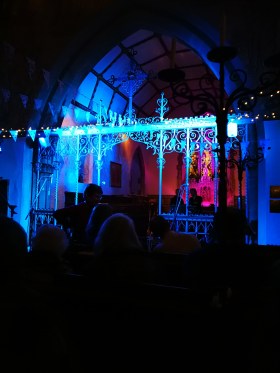
Inside, there is beer available, and we are at liberty to sit eating our curry in these old wooden pews. Modern electronic concert lighting brings a magical atmosphere to this medieval building. The opening act is the Rector’s own band, The Effras. Encouraging, uplifting, human. Songs, as frontman Revd. Andrew Rumsey notes, about seaside towns, rural churchyards and… Sarf Landan. Here a song about couples canoodling “underneath the angel”, with a name-check for Pernod and black. Or, a song about “Some houses in Croydon”, or my personal favourite, “Penge in bloom”.

Kathryn Williams had the clearest, sweetest voice. She was engagingly nervous and human. At one point she left the stage to fetch some sweets to give to some of the children at the front. She seemed very vulnerable, revealing much of herself in her playing and her stories, such as her candid anecdote of emotional collapse in “Underground”. I was mightily blessed by her songs, her performance, her openness. She had some cool sampling and looping stuff that enabled her to double and triple her voice, and back herself on vocals, and her guitar playing was a delight.

All in all, as the Rector said the following morning, a “transformative” evening. No less than the truth.

A review of “Churchill and Orwell”, by Thomas Ricks

My two favourite writers: A review of “Churchill and Orwell”, by Thomas Ricks

As ever in my book reviews, the word “readable” comes near the beginning and is intended as a compliment. As Orwell himself wrote, the writer should be doing the hard work, not the reader.

Three writers of the last century, have influenced me greatly. Churchill and Orwell are two of them. The third is Ian Fleming. I knew I had to have a copy of this encouraging and inspiring work, the moment I set eyes on it on the shelf in a bookshop in Sevenoaks. A single book about two of my favourite writers, it did not disappoint. Part commentary, part biography, it revealed things that I did not already know. It made me think about my own position – how was I like Churchill, like Orwell? How was I dealing with the Lord Halifaxes, the Neville Chamberlains, the Franklin Roosevelts, in my own life? Neither man was perfect; both had feet of clay. As much can be learnt from a study of their flaws and failures, as from their successes and their greatness.

Churchill, as well he might, tends to dominate that part of the work dealing with their actual lives – the biographical section. Orwell is predominant in the latter part of the book dealing with their legacy. Orwell, virtually unrecognized in his lifetime, is today considered one of the most influential writers of the twentieth century. Ricks argues that Orwell was and is the more influential author and “thought leader” for today’s world, even if Churchill was the more influential at the time. It was interesting to read of the two characters being unrecognised and “in the wilderness” at different times.

There were a few unsure steps and odd passages, some occasional gushing and some arguably unnecessary detail in places, but in general, this was an excellent and worthwhile read. It is amongst those books which I might call “life-changing”.

Citizens of a country that no longer exists

An older couple get onto the train before me. In fact, I inadvertently got between the two of them, and allowed the gentleman onto the train before me. He thanked me with grave and particular courtesy.

The past is a different country. Any of us might be citizens of that country that no longer exists. An England, or indeed any land, that has passed away, ceased to be. We may be people whose allegiance is to a time, and place, and way of life, that is now forgotten.

I myself, never mind that polite old gent, am a citizen of such a land. Like someone standing on the seashore, as the wave recedes, who feels the water rushing past, draining away, eroding their footing in the sand of the present.

I know a younger lady, but lately married, who herself also belongs to that country. Though only young, she has dual citizenship in the countries of the present and the past.

GK Chesterton once replied to the accusation that he lived in the past, with the sharp and truthful observation that there was no room in the present.