Unknown's avatar

About Nick Hough

Don't get rich quick - get smart forever: I believe in knowledge. I'm interested in politics, economics, religion, science, and engineering. I'm a Christian, a family man, and a Scouter. I also tweet @enough32.

I do hope there’s hope: a review of The Rig, by Roger Levy

I cannot now recall who recommended this story by Roger Levy: possibly William Gibson, on Twitter, or possibly the recommendation came from having read Dave Eggers’ upsetting story “The Circle”.

Do we judge a book by it’s cover? Alas, we do, and the publishers are complicit in this, bringing us paperbacks for womenfolk that are broadly (but not always) in light, pastel colours, and paperbacks for men, that are either black or in dark hues. You won’t be reading an Iain M. Banks novel in a paperback copy that is anything other than dark in colour. “Dark have been my dreams of late”, said Theoden King, in the Lord of the Rings. And well they might have been if he’d read this book or indeed a lot of other modern science fiction.

I long for science fiction that is positive and hopeful. I started “The Rig” and after a struggle at the start, I got into it. So I tweeted to the author that I thought it was great. [That this is possible at all is a both a blessing and a curse of modern social media]. I wrote to him, “I do hope there is hope”

What we have in “The Rig” is a future where humankind has had to move to another “system” where there are a number of nominally habitable planets. Much is made of terraforming. Two planets are different – and one of them, Gehenna, a loosely Christian religious dictatorship, forms the background to the opening of the story. The story’s hero is, as some say, “on the spectrum“. Indeed, Alef is autistic to the point of being socially inadequate, but very, very clever. He – and his father before him – are the not exactly unwilling tools of an unpleasant gangster needing assistance with computers.

We’ve seen it all before. These gangsters and all their disgusting subordinate mercenaries, enforcers, mistresses and hangers-on all appear in the dark science fiction of such authors as Alistair Reynolds, Paul McAuley, Iain. M Banks and most particularly Richard Morgan. I grow tired of them. It displeases me that writers, publishers and indeed the reading public, seem have a fascination for them, all the sordid violence and mutilation, all the vengeance and torture. I agree with R.A Heinlein’s character Lazarus Long, who said in “Time enough for love”: “I’ve never understood the gangster mentality. I simply know what to do with gangsters“.

Notwithstanding all that, I found I could hardly put this book down, and I found that the plot drew me on. It was simple enough not to confuse me and yet refined and complex enough not to be completely see-through. You’ve got implicit discussion of the internet and what it all means; you’ve got old Earth clearly destroyed or rendered uninhabitable by some unexplained environmental catastrophe. You’ve got a dig at organised religion and for that matter, at Christianity. So far, so normal for “dark” sci-fi – all the right boxes are ticked. But, much more unusually, you’ve got an autistic main character whose feelings and thoughts the author has worked hard to portray.

I’d make a plea, as a Christian, for positive, hopeful and uplifting stories. I’ll admit the publisher may say “it won’t sell”, but you know – I think it will. Something that defies the rather H.P Lovecraftian view taken by nearly all modern science-fiction. In all my life of reading I can think of only a handful of authors writing such material. I was impressed by Maria Dona Russell’s “The Sparrow” – reviewed here, then we’re back to Stephen Lawhead, whose works The Search for Fierra/The Siege of Dome and Dream Thief I read thirty years ago. Or even C.S Lewis’ classics like “Out of the Silent Planet”, “Perelandraand “That Hideous Strength”.

From the Gulag to the Killing Fields – notes on Totalitarianism

A few musings on totalitarianism, brought on by a work-related visit to Vietnam. I have juxtaposed this with a recent re-reading of Orwell’s “1984”. I read a lot of books at once, mind, and I am also ploughing my way through a collection called “From the Gulag to the Killing Fields: Personal Accounts of Political Violence and Repression in Communist States”. It has been put together by an academic called Paul Hollander, himself a victim of the political violence of the Hungarian uprising of 1956. It’s certainly not bedtime reading. It makes uncomfortable reading for me, much less for anyone with remotely left-wing sensibilities. We tend to look at Russia and China as the worst offenders in terms of the sheer volume and quantity of communist political oppression and violence, and this book tends to support that view. But reading books these upsetting personal stories, other places take the record for sheer horror and human tragedy (Cambodia and Vietnam). For the ill-treatment of political prisoners, I’d look at Cuba, where there was a peculiar and toxic mixture of Latin machismo and the malevolent foolishness of Marxism.

It never fails to be a pleasant surprise to me that books like this collection are in print in the UK at all. It is not beyond the bounds of darkest fantasy that a time will come for the UK when having a copy of such a book could put someone at risk of being sent to prison.

It’s always good to pick up a few points from Orwell. His character “Bernstein” who ostensibly writes the “book within the book” plot device allowing Orwell to lecture us on totalitarianism, says that the rise of machines has, “by producing wealth which is sometimes impossible not to distribute”, led to an increase in average living standards. Our standard of living has indeed improved from the early 20th century (earlier really) until now, and should continue to improve all this century. This is not politics, nor economics, but technology – the rise of machines. Orwell notes that “an all-round increase in wealth threatens a hierarchical society” and “A hierarchical society is only possible on the basis of poverty and ignorance”. Amen. This truth lies at the very heart of “1984”, and at the heart of opposition to technology for it’s own sake. Opposition to “machines taking over men’s jobs” is at heart a desire for order and hierarchy, a vote for the established order, an endorsement of the status quo. And I believe the status quo is almost invariably worth upsetting. Technology and machines, of themselves, create wealth and hence threaten the status quo in hierarchical societies.

The frailty of human life

Three recent deaths, all juxtaposed, all very different, form a backdrop to the last few days and move me to put pen to paper. A murder, a suicide, a death from disease.

Knife murder: The murder of Jodie Chesney comes to mind first. A young person is snatched from us as a result of a deliberate act of deadly violence. It is doubly brought to my attention because she was an Explorer Scout: I am a District Commissioner for Scouts. We all wring our hands – what can we do? Some say, with strident tone, “This has to stop!” and of course, they are right. But these are empty words; those who say this have little if any power to prevent the rampant knife crime that racks our nation. I suspect that our government, realistically, lacks the political will to do anything really effective about knife crime. I was in Singapore recently and saw how it is quite safe to leave your wallet lying around. Singaporeans explained to me graphically what the state does to thieves in Singapore. I don’t expect there’s much knife crime in Singapore either. But just and appropriate treatment of knife criminals and indeed knife murderers will be too much for most of us in UK to stomach. Some rightly argue for a solution that is not penal in nature – addressing the root of the problem. But that is a long term solution delivering a safe Britain in the 2030s, and does not solve the problem we face now. Meantime, we look behind ourselves more often and stay more alert in public spaces – good if cynical advice at any time.

The suicide of Keith Flint of The Prodigy is the second death I would reflect upon. The Prodigy, if not actual rock’n’roll, follows the important rock’n’roll principle of scaring your mum and dad. I myself am drawn to The Prodigy precisely for that reason – their music is not nice. To some, it is offensive. I sometimes tire of “nice”. Say what you like about The Prodigy, you could not call them hypocritical. There are other musicians out there playing very listenable traditional blues rock’n’roll. Reputably and by commonly acknowledged anecdote, some of these players are rude and unpleasant men, however harmonious their music may be. Keith Flint and the music of The Prodigy may not have been harmonious to some of us. But for all that, he did have a reputation for being a friendly and helpful guy. And he took his own life, which points up the growing concern we have today for mental health: a vital issue that ought not be neglected.

The third death I would reflect upon, I only found out about by browsing a Christian magazine. The passing away on 6th February of the theologian Canon Michael Green, was a shame and a sad loss. You wouldn’t have heard about that on the BBC, I thought. He was and remains very influential as a thinker: I’ve read a number of his books; they are on my shelf still. I once heard him preach at St Alkmunds Derby, in the late 1990’s. He recounted in that sermon how he had met a guy in a car park at Euston station, and this guy asked him if he could break a fiver for change for parking. Michael Green had given the driver the few quid in change he needed – to which the driver’s response was a horrified refusal. Canon Michael replied – “Take it – that’s the way my Boss works…” which opened the way for a conversation about Christianity. As he himself noted, he was an academic who was also passionate about the Lord Jesus Christ.

I make no apology for mentioning all these three sad deaths in the same post. All were tragic: a murder, a suicide, a death from a dreaded illness. We do well to remember how frail we are, and as my wife’s late Aunt noted, we should live while we are alive.

A review of “Rocket Fighter”, by Mano Ziegler

A review of “Rocket Fighter”, by Mano Ziegler

What a remarkable read! Mano Ziegler, a second world war fighter pilot with the Luftwaffe, published, in 1961, “Raketenjaeger 163“. This excellent little book was subsequently published in English as “Rocket Fighter”. It is the very readable story of the development of the Messerschmidt 163 rocket-powered interceptor during WWII. My copy came as a gift from a close friend of mine.

image: Wikipedia

It is wonderfully written. Lovely English – one may ask whether this is because it was well written in the original German (which I find more than likely) or is it an artifact of translation by someone who can write beautiful English? It comes across in waves of easy-to-read, rolling prose.

It’s worth mentioning, at a remove of seventy years since WWII, that the work is completely free of any political rancour or bitterness, and there is little mention of the war itself at all, except toward the end of the book when the onward juggernaut of the Soviets was making its way across eastern Germany. The war is seen always as an effect, a shadow, an influence.

The story here is about the airmen who worked to the best of their abilities to transform this innovative new rocket plane into an actual operational fighter. The heroes are the airmen. They are no different to American airmen, or British airmen. At one point, a pair of Mustangs fly over and strafe the airfield, causing the flyers and a number of their female colleagues (WAAFs of some kind) to fling themselves into a slit trench or ditch for shelter. Emerging from shelter after the raiders had gone, one of the airmen shakes his fist at the retreating Americans: “look at my bloody trousers – straight from the cleaners too!!” These men had an excellent custom of “birthdays”. if something happened to an airman where he ought by rights, to have died – but survives – that day, ever afterwards, becomes a new birthday, with cake and drinks and appropriate celebration.

The heroes are the men that lived and died working on the rocket planes, which were unreliable if amazing when they worked. And these brave men sometimes died hard, literally dissolved by the liquid rocket fuel, which was concentrated Hydrogen Peroxide.

The astonishing technology is the other hidden hero here. History is generally written by the victors: I was brought up in 1970’s Britain, and was taught in school that Frank Whittle invented the jet engine. German aviation technology seems almost like “alternative history” to me. Men like Alexander Lippisch, who pioneered the tail-less “delta” shaped aircraft (so iconic later in the Avro Vulcan) so nearly brought the Germans victory in WWII. To read or watch Philip K Dick’s nightmare vision of a 1960’s where the Nazis won (“The Man in the High Castle“) and see a world spanned by supersonic jets, and a manned mission to Mars, is to shiver. Terribly plausible, at one level, when you consider this frighteningly advanced technology, and the upright, honest and capable men, like Mano Ziegler and others, who were set by the Nazis to develop it and fly it.

There’s hope for Merrie England

In posh frocks and best suits, we took train in the rainy morning up to London Bridge. It was that kind of fine rain that gets you wet. The event we were invited to was not a wedding, but it proved to be more like a wedding than anything else. We were going to Southwark Cathedral for the Ordination and Consecration to Bishop of our friend and former rector, the Reverend Doctor Andrew Rumsey.

At the cathedral we took coffee with a lady we know who must use crutches to get about. She bears considerable pain and disability in her life with a very English stoicism and understatement, and she often looks rather tired and drawn. But today she had battled through on her crutches and was looking very well, pushing the boat out to join in this important celebration.

And then we were all seated. There was a short warm-up act, a deacon or dean or some such, who made everyone laugh while explaining how things would go during the service. In a more secular gathering, he would have been the person who had to start his short speech by saying “There are no planned fire drills today”.

Then there was a procession. There were dozens of richly robed prelates and lords spiritual. Bishops, deans, deacons, priests, acolytes and singers. A number of people carrying shiny sticks, or candles, or holding up Bibles. And amongst this procession, all our clergy friends. In all this colour, pomp and pagaentry, a connection to people we knew. A young priest I know touched my shoulder as he walked past. Hey Nick!!

The final person in the procession was the Archbishop of Canterbury, who took the service. Our former vicar was presented to Canterbury by two mentors, one on either side: the Bishops of Salisbury and Southwark. Questions were asked, “Do you believe him to be of Godly life and sound learning?“, using a form of words that must be centuries old.

Canterbury went on to cause a clerk – “the Provincial Registrar” – to read out the whole of the letter of authorisation for the ordination of a Bishop – the letter patent. Here was language linking the everyday of the here and now, to the sweeping arc of history; here were words from the seat of power, from the Queen herself, relating to someone I’ve sat and had a pint and peanuts with. Just remarkable. One might feel part of a nation, tribe or group as it exists across the land today, but less often, perhaps, might we feel that sense of belonging across time, stretching back through the generations. And listening to this letter being read out, we were all part of Merrie England. Someone else deserves the credit for saying this, but there is hope for Merrie England when people like Andrew Rumsey are appointed to posts like this.

The sermon was given by the Reverend Canon Chris Russell, the Archbishop’s Adviser for Evangelism and Witness, and parish priest in Reading. And what a sermon! Of the art and craft of sermons, my old vicar used to say, “always start with personal stories”. Chris Russell did just that and took us from the inessential (in his family’s case, a shower head that lit up) to what we really need. What do we really need? What do we really want? What MUST we have? God’s call on our lives: all of us are called by God personally, and by name. We are called by name because we all matter, each and every one of us. God has questions for us, which must be answered – again, because we all matter to God.

Later on, the college of Bishops laid hands on their new colleague Andrew at the actual moment of his ordination. There were dozens of them; not all could get near him. The further away Bishops laid hands on nearer Bishops who in turn laid hands on Andrew. To see this very physical act, this laying on of hands, right at the pinnacle of the Anglican establishment, was a remarkable sight. History, tradition and the teaching of Scripture brought right into the present. The laying on of hands is a common enough practice in house churches and in Charismatic churchmanship, but perhaps less common in the grass-roots Church of England.

There was a giving of appropriate and symbolic gifts. A Bible, a ring; a cross, a crozier – all the “stuff” a Bishop might traditionally use to exercise their office. A word on the crozier. My wife organised that. It was again, a moment of connection. We’d driven across all England, all the way to a former mining village near Durham to collect this fine piece of work, which was now in the hands of the Archbishop of Canterbury. A craftsman by the name of Tom Keers made the Cleek (that is, the curved part made of horn at the top) and another, named Roger Marwood, made the shaft of oak- from Acstede – “the Place of the Oaks.” Both will be proud to see their work in such hands.

And then it was over: the rector was become a Bishop. The gathered prelates and lords of the church started to process down the aisle with their newest colleague among them. As they did so, there was a spontaneous round of applause and cheering for Andrew Rumsey, which he acknowledged with a smile. It was another human moment in a big, portentous, important occasion when powerful forces for good were at work.

As the procession of lords spiritual, prelates, clerks, singers, acolytes and men carrying shiny sticks made its way out, I saw the Archbishop of Canterbury stop, greet and touch fists with a ten year old boy, who like me, had an aisle seat. Canterbury didn’t need to do that. In doing so, in stopping to greet that lad, he made his day. And mine too.

Extraordinary complexity

We live in times of extraordinary complexity. Perhaps it was ever thus: were there ever truly simple and straightforward times? Yet, our willingness and our ability to discern complexity is under attack as never before. It is under attack from social media; it is under attack from the rise in sentimentality we’ve seen over this last twenty years or so, and it is under attack because of the fashion for hyperbole and over-statement.

The deplorable rise of “spin” – the use of language to conceal, obscure or divert people from the facts – has much to answer for.  The use of carefully chosen, politically charged, and nuanced phrasing, has, paradoxically, eroded our capability to discern nuance.

We look back at events like the Great War, and perhaps see simple causes, straightforward effects, obvious and clear protagonists and antagonists.  We view such events through the simple lens of modern thinking.  Cliches such as “senseless slaughter” come to our lips; we take off our hats, and rightly, spend a moment in silence to remember the fallen. 

But it was never that simple: that war was no simple struggle between good and evil, nor even a titanic battle between two great empires, the British and the Austro-Hungarian.  Britain, even the British Empire, was part of an alliance, and not even the senior partner at that.   

And then, consider what else was happening at the same time as the Great War.  The struggle for female emancipation and women’s suffrage.  The Easter Rising and the struggle for independence in Ireland.  The Russian revolution.  The technical innovation happening as a result of the war; the changing relationship between the New World and the Old.  

All of it points to a time of complexity to which we don’t do justice by over-simplifying what happened. It is not less true today.  I’m minded to reflect on our shortening attention span.  My boss wants 3-5 bullet points, size 21 font, one slide in Microsoft PowerPoint – just the salient facts to present to the Board.  In the second war,  Churchill reputedly turned to his underlings and asked them to provide for him a “report on the current state of the Royal Navy – on one side of a sheet of paper”.  As writers we do have a duty to keep things simple, to use short words, sentences and paragraphs, and to cut out unnecessary waffle. There is a case for simplicity – but we have made the case for simplicity our idol. 

How are we going to comment meaningfully and profitably on the hideous complexity through which we are now living? Three bullet points won’t cover Brexit nor explain the reasons for and against it.  One side of a sheet of paper may not cover the reasons for our changing culture.  A few photographs will not explain the balance of power between the West, China and Russia.  The job of the commentator is made doubly difficult by the fact that everyday folk have lost interest in complexity.  Today we have Twitter and Instagram – but think of the walls of text in a Victorian newspaper.  Today we want to see things reduced to three bullet points, the sound bite, the black and white. We want to see the spectacle of wrong and right, of bread and circuses.  Who needs a judge and jury when you’ve got Facebook?

A review of “Walk East Til I die”, by Mike Pinnock

A review of “Walk East Til I die“, by Mike Pinnock

I like a good outdoorsman’s travelogue, and this falls into the same category as Nicholas Crane’s “Clear Waters Rising” or “Two degrees West”.  An Englishman of a certain age sets himself to do an all-but impossible adventure – what’s not to like? I’m an Englishman of a certain age myself – but Mike is older.  I should admit early on in the interests of transparency that Mike is a relative of mine.   

All that said, I liked the historical accounts in this work better.  There’s only so many pints of lager you vicariously enjoy.  Mike paints an interesting story of Eire today and in the past.  My wife and I visited Kerry on our honeymoon in 1990, and we were told that almost no-one lives within twenty miles of the west coast of Ireland, except for those whose living depends on tourism.  Mike’s account bears that out – there seems to be no-one there.  A far cry from queuing up to walk along Crib Goch in Snowdonia, as you’ll have to do on any fine weekend in summer.  

I learned much of Irlsh history.  You’ll not be learning this kind of thing in English schools, not this last 40-50 years. I’d heard of Michael Collins, of the Easter Rising, and of the Irish Free State, and few would not have heard of Eamon De Valera.  What Mike has done has coloured in the gaps a little, brought to life some of that fascinating past, some of the terrible suffering.  From the medieval saints, through the Norman overlordship, and onto Cromwell’s atrocities, then the Potato Famine and the emergence of Eire, Mike has provided some insights into Irish history without ever being partisan or taking an obvious side.  

Great future inventions

I was minded to write about some of the great inventions we may yet see, and to look at the rich imaginations of some of our great sci-fi writers.

1. The diamond flechette gun in Alistair Reynold’s “Chasm City”.  A small and easily concealed hand weapon, made out of diamond and exotic forms of Carbon – because there is no metal in it, of course, it can be carried with impunity through airport scanners and other such devices.  It is clockwork and as well as being made of diamond, fires bits of diamond as projectiles. It might be clockwork but I don’t think the users wind it up. It is, as characters describe, a thing of ‘intense, evil beauty’.  “Chasm City” is set in the 27th century.

2. The Turing Gate in Paul MacAuley’s “Cowboy Angels”.  In an alternative reality, Alan Turing is not hounded to death by the state for being gay, but emigrates to America where he goes onto invent a strange gate or means to move between dimensions and alternate realities.  The Americans of that reality (not ours) take it upon themselves to visit their particular brand of democracy on all other Americas in existence. All well and good until they visit the reality where President Nixon was elected.

3. The cortical stack, allowing Digital Human Storage, in Richard Morgan’s “Altered Carbon” and it’s two sequels.  This memory device is about the size of a cigarette butt.  The device is implanted in the spinal column soon after birth and records everything – sensations, memories, feelings. All can be backed up, everything can be uploaded into a computer as digital data.  Humanity is reduced to big data – both freed from death and enslaved by eternal life.

4. Douglas-Martin sun-power screens in R.A Heinlein’s “Let there be light”. Two inventors in the 1960’s perfect bioluminescent screens that can be used to convert electricity into light, or, if stuck in the sunshine, act as an effective solar panel, generating electricity.

5. The Bobble, in Vernor Vinge’s “Across realtime“.  A spherical and perfectly reflective indestructable minature cosmos, which can be created in any size from tiny up to tens of kilometres across.  They can last for moments – or for tens of millions of years.  Anything trapped inside endures NO duration at all, no matter how long they or it are stuck inside. They are effective one-way time machines.  Vinge has his characters use them as perfect (if someone inconveniently shaped) fridges, as remarkable air bags to protect aircraftmen in crashes, as restraints for madmen, as time machines, and as a means to contain political prisoners. Oddly he misses using micrometre sized bobbles as a building material.

6. The piece of paper as a computer in Neal Stephenson’s “The Diamond Age”. In the Diamond Age – late in this century – nanotech is all. An everyday piece of paper is many tens of thousands of molecules thick.  It’s a small matter to design the inside of it so that those many molecules can act as a kind of electro-mechanical microprocessor, churning through sums, doing calculations – doing computer stuff, in fact.

7. The genetically modified millipede used as sutures, in William Gibson’s “Count Zero“, set in the early 21st century but written in the 1980’s.  Our young hero is slashed across the back in a knife attack whilst on the run. The surgeon places a length of this millipede over the wound, ensures all the many legs are properly lined up on each side, and with a flourish, rips the spine from the brainless bio-artifact. It’s death spasm causes the legs to contract, neatly sewing a huge wound together in a split second.

8. Windows running on your clothes, and displaying in contact lenses, in Vernor Vinge’s “Rainbow’s End”.  Vinge can’t call it Windows of course, but calls it “Symphony”. Your clothes are embedded with threads acting as powerful microprocessors, and they are able to send information to contact lenses. Augmented reality – you want the low-down on this neighbourhood? Just google it and the info scrolls across the top right of your field of vision.  Communicate with your computer by sub-vocalising or just thinking what want to say,

9. The means to broadcast sound direct to your aural nerve – the “friend” device as seen in Stephen Baxter’s “Ark”.  Developed before 2020, the device renders earphones obsolete. A small instrument in your pocket, or your mobile phone, broadcasts sound in perfect hi-fi direct to your brain.  It’s a side issue in Baxter’s story which is about rising waters flooding the whole earth.

10.  The monomolecular spray-on hosiery in Iain M Banks’ “Against a dark background”. Others have said there are more ideas on one page of an Iain M. Banks novel than in whole books by other others. Here, he proposes a monomolecular covering for the female leg that looks great and feels great – spray on tights, in effect.

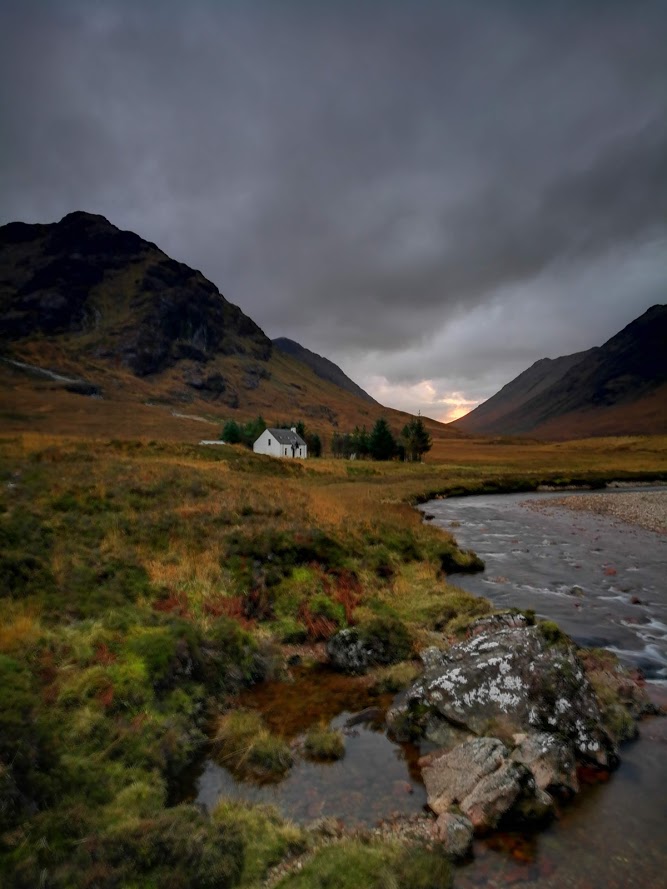
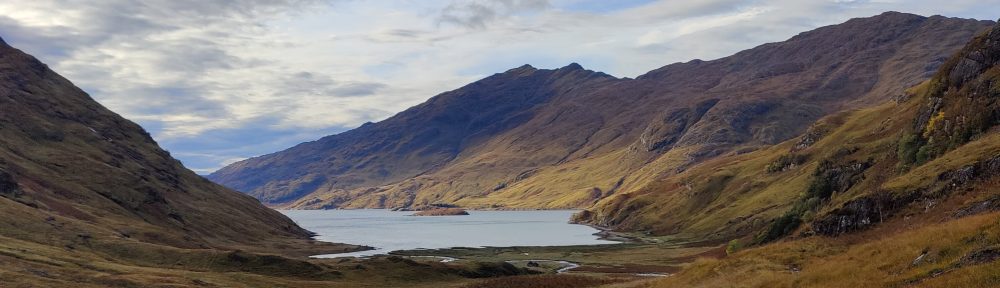
Buchaille Etive Mor

We took the sleeper from Euston, for a long weekend in the Highlands. As well as some hillwalking, there was a serious task at hand; the scattering of some ashes of a young woman who earlier this year, had taken her own life.

Our journey north was enlivened by about four fingers each of Glenlivet. We arrived at Glasgow Central after an adequate nights sleep, perhaps disturbed in my case by some rather odd whisky dreams. After a quick breakfast in the Gordon Street Cafe next to the station, we nipped off through the chill city streets to get our rental car. By 10 a.m we were parking up at Inveruglas on Loch Lomondside, in light rain.

Ben Vorlich

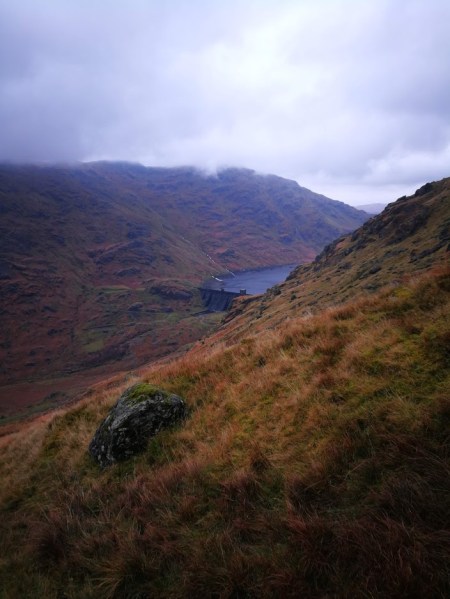
Past the rather impressive hydro-electric power station, you go under the West Highland Line, turn uphill keeping some rapids in a gorge on the left, and up a private road into the brown valley. Up ahead, there is a black industrial-looking dam.

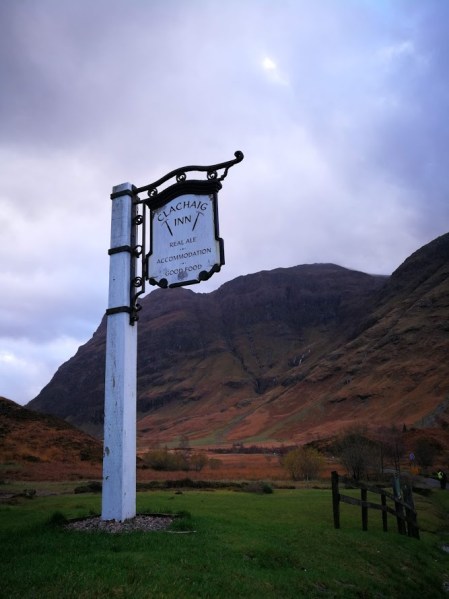
Power lines march off into the distance. Dodging some maternal cattle who were monopolising the road, we broke right straight up into the hills, a long slog. We stopped for a quick bite to eat in a draughty cleft in the rocks, and pushed on to the summit. As we did so, the weather broke with a vengeance. Another half an hour later in starting, and we’d have been forced to turn back from the summit. In a howling, lashing storm, we bagged the summit and retreated as fast as possible. Fortunately there’s a clear path, even in thick clag. We were off the hill before 2pm, meaning that we’d bagged a Munro in less than four hours. Rather pleased with ourselves, we got in the car and drove north to the Clachaig.

IMG_20181110_093531

In Glencoe, we pitched our tents, not without some wind-related challenges, and retreated through the storm to the warmth of the pub:

“The evening shadows on the dry stone walls
The night draws in and the ale house calls”

(Chris Rea, “Chisel Hill“)

Buchaille Etive Mor

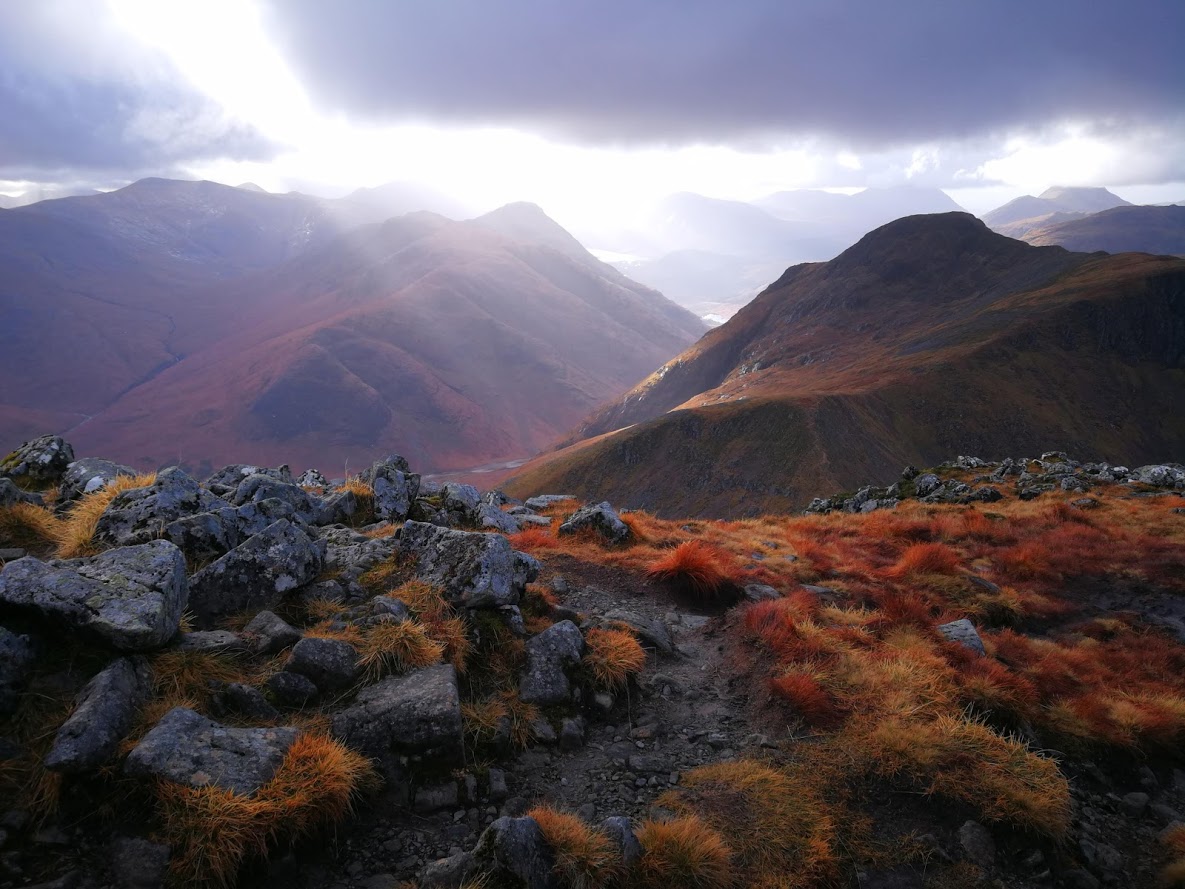
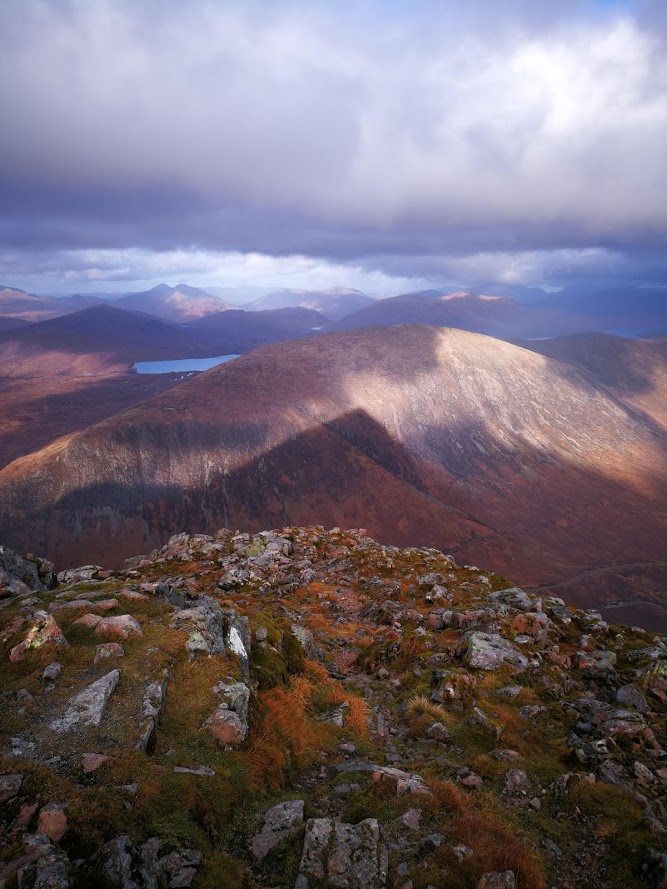
Around 10.30a.m, a party of eight of us set off up the Lairig Gartain. On the walk up the glen we had twice to ford streams that were running quite full and needed crossing with care. This was the largest group of people I’ve been on the hill with for twenty years. Six of the people present were university students less than half my age, and a handful of those young people were experienced hillwalkers. Everyone was quite fit, but the collective pace of such a group is slower than that of a smaller party. The route lay zig-zag up into Coire Altrium, negotiating through a band of cliffs and broken ground up onto the col between Stob Coire Altrium and Stob na Doire. We did not reach the ridge until after noon, and we paused there for refreshment. The day was wide open; whilst it was cold and windy, the weather seemed to be clearing.

The delicate light and remarkable visibility improved as the afternoon wore on.

IMG_20181110_131139

Along the ridge, things seemed further away than they really were. We met two parties as we continued north-west. The first was two guys, one of them with a rope over his shoulders. He reassured us in a strong Italian accent that the summit of Stob Dearg was by no means too far away. The second party was formed of more members of the university hiking club.

As we moved up towards the main summit of Stob Dearg, we were visited by a very tame raven.

IMG_20181110_140152

Strange, very strange, was this, to my eyes. I only found out later that this bird is a regular denizen of this summit. I should have known my local history better: A mountain with a route up it called Raven’s Gully might well have such birds lurking at the summit. The raven afforded some remarkable wildlife photography, with Ben Nevis prominent thirty miles away in the background.

At the summit of Stob Dearg – the shapely triangular mountain commonly referred to as “Buchaille Etive Mor”, the party paused for a moment of reflection. Earlier in the year, someone known and loved by members of the party had taken her own life whilst suffering from depression. Ashes were scattered. It was fitting that such an event should take place on the weekend of Remembrance Sunday.

IMG_20181110_143752

And then onwards and down. First, down to the col, and then, the steep descent into Coire na Tuliach. Until the party went down into the gully, the light remained absolutely remarkable. One might go on the hill for two years and not see conditions like it. Tired now, the party descended to Lagangarbh, and crossed the river. Only as we approached the road on the long tramp back to the car, did we reach for our torches. Our timing was perfect – in more ways than one, for the following day was rainy too. We were lucky enough to do our hike in all too brief weather window as Autumn slowly turned to Winter.

Stand up, hold my hand
I hope you understand
Here where time is still, I walk the hill

Stand here, close to me
Here for all eternity
I wait as others will, I walk the hill

(Stuart Adamson)

IMG_20181111_151448

By train to Euston

The train hisses through anonymous railway stations and anonymous towns. The stations fly past to quickly for me to catch their names. The towns? Houses and streets, industrial units, perhaps the odd ancient church standing out through the early morning mist.

Across the heartland the train goes, through the very essence of middle England. You don’t need to know what the names of the towns are, to know what they are like. The rails shine with use; the electrical wires and their supporting posts flash by. In the distance, green fields and hills under an early morning sky of pale blue. The molten sunshine of not long after dawn washes everything clean. It all looks idyllic. Frost-covered green fields, patches of ground mist.

Tail lights

Red tail lights
Vanish into the night
In the mist and the rain,
They vanish from sight.
Friends move on
To life elsewhere.
Bringing much to our lives
While they were here.
They are gone:
There’s no need to fear.
We’ll bring light to others
We’ll take up the cloak
Do what we can,
Live always in hope.

Emily Barker at St. Peter’s, Tandridge

Earlier this year we attended the first pop concert in 800 years, at St. Peter’s church, Tandridge village. It was an unseasonably cold night in March, and late snow lay on the ground. Tonight, we returned, in mid-October, on what was another unseasonable night. This time, however, the weather was very warm. To be able to walk around on a mid-October night in shirt-sleeves is most unusual.

This event, like it’s predecessor, was a benefit gig aimed at raising money for the fabric of this wonderful and ancient church.  In this case, money is sought to install a much-needed loo: prosaic, but a vital human need.  And this evening was both human and prosaic, warm and uplifting, but friendly and community-oriented.  The Rector, Andrew Rumsey, introduced the evening with a warm-up act of a brace of autumnal songs that might have even been written for the occasion.

The actual support act for Emily Barker were two gents called Roy Hill and Ty Watling. These gents looked and sounded like characters from Mark Knopfler’s “Sultans of Swing”

…Check out guitar George
He knows all the chords…

Mind, Ty Watling did indeed know how to make his guitar cry and sing, and that he went on to do.  Roy Hill was of indeterminate age, and was in good voice, and made banter with the audience about how much better this was than their usual pub gig.  They started dark, with a song about pain beginning, and finished with a deeply moving number about failing mental health, yet, they were always somehow encouraging, humane, and uplifting.

Emily Barker came on and immediately impressed everyone with her beautiful clear voice and her guitar playing.  This evening has seen a series of guitarists bringing great joy and beauty into the world through their playing, song-writing and singing, like Chet Atkins:

…Money don’t matter as long as I scatter a little bit of happiness around
If people keep a grinnin’ I figure I’m a winnin’…

In between the numbers she told us stories of her early life, in a discernable Aussie twang.  It is always engaging when pop stars do that – you want to know that they do go to the shops, that they were once kids in the back of a car going on holiday, singing along to cassettes.  She performed an old Bruce Springsteen number – “Tunnel of love” – to illustrate this story.

Somehow, the fact that she is a supremely skilled professional guitarist and pianist, a powerful and gifted singer and a talented songwriter did not discourage or demotivate. After the concert I was speaking to a lady in the audience who has Downs Syndrome.  She wants to write songs – and she was saying, by no means demotivated, how high the bar has been set by Emily Barker.  The lesson is, everything is possible; anyone can do anything if they set themselves to it.  A lady you might pass in the street, wearing blue jeans and a cardigan, has a voice like Aretha Franklin, a solo voice so beautiful, so powerful, as to carry an entire church in stunned silence.

“To one, he gave five bags of gold, to another, two, to another, one bag, each according to his ability” – Matthew 25:15.  It’s what you do with what you’ve got that matters, not how much you’ve got.

There’s a pattern emerging here with these concerts: Not so much inspiring, as inspirational.  Do new things. Dare to create, dare to do something new with your bag of gold.

A review of “Dark Eden”, by Chris Beckett

A review of “Dark Eden”, by Chris Beckett

I picked this up in a charity shop in Aberdeen: I’ve been in that shop a dozen times and bought nothing. Then, I go in on a rainy September morning, on the way from one meeting to another, and find not one, not two, but three books. I’m reading all three at once; this one I have finished already.

“Dark Eden” explores what might happen a few generations down the line, if a very few people – in this case, just two – found themselves having to scratch a living having landed with little or no equipment on a deeply unsuitable world. Stephen Baxter covers similar ideas in his “pendant” short stories “Earth II” and “Earth III”. Heinlein touches on it in a brief aside in “Time enough for love”.

Beckett neatly side-steps the science. It is not necessary to explain the biology and geology of his strange sunless world, quite literally enlivened by bizarre geothermal trees. But we’ve seen the life on geothermal vents on the seabed – such things are more than plausible. His forests are islands full of life and light, in a sea of darkness, snow and ice. In the story, the protagonists travel from one such island to another, to make a new life where there is more game, more space, more resources. It is an ancient story, going back a million years on our own world.

Where the story excels, is in dealing with human relationships. It deals head on with the very serious consequences of inbreeding several generations in from just one man and woman. Many of the population have cleft pallettes, hare lips and club feet – and are looked after by their healthier, luckier siblings. Truly a dark Eden, but with the warm light of compassion only now starting to flicker. The primitive society that has formed from the original couple is matriarchal, and the heroine can see that the time for this is ending, and that “the time of men” is coming. The hero, John Redlantern, as well as being a visionary, a Moses who leads his people through the wilderness, is also the first to commit murder, a destroyer of tradition and stability, and also inherently self-centred – it’s all about him.

Wikipedia describes the novel as “Social science fiction” which may not be flattering. But, “social science” is all over the story. Many important ideas are discussed. We see how hunter-gatherers can lay waste to swathes of forest over generations. We see how a matriarchal society can work where there is plenty – but how such a society begins to break down when resources are scarce. We see the effects of inbreeding. We see the importance of tradition in retaining knowledge in a society where there is little or no learning.

What I liked is that this is no dystopia: though things are going wrong, though things are changing, from beginning to end, there is a positive dialogue with what is happening and what has happened. In a genre where so often we find stories focusing on the negative – the very dark but excellent work of Richard Morgan and Alistair Reynolds are just two examples – it’s refreshing to see a positive outlook.

Waverley station

One of my favourite places to be “outdoors” is the concourse of a big city railway station.  To have coffee, or better yet, to be at beer, is an added bonus.

After an excellent breakfast at a little deli in Callander, I drove on southwards.  It was interesting to see clouds form over the central valley.  Coming into Edinburgh, there was heavy fog and drizzle, though it remained warm.

On the way down, I happened across an #Engineering #Marvel, and went out of way to go and see it.  Many years ago, touring with a friend of mine, on two occasions, we’d found ourselves at a loose end on a Sunday afternoon, and visited – quite by chance, as it were – engineering marvels.  One was a certain “nuclear installation” on the coast of Cumbria; the other, a radio telescope in Cheshire.  To pass within a few miles of the Falkirk Wheel, and not pay a visit, would be crass.  And I speak as someone who can allow the Flying Scotsman to steam unseen past the end of my garden at 5a.m on a working day, whilst I lie in bed.

I allowed myself the luxury of complete dependence on the Google sat nav to get me to my final destination, with only one or two cursory glances at it to ensure that it knew what it was doing.  There’s no call when using sat nav to switch off your common sense or your sense of direction.  At one point I drove past Fettes College.

But back to the great railway stations: I love big stations.  Victoria, St Pancras. Glasgow Central.  The destinations boards, the bustle and hustle, the romance.  Better still – possibly – in the days of steam, with whistles, steam heating, clatter and bang.  I remember steam heated trains from my youth.

And what of the journey, the pilgrimage, the embracing of change, the understanding that things must change? Steam has gone, but most everything changes.  Tomorrow will be different.  The journey never ends. We must take nourishment from all aspects of it: the good, the bad.  From the  rest and the rush.  From the pleasure and the pain.

On a journey, we may do things differently at the end, than at the beginning.  On a journey we must adapt and learn, most especially from our mistakes.

Mhor 84, at Lochearnhead

I arrived at Mallaig off McBrayne’s ferry Loch Nevis, about 5.30pm on a hot sunny evening. I bought such things as I might need were I to have to camp, and set off south at ten past six.  Lovely motoring through delicate evening light – or perhaps late afternoon sunshine.  It would have been nice to stop, but I couldn’t really spare the time. 

I was hampered in places by motorists “pootling”, particularly on the Mallaig to Fort William section, in Glen Coe, and on Rannoch Moor.  The practice of pootling is deplorable.  It is the practice of not driving as fast as the road will safely allow,  and not a mile an hour slower.  That this may be faster than the national speed limit is neither here nor there.  As an aside to the once delightful road across Rannoch Moor, I can see the authorities have found a very cost-effective way of restricting the speed of motorists on that stretch:  Failing to maintain the road.  A road that as recently as ten years ago was quite safe to take at 90 or even 100 mph is now so rutted and pot-holed as to be literally – not metaphorically – a white-knuckle ride at 75mph.

I got to Crianlarich at 8.15pm and I had every intent of staying in the Crianlarich Hotel, which I know had rooms available.  The restaurant was heaving with the Grey Pound, but the reception desk was abandoned.  I rang the bell. I waited. I left. Distinctly unimpressed, I pushed on down the Stirling road towards Lochearnhead.  I’d never driven this road, and it is over thirty years since I was taken along it in a minibus.  Lochearnhead itself has no licensed premises or hostelries of any form whatsoever. Slightly further on, and growing a little edgy as evening wore on, I saw and drove past “Mhor 84”. I stopped, three-pointed and came back.  It was 8.45p.m – the edge of the reasonable time for supper.  I could have ended up in some Travel Lodge in Stirling, or camping rough in the lowlands in some farmer’s field – this is not the wilderness of the Great Glen.

Mine host – a pleasant mannered and rounded Antipodean lady – said she had a room, for which the booked clients had not yet turned up.  On the basis that a bird in the hand is worth two in the bush, she promised the room to me, even as I stood before her.  Somewhat relieved, I went into dinner, and started a much-needed pint.  This meant that I wasn’t driving any further even if the Australian lady wasn’t good for her word.  But she was.

The room was small and white, with Venetian blinds which at this time of year at this latitude are not a lot of use. There were some great vintage signs on the walls – an RAC sign on one wall, and a training display of the Norwegian alphabet on another.  Some antlers had been salvaged from elsewhere.  I loved the fact that they had been wrenched by main force from a wall panel of that now lost building.  A little scrap of panel remained on the white wall.  A nice touch, was a flask of fresh milk to make tea in the morning.

In the morning I sat down for breakfast and it became clear to me that I had not paid £90 for B&B, only for the bed.  They wanted another £12 or so for my breakfast. I left on the instant, perhaps not with the greatest grace, and checked out.  Nice place, arguably over-priced.

Ten miles down the road in Callander I stopped in a little cafe – the Deli Ecosse – for a first rate Full Scottish with coffee, for a little over £6. Lovely atmosphere, great service.  That’s why I love the free market.